


When Spain played Salome for James 1
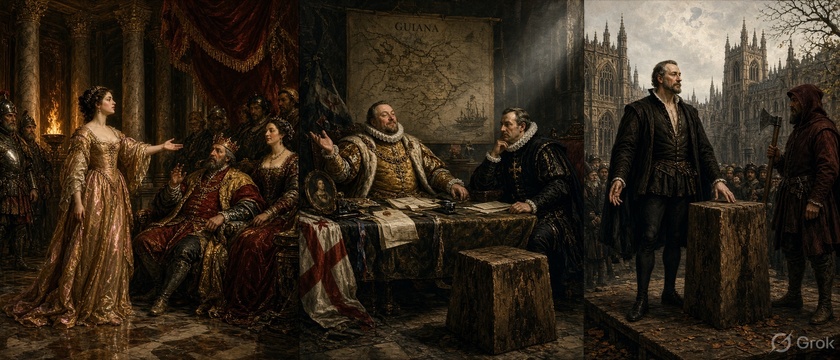
Sir Walter Raleigh was beheaded on 29 October 1618 in the Old Palace Yard at the Palace of Westminster under a revived 1603 treason sentence. The immediate trigger was the failure of his second Guiana expedition and the attack by his men on a Spanish settlement, which clashed with King James I’s policy of peace with Spain.
Background
Raleigh (c. 1552/1554–1618) rose under Elizabeth I as a soldier, courtier, poet, explorer, and promoter of English colonization in North America (including the Roanoke ventures). He fought against the Spanish Armada, served in Ireland, and held offices such as captain of the Queen’s Guard. After Elizabeth’s death in 1603, he was implicated in the Main Plot against the new king, James I. Tried for treason, he was sentenced to death but the sentence was stayed; he spent most of the next thirteen years in the Tower of London, where he wrote The History of the World and pursued scientific and literary interests.
In 1616 James released him to lead an expedition to Guiana (present-day Venezuela/Guyana) in search of gold or El Dorado. Strict orders forbade any attack on Spanish possessions, as James was pursuing a marriage alliance and peace with Spain. The 1617–1618 voyage failed to find the promised mine. Raleigh’s son Wat was killed in a clash when some of the English force, under Lawrence Keymis, attacked the Spanish outpost of San Thomé on the Orinoco. Raleigh returned to England in 1618; the Spanish ambassador, Diego Sarmiento de Acuña (Count of Gondomar), demanded his execution. James reinstated the old 1603 sentence rather than hold a new trial.
The Execution
On the morning of 29 October 1618, Raleigh was brought from the Tower to the scaffold in Old Palace Yard. He showed notable composure: he asked to see the axe, ran his thumb along the blade, and remarked, “This is a sharp medicine, but it is a physician for all diseases.” He delivered a scaffold speech denying the main charges of conspiracy with Spain or France, affirming his loyalty, and admitting personal vanity and a sinful life as soldier, sailor, and courtier. When the executioner hesitated, Raleigh is reported to have said, “What dost thou fear? Strike, man, strike!” His head was severed in two blows.
His wife, Elizabeth (“Bess”) Throckmorton, claimed the head, had it embalmed, and kept it in a red leather bag for the remaining twenty-nine years of her life. His body was buried at St Margaret’s, Westminster.
Significant Figures
- Sir Walter Raleigh — the condemned man; Elizabethan adventurer, writer, and colonizer whose execution became a symbol of Stuart justice and Spanish influence.
- King James I — ordered the execution to satisfy Spanish demands and preserve his foreign policy of rapprochement with Spain.
- Diego Sarmiento de Acuña, Count of Gondomar — Spanish ambassador who pressed for Raleigh’s death after the San Thomé incident.
- Elizabeth (“Bess”) Throckmorton — Raleigh’s wife; secretly married him in 1591, shared his imprisonment periods, and preserved his head.
- Lawrence Keymis — Raleigh’s lieutenant who led the attack on San Thomé; he later committed suicide.
- Wat Raleigh — Raleigh’s eldest son, killed in the fighting at San Thomé.
- Thomas Hariot — scientist and former associate who was present among the spectators.
Result and Significance
The execution ended Raleigh’s life and the last major Elizabethan adventurer’s career. It demonstrated James I’s willingness to sacrifice an English figure to maintain peace with Spain, reinforced perceptions of Spanish influence at court, and turned Raleigh into a popular martyr. His scaffold conduct and final words entered legend, and his writings and colonial vision continued to shape English expansion in the Americas.
= October 29th
These events form a classic late-October cluster (mostly 27–29 October, depending on calendar and source). Several are traditionally linked to the 27th or the days immediately around it.
539 BC – Fall of Babylon and the Jewish return
Persian forces under Gobryas (Ugbaru) entered Babylon without a fight on 12 October 539 BC after victories at Opis and Sippar. Cyrus the Great himself entered the city on 29 October. The Cyrus Cylinder and the biblical book of Ezra record his policy of allowing deported peoples, including the Jews of the Babylonian Exile, to return home and rebuild their temple. This ended Neo-Babylonian rule and began the Achaemenid Empire’s control of Mesopotamia, Syria, and the Levant.
312 – Constantine after the Milvian Bridge
The night of 27 October is traditionally associated with Constantine’s vision (Lactantius’s dream of the heavenly sign; Eusebius’s later account of the cross of light and the words In hoc signo vinces). The Battle of the Milvian Bridge itself was fought on 28 October. Constantine then entered Rome in a formal adventus amid popular acclaim. Maxentius drowned in the Tiber; his body was recovered and his head displayed. The victory secured Constantine’s control of the West and is the traditional starting point of his favour toward Christianity.
437 – Marriage of Valentinian III and Licinia Eudoxia
On or about 29 October 437 in Constantinople, the Western emperor Valentinian III married his cousin Licinia Eudoxia, daughter of the Eastern emperor Theodosius II. The wedding formally reunited the two branches of the Theodosian house after years of betrothal and helped stabilise relations between the eastern and western courts, though real power in the West remained with the general Aetius.
969 – Byzantine capture of Antioch
After a prolonged blockade, Byzantine forces under Michael Bourtzes and Petros took Antioch from the Hamdanids on 28 October 969. The city, lost to the Arabs in the 7th century, returned to imperial control. The victory was followed by the Treaty of Safar, which made the Emirate of Aleppo a Byzantine tributary and secured northern Syria for the empire under Nikephoros II Phokas.
1268 – Execution of Conradin
On 29 October 1268 in Naples, the 16-year-old Conradin (last male Hohenstaufen heir, nominal King of Jerusalem and Sicily) and his companion Frederick of Baden were beheaded on the orders of Charles I of Anjou (Charles of Sicily). The execution extinguished the direct Hohenstaufen line and confirmed Angevin rule in southern Italy.
1390 – First documented witchcraft trial in Paris
Around 29 October 1390 the secular court of the Châtelet in Paris began proceedings against Jeanne de Brigue (La Cordière) and others (including Margot de la Barre and Marion la Droiturière). Accused of sorcery, love magic, and diabolism, several were tortured, convicted, and later burned. It is the earliest well-documented Parisian witchcraft case and marks the shift of such prosecutions from ecclesiastical to secular courts.
1467 – Charles the Bold defeats Liège
On 28 October 1467 at the Battle of Brustem, Burgundian forces under Charles the Bold (then Count of Charolais, soon Duke) routed the army of Liège. The victory led to the city’s submission, the demolition of its walls, and the conversion of the Prince-Bishopric into a Burgundian protectorate. It was the second of the Wars of Liège; a third and more destructive rising was crushed the following year.
1591 – Election of Pope Innocent IX
The short conclave of 27–29 October elected Cardinal Giovanni Antonio Facchinetti as Pope Innocent IX on 29 October. A compromise candidate favoured by the Spanish party, he reigned only until 30 December 1591. During his brief pontificate he supported Philip II and the Catholic League in the French Wars of Religion.
1611 – Russian homage to Sigismund III Vasa
On 29 October 1611 in the Senate Hall of the Royal Castle in Warsaw, the deposed Tsar Vasily IV Shuysky, his brothers Ivan and Dmitry, and other captives taken after the Polish capture of Moscow paid formal homage to King Sigismund III Vasa and his son Prince Władysław. The ceremony (the “Shuysky Tribute”) was a high point of Polish-Lithuanian power during the Time of Troubles.
1618 – Execution of Sir Walter Raleigh
On 29 October 1618 in the Old Palace Yard at Westminster, Sir Walter Raleigh was beheaded under the revived 1603 treason sentence. The immediate cause was the failure of his second Guiana expedition and the attack on a Spanish settlement, which angered James I’s desire for peace with Spain. Raleigh’s scaffold speech and composure became legendary.
1658 – Battle of the Sound
On 29 October (Old Style) / 8 November (New Style) 1658, a Dutch fleet under Jacob van Wassenaer Obdam defeated a Swedish fleet under Carl Gustaf Wrangel in the Øresund. The victory broke the Swedish blockade of Copenhagen, relieved the Danish capital, and prevented Sweden from controlling both sides of the Sound and thus the Baltic trade routes.
1665 – Battle of Mbwila
On 29 October 1665 near Mbwila (present-day Angola), a Portuguese force defeated the army of the Kingdom of Kongo. King António I (Nvita a Nkanga) was killed and decapitated; many nobles died or were captured. The defeat shattered Kongo’s political unity, triggered civil war between rival kandas, and accelerated Portuguese influence and the slave trade in the region.
1675 – Leibniz and the integral symbol
On 29 October 1675, in an unpublished manuscript (Analyseos tetragonisticae pars secunda), Gottfried Wilhelm Leibniz first used the elongated “∫” (from the Latin summa) as the symbol for the integral. Two weeks later he combined it with the differential notation dx. The system remains the standard notation of calculus.
1787 – Premiere of Don Giovanni
On 29 October 1787 at the Estates (Nostitz) Theatre in Prague, Mozart conducted the world premiere of his opera Don Giovanni (K. 527), with a libretto by Lorenzo Da Ponte. Delayed by production difficulties, the performance was a triumph and remains one of the greatest works in the operatic repertoire.
1792 – Naming of Mount Hood
On 29 October 1792, while exploring the Columbia River as part of George Vancouver’s expedition, Lieutenant William Broughton sighted the great Cascade volcano (known to local peoples as Wy’east) from near the mouth of the Willamette and named it Mount Hood after Admiral Samuel Hood, 1st Viscount Hood.
Together these episodes illustrate the recurring late-October rhythm of conquest, dynastic marriage, judicial violence, scientific invention, and artistic creation across more than two millennia.