


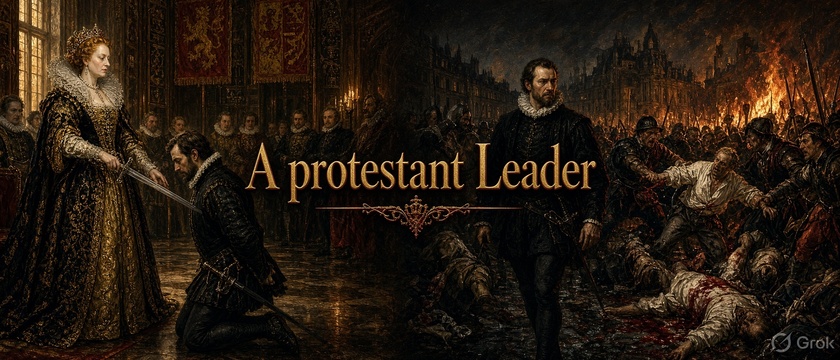
Walsingham led Protestants
The St. Bartholomew’s Day Massacre (23–24 August 1572 and the weeks that followed) was a series of targeted assassinations and mob violence in which French Catholics killed thousands of Huguenots (French Calvinist Protestants). It began in Paris and spread to other cities, becoming the bloodiest episode of the French Wars of Religion.
Background
France had been torn by three civil wars between Catholics and Huguenots since 1562. The Peace of Saint-Germain (1570) temporarily ended the fighting and granted limited rights to Protestants. To cement the peace, Queen Mother Catherine de’ Medici arranged the marriage of her Catholic daughter Margaret of Valois to the Protestant Henry of Navarre (the future Henry IV). The wedding took place in Paris on 18 August 1572, bringing many Huguenot nobles into the largely Catholic capital.
A key figure was Admiral Gaspard de Coligny, the leading Huguenot military commander. He had gained influence over the young King Charles IX and was urging France to support the Dutch Protestant revolt against Spain—something Catherine and the ultra-Catholic Guise family opposed.
Immediate events
- 22 August: An assassin (linked to the Guise family) shot and wounded Coligny. The attempt failed to kill him.
- Huguenot leaders demanded justice and revenge. Fearing a Protestant uprising or the exposure of court involvement in the assassination attempt, the royal council (including Catherine and Charles IX) decided to eliminate the principal Huguenot leaders then in Paris.
- Night of 23–24 August (the eve of the feast of St Bartholomew): Soldiers under the Duke of Guise murdered Coligny in his bed and threw his body from a window. Other Huguenot leaders were systematically killed.
- Once the killing began, Parisian Catholic militias and mobs joined in. What had been a targeted operation against leaders turned into a general slaughter of Protestants in the city. Bodies were thrown into the Seine; houses were looted.
The violence spread over the following weeks to other French cities (Rouen, Lyon, Orléans, Bourges, Bordeaux and elsewhere).
Scale
Modern historians generally estimate:
- roughly 2,000–3,000 killed in Paris,
- several thousand more in the provinces,
- total deaths commonly placed between 5,000 and 30,000 (contemporary Huguenot sources gave higher figures).
Exact numbers are impossible to establish.
Key figures
- Catherine de’ Medici – Queen Mother; long blamed as the chief instigator, though her precise role remains debated. She approved the elimination of the Huguenot leadership after the failed attempt on Coligny.
- Charles IX – the young king who ultimately authorised the killings.
- Gaspard de Coligny – Huguenot leader and first major victim.
- Henry, Duke of Guise – led the assassination of Coligny; the Guise family had a personal vendetta against him.
- Henry of Navarre (later Henry IV) and the Prince of Condé – spared but forced to convert to Catholicism (Henry later reverted).
Consequences
The massacre shattered the fragile peace and triggered the fourth War of Religion. It radicalised both sides, deepened the religious divide, and damaged the reputation of the French crown abroad—especially in Protestant England and the German states. Francis Walsingham, then English ambassador in Paris, was present and the experience confirmed his lifelong hostility toward Catholic powers and Mary, Queen of Scots.
The French Wars of Religion continued until the Edict of Nantes (1598) under Henry IV. The St Bartholomew’s Day Massacre remains the most infamous single atrocity of those wars.
=
1 December 1577: Francis Walsingham is knighted by Queen Elizabeth I at Windsor Castle.
This was a formal mark of favour and recognition of his rising status rather than a sudden promotion. By this date he was already one of the most powerful men in Elizabeth’s government.
Before the knighthood
Walsingham (born c. 1532 in Kent) came from a well-connected gentry family. A committed Protestant, he spent the reign of the Catholic Queen Mary I in exile on the Continent (Switzerland and Italy). After Elizabeth’s accession he entered public life, sitting in Parliament and, from about 1568, performing confidential work for Sir William Cecil (later Lord Burghley).
In 1570 he was sent as English ambassador to France. There he negotiated (ultimately unsuccessfully) a possible marriage between Elizabeth and the Duke of Anjou, supported the Huguenots, and in August 1572 personally witnessed the St Bartholomew’s Day Massacre. The experience confirmed his lifelong conviction that Catholic powers and Mary, Queen of Scots, posed an existential threat to Elizabeth’s Protestant England.
Recalled in 1573, he was appointed to the Privy Council and made joint principal secretary (the office later called Secretary of State) with the elderly Sir Thomas Smith on 20 December 1573. When Smith effectively retired in 1576, Walsingham took sole practical control of the office, handling foreign correspondence, domestic security, and much of the day-to-day business of government. By late 1577 he had already begun constructing the sophisticated intelligence network that would make him famous.
The knighthood itself
On 1 December 1577 Elizabeth personally knighted him at Windsor Castle. Contemporary and near-contemporary sources (including the Dictionary of National Biography) record the place and the fact that the queen conferred the honour. It was one of several marks of personal favour she showed him in these years; at the following New Year she accepted a blue satin gown from him and returned a substantial gift of gilt plate. The knighthood recognised both his competence and the trust the queen and Burghley placed in him, even though Elizabeth sometimes found his blunt, puritanical advice irritating (she nicknamed him her “Moor” for his dark complexion and sombre dress).
Immediately after
- 22 April 1578: appointed Chancellor of the Order of the Garter (he held this until 1587).
- He continued consolidating control of routine state business, including projects such as the rebuilding of Dover Harbour and support for Martin Frobisher’s North-West Passage voyages.
- He pressed for more active English intervention on behalf of the Dutch rebels against Spain—a policy he consistently favoured and Burghley treated more cautiously.
Significant figures around him in this period
- Queen Elizabeth I – his sovereign and ultimate employer; the relationship was close but often tense.
- William Cecil, Lord Burghley – his patron and senior colleague; the two men dominated Elizabethan government.
- Sir Thomas Smith – the joint principal secretary whose retirement left Walsingham in effective control.
- Robert Dudley, Earl of Leicester – another powerful courtier with whom Walsingham often aligned on Protestant foreign policy.
- Mary, Queen of Scots – already the focus of Catholic plots; Walsingham’s later intelligence work (Throckmorton Plot 1583, Babington Plot 1586) would lead directly to her trial and execution in 1587.
In short, the knighthood of 1 December 1577 was a public confirmation that Walsingham had arrived at the centre of power. From this point until his death in April 1590 he remained principal secretary and the architect of the Elizabethan intelligence system that protected the queen and the Protestant settlement.
= December 1st
These are all events that occurred on 1 December in their respective years.
800 – Charlemagne and the accusations against Pope Leo III
In late 800, Charlemagne was in Rome to settle the crisis surrounding Pope Leo III. In April 799, Leo had been violently attacked in Rome by a faction linked to the late Pope Adrian I’s relatives. The attackers intended to blind him and cut out his tongue so he could no longer serve as pope. Leo escaped, fled to Charlemagne at Paderborn, and was later restored in Rome under Frankish protection.
On 1 December 800 (or in a synod that opened around then), Charlemagne presided over a gathering of Frankish and Roman clergy and nobles in Rome to examine the charges of adultery and perjury against the pope. The assembly took the position that no earthly authority was competent to judge the pope. Leo then voluntarily swore an oath of innocence (most sources place the formal oath on 23 December). Two days later, on Christmas Day 800, Leo crowned Charlemagne Emperor of the Romans in St Peter’s Basilica—the event that created the medieval Western Empire.
1420 – Henry V of England enters Paris
After the Treaty of Troyes (May 1420), which made Henry V the regent and heir to the French throne (and husband of Catherine of Valois, daughter of the mad King Charles VI), Henry entered Paris on 1 December 1420 alongside his father-in-law Charles VI. He rode in the place of honour on the right of the French king.
The entry was ceremonial rather than a military conquest of the city. Paris was already under Anglo-Burgundian influence after years of civil war between the Armagnacs and Burgundians. English troops quickly secured key strongpoints (including the Bastille). The city was in a wretched state from war, famine and disease; chroniclers noted people dying in the streets even as the royal procession passed. Henry spent Christmas in Paris before returning to England with his queen.
1577 – Francis Walsingham is knighted
Francis Walsingham (c. 1532–1590), already principal secretary to Elizabeth I and the architect of her intelligence network, was knighted on 1 December 1577. He had been joint principal secretary since 1573 and, after Sir Thomas Smith’s retirement in 1576, effectively controlled the office. The knighthood recognised his growing power over foreign policy, domestic security and the Protestant cause. He is remembered as Elizabeth’s “spymaster,” responsible for uncovering plots (including those involving Mary, Queen of Scots) and for building a sophisticated European intelligence system.
1640 – End of the Iberian Union; João IV acclaimed in Portugal
On 1 December 1640 a group of Portuguese nobles (the “Forty Conspirators”) seized the Ribeira Palace in Lisbon. They killed Miguel de Vasconcelos, the pro-Spanish secretary of state, and imprisoned the vicereine, Margaret of Savoy (Philip IV’s cousin).
John, 8th Duke of Braganza (later João IV), was immediately acclaimed king. This ended the Iberian Union—the personal union of the Portuguese and Spanish crowns under the Spanish Habsburgs that had begun in 1580. Spain was distracted by the Catalan revolt and the Thirty Years’ War, so could not react immediately. The Portuguese Restoration War that followed lasted until Spain formally recognised Portuguese independence in the Treaty of Lisbon (1668). João IV is known in Portugal as “the Restorer.”
1768 – The slave ship Fredensborg sinks off Tromøya, Norway
The Danish-Norwegian frigate Fredensborg (originally Cron Prindz Christian), a slave ship belonging to the Danish West India–Guinea Company, was wrecked in a storm on 1 December 1768 off Tromøya island near Arendal, southern Norway.
She had completed the triangular trade: she had loaded captives on the Gold Coast (present-day Ghana) at Forts Christiansborg and Fredensborg, carried them to St Croix in the Danish West Indies (where she landed 235 of the 265 people embarked), and was returning to Copenhagen with a cargo that included ivory, dyewood and sugar. All those still aboard (crew, passengers and two remaining slaves) reached shore, though two crew members died soon afterwards. The wreck was rediscovered by divers in 1974; the surviving logbooks make Fredensborg one of the best-documented slave ships known from the wreck itself.
These five events, spanning nearly a millennium, all fall on the same calendar date and touch major themes of the period: papal-imperial relations, the Hundred Years’ War, Elizabethan statecraft, Iberian independence, and the Atlantic slave trade.