

Anniversary of the Battle of Trafalgar
From the decks of HMS Victory
Dawn on 21 October 1805 broke with a light westerly breeze and a long Atlantic swell. From the quarterdeck of the three-decker Victory, Nelson’s 100-gun flagship, the Combined Fleet was already in sight to the east-southeast—thirty-three ships of the line in a long, slightly irregular line of battle stretching toward Cape Trafalgar. British frigates had reported their sailing the previous evening. Nelson ordered the fleet to form the two columns he had planned: his own weather column leading in Victory, Collingwood’s lee column further south.
For nearly an hour the Victory sailed slowly toward the enemy centre under a rising but still light wind. Around 11:50 the French and Spanish ships began to fire. The first shots fell short; then they found the range. For the next forty minutes Victory endured a concentrated fire she could barely answer. Her wheel was shot away early, her mizzen topmast and other spars were cut down, and men fell on the upper decks. Nelson, pacing the quarterdeck with Captain Thomas Hardy, remained conspicuous in his faded uniform with the stars of his orders on his breast.
At roughly 12:30 Victory reached the Allied line just astern of Villeneuve’s flagship Bucentaure (80 guns) and ahead of the French 74 Redoutable. She passed under the Bucentaure’s stern and poured a double-shotted broadside of nearly fifty guns into the unprotected after end of the French flagship at point-blank range. The effect was catastrophic: guns were dismounted, the decks were swept by shot and splinters, and scores of men were killed or wounded in moments. Victory then turned and fell alongside the Redoutable, whose captain, Jean-Jacques Étienne Lucas, had trained his crew especially for close-quarters fighting.
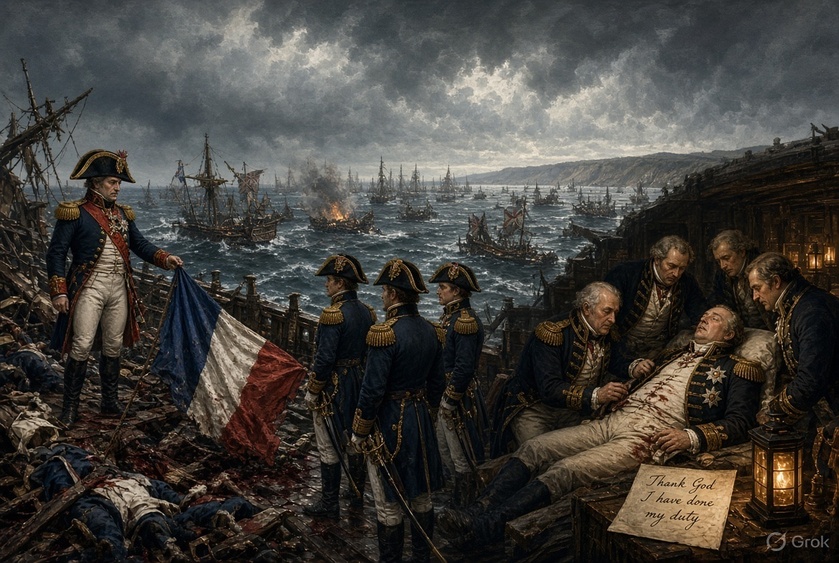
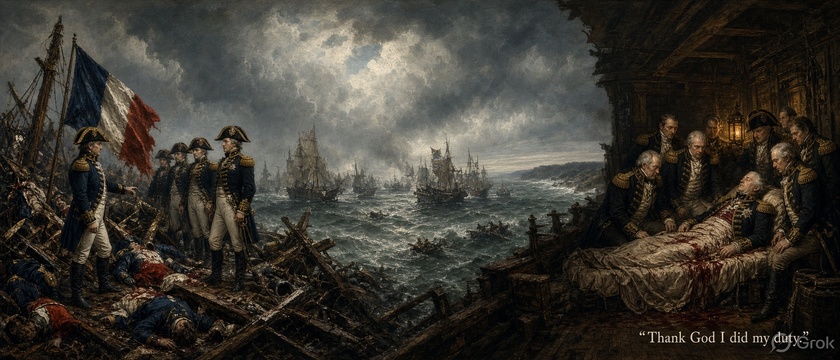
The two ships locked together. For the next half-hour the fight became a furious melee of cannon, musketry, and grenades. Redoutable’s marksmen in the tops and along the rail poured a heavy fire onto Victory’s upper decks, killing or wounding most of the men stationed there. At about 1:15 a musket ball from the Redoutable’s mizzen top struck Nelson in the left shoulder, passed through his lung and lodged against his spine. He fell to the deck, saying to Hardy, “They have done for me at last.” He was carried below to the orlop deck.
Meanwhile HMS Temeraire came up on the other side of the Redoutable and raked her. The French ship’s attempt to board Victory was broken up by British carronades and musketry. Redoutable was eventually reduced to a floating wreck with roughly three-quarters of her crew dead or wounded. Victory herself was badly cut up aloft and had suffered heavy losses on her upper decks, but her lower-deck batteries continued to fire. Nelson lived long enough to hear that the battle was won; his last recorded words were “Thank God I have done my duty.” He died around 4:30 p.m.
From the French flagship Bucentaure and Villeneuve’s viewpoint
Vice-Admiral Pierre-Charles Villeneuve stood on the quarterdeck of the Bucentaure, near the centre of the Combined Fleet. He had correctly anticipated that Nelson would try to break the line rather than fight a conventional parallel action, and he had ordered his captains to close up and be ready to support one another. The light wind made the manoeuvre difficult. When Victory approached, the ships immediately ahead of Bucentaure (the French Neptune and Spanish San Leandro) had fallen slightly out of station, leaving a gap.
Villeneuve watched the British three-decker bear down under fire. The moment Victory passed under his stern and delivered her raking broadside, the Bucentaure was effectively crippled as a fighting ship. Captain Magendie was wounded; many of the upper-deck guns were dismounted; and the after part of the ship was a scene of carnage. Villeneuve himself was unhurt—he later remarked that fate had spared him while men fell all around him.
For the next three hours successive British ships (Neptune, Leviathan, Conqueror and others) passed through the same gap and poured further broadsides into the Bucentaure. The French flagship lost all her masts, most of her guns, and roughly half her crew. Villeneuve tried to signal the van (under Rear-Admiral Dumanoir) to come about and help the centre, but the signal was late and the response ineffective. By mid-afternoon the Bucentaure was surrounded, dismasted, and unable to fire. Villeneuve struck his colours. He was taken prisoner by an officer from HMS Conqueror. When told the name of the captain who had accepted his surrender, he is said to have remarked that England was fortunate to have such officers.
In the days that followed, the Bucentaure was recaptured by her own crew from the prize crew, only to be wrecked in the storm that struck the fleet. Villeneuve was carried to England as a prisoner; he was later released and returned to France, where he died in 1806 under circumstances that remain disputed.
=
The Battle of Trafalgar was fought on 21 October 1805 off Cape Trafalgar, on the southwest coast of Spain (between Cádiz and the Strait of Gibraltar). A British fleet of 27 ships of the line under Vice-Admiral Horatio Lord Nelson defeated a combined Franco-Spanish fleet of 33 ships of the line under French Vice-Admiral Pierre-Charles Villeneuve. It confirmed British naval supremacy for the rest of the Napoleonic Wars and ended any realistic French plan to invade Britain.
Significant figures
- Vice-Admiral Horatio Lord Nelson (British): Overall commander, flying his flag in HMS Victory. Already famous for victories at the Nile (1798) and Copenhagen (1801). He devised the unorthodox “Nelson Touch” plan of attacking in two columns to break the enemy line. He was mortally wounded by a French marksman during the battle and died knowing victory was secured. His famous signal “England expects that every man will do his duty” was hoisted before the engagement.
- Vice-Admiral Cuthbert Collingwood (British): Commanded the second (lee) column. He took over command after Nelson was wounded and completed the destruction of the Allied rear. He later managed the difficult aftermath in stormy weather.
- Vice-Admiral Pierre-Charles Villeneuve (French): Commander of the combined fleet. Cautious and aware of the qualitative inferiority of his crews, he had earlier failed to execute Napoleon’s more ambitious concentration plans. He was captured with his flagship Bucentaure.
- Admiral Federico Gravina (Spanish): Senior Spanish commander. Wounded in the battle; he died of those wounds several months later. Several Spanish captains (notably Cosme Damián Churruca of the San Juan Nepomuceno) fought with particular determination and were killed after refusing to surrender.
Napoleon himself was not present; by the time of the battle he had already abandoned the invasion of Britain and was marching toward the decisive continental victory at Austerlitz.
Lead-up
After the breakdown of the Peace of Amiens, Napoleon resumed war with Britain in 1803 and prepared an invasion army (the Armée d’Angleterre) on the Channel coast. The plan required the French and Spanish fleets to concentrate, seize temporary control of the English Channel, and escort the invasion barges across. Spain joined France as an ally late in 1804.
In early 1805 Villeneuve’s Toulon squadron escaped the British blockade, joined Spanish ships, and sailed to the West Indies in an attempt to draw off British forces. Nelson pursued him across the Atlantic and back. Villeneuve then fought an inconclusive action with a British squadron under Sir Robert Calder off Cape Finisterre and took refuge in Cádiz. Napoleon’s elaborate scheme collapsed; by late August he had turned eastward against Austria instead.
Nelson arrived off Cádiz in late September 1805 to take command of the blockading fleet. On 19–20 October Villeneuve, pressured by the fear of being replaced and by orders to enter the Mediterranean, sailed with 33 ships of the line. Nelson, with 27, intercepted them the next morning. He had already explained to his captains his plan to abandon the traditional parallel line of battle, form two columns, and cut the Allied line at right angles so that superior British gunnery and seamanship could overwhelm the enemy in a close-range melee.
Result
The British attack began around noon. Nelson’s weather column broke the Allied centre near Villeneuve’s flagship; Collingwood’s lee column smashed the rear. The leading British ships suffered heavy fire while approaching, but once the line was broken the battle became a series of individual ship actions in which British crews generally prevailed. Fighting ended in the late afternoon.
Casualties and material losses (approximate, standard figures):
- British: ~449–458 killed, ~1,200 wounded. No ships lost.
- Franco-Spanish: ~4,400 killed, ~2,500 wounded, and roughly 7,000–8,000 captured. About 17–18 ships of the line were taken (many later wrecked or scuttled in the storm that followed); one was destroyed. Villeneuve was captured.
A violent storm after the battle sank or drove ashore many of the prizes and further increased Allied losses. Collingwood reported the victory to London with the words that became famous: “We have gained a great victory, but we have lost Lord Nelson.”
Strategically, Trafalgar destroyed the Combined Fleet as an effective fighting force and secured British command of the sea for the remainder of the wars. Napoleon’s invasion plans were already dead before the battle, but the result removed any remaining threat and allowed Britain to sustain the long naval blockade and support coalitions on the Continent. The war continued for another decade until Waterloo (1815). Nelson’s death in the hour of victory turned him into Britain’s pre-eminent national hero; his body was preserved in brandy, returned to England, and buried with a state funeral at St Paul’s Cathedral.
= October 21st
These events cluster around mid-to-late October (mostly the 19th–21st) across different centuries. Several of the dates in your list are approximate or off by a day or two; the notes below use the best-supported dates from primary and standard historical sources.
1096 – People’s Crusade (Battle of Civetot)
On 21 October 1096, a Seljuk Turkish force under Kilij Arslan I annihilated most of the People’s Crusade (also called the Peasants’ or Popular Crusade) near Civetot, not far from Nicaea in Anatolia. This was the large, poorly armed, and largely untrained contingent led by Peter the Hermit that had set out months ahead of the official First Crusade. Roughly 20,000 people marched out of their camp; most were slaughtered in a narrow wooded valley after a Turkish ambush. Only a few thousand survivors reached safety. The disaster showed the limits of popular enthusiasm without military organization and cleared the way for the better-equipped Princes’ Crusade the following year.
1097 – Siege of Antioch begins
Crusaders under Godfrey of Bouillon, Bohemond of Taranto, and Raymond IV of Toulouse reached the heavily fortified city of Antioch (modern Antakya, Turkey) on 20–21 October 1097 and began a siege that lasted until June 1098. The city controlled the route through Syria toward Jerusalem. The crusaders eventually entered through treachery (a gate opened by an insider) on the night of 2/3 June 1098, only to be immediately besieged themselves by a large relieving army under Kerbogha of Mosul. They broke out and won a decisive victory later that month. The episode was marked by starvation, desertions, massacres, and the later discovery of the “Holy Lance.”
1209 – Otto IV crowned emperor
Otto IV of the Welf dynasty was crowned Holy Roman Emperor by Pope Innocent III in Rome on 4 October 1209 (not the 19th). After years of civil war against the Hohenstaufen claimant Philip of Swabia, Otto had become the sole German king following Philip’s murder in 1208. He reaffirmed papal territorial claims to secure the coronation, but almost immediately afterward he broke those promises by occupying church lands in central Italy and invading the Kingdom of Sicily. Innocent excommunicated him in 1210; Otto was later defeated at Bouvines (1214) and lost the imperial title to Frederick II.
1392 – End of the Nanboku-chō schism
In October 1392 (sources give dates around 15–21 October or into November under the lunar calendar), the Southern Court emperor Go-Kameyama abdicated and handed over the imperial regalia to the Northern Court emperor Go-Komatsu. This formally ended the Nanboku-chō period (1336–1392), the long split between two rival imperial lines that had followed Emperor Go-Daigo’s failed attempt to restore direct imperial rule. Shogun Ashikaga Yoshimitsu brokered the settlement. The agreement was supposed to alternate the throne between the two lines, but the Northern Court quickly reneged. Go-Kameyama later briefly revived Southern claims in Yoshino; residual resistance continued for decades.
1512 – Martin Luther’s doctorate
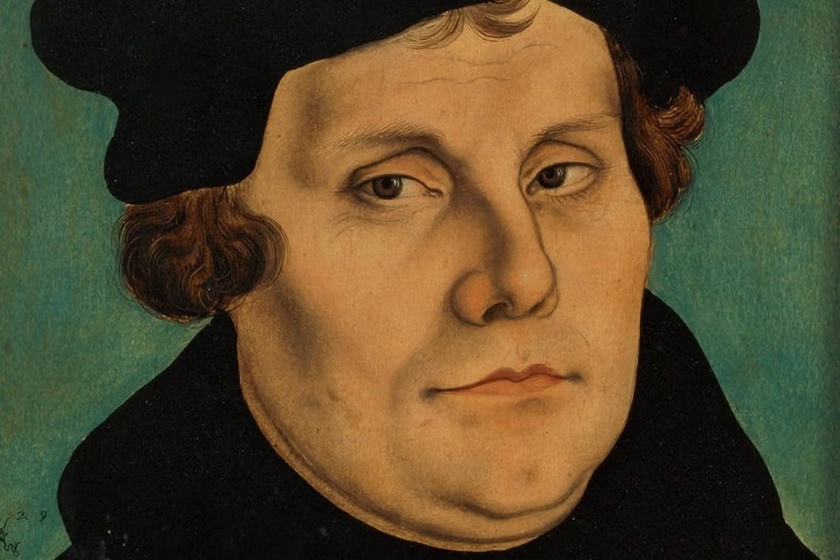
On 19 October 1512, Martin Luther received his Doctor of Theology degree at the University of Wittenberg. Two days later he was formally received into the theological faculty and succeeded Johann von Staupitz as professor of Bible. This academic position gave him the platform from which he later challenged indulgences (the Ninety-five Theses of 1517) and developed the theological arguments of the Reformation.
1520 – Magellan and Fagundes
On 21 October 1520, Ferdinand Magellan’s expedition rounded Cape Virgenes and entered the strait that now bears his name, the navigable passage between the Atlantic and Pacific at the southern tip of South America. He navigated it over the following weeks and emerged into the Pacific on 28 November. One ship deserted during the passage; the remaining three continued the first circumnavigation (completed after Magellan’s death in the Philippines).
Around the same date (commonly given as 21 October 1520), the Portuguese explorer João Álvares Fagundes sighted the islands now known as Saint Pierre and Miquelon off Newfoundland. He named the archipelago the “Islands of the 11,000 Virgins” (after Saint Ursula). He later received letters patent from the Portuguese crown confirming rights to lands he had explored in the region. Basque and French fishermen were already active in the area; Fagundes is credited with the earliest documented European naming of these specific islands.
1600 – Battle of Sekigahara
On 21 October 1600, Tokugawa Ieyasu’s Eastern Army defeated the Western Army led by Ishida Mitsunari at Sekigahara in central Japan. The battle decided the succession struggle after the death of Toyotomi Hideyoshi and effectively ended the Sengoku (Warring States) period. Ieyasu’s victory allowed him to consolidate power; he was appointed shogun in 1603, founding the Tokugawa shogunate that ruled Japan until 1868. Betrayals and delayed reinforcements on the Western side were decisive.
1774 – Taunton “Liberty and Union” flag
On 21 October 1774, colonists in Taunton, Massachusetts, raised a liberty pole (reported as 112 feet high) and flew a red ensign with the British Union flag in the canton and the words “Liberty and Union” (sometimes described simply as “Liberty”) across the field. This was one of the earliest public displays of colonial resistance to parliamentary taxation and other British policies, occurring well before Lexington and Concord. The modern city flag of Taunton is based on this design.
1797 – USS Constitution launched
After two failed attempts, the 44-gun frigate USS Constitution was successfully launched in Boston Harbor on 21 October 1797. One of the six original frigates authorized for the new United States Navy, she served against the Barbary pirates and gained lasting fame in the War of 1812 (especially her victory over HMS Guerriere, which earned her the nickname “Old Ironsides”). She remains the world’s oldest commissioned warship still afloat and is berthed at the Charlestown Navy Yard in Boston.
These events range from medieval crusading warfare and imperial politics, through Japanese unification and the Reformation, to early modern exploration and the American Revolution. Many of the military and political turning points fall on or very near 21 October.