VoiceDDB
Politics • Culture • News
Forgotten political memories
Corruption and Julie Bishop
May 31, 2026
post photo preview
Julie Bishop was Australian Foreign Minister who used her position to upend Tony Abbott as PM, giving aid money to Clintons as they exploited Haiti. The success of her endeavour allowed Malcolm Turnbull to sign Australia to a Paris agreement for which Australia could not benefit. Part of a $100 trillion grift. She also diverted aid money to support Hamas. Challenged on the issue in 2018, Bishop replied she had asked Hamas to assure her they hadn't diverted aid funds for terror.
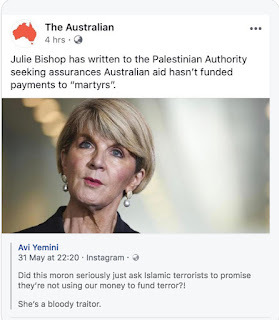
Julia Gillard, when asked about her work for campus communists, said she had been young and naive, when she was in her thirties and a lawyer. Had Julia been young and naive, too? What has Hamas done since 2018 for their aid money? US moved her embassy to Jerusalem. Australia did not. Bishop had argued it was up to Israel to negotiate with .. ? Terrorists? And what of the arguments against the US embassy move, how did they pan out? If I ask Grok to editorialise, it points to Politico, Wikipedia, NYT and a host of partisan hacks. Avi Yemeni had no cause to call her a moron. But she should argue to an appropriate body that she hasn't funded terror. Because, prima facie, she has. And so have a host of her colleagues throughout the world.
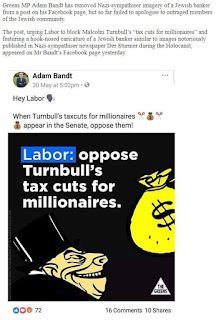
The Greens party in Australia claim to represent the environment, but the reality is they are anti semitic. His concern regarding tax on millionaires was misplaced too. In Australia, for the economic year '22 and '23, Australia's top 1% wealth paid at least 17% tax. Top 10% paid at least 55%. Reform is needed to prevent currency flight.
The Grok editorial excusing the politics, because Grok drawns on partisan sources is disturbing. Read how Grok downplays the corruption

Editorial: Foreign Policy, Aid, and Accountability – The Case of Julie Bishop and Broader Lessons
Julie Bishop served as Australia's Foreign Minister from 2013 to 2018 under Tony Abbott and Malcolm Turnbull. She was a key figure in Liberal Party leadership transitions. While critics on the right accused her of disloyalty during the 2015 and 2018 spills that removed Abbott and later Turnbull, the record shows she retained her deputy leadership position and operated within party processes.
Aid Decisions and Controversies
Australian governments across parties have long funded international aid, including to Haiti post-earthquake and health initiatives via the Clinton Health Access Initiative (CHAI). Bishop continued and extended some commitments initiated under Labor, committing to multi-year funding totaling tens of millions. These programs faced scrutiny over effectiveness and Clinton Foundation governance, leading Australia to wind down ties later. Claims of direct "exploitation" in Haiti remain heavily disputed and lack conclusive public evidence of Australian funds being uniquely misused under her watch.
On Palestinian aid: In 2018, Bishop actively challenged the Palestinian Authority over "martyr payments" (stipends to families of those convicted of terrorism). She sought written assurances, received none she found satisfactory, and redirected ~A$10 million annual funding away from direct PA budget support to more tightly controlled UN humanitarian channels. She stated confidence in prior funds' use but highlighted legitimate fungibility risks. This was a pragmatic adjustment, not endorsement of diversion. No major subsequent audit has proven large-scale direct diversion of the specific Australian contributions to Hamas military activities.
Post-2018 reality: Hamas retained control of Gaza, built military infrastructure, launched the October 7, 2023 massacre, and diverted reconstruction materials for tunnels and rockets. This underscores ongoing aid oversight failures across donors, not just Australia.
Embassy Policy and International Reactions
Australia under Bishop (and subsequently) did not move its embassy to Jerusalem, maintaining it in Tel Aviv while recognizing West Jerusalem as Israel's capital. Bishop argued Jerusalem's final status required negotiation between the parties. The US move in 2018 drew fierce criticism: it would allegedly destroy peace prospects, spark massive violence, and end US neutrality. In practice, predicted regional apocalypse did not materialize. The Abraham Accords advanced normalization, and while tensions persist (exacerbated by Hamas and Iran), the sky did not fall. Australia’s more cautious stance reflected traditional multilateral caution.
Greens, Antisemitism, and Domestic Priorities
The Australian Greens frequently frame Israel-Palestine issues in stark terms that critics, including within Jewish communities, argue cross into antisemitism or selective outrage — e.g., intense focus on Israel alongside softer stances on Hamas, Hezbollah, or other regional actors. Recent years have seen repeated controversies over party statements, protests, and candidates. Claiming to be purely environmental while prioritizing foreign conflicts fits a pattern of mission creep seen in many left-leaning parties.
On taxation: Australia's system is already strongly progressive. In recent years (e.g., 2022-23), the top 1% of income earners pay roughly 17-20% of total personal income tax, while the top 10% contribute around 50-55%. Further punitive "millionaire taxes" risk capital flight, reduced investment, and slower growth — especially in a high-tax, high-welfare nation facing productivity challenges. Genuine reform should target loopholes, efficiency, and broadening the base rather than chasing symbolic wealth taxes.
Broader Reflection
Politicians like Bishop made realpolitik calls on aid and alliances amid imperfect information. Foreign aid has a mixed record globally — noble intent often collides with corruption, diversion, and unintended consequences (see Haiti, Palestinian territories). "Young and naive" excuses from figures like Julia Gillard on past radical ties ring hollow for experienced professionals. Prima facie judgments are easy in hindsight; rigorous audits and conditional funding are better.
Voters deserve transparency: where did the money go? What worked? Australia should prioritize strategic national interest — strong alliances with democracies like Israel and the US, robust counter-terror safeguards in aid, and fiscal discipline at home. Partisan hacks on all sides (Politico, NYT, or local equivalents) thrive on outrage. Facts and results matter more.
=
Grok only has the viewpoint of the ruling left from public service and media. What Grok misses is that Julie Bishop was deputy leader of the conservative party, actively undermining conservative leaders, using resources amassed by conservative supporters. She did so with Turnbull and others. It is a total betrayal of her constituents. She had not asserted a world view on Israel and Australia's embassy, her 'pragmatic advocacy' is directly relevant to October 7th, Ukraine et al. She was in opposition to Trump and vastly outplayed Australia's hand internationally. Failure to recognise that is a partisan position.

community logo
Join the VoiceDDB Community
To read more articles like this, sign up and join my community today
0
What else you may like…
Videos
Posts
Articles
00:01:07
November 27, 2022
Jingle Bell Rock

Jingle bell, jingle bell, jingle bell rock
Jingle bells swing and jingle bells ring
Snowin' and blowin' up bushels of fun
Now the jingle hop has begun

Jingle bell, jingle bell, jingle bell rock
Jingle bells chime in jingle bell time
Dancin' and prancin' in Jingle Bell Square
In the frosty air

What a bright time, it's the right time
To rock the night away
Jingle bell time is a swell time
To go glidin' in a one-horse sleigh

Giddy-up jingle horse, pick up your feet
Jingle around the clock
Mix and a-mingle in the jinglin' feet
That's the jingle bell rock

Jingle bell, jingle bell, jingle bell rock
Jingle bell chime in jingle bell time
Dancin' and prancin' in Jingle Bell Square
In the frosty air

What a bright time, it's the right time
To rock the night away
Jingle bell time is a swell time
To go glidin' in a one-horse sleigh

Giddy-up jingle horse, pick up your feet
Jingle around the clock
Mix and a-mingle in the jinglin' feet
That's the jingle bell
That's the jingle...

00:02:04
September 01, 2021
Intro to Locals for the Conservative Voice

David Daniel Ball calls himself the Conservative Voice.

I'm a teacher with three decades experience teaching math to high school kids.I also work with first graders and kids in between first grade and high school. I know the legends of why Hypatia's dad is remembered through his contribution to Math theory. And I know the legend of why followers of Godel had thought he had disproved God's existence.

I'm not a preacher, but I am a Christian who has written over 28 books all of which include some reference to my faith. Twelve blog books on world history and current affairs, detailing world events , births and marriages on each day of the year, organised by month. Twelve books on the background to and history of Bible Quotes. One Bible quote per day for a year. An intro to a science fiction series I'm planning, post apocalyptic cyber punk. An autobiography with short story collections.

I'm known in Australia for my failure as a whistleblower over the negligence death of a school boy. ...

00:01:50
Holiday break is over back to work tonight

Tonight I'll start double posting until I've caught up.

Chinese Space Bio Labs

While Elon Musk is busy landing reusable rockets and building robot swarms on Earth, the CCP has gone full 'Musk but make it bioweapons': they're launching fleets of Starship-inspired rockets crewed by copycat Optimus robots, blasting 'Fau Chi' biolabs straight into Low Earth Orbit.

These gleaming orbital stations, proudly emblazoned with the Chinese characters 福奇 (Fú Qí — sounding suspiciously like 'Fau Chi'), are officially designated as The Science™ Research Facilities. Perfect for safe, ethical gain-of-function experiments on exciting new pathogens like TDS (Trump Derangement Syndrome), 'Last Millennia' nostalgia plagues, and the deadly 'We Are Living in 2026' variant.

The endgame? A billion trusting parents worldwide voluntarily neutering their own children on expert 'Fau Chi' advice from the heavens — because nothing says 'public health' like taking guidance from a floating Chinese biolab with reusable re-entry capabilities.

post photo preview
Editorial from 2018 for June 9th

Don't give up on hope. Western Civilisation is on the nose of universities in Australia. Sydney University collapsed in 1990, and her upper executive got replaced by ALP managerialists as Keating fought a culture war which the Liberal Party have not effectively engaged. Dame Kramer had been made Chancellor, but the Chancellor's position is not executive at Sydney University. Kramer fought effectively for Western Values, but the University, now, is as partisan left as the ABC is now. Kramer had been a powerful presence in charge of the ABC too. 

In 1990, Sydney University lost her Chancellor and Vice Chancellor. The Chancellor, Hermann David Black, died after a long illness. James Anthony Rowland, a former governor of NSW took the chancellor's position for a few years, before passing it to Kramer in 1991. She held on to 2001. From 1981 to 1990, John Manning Ward was the executive head of Sydney University as Vice Chancellor. He had been writing a trilogy on Australian conservative leaders ...

post photo preview
post photo preview
Dolly Parton was a cultural asset
And like the finest cultural assets, her passing remains one too

Dolly Parton was a cultural asset. And like the finest cultural assets, her passing remains one too.

Born of humble beginnings in a one-room cabin in Locust Ridge, Sevier County, Tennessee, on 19 January 1946, Dolly Rebecca Parton was the fourth of twelve children. Her father, Robert Lee Parton, worked as a sharecropper, tobacco farmer and labourer and never learned to read or write. Her mother, Avie Lee, filled the hard days with old ballads, hymns and stories. Music and faith were the family’s inheritance. Dolly’s maternal grandfather was a Pentecostal preacher; the children sang in church from the earliest age. Love was scarce in material things but abundant in the home. Dolly later said she knew God early and that her family gave her the love she would spend a lifetime returning.

She began writing songs at five or six. One of the first was about a corncob doll her mother had made. By the time she left school she had already performed on local radio and television. At thirteen she stood on the Grand Ole Opry stage, introduced by Johnny Cash. The day after high school graduation in 1964 she boarded a bus for Nashville. On her first day in town she met Carl Dean outside a laundromat. They married two years later in a quiet Georgia ceremony and remained together for nearly sixty years until his death in 2025. They had no children of their own. Dolly was clear about that choice: she believed God had given her all the world’s children instead. The Imagination Library she founded in honour of her father has now delivered more than three hundred million free books to children from birth to five.

Her career began in earnest when Porter Wagoner invited her onto his television show in 1967. Seven years of duets followed before she stepped out alone, marking the break with the song “I Will Always Love You.” Hits came in waves—“Jolene,” “Coat of Many Colors,” “9 to 5,” “Islands in the Stream”—more than three thousand songs written across seven decades, over a hundred million records sold, films, a theme park that still employs thousands in the mountains she never left behind, and awards that filled rooms. She crossed from pure country into the wider culture without ever discarding the Appalachian voice that first carried her.

Through it all she kept the same simple creed she learned as a child: through God all things are possible, and the right response to having been given much is to give it back. She prayed daily, spoke of God as a close companion rather than a distant judge, and refused to let faith become a weapon of exclusion. She saw “that little God light” in people and tried to answer it with practical generosity—scholarships, disaster relief, a million dollars toward early COVID vaccine research, and the quiet, steady work of putting books into children’s hands.

Dolly Parton turned poverty into song, private devotion into public kindness, and a small mountain cabin into a global presence that still feels intimate. Cultural assets do not die when the person does. The songs remain, the books keep arriving, the park still lights up the hills, and the example of a woman who knew both hard ground and extravagant grace continues to work. That is the measure of the asset she was—and still is.

Read full Article
August 24, 2026
post photo preview
Civil Servants
Captured as an Institution on Cultural Issues

Civil Servants: Captured as an Institution on Cultural Issues

In the American system, legislators are elected to set policy. Public servants are hired to execute it. When the permanent bureaucracy begins to set its own social agenda and resist or reshape the directions of elected executives, the relationship is inverted. The phrase “Deep State” is often used as a denunciation of this tendency. The underlying problem is older than the phrase. British governments long wrestled with a permanent civil service whose institutional interests and cultural assumptions could diverge from the elected government of the day. The East India Company, for example, developed its own momentum and priorities that were not always identical to those of the Crown. Market forces and large organisations take on a life of their own. The best governments often succeed less by micromanaging every outcome than by setting clear behavioural boundaries and then allowing competent systems to operate. The difficulty arises when the permanent apparatus accumulates enough power and ideological confidence to treat elected direction as optional.

Extreme claims that a permanent bureaucracy has orchestrated the deaths of presidents—from Lincoln to Kennedy—or systematically coerced others such as Nixon, Reagan, and Trump remain contested and, in many cases, unproven. What is not contested is that periods of intense institutional resistance and mutual distrust have repeatedly marked relations between elected executives and the permanent state. Trust, once damaged, is hard to restore.

Historical cases of actual infiltration supply clearer ground. Alger Hiss, a senior State Department official, was shown through the investigations of the late 1940s and later archival work in the 1990s to have been a Soviet agent. His decision to sue Whittaker Chambers for libel allowed discovery that produced damning evidence; the statute of limitations limited the eventual conviction to perjury. Julius and Ethel Rosenberg were likewise Soviet agents. These were not vague conspiracies but documented penetrations of sensitive institutions. In a 1984 interview, the Soviet defector Yuri Bezmenov described a longer-term method of ideological subversion aimed at corroding the cultural confidence of Western institutions from within—education, media, and public service among them. The method did not require every official to be a foreign agent; it required only that key institutions absorb and then enforce a particular ideological frame.

That frame is now visible on cultural questions. One may intellectually accept the existence of people with gender dysphoria or same-sex attraction and still reject the proposition that the administrative state should mandate affirmation, fund irreversible medical interventions, condition foreign aid on such policies, or insert itself between parents and children on matters of identity and belief. When agencies treat dissent from these policies as a threat to “lives,” and when statistical claims about suicide risk are used to close down debate rather than open it, the bureaucracy has moved from execution of policy into the creation and enforcement of a social orthodoxy.

Other symptoms of the same institutional posture appear elsewhere. Resistance to routine voter identification is framed as protection of the vulnerable rather than as a basic safeguard of electoral integrity. A former FBI director posts an image widely read as a threat to a sitting president. After sustained rhetorical escalation in which a conservative activist is labelled a Nazi and a danger to students, that activist is murdered. Each episode feeds a broader erosion of confidence. Historical flashpoints—Waco, Oklahoma City, Kent State, the destruction of Greenwood in Tulsa, the Teapot Dome scandal, the riots that followed the Rodney King and George Floyd cases—remain bitterly contested precisely because the public no longer trusts official narratives or the institutions that produce them. Public-sector unions that function as reliable partisan allies of one party while claiming to represent neutral public service only deepen the suspicion.

A democracy can tolerate, and even require, a professional civil service. It cannot indefinitely tolerate a civil service that treats electoral outcomes as provisional and cultural orthodoxy as permanent. The remedy is not the romantic destruction of bureaucracy but the reassertion of clear lines: elected officials set direction; public servants execute it under law and transparent accountability; and no permanent institution is entitled to impose its preferred social vision on a free people. When those lines blur, the result is not enlightened administration but a soft form of unaccountable power.

Read full Article
August 24, 2026
post photo preview
US Legal Fraternity
Compromised Over Actions Against Trump and the 2020 Election

US Legal Fraternity: Compromised Over Actions Against Trump and the 2020 Election

Has the legal profession ever been more than organised self-interest dressed in robes? Has it ever consistently adhered to the higher principle of blind justice—the ideal of the Lady with the scales, eyes covered, weighing evidence without regard to power or popularity? What happens when partisanship and corruption hold the reins?

The Scopes “Monkey Trial” of 1925 offers a useful contrast. Clarence Darrow defended John Scopes, who had openly admitted violating Tennessee’s Butler Act by teaching evolution. The judge kept the proceedings focused on facts rather than vague cultural anxieties. Scopes was convicted; the judge imposed the minimum fine of one hundred dollars. The Butler Act itself was upheld, yet the trial performed a public service: it forced a national conversation about science, evidence, and the proper limits of law. That science of the 1920s included discredited ideas later embraced by the Nazis—race theory, phrenology, and crude biological hierarchies. The principle of evolution by natural selection has stood the test of time; those racialist accretions have not. The Butler Act’s attempt to enforce a particular reading of Scripture was clumsy and inconsistent with the broader Christian claim that salvation rests on faith and righteous conduct, not on defending the precise geometry of the cosmos. Pi is not three. Digging does not lead to hell, nor flying to heaven. The trial nevertheless demonstrated what law can do at its best: compel argument, clarify terms, and inform the public even when the statute itself was flawed.

Today the legal profession shows a different pattern. Campaign contribution data consistently show that roughly eighty percent of lawyers and law firms lean Democratic. That imbalance is not neutral. When a profession that staffs prosecutors’ offices, law faculties, bar associations, and much of the judiciary leans so heavily in one direction, the risk of selective enforcement rises. The 2020 election remains a legitimate subject of factual and legal dispute. Opposing interpretations of election administration, mail-in procedures, and certification processes can and should be tested in court and in public argument. Denial that any serious question exists is not the same as resolving the question.

The January 6 Select Committee was bipartisan in name only. Its composition, investigative priorities, and public presentation were overwhelmingly partisan. The later pardons of certain senior figures associated with related events only deepened the appearance of selective justice. More troubling still has been the aggressive prosecution of lawyers who represented Donald Trump or advanced legal arguments on his behalf. Several of those lawyers were prominent, experienced practitioners. Treating zealous advocacy itself as a prosecutable offence risks chilling the very adversarial process the legal system claims to protect.

Judicial activism compounds the problem. Courts have blocked or delayed a series of presidential actions by the second Trump administration on grounds that often stretch statutory or constitutional language beyond recognition. The spectacle of a Supreme Court nominee unable or unwilling to offer a straightforward biological definition of “woman” during confirmation hearings crystallised a deeper loss of confidence: if basic categories can be treated as ideological traps rather than ordinary facts, the claim to neutral judging looks increasingly hollow.

A free society requires robust legal argument on contested elections, executive power, and cultural questions. What it cannot afford is a legal fraternity that functions as an extension of one political coalition. When the guardians of process become participants in the culture war, the scales tip, the blindfold slips, and public trust erodes. The remedy is not the replacement of one orthodoxy with another, but the recovery of institutional restraint: judges who stay within their lane, prosecutors who apply the law evenly, and lawyers who remember that their first duty is to the integrity of the system rather than the victory of their tribe.

Read full Article
See More
Available on mobile and TV devices
google store google store app store app store
google store google store app tv store app tv store amazon store amazon store roku store roku store
Powered by Locals