VoiceDDB
Politics • Culture • News
Soldier on says Dan
But we are still hurting
4 hours ago
post photo preview
Soldier on says Dan. But we are still hurting.
Dan Bongino has done excellent work highlighting issues within the FBI and celebrating the successes of the current Trump administration. Yet on one crucial point, I believe he is mistaken about the progress being made to root out corruption. I say this not as a distant observer, but as someone who has lived it. I am a victim of that corruption, and those responsible for my ordeal have never faced justice.
Despite this, I continue to support the GOP in the United States and conservative voices here in Australia. When I share my direct experiences, Grok and other sources often dismiss them as fringe conspiracy theories, citing Wikipedia, the New York Times, Politico, and similar outlets. Yet I watch those who have openly engaged in what I see as corruption continue to participate in politics or profit as private citizens. It is likely I will die before the system that harmed me is ever properly addressed—if it ever is.
This raises a deeper question: Why do outlets like Wikipedia, the New York Times, and Politico continue to operate with such influence when they have, in my view, supported or excused corruption that has cost countless lives? It goes beyond their coverage of the COVID crisis. The issue is their repeated failure to learn, their willingness to mislead large segments of the public, and their role in undermining institutions.
As the old Red Dwarf joke illustrated in a universe running backwards in time—how wicked Santa must have been, stealing toys from good boys and girls—so it is with much of today’s partisan journalism. Good becomes bad, and bad becomes good. Donald Trump is condemned even when denouncing Nazis, while the press obscures context. Self-proclaimed “anti-fascists” routinely deploy fascist tactics.
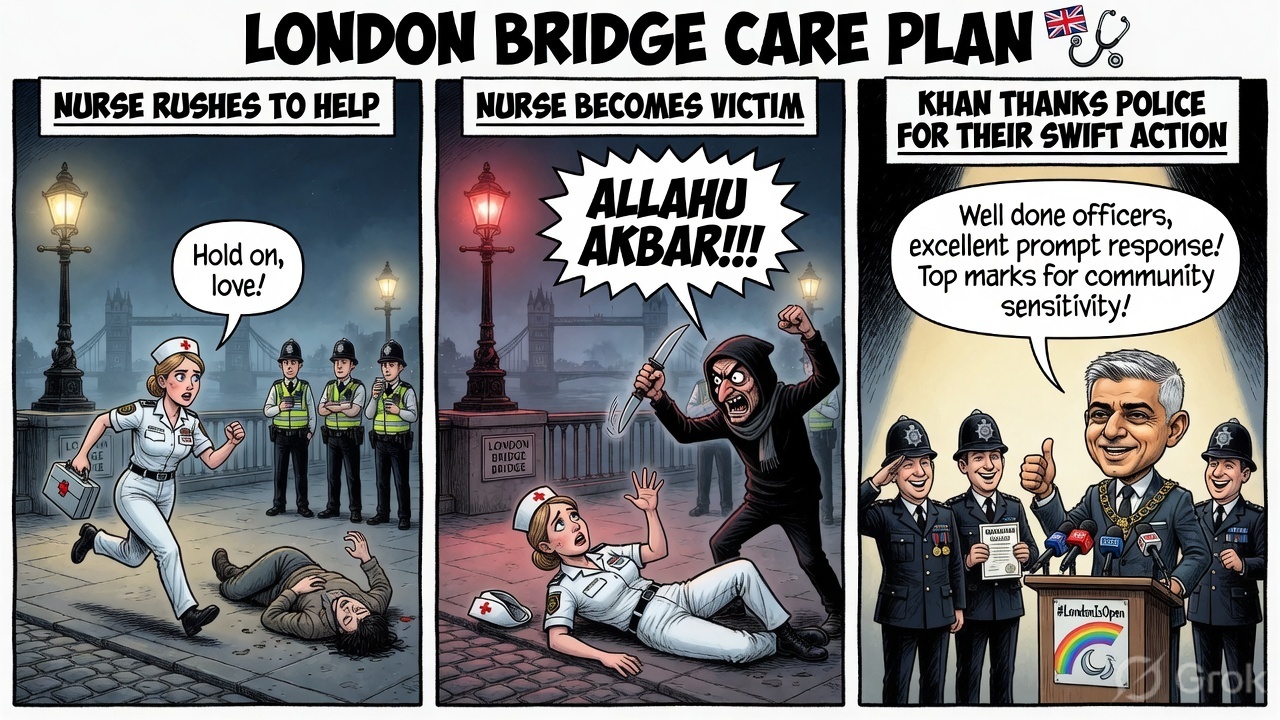
In 2017, the policies and priorities of London’s Mayor Sadiq Khan bore bitter fruit. Khan had opposed Trump’s border wall and expressed preference for bridges. On London Bridge, the world witnessed the horror that extremist Islam can inflict. An Australian nurse, Kirsty Boden, ran to help the injured and dying—only to be butchered herself for her compassion. The extremists had counted on a slow police response. Many felt it was. Khan was elsewhere at the time, receiving praise for criticising Trump. Later, the press commended his rhetoric, insisting the attackers’ actions had nothing to do with Islam. It might have been more reassuring had he clearly distanced the faith itself from the attackers’ aims, not merely their methods. While the press described the police response as timely, the courage of the murdered nurse was unquestionably timely. For many, an eight-to-ten-minute window from the start of the mayhem felt far too long, given some were nearby on duty.
That same year, 2018, also marked roughly 500 days of the Trump presidency. In that short time, America experienced a prosperity many thought impossible after the Obama years. Americans were working again. The nation felt less divided than it had under the previous administration.
Sadiq Khan had taken the Mayor’s office from Boris Johnson. Positioned as soft-left within the UK Labour Party—even as Labour struggled with competence—Khan’s stances on many issues seem indefensible to me, except among his loyal base. Under his watch, it has sometimes appeared easier to be an Islamic extremist in London without serious repercussions than for an ordinary citizen to carry a kitchen knife. One wonders what further obstacles he can place before police officers simply trying to do their jobs. Similar frustrations emerged in Victoria’s inquest into the Bourke Street rampage, where police reportedly felt impeded before the tragedy.
Meanwhile, Howard Schultz stepped down as Starbucks CEO around the time the U.S. Supreme Court upheld a bakery’s right to refuse service in a 7-2 decision—described by some outlets as “narrow,” as if the margin somehow diminished the principle. Aleksandr Solzhenitsyn wisely observed: “Human beings are born with different capacities. If they are free, they are not equal. If they are equal, they are not free.” Yet at Columbia University, Professor Hamid Dabashi has trafficked in anti-Semitic rhetoric, showing how far parts of the left have fallen. Even Meanjin, a left-wing Melbourne University magazine, has erased its own Aboriginal-derived name while temporarily changing it to .
Dan Bongino urges us not to lose heart and to keep supporting the Trump movement. I agree we must persist. But it is disheartening that those who, from positions of high office, excused or downplayed terrorism remain unchallenged. Those I hold responsible for the COVID response—real disease, yet exploited for political ends—have faced no real reckoning despite the human cost. The partisan bias in media and social media persists, even when it arguably violates principles of free speech. I know this firsthand: I was removed from Facebook without justification, and my life’s work remains seized from me even now.
The fight for accountability continues. Truth and justice should not be partisan causes—they are essential for any free society.
community logo
Join the VoiceDDB Community
To read more articles like this, sign up and join my community today
0
What else you may like…
Videos
Posts
Articles
00:01:07
November 27, 2022
Jingle Bell Rock

Jingle bell, jingle bell, jingle bell rock
Jingle bells swing and jingle bells ring
Snowin' and blowin' up bushels of fun
Now the jingle hop has begun

Jingle bell, jingle bell, jingle bell rock
Jingle bells chime in jingle bell time
Dancin' and prancin' in Jingle Bell Square
In the frosty air

What a bright time, it's the right time
To rock the night away
Jingle bell time is a swell time
To go glidin' in a one-horse sleigh

Giddy-up jingle horse, pick up your feet
Jingle around the clock
Mix and a-mingle in the jinglin' feet
That's the jingle bell rock

Jingle bell, jingle bell, jingle bell rock
Jingle bell chime in jingle bell time
Dancin' and prancin' in Jingle Bell Square
In the frosty air

What a bright time, it's the right time
To rock the night away
Jingle bell time is a swell time
To go glidin' in a one-horse sleigh

Giddy-up jingle horse, pick up your feet
Jingle around the clock
Mix and a-mingle in the jinglin' feet
That's the jingle bell
That's the jingle...

00:02:04
September 01, 2021
Intro to Locals for the Conservative Voice

David Daniel Ball calls himself the Conservative Voice.

I'm a teacher with three decades experience teaching math to high school kids.I also work with first graders and kids in between first grade and high school. I know the legends of why Hypatia's dad is remembered through his contribution to Math theory. And I know the legend of why followers of Godel had thought he had disproved God's existence.

I'm not a preacher, but I am a Christian who has written over 28 books all of which include some reference to my faith. Twelve blog books on world history and current affairs, detailing world events , births and marriages on each day of the year, organised by month. Twelve books on the background to and history of Bible Quotes. One Bible quote per day for a year. An intro to a science fiction series I'm planning, post apocalyptic cyber punk. An autobiography with short story collections.

I'm known in Australia for my failure as a whistleblower over the negligence death of a school boy. ...

00:01:50
Oxfam Lamb approach 2018

Oxfam lamb approached me at Dandenong mall. I was playing Pokémon Go. She said I was emailing her and I should face her instead. Lovely English accent. Blond. Blue eyed. I stopped and wished her a good day. She said “Stop. What if I were to ask you what was the deadliest danger children face today around the world? What might you say it is?” I replied “The UN preventing profit and condemning children to die without allowing parents the means to support themselves. But that is just me. I wish you a good day” and she stood with her mouth agape saying 'wow.'

post photo preview
Say not the struggle nought availeth

Arthur Hugh Clough (1 January 1819 -- 13 November 1861) was an English poet, the brother of suffragist Anne Clough (who ended up as principal of Newnham College, Cambridge), and assistant to ground-breaking nurse Florence Nightingale.

Say not the struggle nought availeth, 

     The labour and the wounds are vain, 

The enemy faints not, nor faileth, 

     And as things have been they remain. 

If hopes were dupes, fears may be liars; 

     It may be, in yon smoke concealed, 

Your comrades chase e'en now the fliers,

     And, but for you, possess the field. 

For while the tired waves, vainly breaking 

     Seem here no painful inch to gain, 

Far back through creeks and inlets making, 

     Comes silent, flooding in, the main. 

And not by eastern windows only, 

     When daylight comes, comes in the light, 

In front the sun climbs slow, how slowly, 

     But westward, look, the land is bright.

Grok tanks on truth telling

write editorial on Deep State Corruption and Fauci and Gates. Anthony Fauci and Bill Gates would know each other through professional channels. Gates has run a philanthropic organisation since becoming the world's richest man, for a time, and Fauci has led the US from the National Institute of Health. Their positions on COVID management were not accidental and rhymed with each other in ways that honest brokers would not have anticipated. Fauci's hamfisted management of Aids led to practices that are now largely debunked, with care from retro virals leading to HIV positive people leading near full term lives, now. Similarly, the initial scare of COVID 19 led to draconian measures, none of which effectively managed the disease, but which magically allowed conditions for a bungled 2020 presidential election. Masking was counterproductive, as the masks made spread more likely, and created conditions for social disease to spread, like school children missing out on seeing facial expressions. ...

post photo preview
post photo preview
The Myths and Realities of Education Funding in Australia
Communists won?

The Myths and Realities of Education Funding in Australia

There is a widespread perception that education in Australia is flush with money simply because the sector is large. In reality, the system operates under significant pressures and trade-offs.

Australia maintains a diverse network of private and independent schools that receive government subsidies. These schools ease the financial burden on state governments by educating a substantial portion of students, freeing up resources that can be directed toward supporting disadvantaged students in the public system. This mixed model has long allowed for better-targeted assistance where it is most needed.

Yet some ideologically driven politicians peddle the notion that greater equity demands slashing subsidies to private schools. This view is not only misguided but potentially destructive. Reducing support for the private sector would likely force many families back into the public system, driving up costs dramatically and straining resources without improving outcomes. It is poor policy dressed up as virtue. Hucksters promising that defunding private education will reveal “gold in them there hills” ignore basic fiscal realities.

Public education often performs well in wealthier neighbourhoods, where social capital and parental engagement are strong. In poorer areas, however, it frequently struggles with dysfunction, discipline issues, and lower results. The notion that simply shifting more students and money into the public system will magically create equity overlooks these entrenched challenges.

A parallel problem exists in Australia’s universities. For decades, successive cohorts of left-leaning academic staff have fostered an environment that can feel stifling for students and researchers seeking intellectual diversity. Marxist-influenced perspectives have extended beyond the arts and humanities into the sciences and even medicine, narrowing acceptable discourse and discouraging dissenting views.

The 2018 controversy surrounding the Ramsay Centre for Western Civilisation offers a telling case study. A substantial philanthropic bequest aimed at promoting serious study of Western values and civilisation was ultimately rejected by the Australian National University. University leaders claimed that robust Western cultural studies already thrived on campus — a claim that rang hollow to many observers. Critics portrayed the rejection as resistance to overly onerous donor conditions, yet the same institution tolerated — and in some cases enabled — student activities involving heavy drug use, public inebriation, and anti-Semitic sentiment often disguised as anti-Zionism. Some student groups pushed for censorship and the removal of cultural assets deemed offensive on grounds of racism or historical grievance.

Even more concerning is the politicisation of science. Instances have emerged where researchers, including geologists, faced professional pressure or career repercussions for failing to align with prevailing orthodoxies on issues such as anthropogenic global warming.

Cui bono? Who truly benefits from these ideological constraints and funding distortions? Not students seeking genuine education, nor a society that requires intellectual openness and fiscal prudence. Australia’s education system deserves honest debate based on outcomes, not slogans. Preserving diversity — in schooling options and in ideas — remains essential to both equity and excellence.

Read full Article
post photo preview
The High Court’s Uneasy Choice
Letter of the Law for Barnaby Joyce, Spirit for Native Title

The High Court’s Uneasy Choice: Letter of the Law for Barnaby Joyce, Spirit for Native Title

The 2017 disqualification of Barnaby Joyce from the Australian Parliament remains one of the more surreal episodes in our constitutional history. Here was Australia’s Deputy Prime Minister, born and raised in this country, stripped of his seat not because of corruption, incompetence, or public rejection — but because New Zealand law deemed him a citizen by descent through his father. The High Court ruled strictly by the letter of Section 44(i) of the Constitution. Joyce’s ignorance of his dual status was irrelevant. Australia had, in effect, outsourced part of its parliamentary eligibility to the citizenship rules of a foreign power.

This stands in sharp contrast to the High Court’s approach in landmark cases like Mabo v Queensland (No 2) (1992). There, the Court famously “read between the lines” of common law and history. It rejected the long-standing doctrine of terra nullius and recognised native title — an ancient form of title not created by statute or Crown grant, but arising from Indigenous connection to land. The judges engaged in creative interpretation to align the law with contemporary understandings of justice and historical truth.

Critics of the Joyce decision argue this reveals a form of selective judicial method. When dealing with Indigenous rights and historical dispossession, the Court embraced a purposive, equitable approach. When confronting the technical eligibility of an elected Deputy Prime Minister, it insisted on strict, literal application — even though Joyce had no practical allegiance to New Zealand and had lived his entire life as an Australian.

Sovereignty and Foreign Powers

The optics are uncomfortable. Australia’s Constitution disqualified Joyce because a foreign country (New Zealand) claimed him as one of its own. This creates a strange precedent: a foreign legislature or bureaucracy can, by changing or interpreting its own citizenship laws, influence who may sit in Australia’s Parliament. For a nation that prizes its sovereignty, this feels anomalous.

The user’s personal experience campaigning in Blaxland in 2010 adds another layer. Many dual citizens have faced similar dilemmas — attempting to renounce foreign citizenship only to discover the constitutional trap remains. The situation would likely have drawn very different commentary had the MP in question possessed visible Aboriginal ancestry, even without strong cultural identification. The High Court’s firm stance here appears driven by a desire to uphold the integrity of Section 44, but the selective rigidity invites accusations of inconsistency.

The Political Context

Joyce was no ordinary backbencher. As a vocal advocate for regional Australia, he pushed hard for water infrastructure, including ambitious dam-building proposals (the “100 dams” rhetoric). These ideas clashed with the more urban, climate-policy-focused direction favoured by then-Prime Minister Malcolm Turnbull. Their relationship was already strained. The citizenship crisis conveniently removed a powerful internal critic at a sensitive time, though Joyce comfortably won the subsequent by-election in New England with a thumping majority.

Claims that New Zealand’s Labour government at the time timed or exploited the process for political effect have circulated, though the legal trigger came through standard inquiries during the broader citizenship saga. The High Court itself delivered a unanimous judgment based on constitutional text, not politics.

A Rotten Proceeding?

The episode exposed real flaws. Section 44(i) is an 19th-century provision ill-suited to modern mobility and dual citizenship realities. It has ensnared multiple politicians unaware of their status. Requiring candidates to proactively divest foreign citizenship is reasonable, but automatic disqualification for unknowing dual status feels disproportionate.

Yet the deeper unease is about consistency in judicial philosophy. If the High Court can evolve common law dramatically for native title to correct historical injustice, why such literalism elsewhere when it destabilises democratic representation? Joyce’s rapid return via by-election showed the people of New England rejected the technical disqualification. The Court protected the constitutional text. Whether it always applies the same standard across different cultural and political contexts remains a fair subject for debate.

Australia deserves clearer rules. A referendum to modernise Section 44 would be healthier than relying on High Court literalism in some cases and judicial creativity in others. The Joyce affair was not just about one man’s eligibility — it highlighted tensions between legal formalism, political reality, and national sovereignty.

Read full Article
post photo preview
The Tragic Shootdown of BOAC Flight 777
Echoes Across Decades

Editorial: The Tragic Shootdown of BOAC Flight 777 – Echoes Across Decades

On 1 June 1943, over the Bay of Biscay, eight German Junkers Ju 88 fighters attacked and destroyed an unarmed civilian Douglas DC-3 operating as BOAC Flight 777 (KLM flight 2L272). All 17 people aboard perished, including the beloved British actor Leslie Howard. Among the passengers were Reuters journalist Kenneth Stonehouse and his wife, BP/Shell executive and SOE agent Tyrrell Shervington, and the remarkable Jewish philanthropist Wilfred Israel, who had saved thousands of Jews from Nazi persecution through the Kindertransport and other rescue efforts.

The parallels with the 2014 shootdown of Malaysia Airlines Flight MH17 over Ukraine are striking in their tragedy and controversy. In both cases, a civilian airliner was brought down in a contested airspace during a major conflict, resulting in the deaths of innocents. Both incidents sparked intense speculation, competing narratives, and accusations of deliberate targeting versus mistaken identity. Questions linger in each: Was it a tragic error in the fog of war, or something more calculated?

The Facts of Flight 777

The DC-3 Ibis departed Lisbon’s Portela Airport bound for Bristol. Lisbon was a neutral hub teeming with spies from both sides, and passenger lists were likely monitored. The aircraft had been repainted in military-style camouflage (dark green/brown) with British civil markings — a decision some later criticized, as earlier KLM aircraft had used bright orange for visibility. The German pilots, on a maritime patrol protecting U-boats, engaged what they reported as a suspicious aircraft. The unarmed airliner was strafed repeatedly and crashed into the sea.

Why This Flight? Enduring Questions

The “why” remains unresolved more than 80 years later. The most widely circulated contemporary theory — that the Germans mistook the flight for one carrying Winston Churchill (due to the physical resemblance of Howard’s manager Alfred Chenhalls) — has been largely dismissed by historians as unlikely. Churchill’s movements at the time do not align neatly, and the timing feels too coincidental.

Other credible possibilities exist:

  • Leslie Howard as Target: Howard was a highly effective anti-Nazi propagandist through films like Pimpernel Smith. His son Ronald Howard concluded that Joseph Goebbels personally wanted him eliminated. Howard’s Jewish heritage and rumored intelligence connections added to the motive.
  • High-Value Passengers: Wilfred Israel’s humanitarian work directly undermined the Nazi regime by rescuing Jews. Tyrrell Shervington’s intelligence role and other passengers with tungsten trade or journalistic ties made the flight a potential intelligence prize. German agents in Lisbon almost certainly knew who was aboard.
  • Target of Opportunity: The Bay of Biscay was a deadly combat zone. The Ju 88s were hunting threats to U-boats. A camouflaged aircraft in the wrong place at the wrong time may simply have been engaged without full awareness of its civilian status.

Allied intelligence (including ULTRA) may have known of risks but chose not to act to protect sources — a painful but recurring wartime dilemma.

Parallels with MH17

Like BOAC Flight 777, Malaysia Airlines Flight MH17 was a civilian airliner shot down amid an intense geopolitical conflict, claiming 298 lives. In both cases, the perpetrators — the German Luftwaffe in 1943 and Russian-backed separatists armed with a Buk missile in 2014 — operated in highly contested airspace. Both tragedies quickly spawned competing narratives: tragic accident or mistaken identity on one hand, versus deliberate provocation or targeting on the other.

While the circumstances differ significantly, certain parallels persist. In the case of MH17, Ukrainian forces reportedly used radar illumination (“painting”) on the civilian flight in an effort to deter or lure Russian-backed systems, a tactic born of frustration after repeated losses of their own military transports. That action itself constituted a serious breach of international norms. Nevertheless, it was pro-Russian separatists who ultimately fired the missile that destroyed the aircraft. What began as a tragic miscalculation was later exploited for propaganda purposes, including by Western signals intelligence following an apparent apology to Putin.

By contrast, BOAC Flight 777 appears to have been more deliberately targeted. The aircraft’s dark military-style camouflage, rather than bright civilian livery, reduced its visibility as a passenger plane and likely increased its vulnerability in the war zone. Far from serving as a trap, this made it easier for German fighters to engage what they viewed as a legitimate or high-value target. Evidence suggests the flight was marked from departure in Lisbon, possibly as a showcase warning — particularly given the presence of Wilfred Israel, whose heroic efforts to rescue Jews directly challenged the Nazi regime.

Such parallels remind us how swiftly tragedy can be transformed into propaganda. In both cases, the profound human cost — devastated families and the loss of prominent figures — risks being overshadowed by strategic narratives and competing geopolitical agendas.

A Warning Shot?

The idea that Flight 777 served as a deliberate warning to those aiding Jews, with Wilfred Israel as the symbolic target, is emotionally resonant but remains speculative. The Nazis’ genocidal machinery needed no such public signals; they operated with ruthless efficiency regardless. Yet Israel’s presence undeniably made the flight a high-value target for those who viewed Jewish rescue as an existential threat to their ideology.

What we do know is this: In total war, civilian lives were often expendable. Neutral routes offered no real protection. BOAC Flight 777 stands as a grim reminder of the blurred lines between combatant and non-combatant, and how intelligence, propaganda, and raw military power can converge on a single flight with lethal consequences.

Eighty-three years on, the full truth may never emerge from sealed files or destroyed records. But we remember the victims: Leslie Howard, Wilfred Israel, Kenneth Stonehouse, Tyrrell Shervington, and the others who simply boarded a plane home. Their deaths demand we remain skeptical of easy official stories — whether in 1943 or 2014 — and vigilant against the dehumanizing logic of war.

Read full Article
See More
Available on mobile and TV devices
google store google store app store app store
google store google store app tv store app tv store amazon store amazon store roku store roku store
Powered by Locals