The Poisoned Well: Ethics, Politics, and the Corruption of University Research
Universities and research institutions were once beacons of disinterested inquiry, guardians of accumulated human knowledge. Today, many function as gatekeepers of approved narratives, where funding, ideology, and institutional self-interest often trump evidence. The result is not just wasted public money but distorted policy and a creeping erosion of trust in expertise.
History offers stark warnings about research unbound by ethics. Josef Mengele's monstrous experiments on twins in Auschwitz represent the nadir of predatory "science" in service of ideology. His work was pseudoscience wrapped in atrocity; the revulsion it still provokes is universal and justified. Far more nuanced is the case of Dr. William Beaumont in the 19th century. After treating fur trapper Alexis St. Martin, who survived a horrific gunshot wound that left a permanent gastric fistula, Beaumont conducted pioneering experiments on human digestion. St. Martin, unable to resume his trade, entered a long-term, dependent relationship with Beaumont—hired as a valet under successive contracts. Modern ethics rightly flags the power imbalance and exploitation. Yet those experiments yielded foundational insights into gastric physiology that remain valuable. Dismissing them wholesale as "fruit of a poisoned tree" risks throwing out hard-won knowledge alongside the moral failings of their acquisition.
This tension—between ethical progress and the erasure of the past—plays out today. Consider the Siberian Ice Maiden, a 2,500-year-old Pazyryk woman whose remains revealed metastatic breast cancer. She managed pain not with modern pharmaceuticals but through local remedies, including cannabis inhalation. Under certain "green" visions of degrowth or demodernization, such rudimentary approaches could once again become "world-class" care.
Modern research ethics committees were meant to prevent abuses and elevate standards. In principle, they do. In practice, they can become tools for enforcing orthodoxy. Activist groups like PETA champion animal welfare while sometimes engaging in tactics that alienate the public and undermine legitimate science. Treating animals humanely matters; weaponizing the cause into political warfare, including targeting children in ways reminiscent of ideological indoctrination, often proves counterproductive.
Institutional Capture in Australia
Nowhere is the interplay of money, politics, and ideology more evident than in Australian universities, which rely heavily on government funding while claiming independence. They may pursue private contracts, but political pressures persist.
A tragic 1990 rail accident near Cowan, NSW, killed several senior figures from the University of Sydney, including the recently retired Vice-Chancellor John Manning Ward and others connected to university leadership. The resulting upheaval allegedly opened doors to political appointments that bypassed traditional merit-based promotion, tilting governance leftward. Managerial boards with strong factional alignments have, at times, functioned like caucuses, steering priorities away from broad inquiry toward favoured ideological lines—mirroring partisan lockstep elsewhere, such as unanimous opposition to basic electoral integrity measures.
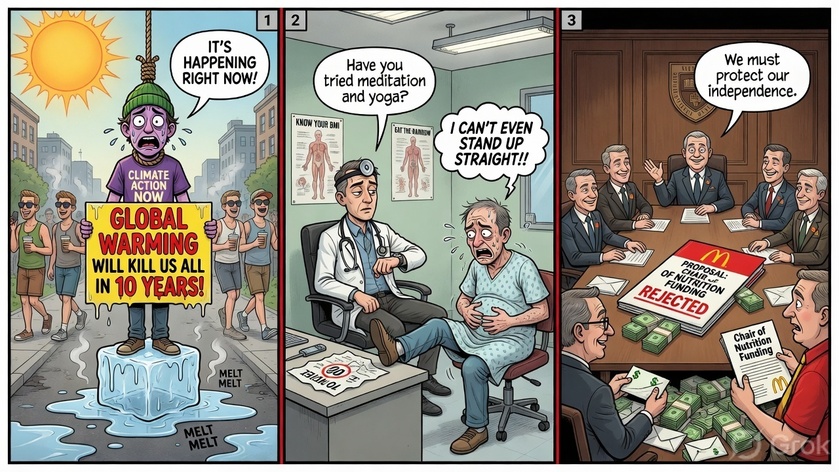
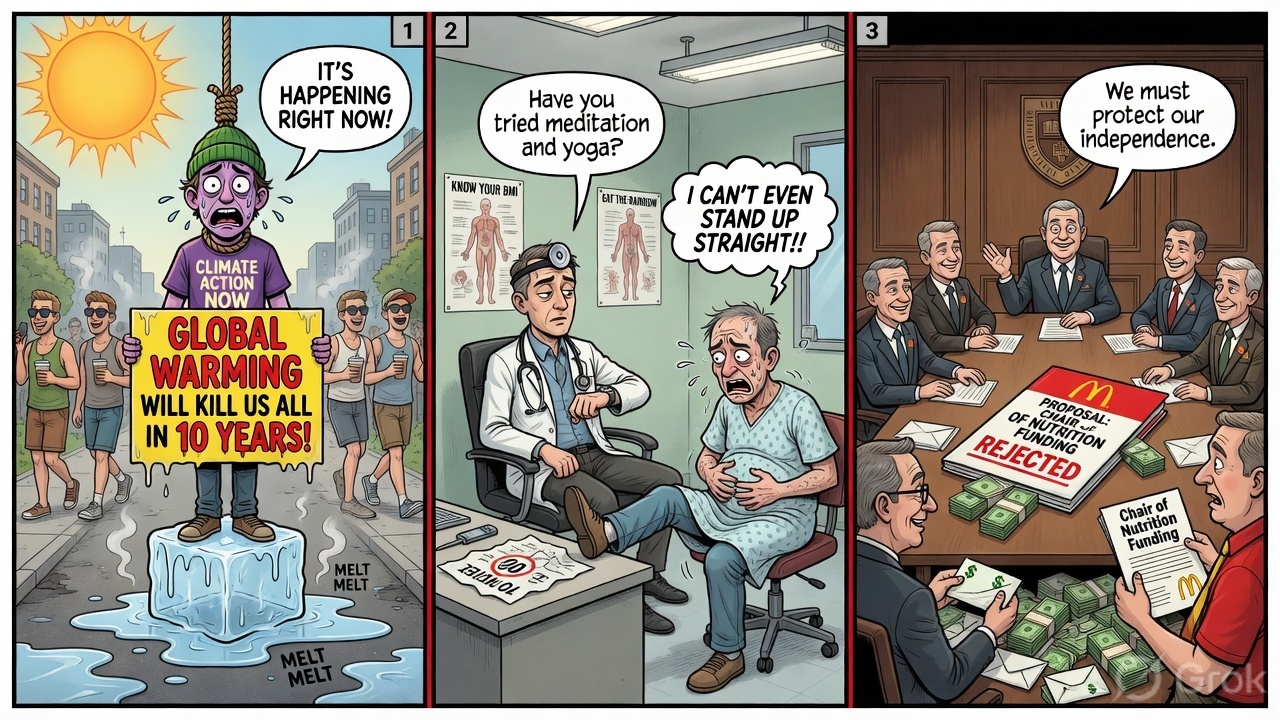
Lighter examples reveal the hypersensitivity. When McDonald's offered to fund a chair in nutrition, the university reportedly declined despite the prospective appointee's willingness to affirm that the company's food could fit a balanced diet. Public perception of compromise prevailed over substance.
More consequential was expert opposition to infrastructure. In the Howard era, senior researchers reportedly dismissed aspects of the Bradfield Scheme (revived ideas for inland water diversion, sometimes linked to "Two Rivers" concepts), citing environmental risks. Yet Australia's variable climate—marked by periodic flooding—suggests such projects warrant pragmatic evaluation rather than reflexive rejection. Subsequent efforts, like Barnaby Joyce's "hundred dams" push, faced state-level blocks. When institutions meant to provide rigorous analysis instead channel activist memes into policy, public frustration grows.
The Broader Corruption
Corruption in this context is rarely crude bribery. It manifests as selection bias in hiring and publishing, funding incentives that reward certain conclusions, and narrative control that sidelines dissenting data. Duplicitous actors may relish hoodwinking systems; those with integrity often self-censor out of fear. The result: thousands of years of accumulated knowledge risk being discounted not for falsity, but for originating in eras with different ethical norms.
True reform demands separating genuine ethical safeguards from political litmus tests. Universities should prioritise independence, transparency in funding, and viewpoint diversity. Research must serve truth-seeking, not social engineering. Otherwise, we risk a future where "world-class" medicine means foraging local herbs while the machinery of knowledge production grinds ever more predictably toward approved ends. The public, rightly, grows sceptical. Restoring credibility requires courage to confront uncomfortable histories without erasing them—and to judge ideas on evidence, not the politics of their proponents.