Failed Corporate Leadership: The ABC, Honours, and Institutional Rot in Australia
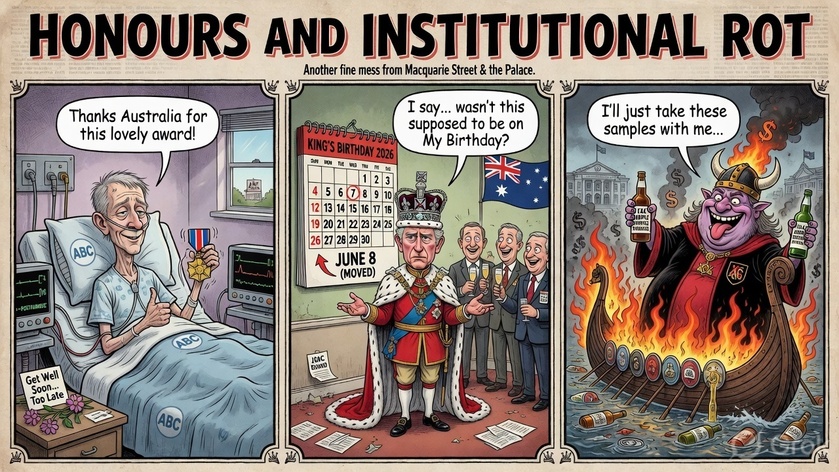
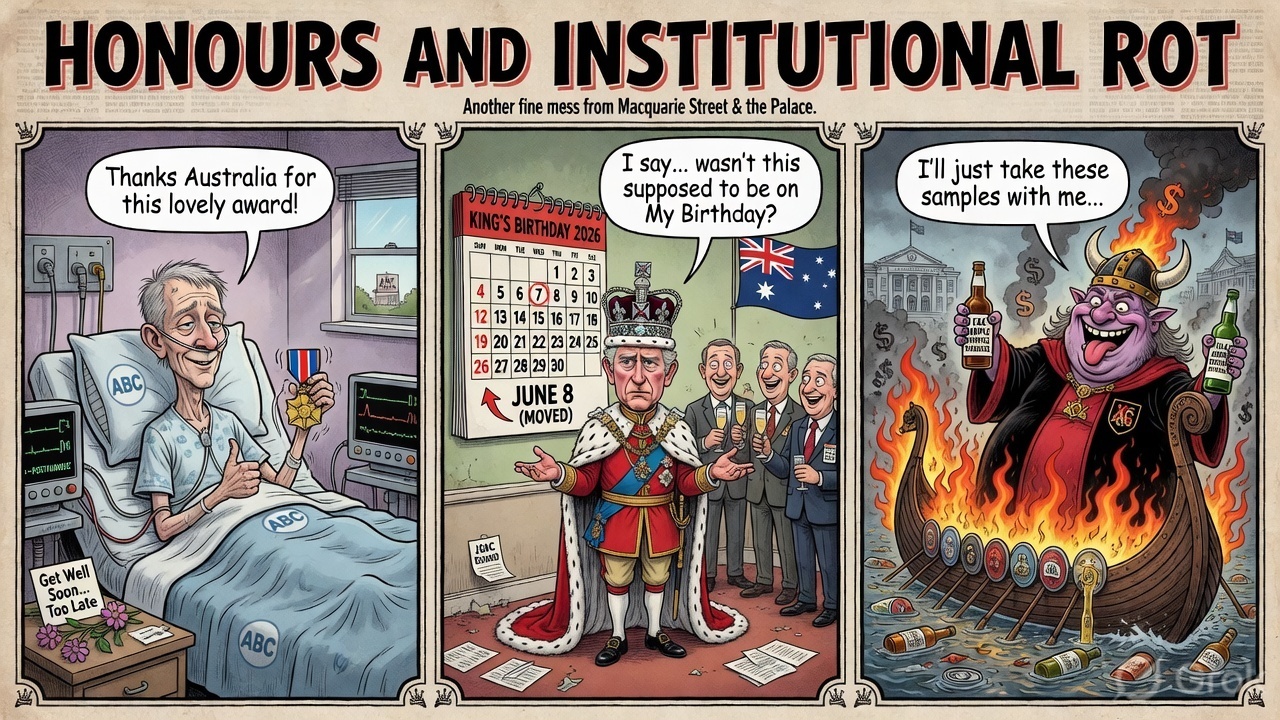
Today, on King’s Birthday, Australians reflect on service and excellence as the 2026 Honours List is announced. Among the recipients is the late broadcaster James Valentine, awarded a Member of the Order of Australia (AM) for his contributions to media, music, and children’s literature. Valentine, the affable ABC Radio Sydney voice known for his wit and warmth, died in April 2026 at 64 after battling oesophageal cancer. The honour was presented to him and his family in a special ceremony before his death — a gesture that highlights both his public affection and the government’s awareness of his final months.
Valentine embodied quiet dignity. He was not a firebrand but carried himself with an everyman charm that disarmed listeners. Yet his career unfolded almost entirely within the ABC — an institution established by Robert Menzies to provide an independent voice, only to pivot into partisan opposition against him from the outset. For decades, the ABC has operated without robust editorial standards, subtly advancing certain worldviews while claiming impartiality. Valentine, described as apolitical, reflected the network’s cultural leanings: affable on the surface, yet aligned with progressive orthodoxies on issues like COVID responses — masking, isolation, and vaccination.
Like many who followed official guidance during the crisis, Valentine faced serious illness. He chose voluntary assisted dying (VAD), surrounded by loved ones on his own terms — or so the subsequent media narrative framed it. The press, particularly his ABC colleagues, amplified his story as a dignified exit and a celebration of choice. But this raises uncomfortable questions about the realities of VAD and the signals sent to a vulnerable public. What message does it convey when a beloved figure’s passing becomes a polished promotion of euthanasia? And what does it say about institutional priorities when honours appear intertwined with such narratives?
This episode exemplifies a deeper failure of corporate leadership in Australian government and its agencies. Public institutions like the ABC, funded by taxpayers to the tune of over $1.28 billion annually (roughly 25–30 cents per working taxpayer per day), have drifted from their charters. They serve as echo chambers rather than independent checks on power, cycling with the electoral tides. When the press pushes ALP or Greens-aligned narratives, voters sometimes swing back to conservatives in resistance. Yet the underlying culture persists.
Consider the cautionary tale of Nick Greiner, NSW Premier in the late 1980s and early 1990s. Greiner inherited a corrupt state and acted decisively: he cleaned up government and established the Independent Commission Against Corruption (ICAC) to root out wrongdoing. When ICAC investigated him over a political appointment involving independent MP Terry Metherell, it found no criminality. Commissioner Ian Temby’s report nevertheless branded the actions “technically corrupt” — a finding later overturned on appeal by the NSW Court of Appeal, which ruled ICAC had exceeded its jurisdiction. Despite exoneration, independents in a hung parliament used the controversy to force Greiner’s resignation. His government stood out for prudence: NSW was the only state to avoid major losses in the savings-and-loans corruption bubble of the era.
The pattern of selective accountability repeats across decades. A stark example is the case of former NSW Attorney-General and later Supreme Court judge Jeff Shaw. In 2004, Shaw was involved in a low-speed collision with parked cars while heavily intoxicated. Police took him to hospital, where he refused a breath test. Hospital staff took blood samples, but Shaw demanded and removed his own vials, breaking the chain of custody. Months later, when he finally handed them over, tests showed he was substantially over the legal limit. Yet Shaw faced no meaningful consequences. He died in 2010 from alcohol-related illness without ever being brought fully to book for the incident. This episode, involving one of the state’s most senior legal figures, underscores how the system often shields its own.
The ICAC has scrutinised conservatives rigorously but struggles to deliver equivalent accountability on the other side. Allegations of sleaze — from insider dealings to policing failures and drug issues in areas like Cabramatta — often evade deep scrutiny when they touch ALP figures. Political scalpings masquerade as justice, while real systemic failures fester.
Australia’s electoral cycle exposes the rot. Voters oscillate between partisan media manipulation and corrective conservative mandates, yet institutions remain captured. Honours lists, COVID-era policies, euthanasia promotion, selective anti-corruption enforcement, and protection of the powerful all point to the same problem: a failure of corporate governance at the highest levels. Leaders treat the state like a corporation without proper oversight, accountability, or fidelity to founding principles.
James Valentine deserved recognition for his talents and humanity. But turning his personal tragedy into institutional theatre, while broader failures in media impartiality, fiscal prudence, and even-handed justice persist, underscores the need for reform. Australians deserve better than managed decline dressed up as compassion and independence. True leadership would restore standards, not reward the symptoms of their erosion. On this King’s Birthday, let us honour service honestly — and demand institutions worthy of it.