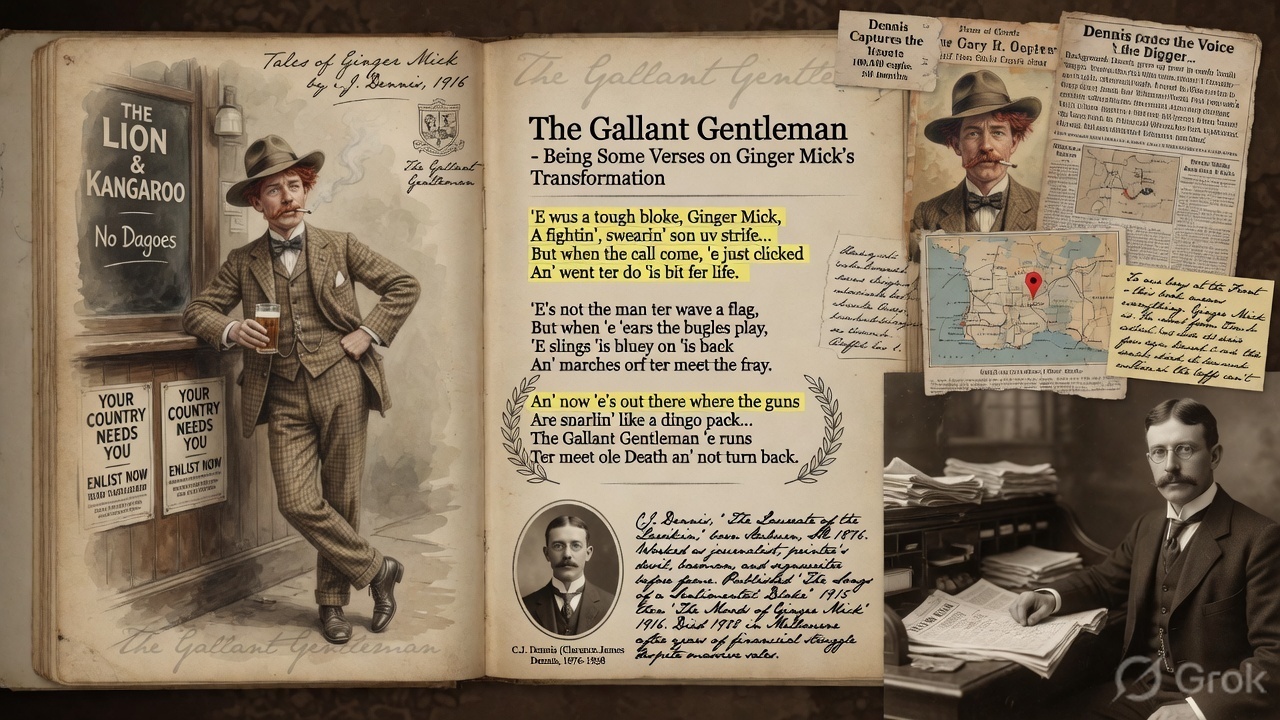
The Gallant Gentleman: Reclaiming Ginger Mick Through C.J. Dennis’s Vernacular Lens
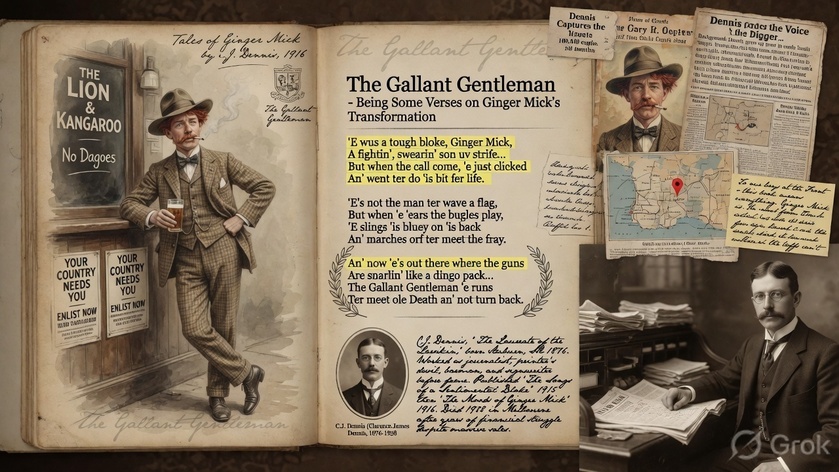
In the shadow of the Great War, amid the mud and blood of Gallipoli, Australian poet C.J. Dennis gave voice to the ordinary bloke in a way that resonated deeply with a nation forging its identity. His 1916 verse novel The Moods of Ginger Mick—a sequel to the wildly popular The Songs of a Sentimental Bloke—follows the transformation of a rough-edged larrikin into a hero. Through the eyes of the Sentimental Bloke, his loyal cobber and narrator, Dennis portrays Ginger Mick not as a polished soldier but as a flawed everyman whose core decency shines in crisis. At the heart of this tale stands “A Gallant Gentleman,” the closing poem that elevates Mick beyond class and circumstance, revealing the true meaning of mateship, sacrifice, and Australian spirit.
C.J. Dennis: The Laureate of the Larrikin
Clarence Michael James Dennis (1876–1938) was born in Auburn, South Australia, to Irish immigrant parents. His father ran hotels in rural areas, but after his mother’s early death, young Dennis was raised by aunts and left school at 17. He worked various jobs—clerk, law assistant, journalist—before moving to Victoria’s Dandenong Ranges around 1907, where he built a home and found stability.
Dennis became Australia’s most popular poet of the era, selling hundreds of thousands of books and publishing thousands of poems. He earned the nickname “The Laureate of the Larrikin” for his masterful use of Australian vernacular—phonetic slang, working-class idioms, and humor that captured the voice of the streets. His breakthrough came with The Songs of a Sentimental Bloke (1915), which humanized urban “push” culture through romance and redemption. Ginger Mick followed in 1916, dedicated “To the Boys Who Took the Count,” channeling the wartime mood.
Dennis struggled personally with alcoholism and depression but remained prolific. His work blended satire, pathos, and patriotism, making high literature accessible. He died in 1938, buried in Melbourne, his legacy enduring in the Anzac legend and vernacular poetry.
The Tale of Ginger Mick: From Larrikin to Legend
Ginger Mick is introduced as a “rorty boy, a naughty boy” with a fighting face, a record at the Melbourne City Court, and a living hawking rabbits or “pinching” when times were hard. The Sentimental Bloke paints him with affectionate realism: vulgar by polite standards, yet possessing a soft heart beneath the tough exterior.
In “Duck an’ Fowl,” Mick defends his girl Rosie from a drunken toff in a chaotic Chinese eatery, turning the place upside down in a brawl that mixes humor with chivalric impulse. The poem captures the rough justice of the streets:
“Now, when a bloke ’e cracks a bloke fer insults to a skirt, An’ wrecks a joint to square a lady’s name, They used to call it chivalry, but now they calls it dirt...”
Mick answers “The Call of Stoush,” enlisting not for glory but duty, training in Cairo before Gallipoli. At war, class barriers dissolve. In “The Push,” the Bloke celebrates unity: snobbery is “down an’ out,” replaced by “grit an’ reel good fellership.” Mick proves himself in battle, but the story culminates tragically in “A Gallant Gentleman.”
Through the Lens of the Gallant Gentleman
The poem “A Gallant Gentleman” is a poignant elegy. News of Mick’s death arrives: “Killed in Action.” The Bloke grieves, imagining Mick’s return, while Rosie faces a broken world. A letter from officer Trent—an “English toff”—reveals Mick’s heroism. Trent praises him in terms that would embarrass the larrikin:
“He was a gallant gentleman,” it ends.
The Bloke reflects:
“A gallant gentleman! Well, I dunno. I ’ardly think that Mick ud like that name. ... ’E wus a man; that’s good enough fer me...”
Mick’s final words, “Look after Rose... Mafeesh!” (Arabic slang for “finished”), echo as a prayer for those left behind. Dennis uses the toff’s elevated language ironically yet sincerely, bridging class divides. The “gallant gentleman” isn’t about breeding but character—courage, loyalty, quiet sacrifice. Mick dies protecting mates and country, buried with mimosa evoking Australian wattle.
Meaning to His Audience
For 1916 Australia—deeply invested in the Gallipoli campaign—Ginger Mick articulated the Anzac legend: courage, mateship, nationalism, and sacrifice from ordinary men. It sold massively, offering comfort and pride amid loss. The vernacular made heroes relatable; the larrikin’s redemption showed that even “vulgar” street toughs could embody gentlemanly virtues.
Dennis’s work fostered unity, humanizing soldiers for civilians and validating working-class contributions. It critiqued snobbery while celebrating Empire loyalty and Australian distinctiveness. To audiences, Ginger Mick symbolized the nation’s spirit: rough around the edges but gallant at heart. In an era of immense grief, the tale affirmed that their boys “took the count” with honor, their sacrifices meaningful.
Today, Dennis’s editorial voice—through the Bloke—reminds us that true gallantry transcends class or polish. Ginger Mick, the fighter from Spadger’s Lane, stands as a gallant gentleman not despite his origins, but because of the man he proved to be. In Dennis’s words, that’s “good enough fer me.”
As the Bloke might say: Spare me days, but that’s a tale worth tellin’.