VoiceDDB
Politics • Culture • News
Corruption in American Politics
An Enduring Stain That Demands Accountability
1 hour ago
post photo preview

Corruption in American Politics: An Enduring Stain That Demands Accountability

Corruption, whether hidden in shadows or brazenly displayed, is never acceptable in a republic founded on the rule of law and consent of the governed. It erodes trust, distorts outcomes, and rewards the cunning over the principled. History offers stark reminders that when institutions fail to confront it rigorously, the consequences compound across decades.

The 1948 Texas Senate Primary and Lyndon Johnson's Path

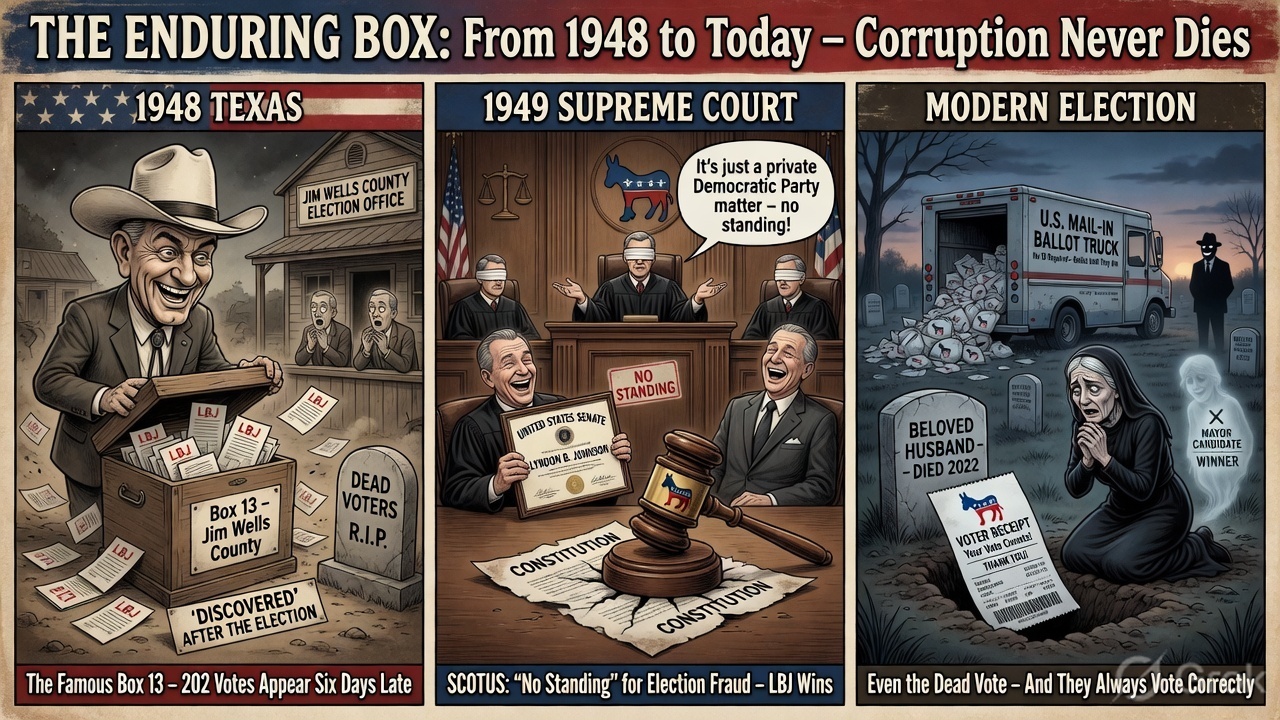
Consider the 1948 Democratic Senate primary runoff in Texas, often called the "Box 13" scandal. In Jim Wells County, six days after polls closed, officials "discovered" 202 additional ballots in Precinct 13—200 for Lyndon B. Johnson and just two for his opponent, Coke Stevenson. This flipped the result, giving Johnson an 87-vote victory out of nearly a million cast. Investigations revealed irregularities: many of the late "voters" were deceased or denied casting ballots, names listed in alphabetical order in different handwriting and ink. A private probe later implicated Johnson in conspiring with political boss George Parr to falsify totals.

Stevenson challenged the outcome in court, but the U.S. Supreme Court effectively declined deep intervention, citing the Democratic Party's status as a private organization for nominating purposes—leaving certification to state processes. Johnson, dubbed "Landslide Lyndon," advanced to the Senate and eventually the presidency following John F. Kennedy's 1963 assassination. These events illustrate how narrow, disputed maneuvers at the local level can reshape national power.

The JFK assassination itself remains deeply contested. While official inquiries like the Warren Commission concluded Lee Harvey Oswald acted alone, persistent material, witness accounts, and forensic debates have fueled credible questions about additional involvement or a cover-up. The swift killing of Oswald by Jack Ruby before a full public accounting only intensified suspicions of a larger cabal. Dismissing all skepticism as baseless "conspiracy theory" overlooks legitimate evidentiary gaps that serious researchers continue to examine.

Modern Echoes: Election Integrity Concerns

Fast-forward to contemporary examples, such as the recent Los Angeles mayoral primary. Reports of delayed mail-in and provisional ballots, ballot harvesting allegations (including claims involving payments in low-income areas), and statistical anomalies in vote updates have raised familiar red flags. Critics point to California's no-excuse mail voting, absence of strict voter ID requirements, and extended counting periods as enabling manipulation—where outcomes can shift days or weeks after initial tallies until preferred candidates prevail. While some claims (like specific zero-vote updates) were debunked as data processing artifacts, broader probes into irregularities persist, underscoring systemic vulnerabilities rather than isolated errors.

These are not relics of the past. Practices like unsecured mail ballots, same-day or extended registration, and resistance to basic safeguards invite exploitation. The pattern—late "discoveries" tipping scales—echoes 1948, yet institutions and media often declare "nothing to see here."

Institutional Capture: The SPLC Example

The Southern Poverty Law Center (SPLC), founded in the 1970s to combat genuine injustice against Black Americans and others, amassed billions in endowments while expanding its mission. Recent federal charges allege it engaged in wire fraud, false statements, and money laundering by secretly funneling millions to informants within extremist groups (including KKK factions and neo-Nazis) while soliciting donations to "fight" them. This raises profound questions about self-perpetuating grievance industries: inflating threats to sustain funding and influence.

Lawsuits and critics have long accused the SPLC of ideological overreach, labeling mainstream conservative organizations as "hate groups" to delegitimize opponents. Wikipedia and aligned outlets often downplay these issues, but the DOJ indictment highlights how even "anti-hate" entities can devolve into opaque power centers detached from their original purpose.

Recent Political Weaponization

The two impeachments of Donald Trump exemplified partisan machinery. The Russia collusion narrative, pushed aggressively by Democratic operatives and amplified by media, relied on the Steele dossier—later discredited as opposition research riddled with unverified claims. The Hunter Biden laptop, containing evidence of influence-peddling, was authentic, yet 51 former intelligence officials publicly suggested it bore "all the classic earmarks of Russian disinformation" weeks before the 2020 election. This letter, coordinated in ways later scrutinized, suppressed legitimate reporting on platforms like Twitter and Facebook.

FBI actions under prior leadership, including Crossfire Hurricane, drew justified criticism for procedural abuses and resource misallocation. High-profile violence, from assassination attempts on Trump to the killing of Charlie Kirk, has been linked by some to inflammatory rhetoric that dehumanizes political opponents. Dog-whistle politics can summon real dogs.

A Path Forward: The SAVE Act

Much of this could be mitigated through basic reforms. The Safeguard American Voter Eligibility (SAVE) Act requires documentary proof of U.S. citizenship for federal voter registration and strengthens identification standards. It targets non-citizen voting risks and promotes uniform integrity without disenfranchising eligible citizens. Opponents claim it burdens voters, but secure elections are foundational—photo ID, citizenship verification, and timely counting are commonsense in most democracies. Passing and enforcing it would restore confidence far more than platitudes about "our democracy."

Conclusion

Corruption thrives in opacity, institutional capture, and selective enforcement. From Box 13 to modern ballot disputes, from SPLC's alleged schemes to intelligence community letterhead operations, the thread is the same: elites bending rules for power while decrying skepticism as extremism. Americans across the spectrum must demand transparency, accountability, and reforms like the SAVE Act. Eternal vigilance remains the price of liberty—corruption, visible or veiled, must be confronted, not excused. The alternative is a republic where outcomes are preordained by insiders, not the people's will.

community logo
Join the VoiceDDB Community
To read more articles like this, sign up and join my community today
0
What else you may like…
Videos
Posts
Articles
00:01:07
November 27, 2022
Jingle Bell Rock

Jingle bell, jingle bell, jingle bell rock
Jingle bells swing and jingle bells ring
Snowin' and blowin' up bushels of fun
Now the jingle hop has begun

Jingle bell, jingle bell, jingle bell rock
Jingle bells chime in jingle bell time
Dancin' and prancin' in Jingle Bell Square
In the frosty air

What a bright time, it's the right time
To rock the night away
Jingle bell time is a swell time
To go glidin' in a one-horse sleigh

Giddy-up jingle horse, pick up your feet
Jingle around the clock
Mix and a-mingle in the jinglin' feet
That's the jingle bell rock

Jingle bell, jingle bell, jingle bell rock
Jingle bell chime in jingle bell time
Dancin' and prancin' in Jingle Bell Square
In the frosty air

What a bright time, it's the right time
To rock the night away
Jingle bell time is a swell time
To go glidin' in a one-horse sleigh

Giddy-up jingle horse, pick up your feet
Jingle around the clock
Mix and a-mingle in the jinglin' feet
That's the jingle bell
That's the jingle...

00:02:04
September 01, 2021
Intro to Locals for the Conservative Voice

David Daniel Ball calls himself the Conservative Voice.

I'm a teacher with three decades experience teaching math to high school kids.I also work with first graders and kids in between first grade and high school. I know the legends of why Hypatia's dad is remembered through his contribution to Math theory. And I know the legend of why followers of Godel had thought he had disproved God's existence.

I'm not a preacher, but I am a Christian who has written over 28 books all of which include some reference to my faith. Twelve blog books on world history and current affairs, detailing world events , births and marriages on each day of the year, organised by month. Twelve books on the background to and history of Bible Quotes. One Bible quote per day for a year. An intro to a science fiction series I'm planning, post apocalyptic cyber punk. An autobiography with short story collections.

I'm known in Australia for my failure as a whistleblower over the negligence death of a school boy. ...

00:01:50
Editorial from 2018 for June 9th

Don't give up on hope. Western Civilisation is on the nose of universities in Australia. Sydney University collapsed in 1990, and her upper executive got replaced by ALP managerialists as Keating fought a culture war which the Liberal Party have not effectively engaged. Dame Kramer had been made Chancellor, but the Chancellor's position is not executive at Sydney University. Kramer fought effectively for Western Values, but the University, now, is as partisan left as the ABC is now. Kramer had been a powerful presence in charge of the ABC too. 

In 1990, Sydney University lost her Chancellor and Vice Chancellor. The Chancellor, Hermann David Black, died after a long illness. James Anthony Rowland, a former governor of NSW took the chancellor's position for a few years, before passing it to Kramer in 1991. She held on to 2001. From 1981 to 1990, John Manning Ward was the executive head of Sydney University as Vice Chancellor. He had been writing a trilogy on Australian conservative leaders ...

post photo preview
Sarah Palin wrote when Obama took office

We're in for a helluva' ride, America. Obama just named Susan Rice as his National Security Adviser and nominated Samantha Power to replace Rice as our U.N. ambassador. Samantha Power is married to Cass Sunstein, the very, very strange Obama pick for an early "czar" position who wowed us with his numerous bizarre claims including the wacko belief that animals should have the right to sue in court, that hunting should be banned as genocide, and that pet ownership is akin to “slavery.” But Mrs. Cass Sunstein’s character judgment in choosing her life partner is the least of America's worries. Information about Obama's new picks will be revealed in coming days. Pay attention to who they are; what they stand for; and what their records, associations, and statements reveal about them and their intentions. Especially consider Obama's chosen ones as evidence of his skewed thinking as he "fundamentally transforms" our great nation.

Here's just a taste, as summarized by The Daily Caller:

"In 2002, ...

Oxfam Lamb approach 2018

Oxfam lamb approached me at Dandenong mall. I was playing Pokémon Go. She said I was emailing her and I should face her instead. Lovely English accent. Blond. Blue eyed. I stopped and wished her a good day. She said “Stop. What if I were to ask you what was the deadliest danger children face today around the world? What might you say it is?” I replied “The UN preventing profit and condemning children to die without allowing parents the means to support themselves. But that is just me. I wish you a good day” and she stood with her mouth agape saying 'wow.'

post photo preview
post photo preview
The Gallant Gentleman
Reclaiming Ginger Mick Through C.J. Dennis’s Vernacular Lens

The Gallant Gentleman: Reclaiming Ginger Mick Through C.J. Dennis’s Vernacular Lens

In the shadow of the Great War, amid the mud and blood of Gallipoli, Australian poet C.J. Dennis gave voice to the ordinary bloke in a way that resonated deeply with a nation forging its identity. His 1916 verse novel The Moods of Ginger Mick—a sequel to the wildly popular The Songs of a Sentimental Bloke—follows the transformation of a rough-edged larrikin into a hero. Through the eyes of the Sentimental Bloke, his loyal cobber and narrator, Dennis portrays Ginger Mick not as a polished soldier but as a flawed everyman whose core decency shines in crisis. At the heart of this tale stands “A Gallant Gentleman,” the closing poem that elevates Mick beyond class and circumstance, revealing the true meaning of mateship, sacrifice, and Australian spirit.

C.J. Dennis: The Laureate of the Larrikin

Clarence Michael James Dennis (1876–1938) was born in Auburn, South Australia, to Irish immigrant parents. His father ran hotels in rural areas, but after his mother’s early death, young Dennis was raised by aunts and left school at 17. He worked various jobs—clerk, law assistant, journalist—before moving to Victoria’s Dandenong Ranges around 1907, where he built a home and found stability.

Dennis became Australia’s most popular poet of the era, selling hundreds of thousands of books and publishing thousands of poems. He earned the nickname “The Laureate of the Larrikin” for his masterful use of Australian vernacular—phonetic slang, working-class idioms, and humor that captured the voice of the streets. His breakthrough came with The Songs of a Sentimental Bloke (1915), which humanized urban “push” culture through romance and redemption. Ginger Mick followed in 1916, dedicated “To the Boys Who Took the Count,” channeling the wartime mood.

Dennis struggled personally with alcoholism and depression but remained prolific. His work blended satire, pathos, and patriotism, making high literature accessible. He died in 1938, buried in Melbourne, his legacy enduring in the Anzac legend and vernacular poetry.

The Tale of Ginger Mick: From Larrikin to Legend

Ginger Mick is introduced as a “rorty boy, a naughty boy” with a fighting face, a record at the Melbourne City Court, and a living hawking rabbits or “pinching” when times were hard. The Sentimental Bloke paints him with affectionate realism: vulgar by polite standards, yet possessing a soft heart beneath the tough exterior.

In “Duck an’ Fowl,” Mick defends his girl Rosie from a drunken toff in a chaotic Chinese eatery, turning the place upside down in a brawl that mixes humor with chivalric impulse. The poem captures the rough justice of the streets:

“Now, when a bloke ’e cracks a bloke fer insults to a skirt, An’ wrecks a joint to square a lady’s name, They used to call it chivalry, but now they calls it dirt...”

Mick answers “The Call of Stoush,” enlisting not for glory but duty, training in Cairo before Gallipoli. At war, class barriers dissolve. In “The Push,” the Bloke celebrates unity: snobbery is “down an’ out,” replaced by “grit an’ reel good fellership.” Mick proves himself in battle, but the story culminates tragically in “A Gallant Gentleman.”

Through the Lens of the Gallant Gentleman

The poem “A Gallant Gentleman” is a poignant elegy. News of Mick’s death arrives: “Killed in Action.” The Bloke grieves, imagining Mick’s return, while Rosie faces a broken world. A letter from officer Trent—an “English toff”—reveals Mick’s heroism. Trent praises him in terms that would embarrass the larrikin:

“He was a gallant gentleman,” it ends.

The Bloke reflects:

“A gallant gentleman! Well, I dunno. I ’ardly think that Mick ud like that name. ... ’E wus a man; that’s good enough fer me...”

Mick’s final words, “Look after Rose... Mafeesh!” (Arabic slang for “finished”), echo as a prayer for those left behind. Dennis uses the toff’s elevated language ironically yet sincerely, bridging class divides. The “gallant gentleman” isn’t about breeding but character—courage, loyalty, quiet sacrifice. Mick dies protecting mates and country, buried with mimosa evoking Australian wattle.

Meaning to His Audience

For 1916 Australia—deeply invested in the Gallipoli campaign—Ginger Mick articulated the Anzac legend: courage, mateship, nationalism, and sacrifice from ordinary men. It sold massively, offering comfort and pride amid loss. The vernacular made heroes relatable; the larrikin’s redemption showed that even “vulgar” street toughs could embody gentlemanly virtues.

Dennis’s work fostered unity, humanizing soldiers for civilians and validating working-class contributions. It critiqued snobbery while celebrating Empire loyalty and Australian distinctiveness. To audiences, Ginger Mick symbolized the nation’s spirit: rough around the edges but gallant at heart. In an era of immense grief, the tale affirmed that their boys “took the count” with honor, their sacrifices meaningful.

Today, Dennis’s editorial voice—through the Bloke—reminds us that true gallantry transcends class or polish. Ginger Mick, the fighter from Spadger’s Lane, stands as a gallant gentleman not despite his origins, but because of the man he proved to be. In Dennis’s words, that’s “good enough fer me.”

As the Bloke might say: Spare me days, but that’s a tale worth tellin’.

Read full Article
post photo preview
Failed Corporate Leadership
The ABC, Honours, and Institutional Rot in Australia

Failed Corporate Leadership: The ABC, Honours, and Institutional Rot in Australia

Today, on King’s Birthday, Australians reflect on service and excellence as the 2026 Honours List is announced. Among the recipients is the late broadcaster James Valentine, awarded a Member of the Order of Australia (AM) for his contributions to media, music, and children’s literature. Valentine, the affable ABC Radio Sydney voice known for his wit and warmth, died in April 2026 at 64 after battling oesophageal cancer. The honour was presented to him and his family in a special ceremony before his death — a gesture that highlights both his public affection and the government’s awareness of his final months.

Valentine embodied quiet dignity. He was not a firebrand but carried himself with an everyman charm that disarmed listeners. Yet his career unfolded almost entirely within the ABC — an institution established by Robert Menzies to provide an independent voice, only to pivot into partisan opposition against him from the outset. For decades, the ABC has operated without robust editorial standards, subtly advancing certain worldviews while claiming impartiality. Valentine, described as apolitical, reflected the network’s cultural leanings: affable on the surface, yet aligned with progressive orthodoxies on issues like COVID responses — masking, isolation, and vaccination.

Like many who followed official guidance during the crisis, Valentine faced serious illness. He chose voluntary assisted dying (VAD), surrounded by loved ones on his own terms — or so the subsequent media narrative framed it. The press, particularly his ABC colleagues, amplified his story as a dignified exit and a celebration of choice. But this raises uncomfortable questions about the realities of VAD and the signals sent to a vulnerable public. What message does it convey when a beloved figure’s passing becomes a polished promotion of euthanasia? And what does it say about institutional priorities when honours appear intertwined with such narratives?

This episode exemplifies a deeper failure of corporate leadership in Australian government and its agencies. Public institutions like the ABC, funded by taxpayers to the tune of over $1.28 billion annually (roughly 25–30 cents per working taxpayer per day), have drifted from their charters. They serve as echo chambers rather than independent checks on power, cycling with the electoral tides. When the press pushes ALP or Greens-aligned narratives, voters sometimes swing back to conservatives in resistance. Yet the underlying culture persists.

Consider the cautionary tale of Nick Greiner, NSW Premier in the late 1980s and early 1990s. Greiner inherited a corrupt state and acted decisively: he cleaned up government and established the Independent Commission Against Corruption (ICAC) to root out wrongdoing. When ICAC investigated him over a political appointment involving independent MP Terry Metherell, it found no criminality. Commissioner Ian Temby’s report nevertheless branded the actions “technically corrupt” — a finding later overturned on appeal by the NSW Court of Appeal, which ruled ICAC had exceeded its jurisdiction. Despite exoneration, independents in a hung parliament used the controversy to force Greiner’s resignation. His government stood out for prudence: NSW was the only state to avoid major losses in the savings-and-loans corruption bubble of the era.

The pattern of selective accountability repeats across decades. A stark example is the case of former NSW Attorney-General and later Supreme Court judge Jeff Shaw. In 2004, Shaw was involved in a low-speed collision with parked cars while heavily intoxicated. Police took him to hospital, where he refused a breath test. Hospital staff took blood samples, but Shaw demanded and removed his own vials, breaking the chain of custody. Months later, when he finally handed them over, tests showed he was substantially over the legal limit. Yet Shaw faced no meaningful consequences. He died in 2010 from alcohol-related illness without ever being brought fully to book for the incident. This episode, involving one of the state’s most senior legal figures, underscores how the system often shields its own.

The ICAC has scrutinised conservatives rigorously but struggles to deliver equivalent accountability on the other side. Allegations of sleaze — from insider dealings to policing failures and drug issues in areas like Cabramatta — often evade deep scrutiny when they touch ALP figures. Political scalpings masquerade as justice, while real systemic failures fester.

Australia’s electoral cycle exposes the rot. Voters oscillate between partisan media manipulation and corrective conservative mandates, yet institutions remain captured. Honours lists, COVID-era policies, euthanasia promotion, selective anti-corruption enforcement, and protection of the powerful all point to the same problem: a failure of corporate governance at the highest levels. Leaders treat the state like a corporation without proper oversight, accountability, or fidelity to founding principles.

James Valentine deserved recognition for his talents and humanity. But turning his personal tragedy into institutional theatre, while broader failures in media impartiality, fiscal prudence, and even-handed justice persist, underscores the need for reform. Australians deserve better than managed decline dressed up as compassion and independence. True leadership would restore standards, not reward the symptoms of their erosion. On this King’s Birthday, let us honour service honestly — and demand institutions worthy of it.

Read full Article
post photo preview
The Vanishing of June 8th
Censorship, Deep State Interference, and the Erasure of Truth on the Northern Territory Conservative

The Vanishing of June 8th: Censorship, Deep State Interference, and the Erasure of Truth on the Northern Territory Conservative

Fellow conservatives, truth-seekers, and those weary of the endless gaslighting from institutions that claim to serve us: something sinister has been uncovered in the archives of this very blog, Northern Territory Conservative. As I recompiled old records with the help of AI—painstakingly reconstructing years of commentary, links, and analysis—a glaring anomaly emerged. June 8th has been effectively excised from the blog's history starting from 2015 onward. Posts, comments, or media embeds from that date? Gone. Wiped. As if the day never existed in the conservative record from the remote heart of Australia.

This isn't some glitch in the matrix or a mundane archiving error. It aligns too neatly with a pattern of targeting I've endured since linking to credible reporting on Syrian chemical weapons programs. Those weapons, it appears, had roots tracing back to Iraq—and ultimately to supplies and knowledge enabled during earlier US policy decisions, including elements connected to the Carter era's defense research and realpolitik transfers in the Iran-Iraq conflict. The United States knew of Saddam Hussein's WMD capabilities in detail because, in key respects, they had facilitated aspects of that program against a common foe. The official narratives around the 2003 Iraq invasion crumbled under scrutiny, yet the deeper story of origins and continuities was inconvenient.

Syria's WMD saga in 2015 was exploding in international headlines—chlorine attacks, OPCW reports, regime accountability debates. My post connecting dots to Iraqi provenance and US historical involvement apparently triggered the machinery. From that point, the Deep State—or its aligned tech and intelligence enablers—has targeted this writer repeatedly. Illegal access to US intelligence streams, funneled through platforms like Facebook and others, has never faced real punishment. Snowden warned us years earlier about exactly this: the NSA's PRISM program and bulk collection sucking in data from Silicon Valley giants, turning private communications and citizen journalism into a surveillance panopticon.

What else vanished with June 8th? Possibly media links and commentary detailing the undermining of then-Prime Minister Tony Abbott by figures like Malcolm Turnbull, Julie Bishop, and Christopher Pyne. The leadership spill that ousted Abbott in September 2015 didn't materialize overnight; the knives were being sharpened earlier amid policy fights over rural Australia, borders, and conservative principles. Or perhaps it captured early observations on Donald Trump's 2016 campaign—clocking the same Deep State corruption that later manifested in endless lawfare, Russia hoaxes, and institutional resistance to the America First agenda. The pattern holds: challenge the narrative on WMD provenance, political betrayals, or the administrative state's overreach, and the record gets scrubbed.

This is personal as well as political. As a whistleblower who paid dearly—losing superannuation, facing financial ruin, and watching a child at risk slip through systemic cracks—I know the cost of speaking truth to power. The corruption that claimed so much has never been fully addressed, and the same forces that seize assets or censor dissent now seem capable of reaching into digital archives. Facebook removals, targeted access, AI-assisted recompilation revealing the gaps: it's all of a piece with Snowden's revelations about unaccountable surveillance.

Mainstream outlets and Wikipedia-style gatekeepers will dismiss this as "conspiracy theory," just as they downplayed institutional bias, election integrity questions, and rural neglect under globalist policies. But conservatives in the Northern Territory—fighting for practical education in Warlpiri communities, resource development, and sovereignty against remote Canberra elites—recognize the game. We value direct knowledge over curated narratives. We remember Abbott's stand on boats and budgets, Trump's exposure of the swamp, and the human cost when WMD truths are twisted for political ends.

The excision of June 8th is a symptom of a deeper malaise: an elite apparatus that deletes inconvenient history while preaching "democracy." They fear recompilation. They fear citizens armed with AI tools reconnecting dots. They fear blogs like Northern Territory Conservative that refuse to bend.

We will not be silenced. The record will be rebuilt. Accountability for surveillance abuses, political knifings, and WMD deceptions demands it. To my readers: preserve your own archives. Question the vanishing acts. Support platforms and voices that prioritize truth over compliance. The Deep State counts on amnesia. We offer memory—and resistance.

David Daniel Ball Northern Territory Conservative Standing for truth in the Outback, June 2026


Read full Article
See More
Available on mobile and TV devices
google store google store app store app store
google store google store app tv store app tv store amazon store amazon store roku store roku store
Powered by Locals