Who do you think you are? Jacques Jacobs 1872 - 1963
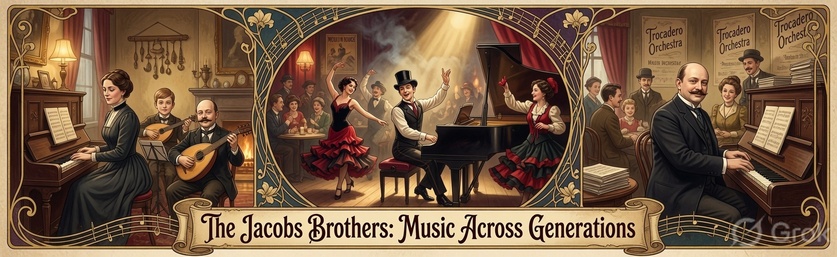
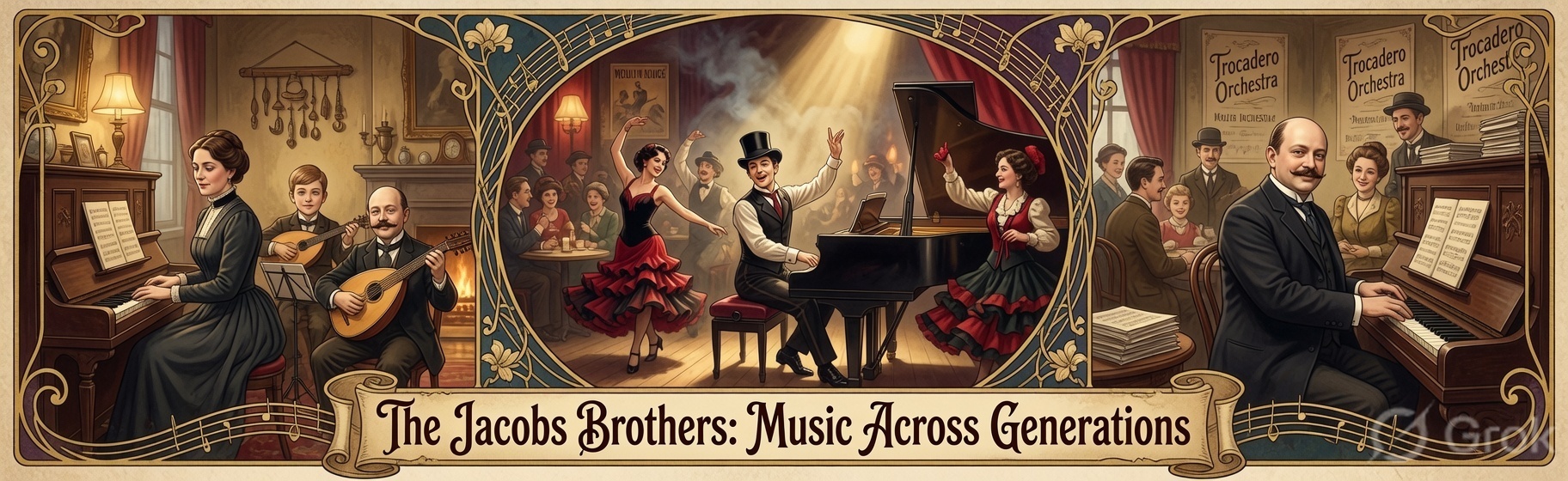
Jacques Jacobs entered the world in Amsterdam in 1872, the year his father died—a bookmaker taken by consumption before he could hold his youngest son. Raised by a mother from Hamburg, whose family breathed music, Jacques and his older brother Eduard were steeped in melody from the cradle. Eduard, the elder, shone first: a multi-instrumentalist who carried cabaret to Holland after time at the Moulin Rouge, a comedian and sharp social observer whose "Tarara Boomdie" ("There is no school today. Our teacher passed away") lingers in memory. Jacques, the violinist, followed a different path—one of quiet ambition, reinvention, and secrets that would ripple through generations.
He married Elizabeth Hurwitz, a woman four years his senior whose own father had died in that same fateful year of 1872. Together they sailed to London around 1897. There, Jacques formed the Trocadero Steak House Orchestra, becoming a fixture in the city's vibrant scene. A Freemason, he toured South Africa and Australia around 1900, mentoring the young Percy Grainger along the way. Recordings of his ensembles—light classics, popular tunes for silent films and coffee houses—survive in archives like the British Library. He produced sheet music so ordinary families could bring pop songs into their parlours. Success flowed: two children with Elizabeth, thriving businesses, orchestras accompanying the dawn of cinema.
Yet shadows gathered. While maintaining a home in Hammersmith with Elizabeth, Jacques kept a second abode with Ada—another wife in name, sharing the surname, though they had no children. Neither woman, it seems, knew of the other. They both appeared with him in censuses. Bigamy in plain sight, sustained by discretion and distance. Pre-WWI, Eduard died of exhaustion on tour in Indonesia. Jacques lost fortunes invested in airships. By the 1930s, he was in Johannesburg, reportedly commissioned to build an orchestra there.
The family fractures run deeper. Daughter Sylvia (Sarine), a free spirit who left school at 13 and worked as a telephone operator in Edinburgh, married a Catholic man. Jacques walked her down the aisle; her brother Henry, Eton-educated, played the Death March as she processed. The siblings never spoke again. Sylvia sailed to Australia with her husband, seeking work in Melbourne. Hardship followed: alleged pawned jewellery, gambling debts to the mafia, a flight to war service in the Middle East. Sylvia left him, raised three children in a house built with inheritance from her father, and remarried in 1963—listing Jacques as alive on the certificate.
Jacques himself faked his death, freeing himself from the first marriage. His estate passed to his daughter. Elizabeth returned to Amsterdam and died before WWII. Jacques emigrated to the USA with Ada. In 1949, on a cruise ship where he provided entertainment, he carried on an affair—noticed by none other than Percy Grainger, his protégé from nearly fifty years earlier, who recorded the anecdote. Jacques died at the piano in 1963, reportedly in New York City (or Brouwhuis per some records), his companion a lovechild who later went to Israel, wanting nothing to do with the broader family. Speculation lingers: did this restless soul, with his Jewish roots and global travels, play some unseen role in the early days of Israel? Nobody knows the full story of his American years.
Who do you think you are, Jacques Jacobs?
A gifted violinist who mentored giants and filled halls with music. A promoter and entrepreneur who bridged the old world and the new technologies of sound. A man of appetites—talent, ambition, women, reinvention—who lived multiple lives without fully reconciling them. A father whose legacy funded a new life in Australia for his daughter amid personal ruin, yet left bitterness and silence in its wake. A survivor who faked death rather than face the consequences of his choices, dying with secrets intact.
In an era of rigid norms, Jacques embodied the artist's freedom and its costs: family fractured, truths buried, a trail of resilient women and descendants piecing together identity from fragments. His story echoes broader themes—Jewish diaspora resilience, the glamour and grit of early 20th-century entertainment, the personal toll of ambition and moral ambiguity.
For those of us who descend from such lives, or simply reflect on them, Jacques poses a question we all face: Who do we think we are, when the full truth of our forebears is half-hidden in sheet music, ship manifests, census lies, and unwritten biographies? His music played on in parlours and picture houses long after the man slipped away. Perhaps that is legacy enough—imperfect, melodic, enduring.
Rest in the notes you left behind, Great-Grandfather. The orchestra plays on.