VoiceDDB
Politics • Culture • News
The Tragic Fall of a Habsburg Idealist
Crushed Between European Ambition and Resurgent American Power
17 hours ago
post photo preview

Editorial: The Tragic Fall of a Habsburg Idealist — Crushed Between European Ambition and Resurgent American Power

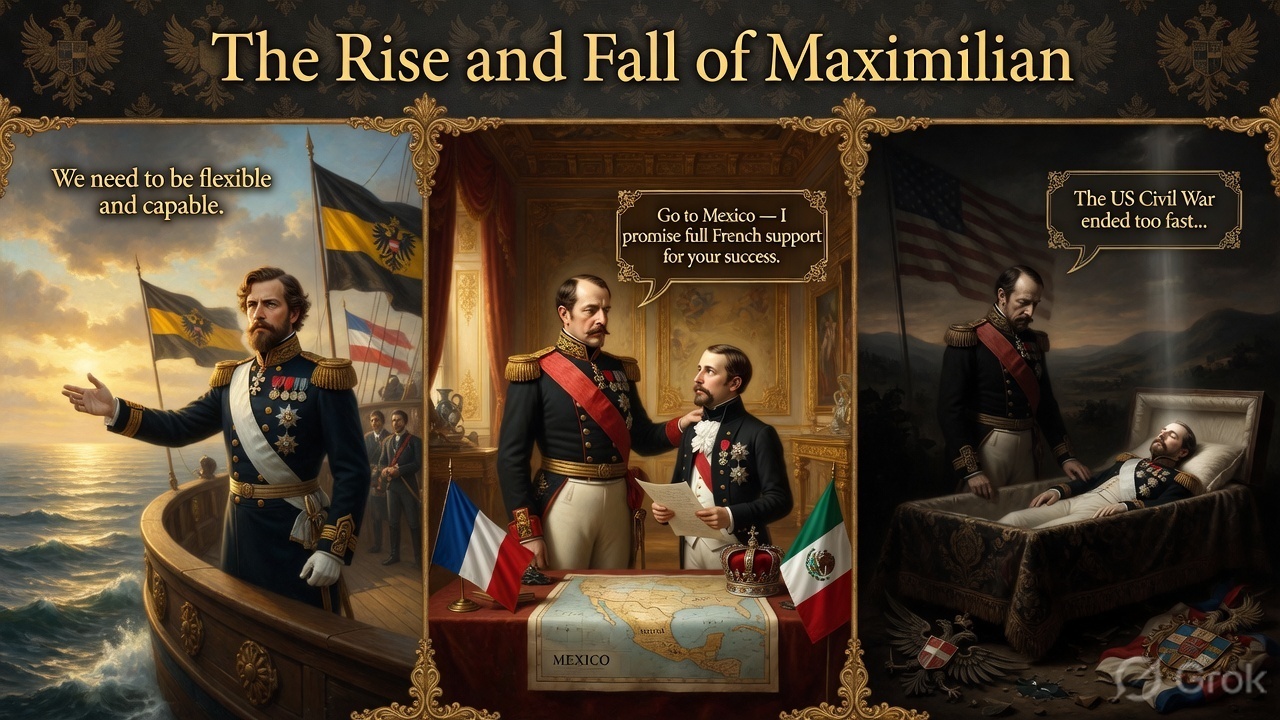
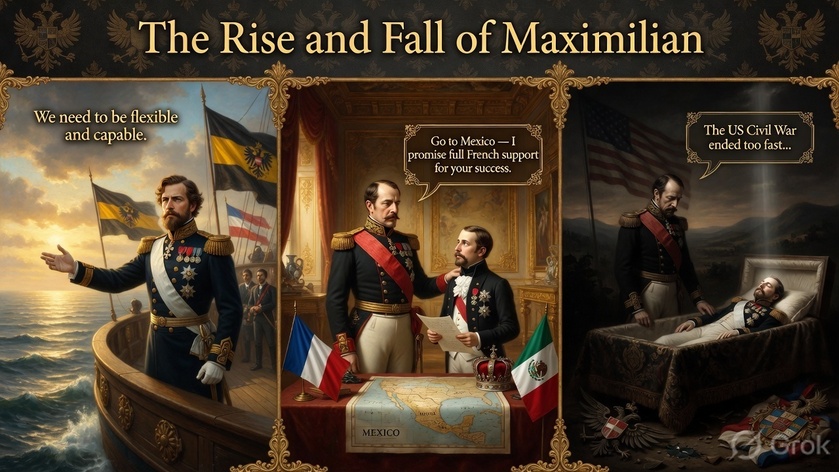
In the summer of 1867, on a dusty hill outside Querétaro, an intelligent and inquisitive European princeling faced a Mexican firing squad with remarkable dignity. Archduke Ferdinand Maximilian of Austria, installed as Emperor Maximilian I of Mexico, handed gold coins to his executioners, forgave them, and uttered his final words in Spanish: “I forgive everyone, and I ask everyone to forgive me. May my blood which is about to be spilled end the bloodshed... Long live Mexico! Long live independence!” He died not as a tyrant, but as a committed reformer abandoned by his patrons and overwhelmed by forces far larger than himself.

Maximilian’s story is one of noble intentions colliding with raw geopolitical reality. Born in 1832 into the opulent Habsburg court at Schönbrunn Palace, he received a rigorous, multifaceted education befitting his station. Hours of study mounted relentlessly, covering languages, history, law, military science, and the arts. Unlike some of his more rigid relatives, Maximilian developed a reputation for charm, liberalism, and genuine interest in reform. His upbringing instilled a deep sense of duty and paternalistic benevolence — the belief that a enlightened monarch could guide and elevate a people. These traits made him adventurous and ambitious, but also somewhat naive about the brutal realities of power politics.

Napoleon III of France saw in him the perfect figurehead for an audacious scheme. Amid Mexico’s instability and debt woes, French forces intervened, and Mexican conservatives invited Maximilian to establish the Second Mexican Empire in 1864. He accepted, arriving with his wife Carlota committed to modernization, liberal reforms, and stabilizing the country. He sought to protect peasants, curb excesses, and build something lasting — a constitutional monarchy with European flair but Mexican roots.

Yet the venture unraveled swiftly. The end of the American Civil War in 1865 freed the United States to reassert itself in the hemisphere. President Andrew Johnson’s administration invoked the Monroe Doctrine — originally a warning against European colonization — as a pretext to support Benito Juárez’s liberal republican forces. Material aid flowed to the Juaristas. Facing domestic pressures and the looming threat of wider conflict, Napoleon III withdrew French troops in 1866, leaving Maximilian exposed. What had been expensive for France became fatal for the Habsburg prince.

Maximilian refused to abandon his post. Despite offers to retreat to Europe, he remained committed to the Mexican people and the empire he had sworn to lead. Betrayed by his sponsor and outmatched by resurgent republican nationalism — bolstered by American power — his regime collapsed. Captured in Querétaro, he met his end with grace that impressed even his adversaries.

This episode reveals more than personal tragedy. It illustrates how European monarchist idealism, however well-meaning, clashed with the rising tide of 19th-century republicanism and identity-driven nationalism in the Americas. American policy, framed in lofty anti-colonial terms, effectively crushed a competing vision of governance. Maximilian’s liberalism — his reforms, his benevolence — could not overcome the perception of him as a foreign imposition. In the end, “identity politics” of a sort, wrapped in Mexican nationalism and U.S. hemispheric dominance, prevailed over the experiment.

History often remembers Maximilian as a footnote or a naive puppet. But his dignified death and sincere efforts deserve better. He was a man of his time: an inquisitive product of European courts who dared to believe enlightened rule could transcend borders and factions. The forces that crushed him — great-power maneuvering, ideological fervor, and post-war American assertiveness — reshaped the continent. In an era still wrestling with sovereignty, foreign influence, and competing models of governance, his story remains a cautionary tale of commitment meeting cold calculation. Long live the memory of those who stand by their word, even unto death.
community logo
Join the VoiceDDB Community
To read more articles like this, sign up and join my community today
0
What else you may like…
Videos
Posts
Articles
00:01:07
November 27, 2022
Jingle Bell Rock

Jingle bell, jingle bell, jingle bell rock
Jingle bells swing and jingle bells ring
Snowin' and blowin' up bushels of fun
Now the jingle hop has begun

Jingle bell, jingle bell, jingle bell rock
Jingle bells chime in jingle bell time
Dancin' and prancin' in Jingle Bell Square
In the frosty air

What a bright time, it's the right time
To rock the night away
Jingle bell time is a swell time
To go glidin' in a one-horse sleigh

Giddy-up jingle horse, pick up your feet
Jingle around the clock
Mix and a-mingle in the jinglin' feet
That's the jingle bell rock

Jingle bell, jingle bell, jingle bell rock
Jingle bell chime in jingle bell time
Dancin' and prancin' in Jingle Bell Square
In the frosty air

What a bright time, it's the right time
To rock the night away
Jingle bell time is a swell time
To go glidin' in a one-horse sleigh

Giddy-up jingle horse, pick up your feet
Jingle around the clock
Mix and a-mingle in the jinglin' feet
That's the jingle bell
That's the jingle...

00:02:04
September 01, 2021
Intro to Locals for the Conservative Voice

David Daniel Ball calls himself the Conservative Voice.

I'm a teacher with three decades experience teaching math to high school kids.I also work with first graders and kids in between first grade and high school. I know the legends of why Hypatia's dad is remembered through his contribution to Math theory. And I know the legend of why followers of Godel had thought he had disproved God's existence.

I'm not a preacher, but I am a Christian who has written over 28 books all of which include some reference to my faith. Twelve blog books on world history and current affairs, detailing world events , births and marriages on each day of the year, organised by month. Twelve books on the background to and history of Bible Quotes. One Bible quote per day for a year. An intro to a science fiction series I'm planning, post apocalyptic cyber punk. An autobiography with short story collections.

I'm known in Australia for my failure as a whistleblower over the negligence death of a school boy. ...

00:01:50
Holiday break is over back to work tonight

Tonight I'll start double posting until I've caught up.

Chinese Space Bio Labs

While Elon Musk is busy landing reusable rockets and building robot swarms on Earth, the CCP has gone full 'Musk but make it bioweapons': they're launching fleets of Starship-inspired rockets crewed by copycat Optimus robots, blasting 'Fau Chi' biolabs straight into Low Earth Orbit.

These gleaming orbital stations, proudly emblazoned with the Chinese characters 福奇 (Fú Qí — sounding suspiciously like 'Fau Chi'), are officially designated as The Science™ Research Facilities. Perfect for safe, ethical gain-of-function experiments on exciting new pathogens like TDS (Trump Derangement Syndrome), 'Last Millennia' nostalgia plagues, and the deadly 'We Are Living in 2026' variant.

The endgame? A billion trusting parents worldwide voluntarily neutering their own children on expert 'Fau Chi' advice from the heavens — because nothing says 'public health' like taking guidance from a floating Chinese biolab with reusable re-entry capabilities.

post photo preview
Editorial from 2018 for June 9th

Don't give up on hope. Western Civilisation is on the nose of universities in Australia. Sydney University collapsed in 1990, and her upper executive got replaced by ALP managerialists as Keating fought a culture war which the Liberal Party have not effectively engaged. Dame Kramer had been made Chancellor, but the Chancellor's position is not executive at Sydney University. Kramer fought effectively for Western Values, but the University, now, is as partisan left as the ABC is now. Kramer had been a powerful presence in charge of the ABC too. 

In 1990, Sydney University lost her Chancellor and Vice Chancellor. The Chancellor, Hermann David Black, died after a long illness. James Anthony Rowland, a former governor of NSW took the chancellor's position for a few years, before passing it to Kramer in 1991. She held on to 2001. From 1981 to 1990, John Manning Ward was the executive head of Sydney University as Vice Chancellor. He had been writing a trilogy on Australian conservative leaders ...

post photo preview
post photo preview
The Brief, Bright Flame of James A. Garfield
Reform, Resolve, and a Nation’s Loss

The Brief, Bright Flame of James A. Garfield: Reform, Resolve, and a Nation’s Loss

The 1876 presidential election delivered Rutherford B. Hayes to the White House through a bitterly contested compromise. In exchange for Southern Democratic acquiescence, federal troops withdrew from the South, effectively ending Reconstruction. State Republican governments collapsed, and the region solidified into a one-party Democratic stronghold. African Americans, newly freed and enfranchised, faced systematic isolation, disenfranchisement, and predation. Populism, it seemed, could accommodate such outcomes if it preserved a fragile peace.

James A. Garfield, the 20th President, represented a different Republican tradition. Elected in 1880, he entered office with greater discipline and vision than his predecessor. A Union veteran, scholar, and principled legislator, Garfield understood that the Republic’s strength depended on merit, integrity, and opportunity for all. In his short time in office—roughly 200 days—he moved decisively against the spoils system that bred corruption, particularly in the Post Office. He championed civil service reform, laying groundwork for the Pendleton Act that would follow his death. He appointed African Americans to prominent federal positions and advocated vigorously for civil rights and education, viewing an educated electorate as essential to a free and fair democracy.

Garfield’s vision was rooted in the Radical Republican commitment to the promises of emancipation. He saw the elevation of Black citizens not merely as moral duty but as national necessity—tying economic progress, political stability, and moral legitimacy together. His brief presidency signaled a potential renewal of Reconstruction-era ideals at a moment when many were ready to abandon them.

Then came the tragedy. On July 2, 1881, at a Washington train station, Charles J. Guiteau, a delusional office-seeker, shot Garfield twice from behind. Guiteau, born in Illinois to a Huguenot family, had a troubled path: academic struggles, involvement with a religious cult, failure as a lawyer, plagiarism in theology, and repeated, rejected pleas for patronage from Hayes and then Garfield. He harbored the fantasy that his meager support for Garfield’s campaign entitled him to a diplomatic post. When rebuffed—especially by Garfield’s opposition to the very corruption Guiteau embodied—he chose violence. He selected a pearl-handled revolver for its supposed historical appeal.

Garfield did not die immediately. The bullet wounds were serious but survivable with proper care. Instead, doctors repeatedly probed the wound with unsterilized hands and instruments—practices that would soon become obsolete under Listerian antisepsis. Infection set in, and after 80 agonizing days, Garfield succumbed on September 19, 1881. Guiteau’s later boast—“The doctors killed him; I only shot him”—contained a grim kernel of truth, though it did nothing to absolve him.

Guiteau’s trial featured one of the early high-profile attempts at an insanity defense in the United States. It failed. On June 30, 1882—nearly a year after the shooting—he was hanged. That morning he recited his own poem, “I am Going to the Lordy,” a childlike, repetitive hymn of delusional self-justification:

I am going to the Lordy, I am so glad... I saved my party and my land... But they have murdered me for it... Glory hallelujah! Glory hallelujah!

Guiteau was no coherent “right-wing extremist” in any modern ideological sense. He was a mentally unstable crank, a Stalwart Republican hanger-on driven by entitlement and grievance, not a principled ideologue. Labeling every disordered actor by contemporary political categories distorts more than it illuminates. His case highlighted vulnerabilities in the patronage system Garfield sought to reform and exposed gaps in medical knowledge and presidential security.

The assassination’s indirect legacies were notable. Efforts to cool Garfield’s sickroom spurred early developments in air conditioning for the U.S. Navy. Alexander Graham Bell, at the family’s request, improvised a metal detector in hopes of locating the bullet—though it was thwarted by the metal bed frame.

Garfield’s death was a profound loss. In an era of retreating federal commitment to civil rights, he stood as a bulwark for education, merit, and equality under law. His reforms and appointments pointed toward a more just Republic. The nation that mourned him soon passed civil service legislation in his name, but the fuller promise of his leadership—sustained federal protection for Black citizens and a professional, corruption-resistant government—would take generations to even partially fulfill.

James Garfield served too briefly, yet his example endures: a scholar-president who believed in disciplined governance, civil rights as national strength, and the duty to confront corruption even at personal cost. In remembering him, we confront both the fragility of progress and the enduring need for leaders willing to defend the Republic’s highest ideals against complacency and chaos alike.

Read full Article
post photo preview
How Obama's Policies Enabled North Korea's Nuclear Ambitions
and Failed Otto Warmbier

How Obama's Policies Enabled North Korea's Nuclear Ambitions and Failed Otto Warmbier

North Korea possesses nuclear weapons today in significant part due to policy choices during the Obama administration. Prior to Obama, U.S. strategy emphasized deterrence against Pyongyang's nuclear program. Successive administrations, from Clinton's Agreed Framework to Bush-era efforts, sought to prevent acquisition through diplomacy, sanctions, and pressure—often in coordination with allies and China.

China long treated North Korea (NK) as a strategic buffer and proxy. Beijing had little desire for a nuclear-armed neighbor on its border, preferring a controllable client that could be leveraged against the U.S. and its allies. When pressed on proliferation, China would point to the "mad" regime in Pyongyang and claim only it could restrain Kim's regime.

The Obama administration shifted approach. What began as engagement and "strategic patience" — including the failed 2012 Leap Day deal promising a moratorium on tests — coincided with North Korea conducting multiple nuclear tests (2009, 2013, and more) and advancing its missile capabilities. Critics argue this effectively accepted a path toward a nuclear NK, allowing the U.S. to reframe the issue as primarily China's responsibility rather than a direct U.S. confrontation. North Korea's arsenal grew markedly during Obama's tenure.

NK's nuclear program had deep roots: early Soviet assistance, followed by substantial help from Pakistan via the A.Q. Khan network, which traded uranium enrichment technology and centrifuge designs for North Korean missiles. Pakistan's role in proliferation is well-documented and predates Obama, but the broader critique ties into questions of U.S. policy coherence toward such networks.

Obama's broader foreign policy, critics contend, revived elements of Cold War dynamics. Smaller or rogue states faced pressure to align with major powers for protection. For "axis"-style regimes like NK, Iran, and Pakistan, U.S. domestic cultural signals—particularly on social issues—made alignment unappealing. Many turned toward China and its Belt and Road Initiative. This sidelined U.S. influence while reducing Washington's direct defense burdens. In NK, the regime balanced paranoia toward both external threats and its Chinese patron, maintaining internal control through purges and isolation.

North Korea's history of deception and abduction underscores its ruthlessness. In the 1970s and 1980s, it kidnapped Japanese citizens (at least 17 confirmed cases) to train spies, teach language and culture, and support espionage. When Japan demanded their return, Pyongyang admitted some abductions in 2002 but claimed most victims had died—often in implausible "car accidents" in a country with minimal traffic—or fabricated stories. Many cases remain unresolved.

This pattern of lies and hostage-taking extended to Western tourists. Americans visiting NK were rare and niche, drawn by the regime's controlled "uniqueness" at lower cost than alternatives. Otto Warmbier, a University of Virginia student, traveled there in late 2015 on a guided tour. Arrested in January 2016 for allegedly stealing a propaganda poster from his hotel, he endured a show trial, a 15-year hard labor sentence, and severe mistreatment. He was released in a comatose state in June 2017 (under the incoming Trump administration) and died days later at age 22.

The circumstances remain murky: Was Otto set up? Did a drunken prank escalate? The regime offered shifting explanations (botulism, etc.), widely doubted by U.S. doctors. No real justice was served. Otto's ordeal unfolded largely under Obama; he was effectively "dead in all but name" by the time stronger pressure and diplomacy secured his release. His family and supporters highlighted the prior administration's perceived inaction.

North Korea's leadership eliminates rivals, traffics in falsehoods, and exploits the weak. U.S. policy must prioritize deterrence, alliances, and realism over wishful engagement that emboldens tyrants. Otto Warmbier's tragic death stands as a human cost of strategic miscalculation. True accountability for such regimes demands strength, not accommodation.

Read full Article
post photo preview
Jacques Jacobs 1872 - 1963
Who do you think you are?

Who do you think you are? Jacques Jacobs 1872 - 1963

Jacques Jacobs entered the world in Amsterdam in 1872, the year his father died—a bookmaker taken by consumption before he could hold his youngest son. Raised by a mother from Hamburg, whose family breathed music, Jacques and his older brother Eduard were steeped in melody from the cradle. Eduard, the elder, shone first: a multi-instrumentalist who carried cabaret to Holland after time at the Moulin Rouge, a comedian and sharp social observer whose "Tarara Boomdie" ("There is no school today. Our teacher passed away") lingers in memory. Jacques, the violinist, followed a different path—one of quiet ambition, reinvention, and secrets that would ripple through generations.

He married Elizabeth Hurwitz, a woman four years his senior whose own father had died in that same fateful year of 1872. Together they sailed to London around 1897. There, Jacques formed the Trocadero Steak House Orchestra, becoming a fixture in the city's vibrant scene. A Freemason, he toured South Africa and Australia around 1900, mentoring the young Percy Grainger along the way. Recordings of his ensembles—light classics, popular tunes for silent films and coffee houses—survive in archives like the British Library. He produced sheet music so ordinary families could bring pop songs into their parlours. Success flowed: two children with Elizabeth, thriving businesses, orchestras accompanying the dawn of cinema.

Yet shadows gathered. While maintaining a home in Hammersmith with Elizabeth, Jacques kept a second abode with Ada—another wife in name, sharing the surname, though they had no children. Neither woman, it seems, knew of the other. They both appeared with him in censuses. Bigamy in plain sight, sustained by discretion and distance. Pre-WWI, Eduard died of exhaustion on tour in Indonesia. Jacques lost fortunes invested in airships. By the 1930s, he was in Johannesburg, reportedly commissioned to build an orchestra there.

The family fractures run deeper. Daughter Sylvia (Sarine), a free spirit who left school at 13 and worked as a telephone operator in Edinburgh, married a Catholic man. Jacques walked her down the aisle; her brother Henry, Eton-educated, played the Death March as she processed. The siblings never spoke again. Sylvia sailed to Australia with her husband, seeking work in Melbourne. Hardship followed: alleged pawned jewellery, gambling debts to the mafia, a flight to war service in the Middle East. Sylvia left him, raised three children in a house built with inheritance from her father, and remarried in 1963—listing Jacques as alive on the certificate.

Jacques himself faked his death, freeing himself from the first marriage. His estate passed to his daughter. Elizabeth returned to Amsterdam and died before WWII. Jacques emigrated to the USA with Ada. In 1949, on a cruise ship where he provided entertainment, he carried on an affair—noticed by none other than Percy Grainger, his protégé from nearly fifty years earlier, who recorded the anecdote. Jacques died at the piano in 1963, reportedly in New York City (or Brouwhuis per some records), his companion a lovechild who later went to Israel, wanting nothing to do with the broader family. Speculation lingers: did this restless soul, with his Jewish roots and global travels, play some unseen role in the early days of Israel? Nobody knows the full story of his American years.

Who do you think you are, Jacques Jacobs?

A gifted violinist who mentored giants and filled halls with music. A promoter and entrepreneur who bridged the old world and the new technologies of sound. A man of appetites—talent, ambition, women, reinvention—who lived multiple lives without fully reconciling them. A father whose legacy funded a new life in Australia for his daughter amid personal ruin, yet left bitterness and silence in its wake. A survivor who faked death rather than face the consequences of his choices, dying with secrets intact.

In an era of rigid norms, Jacques embodied the artist's freedom and its costs: family fractured, truths buried, a trail of resilient women and descendants piecing together identity from fragments. His story echoes broader themes—Jewish diaspora resilience, the glamour and grit of early 20th-century entertainment, the personal toll of ambition and moral ambiguity.

For those of us who descend from such lives, or simply reflect on them, Jacques poses a question we all face: Who do we think we are, when the full truth of our forebears is half-hidden in sheet music, ship manifests, census lies, and unwritten biographies? His music played on in parlours and picture houses long after the man slipped away. Perhaps that is legacy enough—imperfect, melodic, enduring.

Rest in the notes you left behind, Great-Grandfather. The orchestra plays on.

Read full Article
See More
Available on mobile and TV devices
google store google store app store app store
google store google store app tv store app tv store amazon store amazon store roku store roku store
Powered by Locals