In the Face of Overwhelming Odds: The Enduring Legacy of Simpson and His Donkey
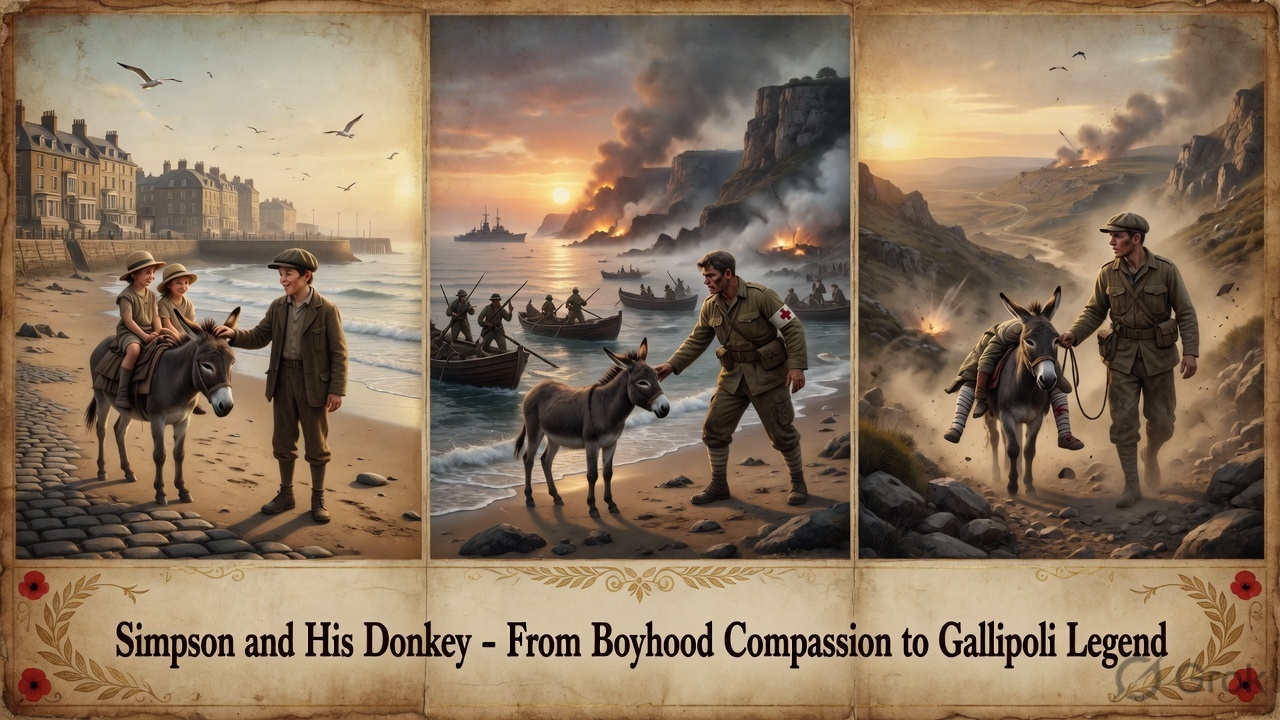
On the rugged slopes above Anzac Cove in the early hours of 25 April 1915, as thousands of Australian and New Zealand troops scrambled ashore into withering Turkish fire, a quiet act of improvisation began that would come to symbolise something far greater than any single battle. A young stretcher-bearer named John Simpson Kirkpatrick — known to history simply as Simpson — spotted stray donkeys amid the chaos. He put them to work carrying wounded men down the steep, bullet-swept gullies to the beach. For the next three and a half weeks, until a machine-gun bullet found him on 19 May, he did this again and again, day and night, under shrapnel and sniper fire.
His story, and that of his donkey, has become one of the most powerful images of the Gallipoli campaign — not because it changed the strategic outcome, but because it revealed what ordinary men can do when the odds are stacked impossibly against them.
Humble beginnings in an English port town
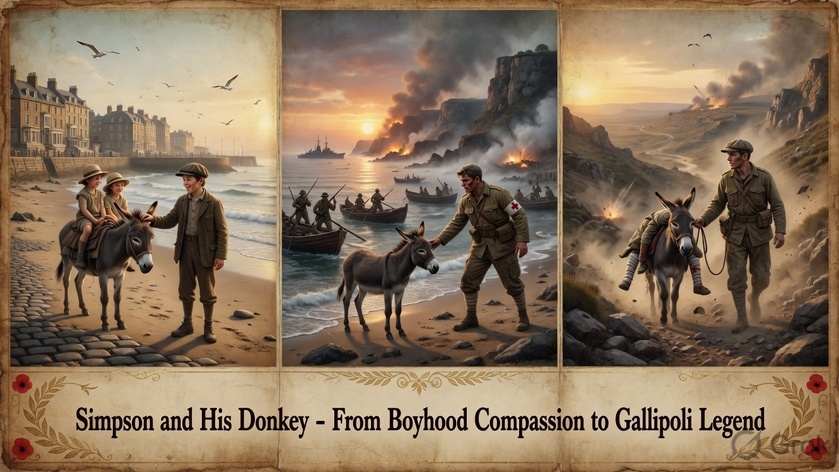
John Kirkpatrick was born on 6 July 1892 in the working-class district of Tyne Dock, South Shields, on the north-east coast of England. He was the son of a Scottish merchant seaman, Robert Kirkpatrick, and Sarah Simpson. One of eight children in a hard-pressed household, several of his siblings died young. The family knew poverty and instability. Young Jack, as he was called, attended local schools but left formal education around age twelve or thirteen. He worked first as a milk delivery boy on a horse-drawn float. During summer holidays he earned pennies leading donkey rides along the beach at Herd Sand — early, unremarkable work with the very animals that would later define his legend.
He loved animals and possessed an independent, restless streak. At sixteen he briefly trained with the Territorial Force. At seventeen he went to sea in the merchant navy. In May 1910 he deserted his ship at Newcastle, New South Wales, and began a wandering life in Australia: swagman, cane-cutter in Queensland, coal miner in the Illawarra, brief time on the Western Australian goldfields, then work as a steward, fireman and greaser on coastal vessels. He sent money home to his mother and sister whenever he could. When war came in 1914 he enlisted in the Australian Imperial Force in Perth on 23 August, giving his name as John Simpson — possibly to obscure his desertion. He was allotted to the 3rd Field Ambulance as a stretcher-bearer. He believed the war might take him back to England. Instead, it took him to Gallipoli.
Three weeks that became legend
Simpson landed at dawn on 25 April with the covering force. The terrain was brutal — steep ridges, narrow gullies like Monash Valley and Shrapnel Gully, all dominated by Turkish positions. Wounded men faced agonisingly slow carries on stretchers over broken ground while under fire. Simpson saw the donkeys — strays or abandoned — and realised they could move faster and carry more. He began leading them, often with two wounded men slung across their backs, down from the forward areas to the beach dressing stations.
He worked with cheerful determination, sometimes singing or whistling. Fellow soldiers knew him as “Simmie,” “Scotty,” or “the bloke with the donk.” Indian muleteers called him Bahadur — “bravest of the brave.” He operated with a degree of independence, sometimes camping with the Indian transport lines. Other stretcher-bearers followed his example. He was not the only one doing this work, but his visible, repeated forays under fire made him the enduring symbol of it.
Popular accounts later credited him with saving around 300 lives. Historians note that precise numbers are impossible to verify and that early propaganda inflated the figure; the physical demands of each trip make 300 in three weeks unrealistic. What is beyond dispute is that he repeatedly risked his life to speed evacuation and ease suffering when every other method was slower and more dangerous. His initiative turned available animals into lifesaving transport.
On 19 May 1915, during a major Turkish counter-attack, Simpson was shot through the heart by machine-gun fire while bringing in wounded in Monash Valley. He was twenty-two. He was buried at Beach Cemetery on the southern end of Anzac Cove. He was mentioned in despatches. Recommendations for higher awards were made but not granted — a point of later controversy, though inquiries have found no clear evidence of a formal Victoria Cross recommendation that was denied.
Sacrifice when victory is not the point
Gallipoli was a campaign conceived in grand strategic terms — to knock the Ottoman Empire out of the war and open a supply route to Russia. It failed. Poor planning, inadequate intelligence, difficult terrain, and determined Turkish defence under Mustafa Kemal turned it into a bloody stalemate. The Allies suffered enormous casualties for no lasting territorial gain and eventually evacuated in December 1915–January 1916. Yet from that military disappointment emerged one of the most powerful national stories Australia and New Zealand possess.
Simpson’s story sits at the heart of that narrative because it embodies the ANZAC qualities most often invoked: mateship, endurance, resourcefulness, and courage in the face of overwhelming odds. He did not storm trenches or win ground. He simply refused to let wounded men lie untended when a donkey and a determined man could do something about it. His sacrifice was not strategic. It was human.
History offers many examples of such stands. The 300 Spartans at Thermopylae delayed a Persian host knowing they would die. Australian militia on the Kokoda Track in 1942 held against better-trained and more numerous Japanese forces long enough for reinforcements to arrive, despite malaria, dysentery, and near-starvation. In every war, stretcher-bearers, medics, runners, and ordinary soldiers have performed similar acts of stubborn mercy or duty when the larger battle looked lost. These moments do not alter maps or treaties. They reveal character.
The broader lesson is not that sacrifice is always wise or that war is glorious. Gallipoli reminds us how easily the lives of young men can be spent by distant planners on flawed premises. Yet within that tragedy, individuals still chose to lessen suffering rather than add to it. Simpson used whatever was at hand — a stray donkey, his own legs and courage — to carry burdens that were not his. That choice, repeated daily under fire, is what turned a brief, obscure service into an enduring symbol.
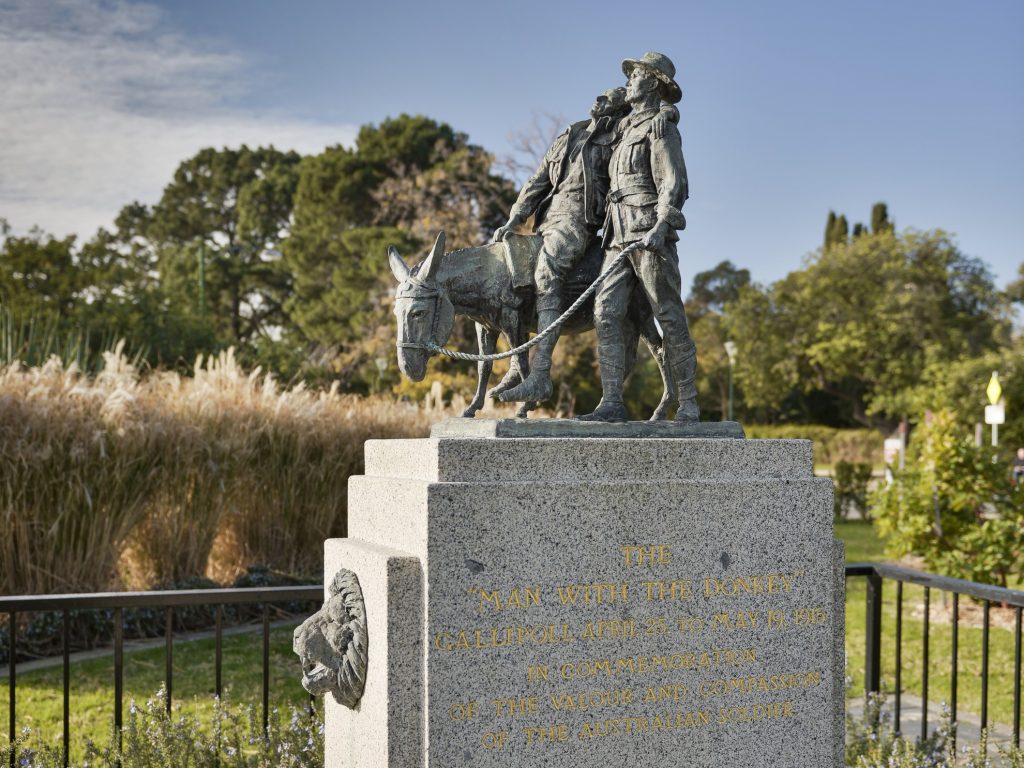
Statues now stand in Melbourne and in his birthplace of South Shields. His image appears on stamps, coins, and in countless school lessons. The legend has grown, and with it some romantic exaggeration. But the core remains true: in a place where everything was stacked against survival and success, one man kept walking into danger to bring others out.
We remember Simpson and his donkey not because they won the day at Gallipoli — they did not — but because they showed what fidelity looks like when the odds are overwhelming and the outcome uncertain. In every generation there are new gullies to cross and new wounded to carry. The question his story still poses is whether we will find the same stubborn compassion, using whatever humble means lie to hand, to do what we can when the larger battle seems already lost.
Lest we forget.