Bannockburn: Scotland’s Eternal Triumph Over Tyranny
On 23 and 24 June 1314, on the fields south of Stirling, a ragged but resolute Scottish army faced an English host that dwarfed it in numbers and equipment. Against overwhelming odds, Robert the Bruce led his countrymen to a victory that would echo through the centuries as the decisive blow for Scottish independence. It was not mere luck or brute force that carried the day, but masterful generalship, intimate knowledge of the land, and an unyielding spirit captured centuries later in Robert Burns’ immortal words: “Scots, wha hae wi’ Wallace bled, Scots, wham Bruce has aften led; Welcome to your gory bed, Or to victory!”
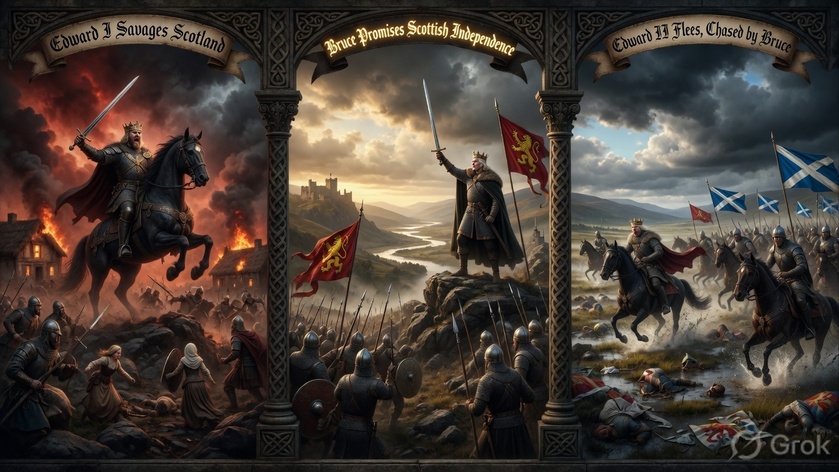
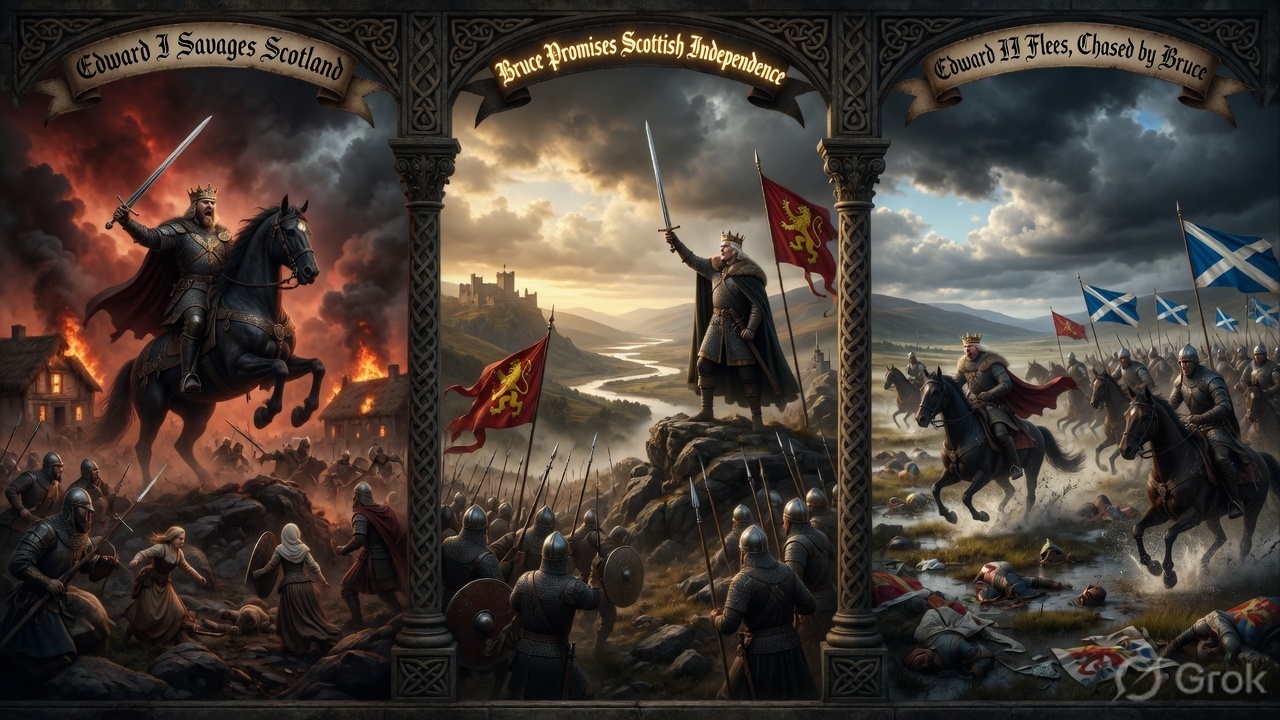
The background was one of existential struggle. Edward I had hammered Scotland into submission, but after his death, his less capable son Edward II faced a resurgent Robert the Bruce. By 1313, Bruce had cleared most English strongholds and besieged Stirling Castle. Its governor promised surrender if unrelieved by Midsummer’s Day 1314. Edward II marched north with a formidable army—estimates suggest 15,000 to 25,000 men, including heavy cavalry and Welsh archers—determined to crush the rebellion and reimpose English dominion. Bruce’s force, perhaps 5,000 to 8,000 strong, was outnumbered perhaps two-to-one or more. Yet Bruce chose his ground deliberately at the New Park, a wooded hunting preserve. He understood what his enemy did not: numbers alone do not win battles when the terrain conspires against the invader.
Bruce’s use of the landscape was nothing short of genius. He positioned his infantry in dense schiltron formations—tight blocks of spearmen nearly impenetrable to cavalry—flanked by woodland that funnelled any English advance into kill zones. His men dug pits and trenches to lame charging horses. To the east and south lay the marshy banks and waters of the Bannock Burn itself, ready to swallow the disordered foe. On the first day, as English vanguard probed forward, Bruce himself exemplified the day’s spirit in single combat, felling the charging knight Henry de Bohun with a single blow of his axe. The English were repulsed, forced to camp uncomfortably on sodden ground. Morale plummeted. A Scottish defector brought word of English disarray. Bruce seized the moment.
“Now’s the day, and now’s the hour; See the front o’ battle lour; See approach proud Edward’s power— Chains and slavery!” So Burns imagined Bruce’s rallying cry. On 24 June, the Scots advanced. English cavalry charges broke harmlessly on the Scottish pikes. When the Earl of Gloucester led a rash assault, he was cut down. Bruce’s light cavalry under Sir Robert Keith swept the English archers from the field. Hemmed in by woods, pits, and marsh, the English army disintegrated into panic. Thousands were slain or drowned in the burn; Edward II barely escaped. The numerical deficiency was overcome not by miracle, but by terrain turned into an ally and troops trained to fight as freemen rather than serfs.
This was no ordinary battle. It was the moment Scotland asserted that its people would not live under foreign chains. Bruce had transformed a guerrilla campaign into a kingdom-defining triumph. Stirling Castle fell soon after; other strongholds followed. Though full legal recognition of independence would come later—with the Declaration of Arbroath in 1320 and the Treaty of Edinburgh-Northampton in 1328—Bannockburn broke the back of English conquest. It proved that determined defenders, fighting for hearth and liberty on home soil, could humble even the mightiest feudal host.
Burns, writing in 1793 amid revolutionary ferment, captured the soul of that day perfectly. His verses thunder with defiance: “Wha will be a traitor knave? Wha can fill a coward’s grave! Wha sae base as be a slave? Let him turn and flee!” And again: “Wha for Scotland’s king and law, Freedom’s sword will strongly draw, Freeman stand, or freeman fa’, Let him follow me!” These are not mere historical reenactment; they are a call across the ages. By oppression’s woes and pains, by sons in servile chains, the Scots would drain their dearest veins—but they would be free.
The lesson of Bannockburn endures. Great odds are not destiny when leadership masters both ground and spirit. Bruce did not wait passively; he chose the battlefield, prepared the traps, inspired his men, and struck when the enemy was vulnerable. In an era of vast empires and overwhelming force, a smaller nation bent on liberty turned the land itself into a weapon. “Lay the proud usurpers low, Tyrants fall in every foe, Liberty’s in every blow!— Let us do or die!”
Today, as Scotland reflects on its past and future, Bannockburn reminds us that independence is never granted—it is seized through courage, cunning, and unity. Robert the Bruce and his warriors faced chains and slavery but chose victory or a gory bed. Their descendants, heirs to that unconquerable spirit, carry the same fire. On that blood-soaked field in 1314, Scotland did not merely survive. It declared, in deeds louder than any declaration, that it would be free. And free it became.
Let every Scot, and every friend of liberty, heed Burns’ immortal charge. The day and the hour may come again in different forms—but the spirit of Bannockburn, of Bruce and his brave hearts, remains undimmed. Let us do or die.