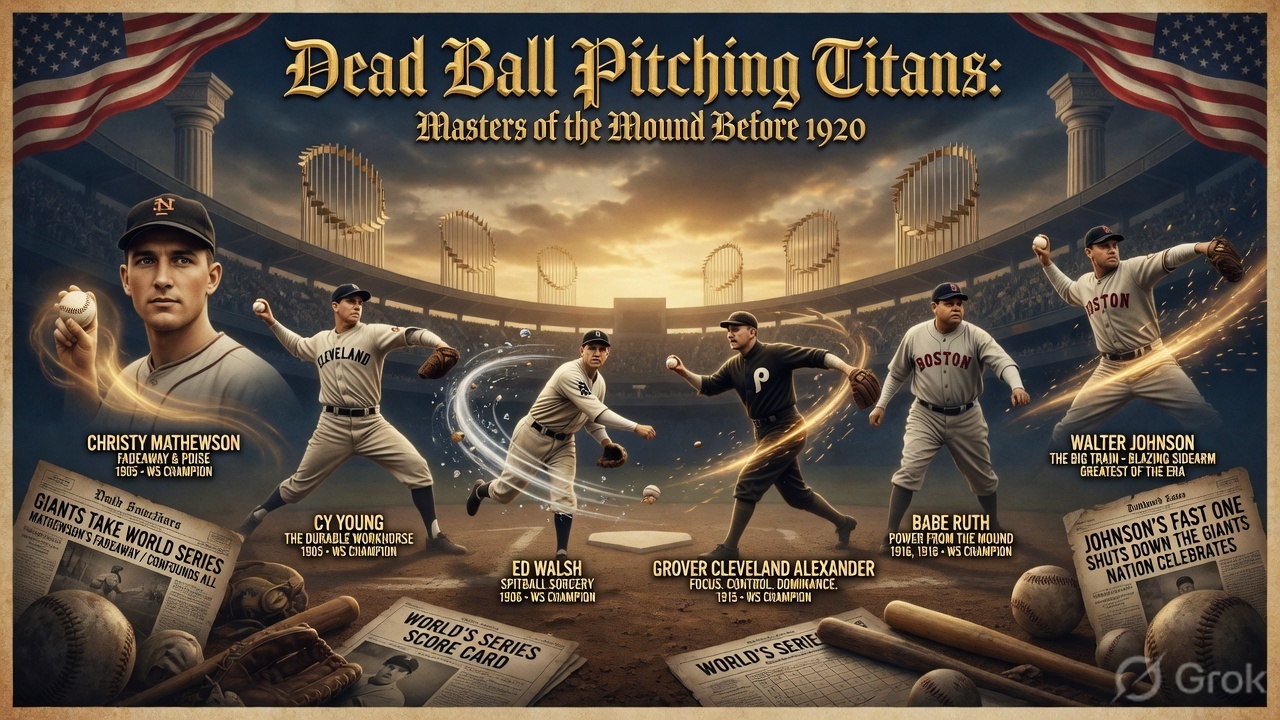
Six Great World Series Dominated by Pitchers Before 1920: When Arms, Not Bats, Decided Everything
In the Dead Ball era before 1920, baseball belonged to the pitchers. Low-scoring games, spacious parks, scuffed and reused baseballs, and the absence of frequent substitutions made complete games the norm and endurance a virtue. Offense was a grind; one dominant arm could carry a team to glory—or heartbreak. The modern World Series, which began in 1903, produced several classics where individual pitchers or staffs seized control, often deciding series almost single-handedly.
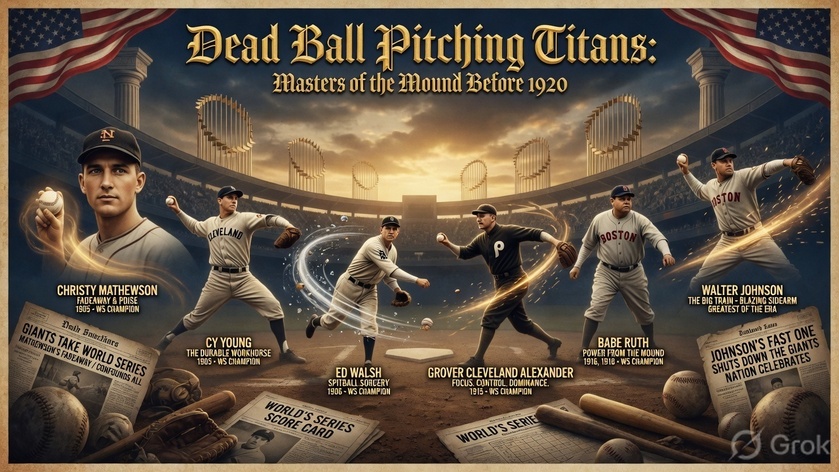
Here are six standout examples featuring (or closely involving) the legendary arms we’ve discussed—Christy Mathewson, Cy Young, Ed Walsh, Grover Cleveland Alexander, and Babe Ruth (in his pitching prime). These performances highlight not just stats, but how these hurlers shaped outcomes through mastery, stamina, and sheer will in an unforgiving era.
1. 1905 World Series: Christy Mathewson’s Triple Shutout Masterpiece (New York Giants 4, Philadelphia Athletics 1)
This remains the gold standard of pitcher-dominated World Series. Every game was a shutout. Christy “Matty” Mathewson, fresh off a Triple Crown season (31 wins, 1.28 ERA), started and completed Games 1, 3, and 5 for the Giants—three complete-game shutouts in six days. He threw 27 innings, allowed just 14 hits and one walk, and surrendered zero runs. His “fadeaway” (screwball-like pitch) baffled the Athletics’ hitters, who managed only four hits in his final start.
Mathewson’s dominance gave the Giants their first World Series title and cemented his reputation as the era’s gentlemanly ace. In a time when teams relied on one or two workhorses, Matty single-handedly tilted the series. His performance is still cited as one of the greatest individual postseason feats ever.
2. 1903 World Series: Cy Young and the Boston Pitching Staff Prevail (Boston Americans 5, Pittsburgh Pirates 3)
The very first modern World Series pitted Cy Young’s Boston Americans against a powerful Pirates squad featuring Honus Wagner. Pitching decided everything. Young went 2-1 with a 1.85 ERA across four appearances (three complete-game starts), including a key 11-2 win in Game 5 where he helped his own cause with a triple. Teammate Bill Dinneen was even more dominant in spots, pitching the clinching shutout in Game 8.
Young, already a veteran workhorse with hundreds of innings under his belt, embodied the era’s iron-man ideal. Boston’s staff outlasted Pirates ace Deacon Phillippe (who started five games due to injuries elsewhere), proving that depth and stamina could overcome star power. This series legitimized the American League and established Young as a postseason winner.
3. 1906 World Series: “Big Ed” Walsh and the “Hitless Wonders” (Chicago White Sox 4, Chicago Cubs 2)
The White Sox hit just .198 as a team yet upset the mighty Cubs thanks to elite pitching, spearheaded by spitball specialist Ed Walsh. In Game 3, Walsh delivered one of the most dominant outings in Series history: a complete-game victory with 12 strikeouts (a record at the time), allowing just two hits after the first inning in a 3-0 or low-scoring win. He struck out at least one batter in every inning.
Walsh’s mastery of the spitball—making the ball dart and drop unpredictably—frustrated the Cubs all series. He pitched multiple games and was the staff ace in an era when one pitcher’s stuff could neutralize even strong lineups. The “Hitless Wonders” nickname became legend because of arms like Walsh’s, showing how pitching could overcome offensive weakness.
4. 1915 World Series: Grover Cleveland Alexander’s Brilliance Amid Red Sox Pitching Dominance (Boston Red Sox 4, Philadelphia Phillies 1)
The Phillies, led by 31-game winner Grover Cleveland “Pete” Alexander, reached their first World Series but fell to a superior Red Sox pitching staff. Alexander started strong, winning at least one complete game and pitching effectively overall despite the loss. His stuff was elite—precise control and movement that made him a Triple Crown threat—but Boston’s rotation (including contributors like Ernie Shore and Dutch Leonard) kept the Phillies’ hitters in check.
Babe Ruth, then a young pitcher/outfielder, appeared only as a pinch-hitter in Game 1 against Alexander. The series underscored pitching’s primacy: even a future great like Alexander couldn’t overcome a deeper staff on the other side. Alexander’s individual excellence in defeat highlighted both his greatness and the brutal margins of Dead Ball baseball.
5. 1916 World Series: Babe Ruth’s Marathon Masterpiece (Boston Red Sox 4, Brooklyn Robins 1)
By 1916, Babe Ruth was already one of the American League’s best left-handed pitchers. In Game 2 against Brooklyn—a 2-1 Red Sox win that remains the longest World Series game ever played at the time—Ruth threw a complete-game 14-inning victory. He allowed just six hits and one run over 14 innings, outdueling Brooklyn’s Sherry Smith in an epic pitchers’ duel.
Ruth’s endurance and poise under pressure helped Boston secure the title. This performance (part of his strong postseason pitching résumé) foreshadowed his later greatness while proving he was already a difference-maker on the mound in the Dead Ball era. His ability to go deep into games was typical of the time but exceptional in execution.
6. 1918 World Series: Babe Ruth’s Scoreless Streak and Dual Threat (Boston Red Sox 4, Chicago Cubs 2)
Ruth’s final great pitching stand came in 1918. He won Game 1 with a 1-0 shutout and returned in Game 4 for another victory. Across the 1916 and 1918 World Series, he threw 29⅔ consecutive scoreless innings—a record that stood until Whitey Ford broke it in 1961. He also contributed with the bat as the Red Sox transitioned him toward the outfield.
In a shortened wartime season, Ruth’s arm (and growing power) helped deliver Boston’s last World Series title until 2004. His versatility embodied the era’s demands: pitchers who could also hit were invaluable. This series marked the end of Ruth’s primary pitching days but cemented his legend as a complete force.
These six World Series capture the essence of pre-1920 baseball: gritty, low-scoring battles where a single pitcher’s dominance—or a staff’s collective excellence—could define legacies. Mathewson’s precision and fadeaway, Young’s workhorse reliability, Walsh’s unhittable spitball, Alexander’s near-perfection even in defeat, and Ruth’s emerging two-way brilliance all shine here. They didn’t just win games; they shaped how we remember the Dead Ball era—as a time when arms ruled and one great performance could echo for generations.
As the Live Ball era dawned with Ruth’s home-run explosion and rule changes favoring offense, these pitchers’ feats became benchmarks of a bygone, pitcher-centric golden age. Their stories remind us that baseball’s greatest drama has always come from the mound.