Editorial: American Greatness Exemplified by the United States Marine Corps
In the annals of military history, few institutions embody the spirit of American resolve, ingenuity, and unyielding commitment to liberty like the United States Marine Corps. From its founding on November 10, 1775, the Marines have stood as sentinels of freedom—first to fight, always faithful, and forever guardians of the nation's honor. Their story is not merely one of battles won but of American greatness forged in fire: a testament to citizen-soldiers who crossed oceans, stormed beaches, and raised the Stars and Stripes amid the chaos of war, proving time and again that the American experiment produces men and women of extraordinary courage.
The Marine Corps Hymn captures this ethos perfectly. Its stirring verses—"From the Halls of Montezuma to the Shores of Tripoli"—trace a legacy of global service, referencing the 1847 Battle of Chapultepec in the Mexican-American War and the 1805 Battle of Derna in the First Barbary War. The hymn declares: "We fight our country's battles / On the land as on the sea. / First to fight for right and freedom / And to keep our honor clean." It concludes with a bold claim of eternal vigilance: if the Army and Navy ever reach heaven, "They will find the streets are guarded / By United States Marines." Born from 19th-century traditions and set to music with roots in European opera, the hymn is more than a song—it is a creed of expeditionary excellence and proud independence.
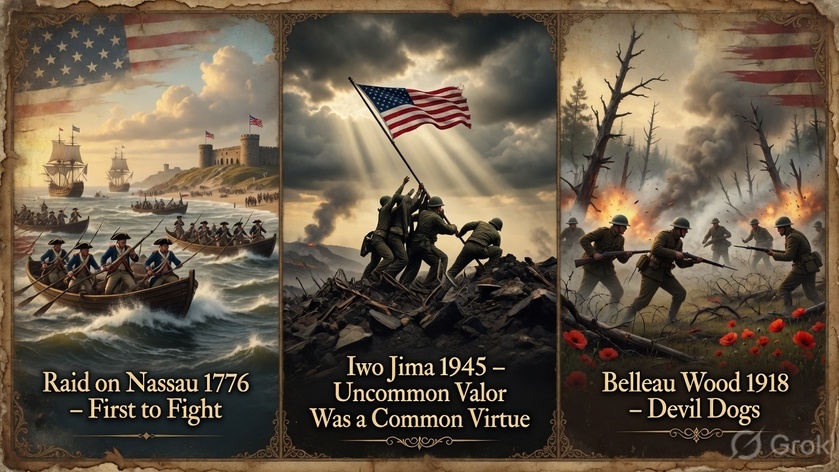
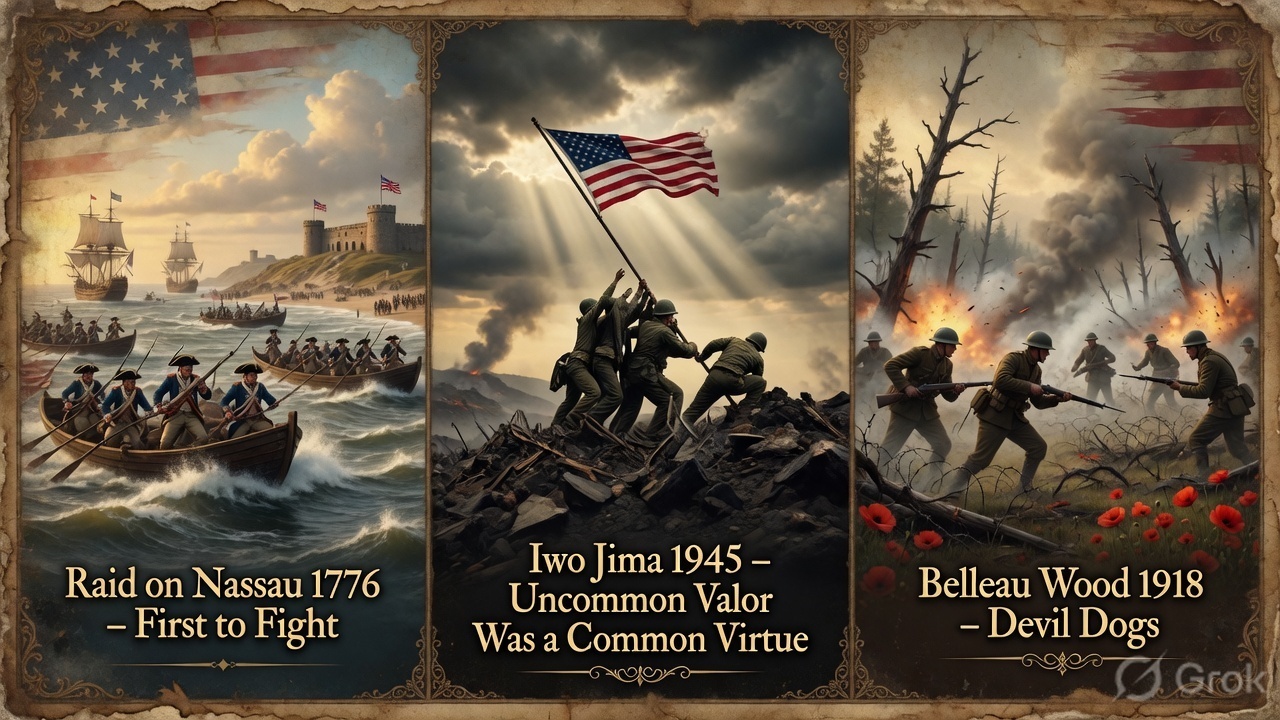
The Corps' greatest successes began in the fires of the American Revolution. Authorized by the Continental Congress, the Continental Marines conducted early amphibious raids, including the daring 1776 assault on Nassau in the Bahamas—the first of its kind for American forces. Disbanded after independence, they were reborn in 1798, proving their enduring value in a young republic wary of standing armies.
Throughout the 19th century, Marines honed their reputation in expeditionary operations. The Barbary Wars secured American commerce against piracy, while actions in Mexico and beyond extended U.S. influence. But it was the 20th century that showcased their evolution into masters of modern warfare.
In World War I, the Battle of Belleau Wood (1918) saw Marines earn the fearsome German nickname "Devil Dogs" through ferocious close-quarters combat that helped blunt a major enemy offensive. Their stand exemplified American doughboys' arrival as a decisive force on the Western Front.
World War II became the Corps' defining epic. Marines led the Pacific island-hopping campaign, turning the tide against Imperial Japan through unprecedented amphibious operations. From Guadalcanal—the first major U.S. offensive, which stopped Japanese expansion—to the brutal fights at Tarawa, Saipan, and Okinawa, Marines adapted, innovated, and prevailed against a fanatical foe.
Iwo Jima stands as a harrowing monument to their sacrifice and a stark preview of what invading the Japanese home islands would entail. In February-March 1945, roughly 70,000 Marines assaulted a heavily fortified 8-square-mile volcanic rock. Nearly 7,000 Americans were killed and over 20,000 wounded in 36 days of hellish fighting against dug-in defenders. The iconic flag-raising on Mount Suribachi, captured by photographer Joe Rosenthal, became an enduring symbol of American determination. Iwo Jima provided critical airfields for B-29 bombers and emergency landings, saving thousands of airmen—but its cost underscored the nightmare awaiting a full invasion of Japan (Operation Downfall). Japanese forces, fighting on their own soil with civilian mobilization, would have inflicted catastrophic casualties.
Japan absorbed the devastation of two atomic bombs—Hiroshima on August 6 and Nagasaki on August 9, 1945—yet held out until the Soviet Union's declaration of war and invasion of Manchuria shattered any remaining strategic hopes. The Emperor's surrender announcement on August 15 followed this dual shock, averting what could have been history's bloodiest invasion. The Marines' valor at Iwo Jima and elsewhere bought the time and positioning that helped force that outcome without the projected million-plus Allied casualties.
Subsequent successes in Korea (notably the Chosin Reservoir breakout), Vietnam, the Gulf War (liberating Kuwait), and operations in Iraq and Afghanistan further demonstrated the Corps' versatility—from conventional battles to counterinsurgency and rapid crisis response. Their ability to project power globally has repeatedly advanced American ideals of freedom and deterred aggression.
The Marine Corps exemplifies American greatness not through conquest for its own sake, but through disciplined force in service of higher principles: defending the homeland, protecting allies, and upholding a republic where individual liberty and collective resolve triumph over tyranny. In an era of uncertainty, the Few and the Proud remind us what disciplined, courageous Americans can achieve. They do not seek glory, but they earn it daily. Semper Fi.
From the Halls of Montezuma to distant shores today, the Marines continue to guard the frontiers of freedom.