VoiceDDB
Politics • Culture • News
James Madison
America’s Last Founding Father – A Life of Principle, Partnership, and Perseverance
5 hours ago
post photo preview
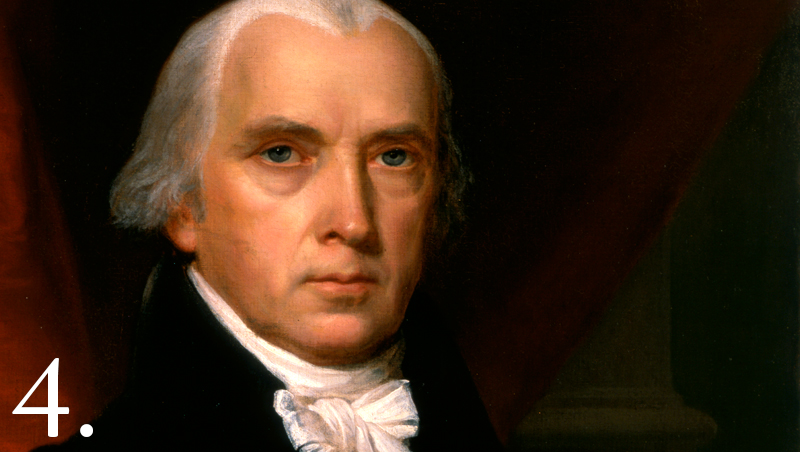
James Madison – The White House

James Madison: America’s Last Founding Father – A Life of Principle, Partnership, and Perseverance

On June 28, 1836, James Madison breathed his last at Montpelier, his Virginia plantation home. With his passing, the United States lost its final living link to the revolutionary generation that birthed the republic. Madison, the fourth President and the man history rightly calls the Father of the Constitution, stood as the last Founding Father. His life offers enduring lessons in intellectual courage, steadfast friendship, resilient leadership, and the quiet power of complementary partnerships—especially with his remarkable wife, Dolley.
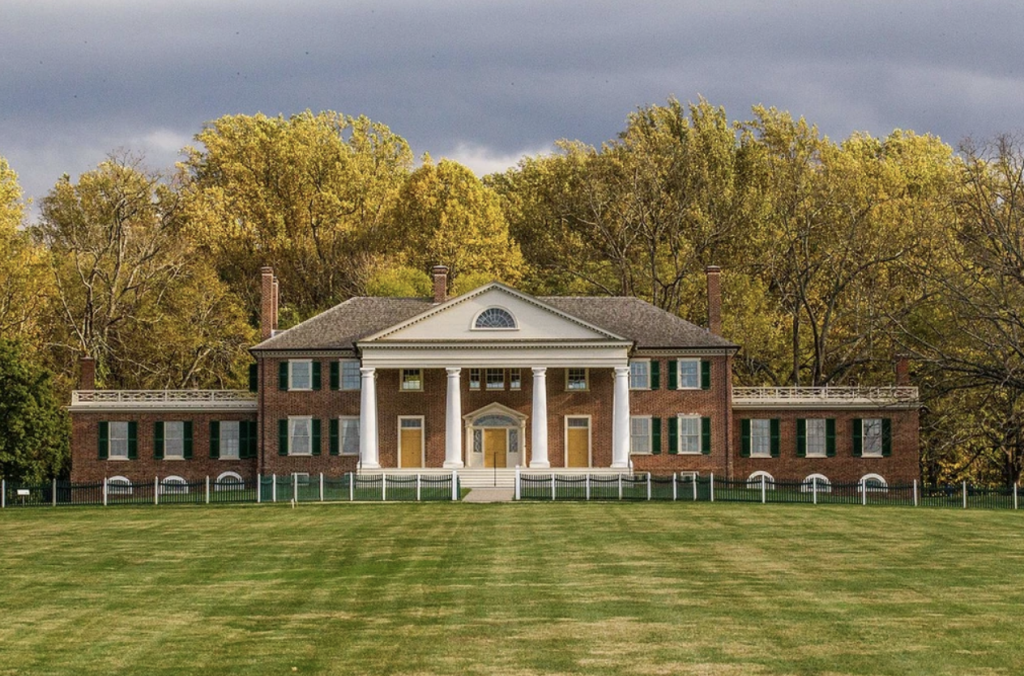
Step Into History: James Madison's Montpelier · Visit Orange County Virginia

Childhood Lessons: The Making of a Scholar-Statesman Born in 1751 into a wealthy Virginia planter family, young “Jemmy” Madison grew up amid the rhythms of plantation life at what would become Montpelier. Often sickly and frail, he could not join his peers in the rough outdoor pursuits of hunting or frontier adventuring. Instead, he turned inward—to books, ideas, and rigorous study.

Under the tutelage of Scottish teacher Donald Robertson and later at the College of New Jersey (Princeton), Madison absorbed the Enlightenment’s emphasis on reason, liberty, and ordered government. These early years taught him the supreme value of education, disciplined thought, and a deep respect for republican institutions. They also exposed him to the realities of a slaveholding society, planting seeds of moral tension he would grapple with throughout his life. From this quiet, studious boy emerged a man who would shape the fundamental law of a nation.

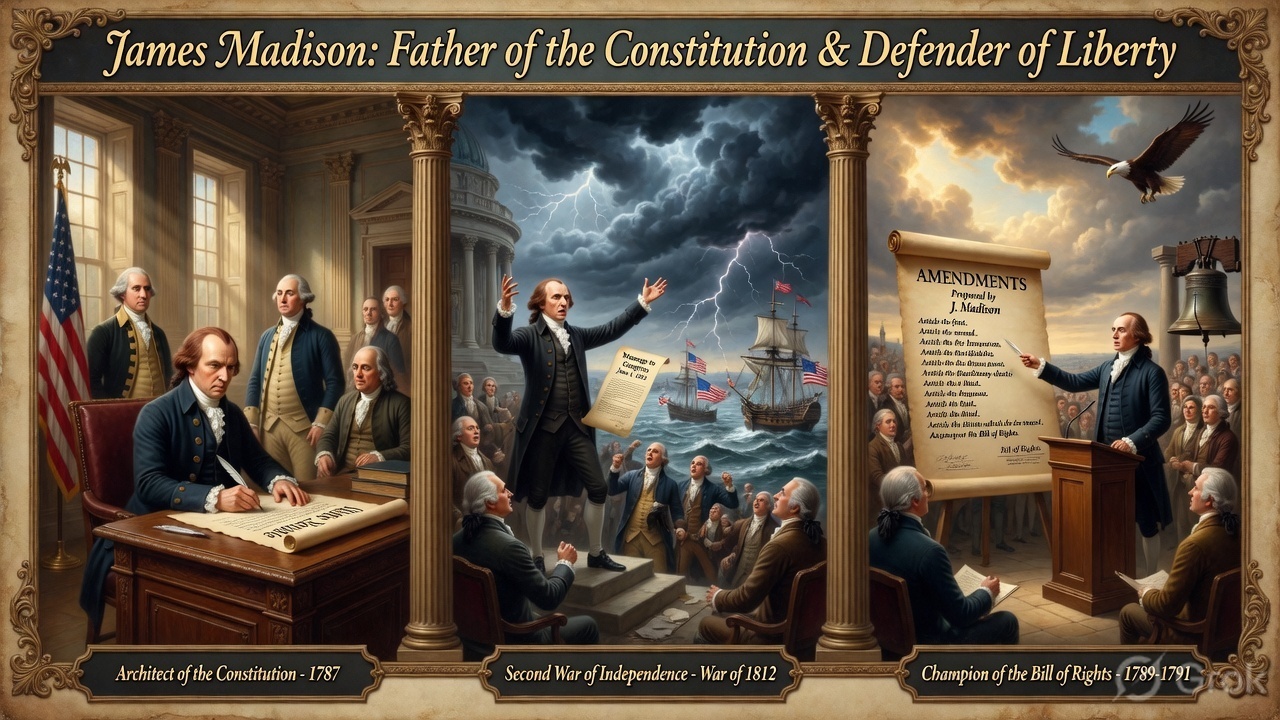
Father of the Constitution and Champion of the Bill of Rights No single individual deserves greater credit for the U.S. Constitution than James Madison. At the 1787 Constitutional Convention, his Virginia Plan provided the essential blueprint for a stronger national government with separated powers and checks and balances. He kept the most detailed notes of the proceedings—our primary window into the Founders’ debates—and fought tirelessly for ratification.

Together with Alexander Hamilton and John Jay, he authored the Federalist Papers, the brilliant defense of the new Constitution. Yet Madison’s deepest allegiance was not to Hamilton’s vision of centralized finance and power, but to his lifelong friend and political soulmate, Thomas Jefferson. Their partnership forged the Democratic-Republican Party and defended agrarian republicanism against what they saw as Federalist overreach.

Madison’s commitment to liberty extended further: as a member of the First Congress, he introduced and championed the Bill of Rights—the first ten amendments that safeguard individual freedoms and limit government. Without Madison, the Constitution might never have been ratified, and the Bill of Rights might never have existed.

The Presidency: A Second War of Independence When Madison assumed the presidency in 1809, the young nation faced renewed threats from Britain—impressment of sailors, trade interference, and incitement of Native American resistance. Diplomatic efforts failed. In 1812, Madison asked Congress to declare war. The conflict became America’s second war of independence.

Though early campaigns faltered and British troops burned Washington, D.C., American resilience prevailed. Victories at Lake Champlain, the Thames, and New Orleans—coupled with the Treaty of Ghent—affirmed U.S. sovereignty. Madison emerged more convinced than ever of the need for a stronger federal government to defend the nation.

In the war’s aftermath, he supported the creation of the Second Bank of the United States to stabilize the economy and backed the Tariff of 1816 to protect emerging American industry. These pragmatic measures showed a statesman willing to adapt principles to preserve the republic he helped create.

Biography of Dolley Madison, Bipartisan First Lady

The Complementary Partnership: James and Dolley Madison Behind every great man stands a great woman—and Dolley Madison was extraordinary. Married in 1794, the couple formed a perfect political and personal partnership. Where James was reserved, soft-spoken, and intellectually intense, Dolley was outgoing, gracious, and socially masterful. She hosted legendary dinners and gatherings that built coalitions and eased tensions in the young capital.

During the British advance on Washington in 1814, Dolley famously saved priceless White House artifacts—including the famous portrait of George Washington—before fleeing. Her courage and quick thinking became legendary. Together, James and Dolley demonstrated that effective leadership often requires both profound thought and warm human connection. Their marriage was a model of mutual respect and shared purpose that strengthened the nation.

Enduring Legacy James Madison’s life teaches us that republics are not preserved by charisma alone, but by intellectual rigor, principled compromise, enduring friendships, and the quiet strength of devoted partnerships. As the last Founding Father, he reminds us that the Constitution is not a relic but a living framework that demands constant defense—through education, vigilance, and wise leadership.

In an age of division and short-term thinking, Madison’s example calls us back to the fundamentals: a government of laws, not men; a commitment to liberty secured by ordered liberty; and the recognition that strong nations are built by those who think deeply, fight bravely when necessary, and stand by their principles and their friends.

America’s last Founding Father left us more than a Constitution and a Bill of Rights. He left a model of statesmanship worth emulating. Let us honor that legacy by cherishing the republic he helped secure.

community logo
Join the VoiceDDB Community
To read more articles like this, sign up and join my community today
0
What else you may like…
Videos
Posts
Articles
00:01:07
November 27, 2022
Jingle Bell Rock

Jingle bell, jingle bell, jingle bell rock
Jingle bells swing and jingle bells ring
Snowin' and blowin' up bushels of fun
Now the jingle hop has begun

Jingle bell, jingle bell, jingle bell rock
Jingle bells chime in jingle bell time
Dancin' and prancin' in Jingle Bell Square
In the frosty air

What a bright time, it's the right time
To rock the night away
Jingle bell time is a swell time
To go glidin' in a one-horse sleigh

Giddy-up jingle horse, pick up your feet
Jingle around the clock
Mix and a-mingle in the jinglin' feet
That's the jingle bell rock

Jingle bell, jingle bell, jingle bell rock
Jingle bell chime in jingle bell time
Dancin' and prancin' in Jingle Bell Square
In the frosty air

What a bright time, it's the right time
To rock the night away
Jingle bell time is a swell time
To go glidin' in a one-horse sleigh

Giddy-up jingle horse, pick up your feet
Jingle around the clock
Mix and a-mingle in the jinglin' feet
That's the jingle bell
That's the jingle...

00:02:04
September 01, 2021
Intro to Locals for the Conservative Voice

David Daniel Ball calls himself the Conservative Voice.

I'm a teacher with three decades experience teaching math to high school kids.I also work with first graders and kids in between first grade and high school. I know the legends of why Hypatia's dad is remembered through his contribution to Math theory. And I know the legend of why followers of Godel had thought he had disproved God's existence.

I'm not a preacher, but I am a Christian who has written over 28 books all of which include some reference to my faith. Twelve blog books on world history and current affairs, detailing world events , births and marriages on each day of the year, organised by month. Twelve books on the background to and history of Bible Quotes. One Bible quote per day for a year. An intro to a science fiction series I'm planning, post apocalyptic cyber punk. An autobiography with short story collections.

I'm known in Australia for my failure as a whistleblower over the negligence death of a school boy. ...

00:01:50
Holiday break is over back to work tonight

Tonight I'll start double posting until I've caught up.

Chinese Space Bio Labs

While Elon Musk is busy landing reusable rockets and building robot swarms on Earth, the CCP has gone full 'Musk but make it bioweapons': they're launching fleets of Starship-inspired rockets crewed by copycat Optimus robots, blasting 'Fau Chi' biolabs straight into Low Earth Orbit.

These gleaming orbital stations, proudly emblazoned with the Chinese characters 福奇 (Fú Qí — sounding suspiciously like 'Fau Chi'), are officially designated as The Science™ Research Facilities. Perfect for safe, ethical gain-of-function experiments on exciting new pathogens like TDS (Trump Derangement Syndrome), 'Last Millennia' nostalgia plagues, and the deadly 'We Are Living in 2026' variant.

The endgame? A billion trusting parents worldwide voluntarily neutering their own children on expert 'Fau Chi' advice from the heavens — because nothing says 'public health' like taking guidance from a floating Chinese biolab with reusable re-entry capabilities.

post photo preview
Editorial from 2018 for June 9th

Don't give up on hope. Western Civilisation is on the nose of universities in Australia. Sydney University collapsed in 1990, and her upper executive got replaced by ALP managerialists as Keating fought a culture war which the Liberal Party have not effectively engaged. Dame Kramer had been made Chancellor, but the Chancellor's position is not executive at Sydney University. Kramer fought effectively for Western Values, but the University, now, is as partisan left as the ABC is now. Kramer had been a powerful presence in charge of the ABC too. 

In 1990, Sydney University lost her Chancellor and Vice Chancellor. The Chancellor, Hermann David Black, died after a long illness. James Anthony Rowland, a former governor of NSW took the chancellor's position for a few years, before passing it to Kramer in 1991. She held on to 2001. From 1981 to 1990, John Manning Ward was the executive head of Sydney University as Vice Chancellor. He had been writing a trilogy on Australian conservative leaders ...

post photo preview
post photo preview
The Hyperspace MacGuffin
From 19th-Century Math to Science Fiction Staple

The Hyperspace MacGuffin: From 19th-Century Math to Science Fiction Staple

In the grand tradition of storytelling, few devices have proven as enduringly useful as the MacGuffin—that plot-driving element characters obsess over while audiences simply ride along for the thrills. Alfred Hitchcock popularized the term, but science fiction claimed one of its most versatile examples: hyperspace. What began as a precise mathematical concept in the 1800s morphed, within decades of Einstein's special relativity (1905), into the go-to shortcut for faster-than-light travel, translocation, and galactic adventure. It is a perfect MacGuffin: essential to the plot, vaguely scientific-sounding, yet largely irrelevant in its details.

Hyperspace originated in 19th-century mathematics as a synonym for spaces of more than three dimensions. Think of a tesseract: the "shadow" or projection of a four-dimensional cube, much as a cube casts a square shadow in two dimensions. Mathematicians exploring non-Euclidean geometry and higher-dimensional manifolds used "hyperspace" to describe these abstract realms. It was rigorous, academic, and far removed from adventure tales.

Then came Einstein, who established the cosmic speed limit of light. Science fiction writers, undeterred, needed a narrative workaround. Hyperspace filled the void beautifully. By the 1930s it was appearing in pulp magazines, and it quickly spread. Robert Heinlein and Isaac Asimov wielded it deftly—Heinlein in tales of exploration and engineering, Asimov in his Foundation and Robot universes where it enabled galactic empires. Television embraced it too: The Tomorrow People treated hyperspace as a psychic or technological realm for instantaneous translocation, while Doctor Who bent it into the fabric of the TARDIS's improbable journeys. Anne McCaffrey's Dragonriders of Pern series used it for "between," a cold, interstitial space dragons traversed for teleportation. In Star Trek and especially Star Wars, it became the highway for hyperdrives, allowing ships to slip past Einstein's barrier and span the stars.

As a MacGuffin, hyperspace excels because writers need not explain how it works in detail. Characters punch coordinates, dodge "mass shadows," or endure the disorientation of jumps, and the story races forward. The audience cares about the peril, the discovery, or the human drama—not the physics. Much like the mysterious papers in a Hitchcock thriller, hyperspace is "the thing the characters worry about, but the audience doesn't."

This reflects a deeper truth about science fiction. The genre rarely predicts the future with precision. Classic works lack self-driving cars, stable AI companions, Optimus-style robots, Neuralink brain interfaces, Boring Company tunnels, Starlink connectivity, or SpaceX reusability. Heinlein's Tunnel in the Sky captures something more timeless: ordinary people thrust into extraordinary circumstances by one leap in a single field. Science fiction thrives not by mirroring "now," but by asking "what if?"

And some "what ifs" remain hauntingly plausible. Consider our expanding universe. As space stretches indefinitely, matter grows ever more isolated. Galaxies recede beyond each other's light horizons. In the far future, after stars die and black holes evaporate, what happens when particles are so distant that local conditions mimic the extreme density and low entropy of a primordial state? Could quantum fluctuations or thermodynamic recurrences spark localized "Big Bangs," birthing new universes in the ashes of the old? These bubble universes might exist side by side, separated by distances so vast that light never bridges them—echoing Poul Anderson's Tau Zero, where relativistic effects and cosmic scales render the crew eternal wanderers through an evolving cosmos.

Modern cosmology toys with eternal inflation, where our Big Bang is one of many in a multiverse, and higher-dimensional theories (string theory's branes and Calabi-Yau spaces) that would feel familiar to those 19th-century mathematicians. Hyperspace, once abstract math, now feels like an intuitive shorthand for ideas at the edge of physics: warped extra dimensions, shortcuts through spacetime, or realms beyond our observable horizon.

Old science fiction rarely gets the technology right, but it often captures the wonder—and the audacity—of pushing against limits. Hyperspace endures not because it is scientifically accurate, but because it lets us dream of transcending barriers. As we probe dark energy, cosmic expansion, and the universe's ultimate fate, that 19th-century word reminds us: the best MacGuffins don't just drive plots. They propel imagination across centuries.

— David Daniel Ball

Read full Article
post photo preview
John Adams
The Conservative Founder Who Presaged the GOP
John Adams: The Conservative Founder Who Presaged the GOP
In an era of revolutionary fervor and partisan strife, John Adams stood as a bulwark of principled conservatism—a man who championed liberty tempered by order, strength through preparedness, and moral consistency over fleeting popularity. As America's second president and a towering Founding Father, Adams embodied values that would later define the Republican Party: a strong national defense, fiscal responsibility rooted in frugality, skepticism of radical upheaval, and an unwavering commitment to republican institutions. Unlike many of his contemporaries, Adams never owned slaves, a testament to his personal integrity and rejection of that peculiar institution long before it divided the nation.
Adams' partnership with his wife, Abigail Adams, remains a model of collaborative leadership. Far from a passive spouse, Abigail was his intellectual equal and trusted advisor. Their extensive correspondence reveals a man who relied on her keen insights on politics, morality, and governance. In an age when women's voices were often sidelined, Adams elevated theirs, demonstrating that true conservatism values stable families and the wisdom found in enduring partnerships.
One of Adams' greatest contributions came early: he signed the Declaration of Independence and encouraged Thomas Jefferson to draft it, serving as its primary advocate in Congress. While radicals pushed for hasty action, Adams counseled deliberate resolve. He understood that independence required not just passion but a firm foundation in law and reason. This caution amid crisis defined his career. When many might have panicked into full-scale war with revolutionary France during the Quasi-War, Adams pursued diplomacy first while preparing for defense—prioritizing American neutrality and sovereignty over entanglement in European chaos.
His administration strengthened the foundations of American power. Adams oversaw the buildup of the Army and Navy, and on July 11, 1798, he signed the act re-establishing the United States Marine Corps as a permanent force amid threats to U.S. shipping. This "Godfather of the Marines" action, alongside creating the Department of the Navy, laid the groundwork for a professional military focused on protecting commerce and deterring aggression—hallmarks of conservative realism that echo in modern GOP emphasis on peace through strength.
Adams' Federalist vision emphasized a balanced government with checks and powers to prevent tyranny or mob rule. He distrusted unchecked democracy and radical experiments, favoring institutions that preserved virtue, education, and the rule of law. These ideas presage core Republican principles: limited but energetic government, defense of the Constitution, and resistance to foreign influence or ideological excess. His decision to keep much of Washington's cabinet and resist party purges reflected a conservatism of continuity and national interest over factionalism.
The Alien and Sedition Acts, were controversial but these must be viewed in context—a response to real threats of subversion during wartime tensions. Now, these acts still are active, but vastly watered down, or applied for partisan political results. Adams ultimately prioritized peace, negotiating an end to the Quasi-War that secured honorable relations with France without conquest or overreach.
In retirement, Adams reconciled with Jefferson, their letters a profound exchange on liberty and governance. He died on July 4, 1826—the 50th anniversary of the Declaration he helped birth—his son John Quincy later continuing the family legacy of public service.
Today, as conservatives grapple with global threats, cultural shifts, and the need for prudent leadership, John Adams offers a timeless example. He was no firebrand seeking glory but a steady hand who built enduring institutions, valued family counsel, rejected moral compromise on slavery, and prepared the nation for strength without unnecessary war. The GOP prosper as Trump lives this example, when other GOP oppose. Adams is not as a distant icon, but a guiding spirit for a party committed to liberty, order, and American greatness. In honoring Adams, we honor the cautious wisdom that made the American experiment possible.
Read full Article
post photo preview
American Greatness Exemplified by the United States Marine Corps
Semper Fi

Editorial: American Greatness Exemplified by the United States Marine Corps

In the annals of military history, few institutions embody the spirit of American resolve, ingenuity, and unyielding commitment to liberty like the United States Marine Corps. From its founding on November 10, 1775, the Marines have stood as sentinels of freedom—first to fight, always faithful, and forever guardians of the nation's honor. Their story is not merely one of battles won but of American greatness forged in fire: a testament to citizen-soldiers who crossed oceans, stormed beaches, and raised the Stars and Stripes amid the chaos of war, proving time and again that the American experiment produces men and women of extraordinary courage.

The Marine Corps Hymn captures this ethos perfectly. Its stirring verses—"From the Halls of Montezuma to the Shores of Tripoli"—trace a legacy of global service, referencing the 1847 Battle of Chapultepec in the Mexican-American War and the 1805 Battle of Derna in the First Barbary War. The hymn declares: "We fight our country's battles / On the land as on the sea. / First to fight for right and freedom / And to keep our honor clean." It concludes with a bold claim of eternal vigilance: if the Army and Navy ever reach heaven, "They will find the streets are guarded / By United States Marines." Born from 19th-century traditions and set to music with roots in European opera, the hymn is more than a song—it is a creed of expeditionary excellence and proud independence.

The Corps' greatest successes began in the fires of the American Revolution. Authorized by the Continental Congress, the Continental Marines conducted early amphibious raids, including the daring 1776 assault on Nassau in the Bahamas—the first of its kind for American forces. Disbanded after independence, they were reborn in 1798, proving their enduring value in a young republic wary of standing armies.

Throughout the 19th century, Marines honed their reputation in expeditionary operations. The Barbary Wars secured American commerce against piracy, while actions in Mexico and beyond extended U.S. influence. But it was the 20th century that showcased their evolution into masters of modern warfare.

In World War I, the Battle of Belleau Wood (1918) saw Marines earn the fearsome German nickname "Devil Dogs" through ferocious close-quarters combat that helped blunt a major enemy offensive. Their stand exemplified American doughboys' arrival as a decisive force on the Western Front.

World War II became the Corps' defining epic. Marines led the Pacific island-hopping campaign, turning the tide against Imperial Japan through unprecedented amphibious operations. From Guadalcanal—the first major U.S. offensive, which stopped Japanese expansion—to the brutal fights at Tarawa, Saipan, and Okinawa, Marines adapted, innovated, and prevailed against a fanatical foe.

Iwo Jima stands as a harrowing monument to their sacrifice and a stark preview of what invading the Japanese home islands would entail. In February-March 1945, roughly 70,000 Marines assaulted a heavily fortified 8-square-mile volcanic rock. Nearly 7,000 Americans were killed and over 20,000 wounded in 36 days of hellish fighting against dug-in defenders. The iconic flag-raising on Mount Suribachi, captured by photographer Joe Rosenthal, became an enduring symbol of American determination. Iwo Jima provided critical airfields for B-29 bombers and emergency landings, saving thousands of airmen—but its cost underscored the nightmare awaiting a full invasion of Japan (Operation Downfall). Japanese forces, fighting on their own soil with civilian mobilization, would have inflicted catastrophic casualties.

Japan absorbed the devastation of two atomic bombs—Hiroshima on August 6 and Nagasaki on August 9, 1945—yet held out until the Soviet Union's declaration of war and invasion of Manchuria shattered any remaining strategic hopes. The Emperor's surrender announcement on August 15 followed this dual shock, averting what could have been history's bloodiest invasion. The Marines' valor at Iwo Jima and elsewhere bought the time and positioning that helped force that outcome without the projected million-plus Allied casualties.

Subsequent successes in Korea (notably the Chosin Reservoir breakout), Vietnam, the Gulf War (liberating Kuwait), and operations in Iraq and Afghanistan further demonstrated the Corps' versatility—from conventional battles to counterinsurgency and rapid crisis response. Their ability to project power globally has repeatedly advanced American ideals of freedom and deterred aggression.

The Marine Corps exemplifies American greatness not through conquest for its own sake, but through disciplined force in service of higher principles: defending the homeland, protecting allies, and upholding a republic where individual liberty and collective resolve triumph over tyranny. In an era of uncertainty, the Few and the Proud remind us what disciplined, courageous Americans can achieve. They do not seek glory, but they earn it daily. Semper Fi.

From the Halls of Montezuma to distant shores today, the Marines continue to guard the frontiers of freedom.

Read full Article
See More
Available on mobile and TV devices
google store google store app store app store
google store google store app tv store app tv store amazon store amazon store roku store roku store
Powered by Locals