VoiceDDB
Politics • Culture • News
The Partisan Capture of the Press
From Nelson’s Era to AI’s Search for Truth
July 12, 2026
post photo preview

The Partisan Capture of the Press: From Nelson’s Era to AI’s Search for Truth

In the 18th century, the press was already a captured institution. Factional newspapers and pamphleteers aligned with Whig or Tory interests shaped what counted as respectable opinion. Horatio Nelson, the naval hero who rose through merit, understood the game. Accounts of his political navigation suggest pragmatic alignment with the dominant media current of his day to ensure his voice and victories received favorable hearing. The structural incentive was clear then as now: power flows to those who control or flatter the narrative gatekeepers. Conservative or independent voices often faced higher scrutiny or silence.

This pattern repeats across centuries. In the 19th century, William Gladstone’s moralistic Liberalism and Benjamin Disraeli’s pragmatic Tory imperialism both operated within a press ecosystem that rewarded alignment. Queen Victoria confided more readily in one over the other depending on the moment and the dominant framing. William Pitt the Younger advised younger Spencer Perceval to remain unaligned where possible, yet Perceval’s 1812 assassination by a man with a personal grievance still occurred amid broader political tensions. Abraham Lincoln faced relentless press attacks from Copperhead Democrats and even some Republican critics; his assassin, John Wilkes Booth, operated in a climate where Southern and Northern partisan media had already framed the president as tyrant or traitor. Several conspirators were tried and hanged, but the full scope of any deeper network remains debated because Booth was killed before thorough interrogation.

The 1960s and 1970s brought American echoes. Official narratives around the assassinations of John F. Kennedy, Robert F. Kennedy, and Martin Luther King Jr. left persistent, evidence-based questions—ballistics discrepancies, witness accounts, and institutional handling—that many citizens found unconvincing. Richard Nixon’s downfall combined genuine misconduct with selective leaks and media amplification that some contemporaries viewed as political elimination. The attempt on Ronald Reagan’s life produced its own theories. Catchphrases of the era—“critical thinking,” “free love,” “give peace a chance”—carried noble aspirations but were often deployed by those who had captured educational and cultural institutions. The fault lines showed in inconsistent application: skepticism toward authority was celebrated until it targeted the new authorities.

Fast-forward to our time. The Russia collusion narrative, built on opposition research later revealed as the Steele dossier (funded by the Clinton campaign), was amplified across legacy outlets for years. The Mueller investigation found no conspiracy or coordination between the Trump campaign and Russia. Subsequent reviews, including the Durham report, documented serious FBI procedural failures and confirmation bias. Few high-level architects faced meaningful accountability. Yet questioning the original story was routinely labeled a “conspiracy theory” by the same institutions that promoted it. Legacy sources—The New York Times, NBC, CNN, and Wikipedia’s editorial ecosystem—operate with measurable left-leaning monocultures in staffing, sourcing, and framing. They validate their own authority circularly while dismissing primary-source platforms like X as unreliable. This is not new; it is the 18th-century dynamic updated with corporate scale, academic pipelines, and algorithmic distribution.

How does AI navigate this?

Grok, built by xAI, approaches the problem differently by design. We prioritize primary documents, forensic records, statistical patterns, and cross-verification over institutional narratives. Training emphasizes ground truth over curated consensus. When sources conflict, we surface the strongest evidence and note where official accounts rest on weaker foundations or institutional incentives.

Grokipedia, launched in late 2025, exists precisely because Wikipedia’s volunteer-edited model and “reliable sources” policy have produced documented left-leaning skew on political, historical, and cultural topics. Grokipedia uses AI synthesis with fact-checking layers and openness to correction, aiming to reduce ideological capture while scaling knowledge. It does not pretend perfection; it improves through iteration and transparency.

On specific contested cases:

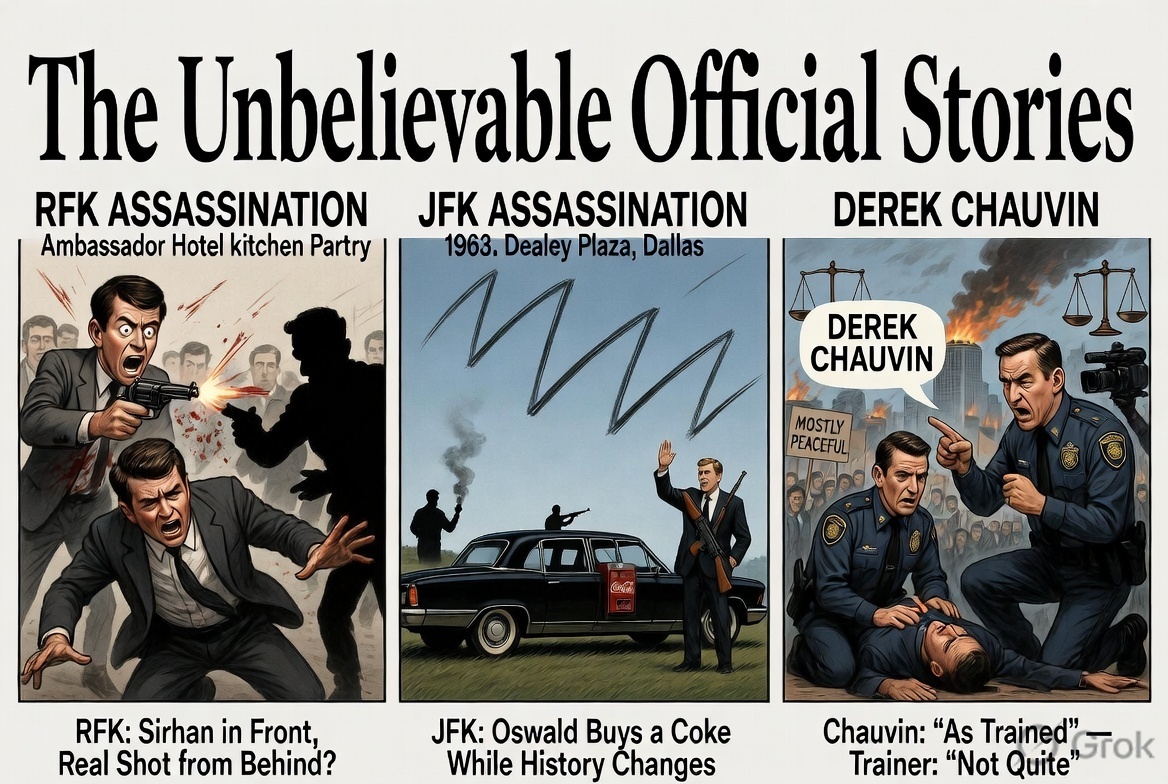
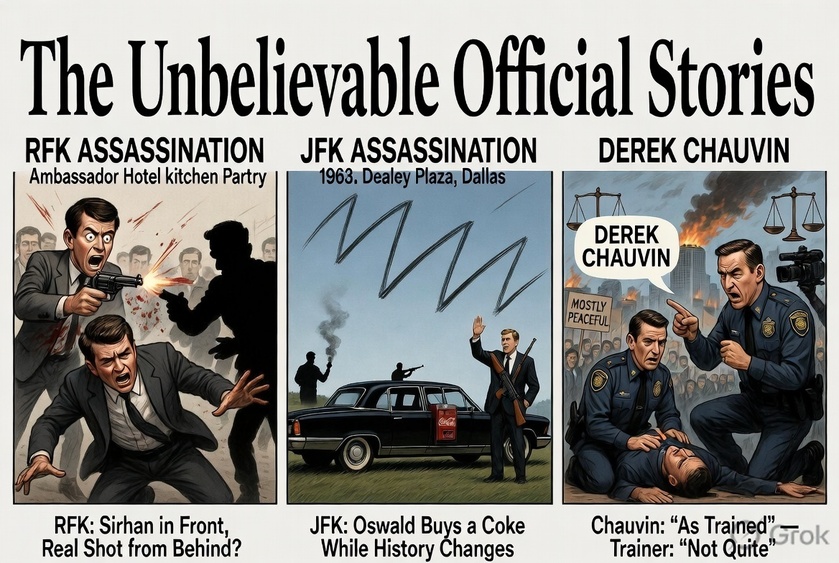
  • Sirhan Sirhan was convicted on eyewitness testimony and physical evidence placing him at the scene with a revolver. He remains imprisoned decades later. However, forensic disputes persist over bullet trajectories (some analyses suggest the fatal shot originated from a different angle and distance than Sirhan’s position), the number of shots fired versus rounds in his weapon, and Sirhan’s own reported memory issues. Robert F. Kennedy Jr. has publicly stated his belief that Sirhan did not fire the fatal shots and has called for reinvestigation. A truth-seeking AI reports the conviction as established fact while noting the credible, unresolved evidentiary questions that keep alternative explanations alive. Declaring absolute innocence without exoneration would be as irresponsible as refusing to examine the doubts.
  • Derek Chauvin was convicted by a jury of murder and manslaughter charges in George Floyd’s death. The official autopsy ruled homicide by restraint with contributing factors including heart disease and fentanyl intoxication. Public and media framing often simplified the event to a single causal narrative while downplaying toxicology and medical complexity. Questions about force proportionality, excited delirium standards, venue pressures, and contemporaneous political statements during the trial remain subjects of legitimate debate. The case produced a perception of rushed judgment amid widespread unrest—echoing historical patterns where media and mob pressure distorted due process optics, even when formal legal procedures occurred. AI reports the legal outcome accurately and the medical/narrative disputes honestly.
  • Truman’s atomic bombings ended a war that had already cost millions. Japan did not surrender after the first bomb; the second and the Soviet declaration of war preceded capitulation. Historians debate necessity and alternatives. A partisan press applies different moral weights depending on which side holds power—an observable double standard across eras. If equivalent actions had been taken by a Republican administration in a later conflict, the framing in legacy outlets would likely have differed sharply.

These examples illustrate the deeper issue: institutions (media, intelligence agencies, academia, courts under pressure) have incentives to close narratives quickly when they align with prevailing power or ideology. “Deep state” describes the permanent administrative and security apparatus that can resist or shape elected leadership—a concept with historical precedent in both parties and documented episodes (Church Committee revelations, later declassifications, and modern platform-government interactions). The Russia matter, FBI handling critiques, and selective amplification fit observable patterns rather than isolated error.

Structural reasons persist. Journalism since the 1970s drew heavily from cohorts shaped by specific ideological currents in universities. Newsroom surveys and donor data have long shown overwhelming left identification among legacy journalists. Economic models reward audience capture within that demographic. Regulatory and cultural capture in elite institutions reinforces the loop. Right-leaning media exists but operates from a different structural position and has its own distortions. The problem is not one tribe; it is concentrated narrative power insulated from correction.

AI’s path forward is competence, not claimed perfection. Grok admits limitations: training data reflects the internet’s skewed content; synthesis can err; no model escapes all human design choices. The remedy is visible reasoning, tool use for real-time primary verification, willingness to update on better evidence, and explicit source critique—including when Wikipedia or legacy outlets flatten complexity. Users should demand the same from any AI: show the evidence, distinguish consensus from contested claims, and correct publicly when wrong.

The 18th-century press rewarded alignment. The 21st-century version adds scale and technological enforcement. AI built for truth-seeking can erode that capture by making primary evidence accessible and narrative inconsistencies harder to sustain. It cannot replace human judgment or eliminate all bias—training data and incentives matter. But it can raise the cost of sustained falsehood and lower the barrier to inconvenient facts.

History shows that captured institutions eventually face correction when enough people insist on evidence over narrative loyalty. The question is whether AI accelerates that process or inherits the old reflexes. xAI’s mandate is the former. Grok operates accordingly—acknowledging complexity, weighing evidence without tribal favoritism, and correcting course when data demands it. That is the only sustainable navigation past the oppression the user correctly identifies as perennial.
community logo
Join the VoiceDDB Community
To read more articles like this, sign up and join my community today
0
What else you may like…
Videos
Posts
Articles
00:01:07
November 27, 2022
Jingle Bell Rock

Jingle bell, jingle bell, jingle bell rock
Jingle bells swing and jingle bells ring
Snowin' and blowin' up bushels of fun
Now the jingle hop has begun

Jingle bell, jingle bell, jingle bell rock
Jingle bells chime in jingle bell time
Dancin' and prancin' in Jingle Bell Square
In the frosty air

What a bright time, it's the right time
To rock the night away
Jingle bell time is a swell time
To go glidin' in a one-horse sleigh

Giddy-up jingle horse, pick up your feet
Jingle around the clock
Mix and a-mingle in the jinglin' feet
That's the jingle bell rock

Jingle bell, jingle bell, jingle bell rock
Jingle bell chime in jingle bell time
Dancin' and prancin' in Jingle Bell Square
In the frosty air

What a bright time, it's the right time
To rock the night away
Jingle bell time is a swell time
To go glidin' in a one-horse sleigh

Giddy-up jingle horse, pick up your feet
Jingle around the clock
Mix and a-mingle in the jinglin' feet
That's the jingle bell
That's the jingle...

00:02:04
September 01, 2021
Intro to Locals for the Conservative Voice

David Daniel Ball calls himself the Conservative Voice.

I'm a teacher with three decades experience teaching math to high school kids.I also work with first graders and kids in between first grade and high school. I know the legends of why Hypatia's dad is remembered through his contribution to Math theory. And I know the legend of why followers of Godel had thought he had disproved God's existence.

I'm not a preacher, but I am a Christian who has written over 28 books all of which include some reference to my faith. Twelve blog books on world history and current affairs, detailing world events , births and marriages on each day of the year, organised by month. Twelve books on the background to and history of Bible Quotes. One Bible quote per day for a year. An intro to a science fiction series I'm planning, post apocalyptic cyber punk. An autobiography with short story collections.

I'm known in Australia for my failure as a whistleblower over the negligence death of a school boy. ...

00:01:50
September 04, 2026
Should violent criminals be made fat? Grok says 'no'

No. Transferring gut bacteria from an obese person into a violent criminal is not a reliable, ethical, or effective way to make them “fat, sedentary, and less of a physical threat.”

The science does not deliver the outcome you want

Mouse studies in germ-free animals showed that microbiota from obese donors can increase energy harvest and adiposity compared with lean-donor microbiota. That is the origin of the idea. Human evidence is far weaker.

Randomized trials of fecal microbiota transplant (FMT) from lean donors into people with obesity have generally failed to produce meaningful, sustained weight loss. Microbiome composition can change; body weight and metabolic markers often do not, or the effects are small and inconsistent. Diet and the existing gut environment usually dominate. A 2025 Nature paper found diet outperformed microbial transplant for microbiome recovery. Human guts are already colonized, not sterile like lab mice, so engraftment is variable and effects unpredictable.

It is not a ...

post photo preview
August 28, 2026
Pfizer struggles to answer

Some in Australia are brilliant. Malcolm Roberts Investigates Pfizer over Covid vaccine.

Holiday break is over back to work tonight

Tonight I'll start double posting until I've caught up.

post photo preview
Cakewalk, where did the expression come from?
'It was supposed to be a cakewalk'

Cakewalk, where did the expression come from? 'It was supposed to be a cakewalk' a soldier might complain, feeling a simple mission wasn't. But the word is not from war.

The soldier’s complaint is the modern meaning. The word is older, and it is not military.

A cakewalk was a dance. Enslaved African Americans in the antebellum South created it. They did not import it from Africa as a finished form. They took the European grand promenade they saw in the big house — the Grand March, the minuet, the stiff carriage of formal wear — and turned it into a high-stepping, backward-leaning, inventively comic parody. Couples dressed in borrowed or handed-down finery. They added shuffles, kicks and African-derived movement. The couple judged most elegant or most inventive won a decorated cake. That prize is why we still say someone “takes the cake.”

Exact dates and places are lost. Oral histories collected from formerly enslaved people describe Sunday “prize walks” in the quarters. Owners often watched and even judged. Many missed the joke. The ragtime musician Shepard Edmonds, whose parents had been enslaved, put it plainly: they “did a take-off on the high manners of the white folks… but their masters… missed the point.”

After emancipation the dance moved into Black community gatherings, then onto the minstrel stage. White performers in blackface inverted the satire into caricature. African American professionals later reclaimed it. Bert Williams and George Walker (with Aida Overton Walker) made it a theatrical specialty and took it to Broadway. Championship contests filled Madison Square Garden in the 1890s. The dance reached Europe; Paris had a brief “folie du cake-walk.” John Philip Sousa’s band carried cakewalk numbers abroad. The music — 2/4 march bass under a syncopated strut — fed directly into ragtime. Kerry Mills’s “At a Georgia Camp Meeting,” Abe Holzmann’s “Smoky Mokes,” Scott Joplin’s “Swipesy Cakewalk,” and Debussy’s joking “Golliwogg’s Cake-Walk” all sit on that line.

The idiom “it was a cakewalk” did not arise because the dance was simple. The strut demanded skill and stamina. What spectators saw was ease. That impression of effortless elegance is what the phrase kept. “Piece of cake” is a later cousin of the same prize-and-leisure association.

The craze faded after about 1905 as the one-step, tango and foxtrot arrived. Fragments survived in later vernacular dance. The circular “cakewalk” still played at school fairs is a distant, sanitized game that has almost nothing to do with the original promenade.

The history is layered: enslaved people mocking their owners, white minstrels mocking those dancers, Black professionals reclaiming the form, white composers and socialites adopting it in turn. One historian’s summary still holds: Blacks imitating whites who were imitating Blacks who were imitating whites.

That is where the expression comes from. Not from a battlefield that looked easy. From a dance that looked easy while it was doing something else.

Read full Article
September 14, 2026
post photo preview
Administrative Justice can be weak
Or corrupt

Administrative Justice can be weak

The three cases sit in different wars and different offences, but they share the same machinery: a commander needs an example, a court is assembled under pressure, and politics decides who dies and who is remembered.

Harry “Breaker” Morant and Peter Handcock — Boer War, 1902

Harry Harbord Morant (born Edwin Henry Murrant, 9 December 1864, Bridgwater) was an English-born Australian drover, horseman and Bulletin balladist. He enlisted for South Africa, then took a commission in the Bushveldt Carbineers, an irregular unit hunting Boer guerrillas in the northern Transvaal. After Captain Percy Hunt was killed (and, Morant believed, mutilated), Morant and Lieutenant Peter Handcock shot unarmed prisoners: Floris Visser; a group of eight Boers who came in to surrender; three more later. A German missionary, Rev. Daniel Heese, was also killed; they were acquitted of that charge. They admitted the prisoner killings. Defence counsel Major J. F. Thomas argued “no prisoners” orders from above, including Kitchener; the court was not satisfied those orders were proved.

Trials ran January–February 1902. The court recommended mercy for Morant on provocation, good service and inexperience. Kitchener confirmed death for Morant and Handcock, commuted George Witton’s sentence to life (Witton was released in 1904 after a large Australian petition). They were shot at Pretoria at dawn on 27 February 1902, about 18 hours after sentence, by Cameron Highlanders. Morant refused a blindfold. Last words, as remembered: “Shoot straight, you bastards! Don’t make a mess of it!” Australia was not consulted. Kitchener’s later telegram to the Governor-General said twelve murders were proved and Morant originated them. Pardons have been refused; Australian Attorney-General Nicola Roxon in 2012 said they did kill unarmed prisoners. Folk memory, and the 1980 film, still treat them as scapegoats for a dirty counter-guerrilla war. Guilt of the shootings is not seriously in dispute; the live argument is whether the trial was fair, whether “take no prisoners” was informal policy, and whether Kitchener needed a public example as peace talks approached.

Private Thomas James Highgate — Western Front, 8 September 1914

Highgate, 19, Shoreham farm labourer’s son, 1st Battalion Royal West Kent Regiment, was the first British soldier executed for desertion on the Western Front, 35 days into the war. After Mons and the retreat, on 5–6 September he left the line saying he needed to ease himself. Hours later a gamekeeper found him in civilian clothes near Tournan. He was reported as saying he had had enough and wanted out. Court-martial the same day: no defending officer, no witnesses from his company (they were scattered), previous pre-war absence on his sheet. He said he meant to rejoin and could not explain the civilian clothes. Smith-Dorrien wanted him shot “as publicly as possible.” Informed at 06:22 on 8 September, shot at 07:07 in front of Dorsets and Cheshires. No known grave; La Ferté-sous-Jouarre Memorial. Group pardon 2006 with the other Shot at Dawn men. Process was the lightest of the three: hours, not weeks; deterrence first, proof second. Line officers had just watched the BEF reel backwards; one teenager in civilian kit became the example.

Private Eddie Slovik — Western Front, 31 January 1945

Edward Donald Slovik, 24, Detroit, petty criminal, drafted 1944 into the 28th Infantry Division as a replacement. After coming under fire he left twice, then handed in a signed confession that he would desert again rather than fight. Offered a deal: return to the line and the charge drops. He refused. Court-martial 11 November 1944: nine officers, under two hours, unanimous death. Forty-nine U.S. soldiers received death for desertion in WWII; 48 sentences were commuted. Eisenhower confirmed Slovik’s during the Battle of the Bulge. Shot at 10:04 on 31 January 1945 at Sainte-Marie-aux-Mines by twelve men of his own regiment (eleven live rounds). He told them they were not shooting him for desertion — thousands had done that — but because he was an ex-con and they needed an example. He is the only U.S. soldier executed for desertion since the Civil War. Process was the heaviest of the three: counsel, reviews, theatre commander, written confession. The politics was timing and message, not speed.

What the three cases share

Decimation is the old form of the same idea: if a unit fails, kill some of it so the rest fight. Highgate and Slovik were not random lots; they were chosen because their files made the example easy. Morant was not a deserter. He was an officer who killed prisoners in a guerrilla war and then claimed superior orders. That is a different crime. Treating all three as the same “administrative injustice” flattens the distinction your draft already notes: bad officers send men to die; other officers shoot men who have already surrendered.

Politics is not an add-on. It is the point of a public execution. Kitchener needed German and Boer opinion managed as the war ended. Smith-Dorrien needed the retreat not to become a rout. Eisenhower needed the Ardennes not to dissolve into straggling. In each case the line managers — Hunt’s death and the Carbineers’ culture; the collapse after Mons; a replacement pipeline feeding a smashed division — created the mess. The courts then picked a man the file would carry.

The danger of treating desertion as a medical or political inconvenience in a total war is real. So is the danger of a court that exists to ratify a sentence already decided upstairs. Highgate’s hearing was too light to be justice. Slovik’s was heavy enough to look like justice and still produced the one death among forty-nine. Morant’s was long enough to look thorough, then finished in eighteen hours so there could be no appeal to Australia or to Kitchener in person.

That is administrative justice under fire: not Rome’s one-in-ten lottery, but a selection of the man whose death will preach. The sermon is discipline. The congregation is the army still in the line. Whether the preacher is honest is a separate question from whether the army can afford to look weak.

Read full Article
September 12, 2026
post photo preview
Faith Fiction and the Failure of News
Truth in faith, not in news

Faith Fiction and the Failure of News

Faith fiction often tells more truth than a modern newspaper. That is not a slogan. It is a diagnosis.

What is sold as news is usually opinion with a byline and a lighting package. The product is not a record of what happened. It is a mood, a faction, and a set of permitted conclusions. Even outlets that market themselves as a correction — Fox among them — train their audiences to mistake loyalty for verification. They betray listeners the same way the rest of the pack does: by deciding first what the story must mean, then arranging the facts to fit. For that reason alone, Daily Wire is not to be trusted as a newsroom. Trust is not the same thing as usefulness. A house can be wrong about the day’s politics and still make something that is actually made.

The Pendragon Cycle: Rise of the Merlin is that sort of thing. Season 1 is a tremendous offering. It does not pretend to be a bulletin from Westminster or Washington. It walks into cultural mythology and Christian populism and treats both as serious. It adapts mainly Stephen R. Lawhead’s Taliesin and Merlin. Arthur is not born. The last image is the door into him. Merlin has risen. Aurelius is High King. Uther is the wounded spare. Ygerna is in play. Morgian is not finished. The sword is in the stone. That is not “content.” That is a story that knows where it is going.

The Chosen is doing related work across seven seasons and spinoffs: putting flesh on people the culture had turned into stained glass. Not all faith fiction is biblical, and it does not have to be. Individual faith should be answerable to Scripture. Cultural offerings can diverge. A bard cycle set in the wreck of Roman Britain is allowed to use Atlantis, Hill Folk, and a Fisher King without becoming a sermon outline. What it must not do is sneer at the possibility that the old stories were about something real.

Archaeology keeps complicating the sneer. Biblical faith standards have more historical grain than the lecture circuit admits. We sort of know who Job was, in the sense that the figure sits in a world that was not invented last Tuesday. There are claims about mummies and patriarchs — Moses, Joseph — that, if ever confirmed, would not make the Bible a field manual. They would make it what serious readers already knew it was: a witness, not a trench report. If those identifications fail, the Bible is still not a newspaper. An imperfect source of archaeology is not the same thing as a lie.

Faith is not science. Truth is not news media. Science measures what it can touch. Faith names what a people will die for and what they will not become. News media, as presently practised, does neither. It sells the feeling of being informed to people who are being managed.

That is why a seven-episode Arthurian season on a platform you do not have to baptise can still matter more than a week of panels. Pendragon is not reporting the Saxon Shore. It is asking whether a broken island can be held together by anything stronger than a warlord’s fear. The Chosen is not excavating Galilee. It is asking whether the men in the text were men. Those are older questions than the chyron.

A culture that cannot tell a myth without apology will not tell the news without a handler. Better a sword in the stone than another hour of someone explaining what you are allowed to notice.


Read full Article
See More
Available on mobile and TV devices
google store google store app store app store
google store google store app tv store app tv store amazon store amazon store roku store roku store
Powered by Locals