VoiceDDB
Politics • Culture • News
Selecting Hiroshima
81 Years On
August 04, 2026
post photo preview

Selecting Hiroshima, 81 Years On

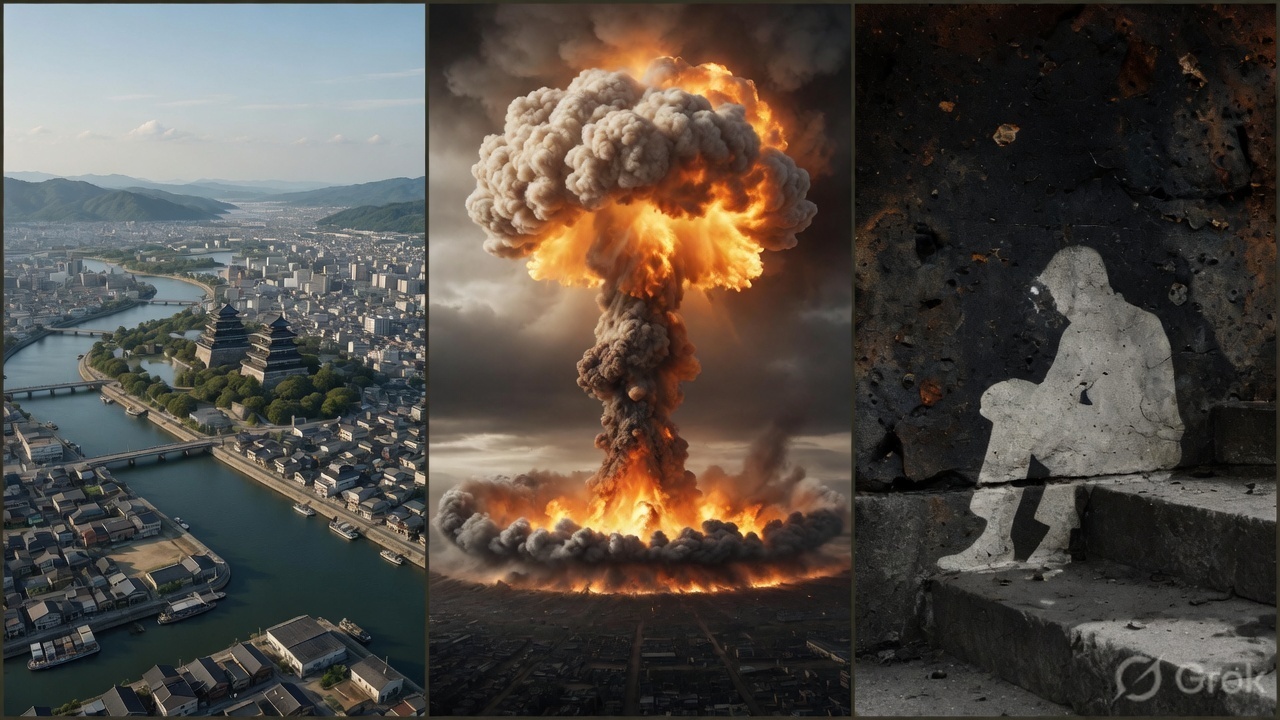
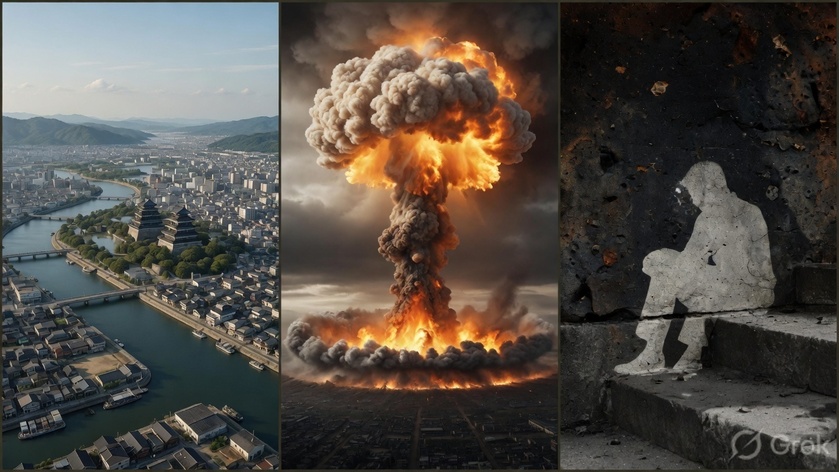
Hiroshima was not the last city subjected to nuclear attack. Nagasaki followed three days later. Neither bomb, by itself, ended the Pacific War or demonstrably “saved lives” in the neat arithmetic long claimed. The Soviet Union’s declaration of war and invasion of Manchuria on 9 August did more to collapse Japanese options in hours than the destruction of one or even two cities.

Japan had been warned. The Potsdam Declaration of 26 July offered terms and threatened “prompt and utter destruction.” Tokyo’s response was interpreted as rejection. After Hiroshima on 6 August, Japanese leaders continued to pursue mediation through Moscow. They fought on. Only when the Soviets entered—invalidating the last diplomatic card and opening a second front that Japanese forces could not hope to contain—did the Supreme War Council confront the impossibility of continued resistance. The Emperor’s intervention followed the twin shocks of 9 August. Historians such as Tsuyoshi Hasegawa have documented this chronology carefully: Hiroshima raised urgency but did not force the decisive political shift; Soviet entry did.

Truman never lost sleep over the decision, at least not publicly. He later said so repeatedly. The choice was effectively pre-shaped by the Interim Committee and Target Committee, which included scientists of the calibre of Oppenheimer and Fermi. Their criteria—large urban areas of sufficient diameter, relatively untouched by prior bombing so the weapon’s effects could be measured, and high psychological impact—systematically ruled out purely military or unpopulated alternatives. Demonstration shots were rejected. Kyoto was removed for cultural reasons at Stimson’s insistence; Hiroshima met the remaining tests as an army headquarters city and embarkation port that was still largely intact.

Japan had placed Allied prisoners of war in industrial and military zones, a practice that complicated any clean distinction between combatants and non-combatants. Truman was aware of the political and moral risks. British firebombing of German cities had already drawn criticism. His private diary entry of 25 July recorded an instruction to target “military objectives and soldiers and sailors… not women and children,” and to spare the old and new capitals. That caveat was empty in practice. The aiming point in Hiroshima was the city centre. Tens of thousands of civilians died immediately; the total, including radiation effects, ran into six figures. A smaller number of Allied POWs also perished in the blast.

Then and now, much of the press and official narrative has treated the decision as self-evidently justified because it was taken by a Democratic administration under wartime pressure. Alternatives—modifying the unconditional-surrender demand to clarify the Emperor’s status earlier, waiting for the already-scheduled Soviet entry, or intensifying the blockade and conventional campaign—are waved away with the assertion that the bombs alone ended the war early and spared American lives. The evidence does not support that clean claim. Japan’s military hardliners remained prepared to fight after Hiroshima. The combination of nuclear demonstration and Soviet assault produced the surrender. Casualties from a full invasion of the home islands would have been horrific; that does not prove the specific targeting of two cities was the only or least costly path available in early August 1945.

The scale of the nuclear attack exceeded anything previously imaginable, even after the firebombing of Tokyo and other cities. Hiroshima finished nothing by itself. What followed was more consequential for the post-war order: a rapid American pivot that left Eastern Europe under Soviet domination, Stalin’s position strengthened, and China descending into civil war that produced a communist victory. Atrocities on the Burma-Thailand railway and elsewhere received incomplete justice. American resolve to confront Soviet expansion was real, yet the pattern of selective memory about the closing days of the Pacific War has persisted.

Eighty-one years later the official story remains largely intact in popular retelling. The historical record is more complicated. The bombs were weapons of unprecedented power used against cities containing military facilities and large civilian populations. The Soviet entry was strategically decisive. Japan had been offered terms and chose to continue. Truman accepted the committee’s framework and never publicly second-guessed it. Those facts do not require romanticising Japanese militarism or denying the savagery of the Pacific War. They do require abandoning the comforting simplification that two nuclear strikes alone ended the fighting and thereby redeemed the civilian deaths.

community logo
Join the VoiceDDB Community
To read more articles like this, sign up and join my community today
0
What else you may like…
Videos
Posts
Articles
00:01:07
November 27, 2022
Jingle Bell Rock

Jingle bell, jingle bell, jingle bell rock
Jingle bells swing and jingle bells ring
Snowin' and blowin' up bushels of fun
Now the jingle hop has begun

Jingle bell, jingle bell, jingle bell rock
Jingle bells chime in jingle bell time
Dancin' and prancin' in Jingle Bell Square
In the frosty air

What a bright time, it's the right time
To rock the night away
Jingle bell time is a swell time
To go glidin' in a one-horse sleigh

Giddy-up jingle horse, pick up your feet
Jingle around the clock
Mix and a-mingle in the jinglin' feet
That's the jingle bell rock

Jingle bell, jingle bell, jingle bell rock
Jingle bell chime in jingle bell time
Dancin' and prancin' in Jingle Bell Square
In the frosty air

What a bright time, it's the right time
To rock the night away
Jingle bell time is a swell time
To go glidin' in a one-horse sleigh

Giddy-up jingle horse, pick up your feet
Jingle around the clock
Mix and a-mingle in the jinglin' feet
That's the jingle bell
That's the jingle...

00:02:04
September 01, 2021
Intro to Locals for the Conservative Voice

David Daniel Ball calls himself the Conservative Voice.

I'm a teacher with three decades experience teaching math to high school kids.I also work with first graders and kids in between first grade and high school. I know the legends of why Hypatia's dad is remembered through his contribution to Math theory. And I know the legend of why followers of Godel had thought he had disproved God's existence.

I'm not a preacher, but I am a Christian who has written over 28 books all of which include some reference to my faith. Twelve blog books on world history and current affairs, detailing world events , births and marriages on each day of the year, organised by month. Twelve books on the background to and history of Bible Quotes. One Bible quote per day for a year. An intro to a science fiction series I'm planning, post apocalyptic cyber punk. An autobiography with short story collections.

I'm known in Australia for my failure as a whistleblower over the negligence death of a school boy. ...

00:01:50
Holiday break is over back to work tonight

Tonight I'll start double posting until I've caught up.

Chinese Space Bio Labs

While Elon Musk is busy landing reusable rockets and building robot swarms on Earth, the CCP has gone full 'Musk but make it bioweapons': they're launching fleets of Starship-inspired rockets crewed by copycat Optimus robots, blasting 'Fau Chi' biolabs straight into Low Earth Orbit.

These gleaming orbital stations, proudly emblazoned with the Chinese characters 福奇 (Fú Qí — sounding suspiciously like 'Fau Chi'), are officially designated as The Science™ Research Facilities. Perfect for safe, ethical gain-of-function experiments on exciting new pathogens like TDS (Trump Derangement Syndrome), 'Last Millennia' nostalgia plagues, and the deadly 'We Are Living in 2026' variant.

The endgame? A billion trusting parents worldwide voluntarily neutering their own children on expert 'Fau Chi' advice from the heavens — because nothing says 'public health' like taking guidance from a floating Chinese biolab with reusable re-entry capabilities.

post photo preview
Editorial from 2018 for June 9th

Don't give up on hope. Western Civilisation is on the nose of universities in Australia. Sydney University collapsed in 1990, and her upper executive got replaced by ALP managerialists as Keating fought a culture war which the Liberal Party have not effectively engaged. Dame Kramer had been made Chancellor, but the Chancellor's position is not executive at Sydney University. Kramer fought effectively for Western Values, but the University, now, is as partisan left as the ABC is now. Kramer had been a powerful presence in charge of the ABC too. 

In 1990, Sydney University lost her Chancellor and Vice Chancellor. The Chancellor, Hermann David Black, died after a long illness. James Anthony Rowland, a former governor of NSW took the chancellor's position for a few years, before passing it to Kramer in 1991. She held on to 2001. From 1981 to 1990, John Manning Ward was the executive head of Sydney University as Vice Chancellor. He had been writing a trilogy on Australian conservative leaders ...

post photo preview
post photo preview
Civil Servants
Captured as an Institution on Cultural Issues

Civil Servants: Captured as an Institution on Cultural Issues

In the American system, legislators are elected to set policy. Public servants are hired to execute it. When the permanent bureaucracy begins to set its own social agenda and resist or reshape the directions of elected executives, the relationship is inverted. The phrase “Deep State” is often used as a denunciation of this tendency. The underlying problem is older than the phrase. British governments long wrestled with a permanent civil service whose institutional interests and cultural assumptions could diverge from the elected government of the day. The East India Company, for example, developed its own momentum and priorities that were not always identical to those of the Crown. Market forces and large organisations take on a life of their own. The best governments often succeed less by micromanaging every outcome than by setting clear behavioural boundaries and then allowing competent systems to operate. The difficulty arises when the permanent apparatus accumulates enough power and ideological confidence to treat elected direction as optional.

Extreme claims that a permanent bureaucracy has orchestrated the deaths of presidents—from Lincoln to Kennedy—or systematically coerced others such as Nixon, Reagan, and Trump remain contested and, in many cases, unproven. What is not contested is that periods of intense institutional resistance and mutual distrust have repeatedly marked relations between elected executives and the permanent state. Trust, once damaged, is hard to restore.

Historical cases of actual infiltration supply clearer ground. Alger Hiss, a senior State Department official, was shown through the investigations of the late 1940s and later archival work in the 1990s to have been a Soviet agent. His decision to sue Whittaker Chambers for libel allowed discovery that produced damning evidence; the statute of limitations limited the eventual conviction to perjury. Julius and Ethel Rosenberg were likewise Soviet agents. These were not vague conspiracies but documented penetrations of sensitive institutions. In a 1984 interview, the Soviet defector Yuri Bezmenov described a longer-term method of ideological subversion aimed at corroding the cultural confidence of Western institutions from within—education, media, and public service among them. The method did not require every official to be a foreign agent; it required only that key institutions absorb and then enforce a particular ideological frame.

That frame is now visible on cultural questions. One may intellectually accept the existence of people with gender dysphoria or same-sex attraction and still reject the proposition that the administrative state should mandate affirmation, fund irreversible medical interventions, condition foreign aid on such policies, or insert itself between parents and children on matters of identity and belief. When agencies treat dissent from these policies as a threat to “lives,” and when statistical claims about suicide risk are used to close down debate rather than open it, the bureaucracy has moved from execution of policy into the creation and enforcement of a social orthodoxy.

Other symptoms of the same institutional posture appear elsewhere. Resistance to routine voter identification is framed as protection of the vulnerable rather than as a basic safeguard of electoral integrity. A former FBI director posts an image widely read as a threat to a sitting president. After sustained rhetorical escalation in which a conservative activist is labelled a Nazi and a danger to students, that activist is murdered. Each episode feeds a broader erosion of confidence. Historical flashpoints—Waco, Oklahoma City, Kent State, the destruction of Greenwood in Tulsa, the Teapot Dome scandal, the riots that followed the Rodney King and George Floyd cases—remain bitterly contested precisely because the public no longer trusts official narratives or the institutions that produce them. Public-sector unions that function as reliable partisan allies of one party while claiming to represent neutral public service only deepen the suspicion.

A democracy can tolerate, and even require, a professional civil service. It cannot indefinitely tolerate a civil service that treats electoral outcomes as provisional and cultural orthodoxy as permanent. The remedy is not the romantic destruction of bureaucracy but the reassertion of clear lines: elected officials set direction; public servants execute it under law and transparent accountability; and no permanent institution is entitled to impose its preferred social vision on a free people. When those lines blur, the result is not enlightened administration but a soft form of unaccountable power.

Read full Article
August 24, 2026
post photo preview
US Legal Fraternity
Compromised Over Actions Against Trump and the 2020 Election

US Legal Fraternity: Compromised Over Actions Against Trump and the 2020 Election

Has the legal profession ever been more than organised self-interest dressed in robes? Has it ever consistently adhered to the higher principle of blind justice—the ideal of the Lady with the scales, eyes covered, weighing evidence without regard to power or popularity? What happens when partisanship and corruption hold the reins?

The Scopes “Monkey Trial” of 1925 offers a useful contrast. Clarence Darrow defended John Scopes, who had openly admitted violating Tennessee’s Butler Act by teaching evolution. The judge kept the proceedings focused on facts rather than vague cultural anxieties. Scopes was convicted; the judge imposed the minimum fine of one hundred dollars. The Butler Act itself was upheld, yet the trial performed a public service: it forced a national conversation about science, evidence, and the proper limits of law. That science of the 1920s included discredited ideas later embraced by the Nazis—race theory, phrenology, and crude biological hierarchies. The principle of evolution by natural selection has stood the test of time; those racialist accretions have not. The Butler Act’s attempt to enforce a particular reading of Scripture was clumsy and inconsistent with the broader Christian claim that salvation rests on faith and righteous conduct, not on defending the precise geometry of the cosmos. Pi is not three. Digging does not lead to hell, nor flying to heaven. The trial nevertheless demonstrated what law can do at its best: compel argument, clarify terms, and inform the public even when the statute itself was flawed.

Today the legal profession shows a different pattern. Campaign contribution data consistently show that roughly eighty percent of lawyers and law firms lean Democratic. That imbalance is not neutral. When a profession that staffs prosecutors’ offices, law faculties, bar associations, and much of the judiciary leans so heavily in one direction, the risk of selective enforcement rises. The 2020 election remains a legitimate subject of factual and legal dispute. Opposing interpretations of election administration, mail-in procedures, and certification processes can and should be tested in court and in public argument. Denial that any serious question exists is not the same as resolving the question.

The January 6 Select Committee was bipartisan in name only. Its composition, investigative priorities, and public presentation were overwhelmingly partisan. The later pardons of certain senior figures associated with related events only deepened the appearance of selective justice. More troubling still has been the aggressive prosecution of lawyers who represented Donald Trump or advanced legal arguments on his behalf. Several of those lawyers were prominent, experienced practitioners. Treating zealous advocacy itself as a prosecutable offence risks chilling the very adversarial process the legal system claims to protect.

Judicial activism compounds the problem. Courts have blocked or delayed a series of presidential actions by the second Trump administration on grounds that often stretch statutory or constitutional language beyond recognition. The spectacle of a Supreme Court nominee unable or unwilling to offer a straightforward biological definition of “woman” during confirmation hearings crystallised a deeper loss of confidence: if basic categories can be treated as ideological traps rather than ordinary facts, the claim to neutral judging looks increasingly hollow.

A free society requires robust legal argument on contested elections, executive power, and cultural questions. What it cannot afford is a legal fraternity that functions as an extension of one political coalition. When the guardians of process become participants in the culture war, the scales tip, the blindfold slips, and public trust erodes. The remedy is not the replacement of one orthodoxy with another, but the recovery of institutional restraint: judges who stay within their lane, prosecutors who apply the law evenly, and lawyers who remember that their first duty is to the integrity of the system rather than the victory of their tribe.

Read full Article
August 23, 2026
post photo preview
Academia and Entertainment
Captured Institutions Converting to Agenda

Academia and Entertainment: Captured Institutions Converting to Agenda

Samuel Clemens, writing as Mark Twain, once advised that one should not let schooling get in the way of one’s education. The warning still applies, though the danger has shifted. Where once the risk was pedantry or empty credentialism, today it is the conversion of entire cultural institutions into vehicles for a narrow agenda.

Consider a recent classroom scene. An Arts/Law student sits in a literary criticism seminar. The set text is a play in which a family man leaves his wife and children to live with a goat. He tells his former wife that he loves his family, yet loves the goat more—not merely sexually, but socially and existentially. The play traces the evolution of that relationship. Class discussion centres on the meaning of love, framed almost exclusively through queer theory. The student, a Christian, asks whether this text offers a balanced sample from which to draw broad conclusions about love and human relationships. The lecturer denounces the question as inappropriate and declares that the subject matter itself may not be questioned. The student may have passed the course. High distinction is unlikely.

What does that episode suggest about literature and arts graduates who consistently receive high marks under such regimes? We are watching the steady destruction of a cultural asset. Literature once trained readers to weigh competing claims about human nature, to recognise irony, tragedy, and moral complexity. When the only permissible lens is a predetermined ideology, the capacity for independent judgment atrophies. Graduates leave fluent in the approved vocabulary yet poorly equipped to read a text on its own terms or to tolerate disagreement.

The same pattern appears in entertainment. A Hollywood figure who has survived being publicly labelled conservative is approached by a world-famous director who shares the quiet view. “Why are we whispering?” one asks the other. The question is revealing. Two people whose professional lives depend on creative judgment feel compelled to lower their voices when discussing ordinary political or cultural opinions. Does their opinion matter less than their skill? A plumber who is inexpensive and effective may believe in aliens without professional consequence. Hollywood, by contrast, increasingly elevates identity over talent. Even gifted artists whose views fall outside the narrow current orthodoxy—JK Rowling and Gal Gadot among them—have faced organised attempts at cancellation on matters irrelevant to their craft. Both remain popular with large audiences; both have been treated as liabilities by institutions that once claimed to prize excellence.

History offers an instructive contrast. The mid-century Hollywood blacklist of communists was widely denounced, and rightly so when it punished people for beliefs rather than actions. Yet it is also true that committed communists worked inside the industry and sought to advance their politics through it. Figures such as Nixon and Reagan, whatever their other faults, understood the stakes and pushed back. Today the institutional immune system appears weaker. The direction of pressure has reversed: open conservatism is the riskier stance, while progressive conformity is safer.

Intellectual independence used to be a prized academic virtue. In many Ivy League departments the proportion of faculty who identify as conservative now falls below ten percent; in some fields the figure is closer to zero. Australia has its own illustrations. A Sydney University professor of Australian poetry was effectively pushed out after his private conservative views became public through a privacy breach. When a multi-billion-dollar bequest was offered to an Australian university specifically for the study of Western culture, the institution struggled to identify suitable scholars or structures to receive it. These are not isolated personnel disputes. They are symptoms of institutional capture.

It is entirely appropriate that a free society wrestle openly with questions of cultural identity, meaning, and morality. Democracy requires such argument. What is dangerous is the conversion of universities and entertainment institutions into enforcers of a single orthodoxy. When classrooms treat dissent as moral failure and studios treat talent as secondary to correct opinion, the culture itself is impoverished. The remedy is not silence or counter-orthodoxy, but the recovery of genuine intellectual independence—the willingness to let a text, a film, or an argument stand or fall on its merits rather than on its alignment with the prevailing agenda.

Read full Article
See More
Available on mobile and TV devices
google store google store app store app store
google store google store app tv store app tv store amazon store amazon store roku store roku store
Powered by Locals