Betty Cuthbert: A Golden Life Unmarked
Some things should not happen, yet they do. When Betty Cuthbert died in August 2017, Australia’s parliament found time to honour two prominent Aboriginal figures. It found no time for the Golden Girl. That omission was not a procedural oversight. It was a cultural failure.
Australia has been unusually blessed in sporting talent. Don Bradman remains the towering figure of cricket. Tennis produced Laver, Newcombe, Margaret Court and a long procession of others. Swimming gave us Dawn Fraser, Murray Rose, Ian Thorpe and more. On the track, Edwin Flack, Herb Elliott, Cathy Freeman and Betty Cuthbert stand in the first rank. Cuthbert was the equal of any of them. She deserved the same public respect and institutional acknowledgement.
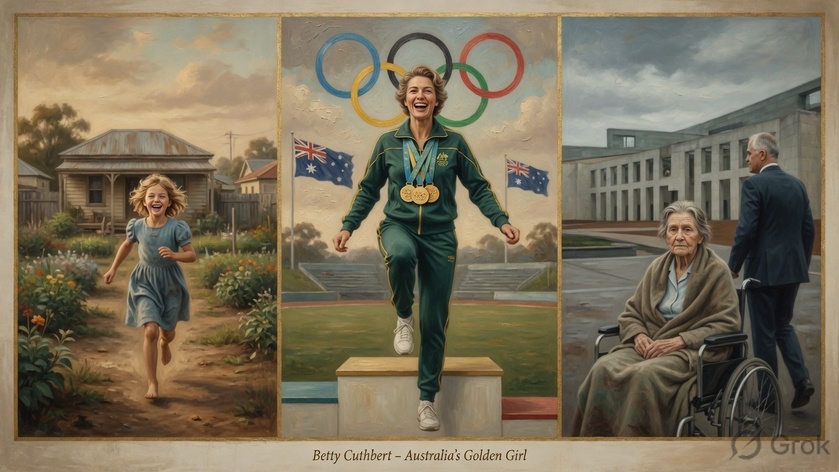
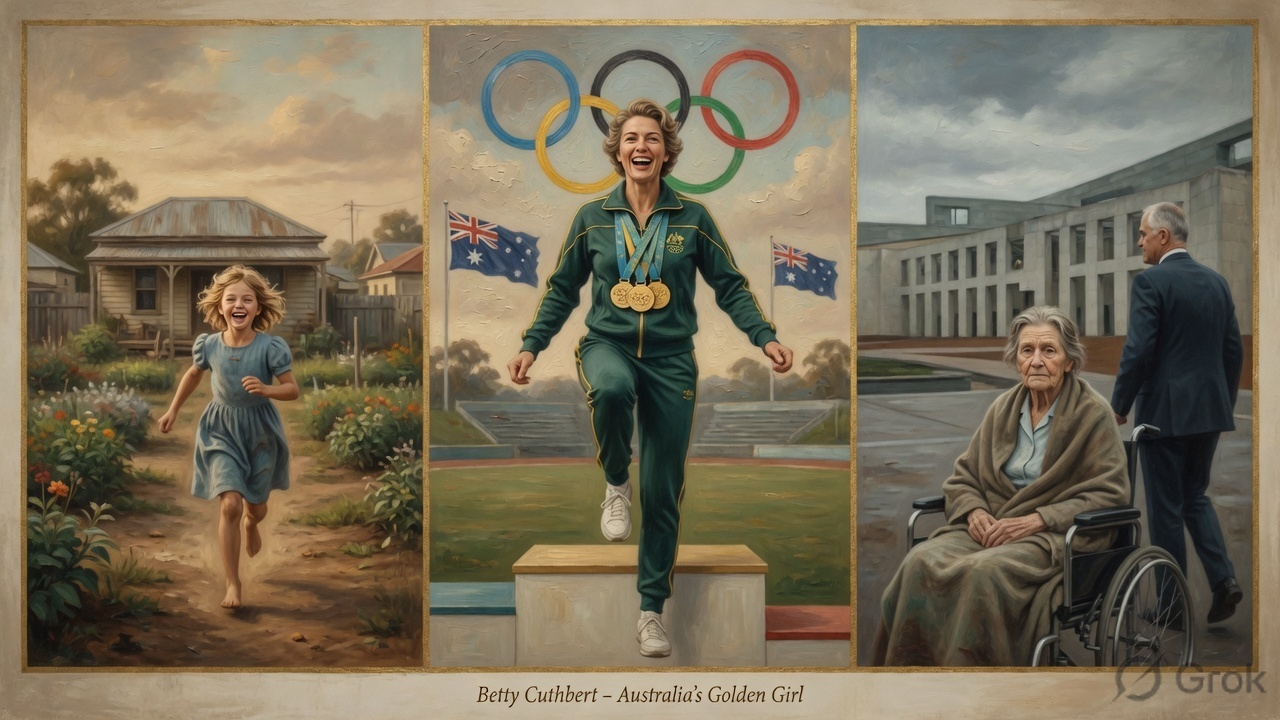
Elizabeth Alyse “Betty” Cuthbert was born on 20 April 1938 in Merrylands, a western Sydney suburb, twenty minutes ahead of her non-identical twin sister Marie, later known as Midge. She had an older brother, John, and an older sister, Jean. When the twins were five the family moved to Ermington, where her father, Leslie, established a flower and vegetable plant nursery. Her mother, Marion, took the children to Sunday school. The household was modest, practical and close-knit.
From early childhood Betty ran. She ran barefoot between the nursery rows because she felt free. She ran to and from Ermington Public School, around the playground, and through the neighbourhood until called in for dinner. By the age of eight she was already winning New South Wales titles and the school trophy for best girl athlete. She later said she knew then that she had a gift from God.
At Parramatta Home Science School her physical education teacher was June Ferguson, a 1948 Olympian. Ferguson recognised the raw talent, spoke to Betty’s mother about the cold winter nights, and persuaded the girl to join the Western Suburbs Athletic Club. Under Ferguson’s coaching the awkward, high-knee, open-mouthed style was refined rather than reinvented. Betty left school at fifteen or sixteen, worked briefly in a children’s clothing factory, then returned to the family nursery. She remained, in her own words, an ordinary girl from the suburbs who happened to run very fast.
In September 1956, still only eighteen and so unsure of selection that she had bought spectator tickets for the Melbourne Olympics, she broke the world 200 metres record. At the Games she won three gold medals in six days: the 100 metres (after setting a world record of 11.4 in her heat), the 200 metres, and the anchor leg of the 4 × 100 metres relay that set another world record. She became the first Australian to win three gold medals at a single Olympics and was instantly christened the Golden Girl. Injury limited her at Rome in 1960. She returned in Tokyo in 1964 and won the inaugural women’s Olympic 400 metres in what she called the only perfect race of her life. She remains the only athlete, male or female, to have claimed Olympic gold in the 100, 200 and 400 metres. Across her career she set or equalled more than a dozen world records from 60 metres to 440 yards and in relays. She also collected Commonwealth medals, including gold in the 4 × 110 yards relay in Perth in 1962.
After Tokyo she retired for good and went back to the nursery. Five years later the first symptoms of multiple sclerosis appeared. The formal diagnosis came in the early 1970s. For nearly half a century the disease progressively stole her mobility until she was confined to a wheelchair, able to move only her left arm. She never asked God “Why me?” She believed instead that the illness had been given so she might help other people.
In 1985, at the age of forty-seven, she became a born-again Christian. From that point her public life took on a new purpose. She became Australia’s most visible advocate for multiple sclerosis research and awareness. She was present at the inauguration of MS Research Australia in 2004 alongside then-Prime Minister John Howard. She lent her name, her presence and her remaining strength to fundraising, public education and encouragement of those living with the disease. Research fellowships and scholarships carry her name. A rose was named after her, with proceeds directed to MS research. Those who worked with the organisation later credited her with an immeasurable impact on national understanding of the condition.
She never married and had no children. In later years she was sustained by her twin sister and by her close friend and carer, Rhonda Gillam. At the 2000 Sydney Olympics she appeared in her wheelchair, still recognisable, still smiling, still carrying the quiet authority of the Golden Girl. She died on 6 August 2017 in Mandurah, Western Australia, aged seventy-nine.
Mortality is hard and the ending is often rough. Few have endured it with such grace. Her early life in the nursery rows of Ermington, her unmatched Olympic record, her long public struggle with multiple sclerosis, and her steady Christian witness form a single coherent story. That story remains a cultural asset. Parliament should have observed it. The failure to do so says more about the selective instincts of the institution than about the stature of the woman who once ran with her mouth open and her heart fixed on something higher.