Oliver Cromwell: A Man of Contradictions
Oliver Cromwell never uttered the famous passage so often attributed to him when he dismissed the Rump Parliament in April 1653. That fiery tirade—“It is high time for me to put an end to your sitting in this place… In the name of God, go!”—is an eighteenth-century political squib, a later invention dressed up as history. Yet its tone still resonates. The contempt for a self-serving political class, the charge of selling the public good for private gain, the demand that those who have failed their trust simply leave: these are sentiments that many citizens, across centuries, have wanted to hurl at their rulers.
Cromwell’s own beginnings were modest and rooted in the lesser gentry of eastern England. Born on 25 April 1599 in Huntingdon, he was the only surviving son of Robert Cromwell, a local landowner, justice of the peace and occasional parliamentarian, and Elizabeth Steward. The family had risen through a distant connection to Thomas Cromwell, Henry VIII’s minister; Oliver’s great-great-grandfather had married Thomas’s sister, and the name and some former monastic lands came with that alliance. He grew up with seven sisters in a household that was comfortable but not grand. After his father’s death in 1617, the eighteen-year-old Oliver left Sidney Sussex College, Cambridge, without a degree to manage the family estate and support his widowed mother and unmarried sisters. He may have studied a little law at Lincoln’s Inn in London, but for the next two decades his life was that of a working country gentleman and farmer—first in Huntingdon, later in St Ives and Ely—collecting rents, farming, and serving as a local magistrate.
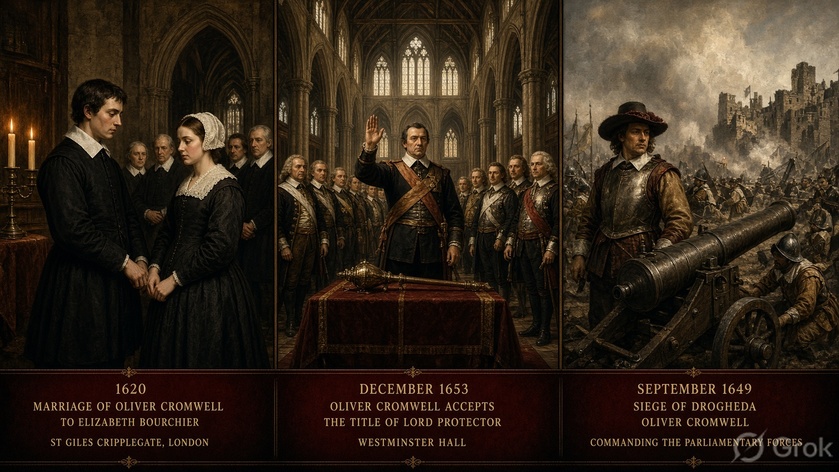
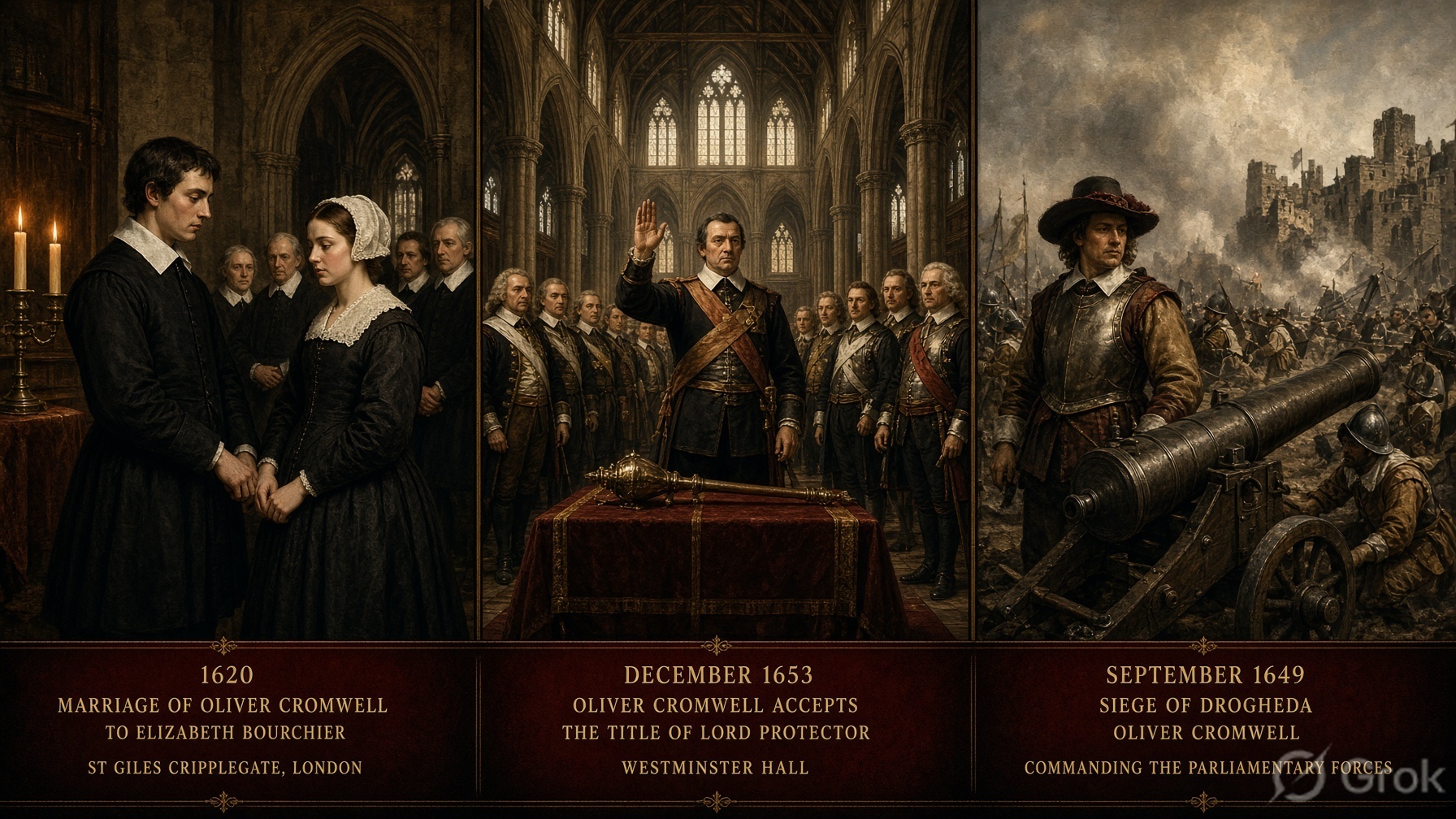
In 1620 he married Elizabeth Bourchier, daughter of a prosperous London merchant with Puritan leanings. The marriage was long and affectionate; they had nine children, of whom six reached adulthood. Cromwell experienced a profound religious conversion in the late 1620s or early 1630s that shaped everything that followed. He became a convinced Puritan, certain that God’s providence directed his path. That same intensity later produced both the disciplined leadership of the New Model Army and the severity that stained his name in Ireland.
Cromwell hated corruption and self-interest in high places, yet the regime he headed as Lord Protector could not escape the charge of authoritarian overreach. He was a man of intense conviction who genuinely believed he was an instrument of divine will. That conviction produced extraordinary military success and, at the same time, terrible severity. It is one thing to hold firm ideals; it is another to enforce them at the point of the sword. The massacres at Drogheda and Wexford remain a permanent stain. His military dictatorship, the rule of the Major-Generals, and the repeated dissolution of parliaments that disappointed him showed how easily zeal for righteousness can slide into the exercise of unchecked power.
In that sense the English Civil Wars and the Commonwealth experiment were a kind of rehearsal for later revolutions. Authority was broken, a king was tried and executed, and a new order was imposed by force of arms and ideology. The public ultimately rejected the experiment. Within two years of Cromwell’s death the monarchy was restored. Something similar occurred after the French Revolution: the cycle of radical purification, terror, and authoritarian consolidation ended in a return to more traditional forms of rule. History does not repeat itself neatly, but it does rhyme. Populations that have endured prolonged upheaval and moral coercion often choose stability over purity.
The time-travel question
What if Cromwell could step into the present and confront those who, in the name of public health or electoral necessity, stretched or overrode ordinary justice during the pandemic years and the contested 2020 American election? The question is speculative, but not empty.
A seventeenth-century Puritan who had fought kings over arbitrary power, who had insisted that even a monarch was under law, and who had dissolved a parliament he judged corrupt, would almost certainly view large-scale emergency rule with suspicion. He would recognise the pattern: emergency powers justified by crisis, dissent treated as moral failure or danger to the community, and ordinary legal restraints set aside for the greater good. Cromwell’s own career showed both the temptation and the cost of that logic. He had used soldiers to clear a parliament; he had imposed moral and religious discipline by force. He also lived long enough to see how quickly such methods breed resentment and how fragile the resulting order becomes once the strong man is gone.
He would likely have little patience for elites who claimed special insight or moral superiority while exempting themselves from the rules they imposed on others. The language of the forged speech—mercenary motives, bartered conscience, contempt for the common good—would fit his temper. Whether he would have endorsed particular claims of electoral irregularity or specific pandemic policies is unknowable; he was a man of his own age, not ours. What can be said is that a leader who had watched one form of absolute authority replace another, and who had seen the public eventually tire of both, would be wary of any system that concentrates power, suppresses scrutiny, and treats disagreement as illegitimate.
Cromwell remains useful precisely because he refuses to be a simple hero or simple villain. From the quiet responsibilities of a country gentleman supporting his mother and sisters to the heights of military command and the lonely exercise of near-absolute power, his life exposes the permanent tension between the desire for clean government and the dangers of those who believe themselves clean enough to impose it by force. The forged speech still circulates because the frustration it expresses is perennial. The historical Cromwell reminds us that the same zeal that topples one set of abuses can easily generate another.