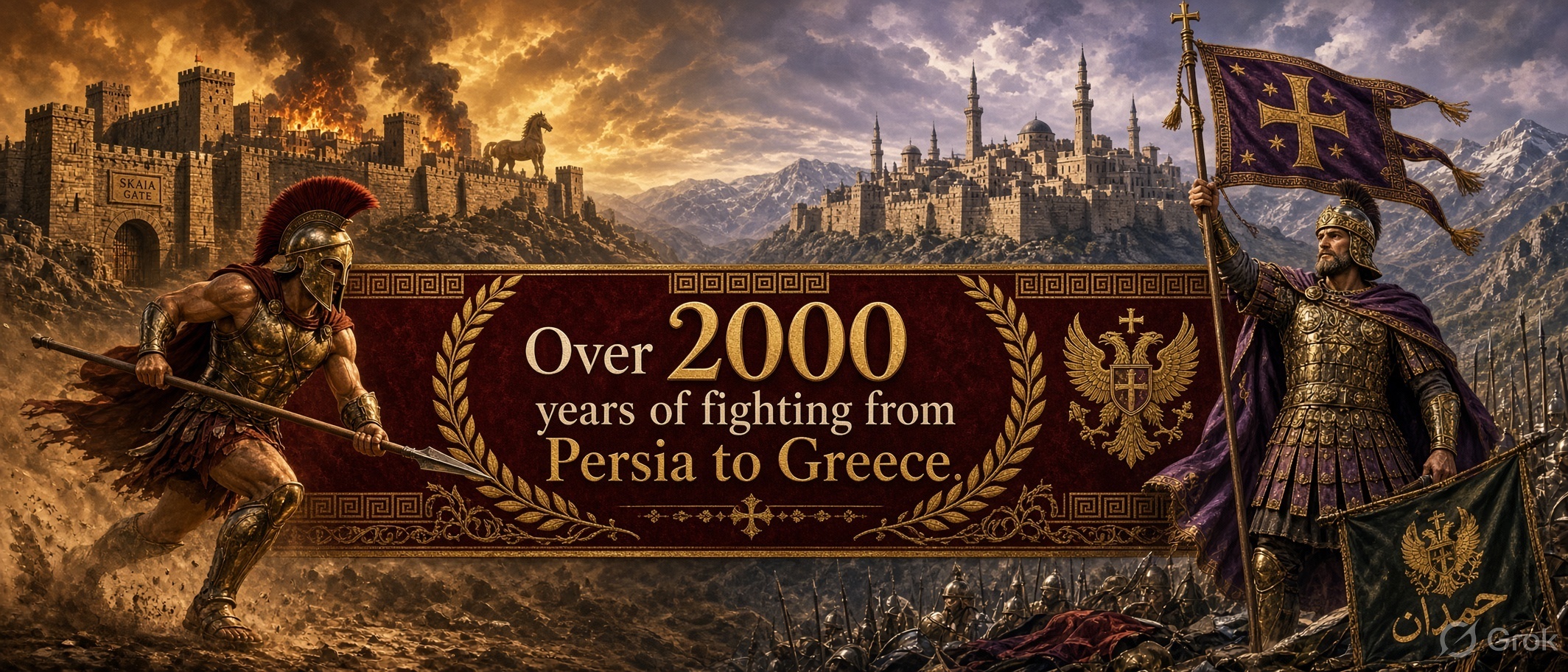
Over 2000 years of fighting from Persia to Greece.
The Battle of Andrassos (or Adrassos), fought on 8 November 960, was a decisive Byzantine ambush victory that broke the offensive power of the Hamdanid Emirate of Aleppo.
Significant Figures
- Leo Phokas the Younger (c. 915–after 971): Byzantine general and younger son of Bardas Phokas the Elder. He rose through eastern theme commands (strategos of Cappadocia, then Anatolikon). Under Emperor Romanos II he became Domestic of the Schools of the West. While his older brother Nikephoros led the main army to Crete, Leo took charge of the eastern defenses and executed the ambush. Later he served as chief minister (kouropalates and logothetes tou dromou) during Nikephoros II’s reign; after Nikephoros’s murder he rebelled against John I Tzimiskes and was blinded.
- Sayf al-Dawla (ʿAlī ibn Abū’l-Hayjāʾ ʿAbdallāh, 916–967): Founder and emir of the Hamdanid Emirate of Aleppo (from 945). Known as the “Sword of the Dynasty,” he was the most formidable Muslim opponent of Byzantium on the eastern frontier in the mid-10th century. He conducted repeated deep raids into Anatolia, patronized poets and scholars (including al-Mutanabbi), and styled himself a leader of jihād. After Andrassos he never again mounted large-scale invasions; hemiplegia and declining authority further weakened him until his death in 967.
- Nikephoros Phokas (later Emperor Nikephoros II, r. 963–969): Leo’s older brother and the dominant Byzantine commander of the period. In 960 he led the major expedition that reconquered Crete (fall of Chandax in 961). His absence created the opportunity Sayf exploited; his subsequent eastern campaigns after returning completed the destruction of Hamdanid power.
- Supporting figures included Constantine Maleinos (co-commander with Leo) and, on the Byzantine side, the broader Phokas family military tradition. Sayf’s force included contingents from Aleppo, Tarsus, and volunteer ghāzīs.
Before the Battle
By the mid-10th century the Byzantine Empire under the Macedonian dynasty had regained strength after earlier losses. Earlier eastern advances under John Kourkouas had been checked by the rise of the Hamdanids. Sayf al-Dawla, based in Aleppo and controlling much of northern Syria and parts of the Jazira, launched repeated raids into Byzantine Asia Minor from the late 940s onward. He scored notable successes in the 950s against Bardas Phokas, but Byzantine fortunes improved after Nikephoros Phokas took command of the eastern armies around 955–956. Leo Phokas and other generals began scoring counter-successes, including raids into Syrian territory.
In 960 Emperor Romanos II (r. 959–963) committed the bulk of the field army—drawn largely from the Anatolian themes—to Nikephoros Phokas’s expedition against the Arab Emirate of Crete. This left the eastern frontier thinly defended. Sayf al-Dawla seized the moment, assembling a large force (contemporary estimates vary widely, often cited around 30,000 including regular troops, Tarsus contingents, and jihād volunteers). He invaded Cappadocia, sacked the fortress of Charsianon, and raided widely, gathering booty and prisoners with little opposition. Leo Phokas, reassigned to cover the east, avoided open battle against the superior numbers and instead prepared an ambush in the Taurus mountain passes through which the Hamdanids would have to return.
The Battle
On 8 November 960 the Hamdanid army, laden with plunder and prisoners, entered the narrow, rugged pass of Andrassos (also called Adrassos or associated with the pass of Kylindros; exact location in the Taurus is unidentified). Byzantine forces under Leo Phokas and Constantine Maleinos, concealed on the heights, waited until the entire column and baggage train were committed to the confined terrain. They then attacked from above and the flanks.
The result was a massacre rather than a conventional battle. The Hamdanids were trapped, their formations broken by the terrain. Byzantine sources (Leo the Deacon, John Skylitzes, and others) describe heavy slaughter; Arab sources later reported that only about 300 cavalrymen escaped with Sayf al-Dawla. The emir himself barely got away, according to Byzantine accounts by scattering coins and valuables to delay his pursuers. Large numbers of prisoners were taken, and the Byzantines recovered the plunder. Leo the Deacon later claimed the bones of the dead could still be seen in the pass years afterward.
After the Battle
Andrassos permanently broke Sayf al-Dawla’s ability to conduct deep, large-scale raids into Byzantine territory. He continued smaller operations and faced internal problems, but his military power and prestige as a jihād leader were irreparably damaged. Growing illness further limited him.
The victory allowed the Byzantines to complete the Cretan campaign without major eastern distraction. After Nikephoros returned in 961, he launched a sustained offensive. In 962 he invaded Cilicia and northern Syria, briefly occupied and sacked Aleppo itself (forcing Sayf to flee), and began the systematic conquest of Cilicia. By 969 the Byzantines controlled Cilicia and the area around Antioch; Aleppo itself was reduced to a tributary/vassal state. The Hamdanid emirate survived in diminished form under Sayf’s son Saʿd al-Dawla, but it was no longer a major independent threat.
The battle marked a clear turning point in the Arab–Byzantine wars on the eastern frontier: the initiative passed decisively to Byzantium and remained there through the campaigns of Nikephoros II and John I Tzimiskes. It also enhanced the prestige of the Phokas family, contributing to Nikephoros’s later seizure of the throne in 963.
= November 8th
These events are a classic “on this day” list, mostly for 8 November (with a few sources dating one or two of them slightly earlier). Here’s a concise overview of each.
960 – Battle of Andrassos (usually dated 8 November)
Byzantine general Leo Phokas the Younger ambushed the Hamdanid army of Sayf al-Dawla, Emir of Aleppo, in a narrow mountain pass in the Taurus (near Kylindros/Andrassos) as the Hamdanids returned from a deep raid into Cappadocia. The Byzantines, though outnumbered, trapped the column in the defile and annihilated most of it. Sayf al-Dawla barely escaped (reportedly by scattering treasure to slow his pursuers) with only a few hundred men. The defeat permanently weakened the Hamdanids and opened the way for later Byzantine advances under Nikephoros Phokas.
1278 – Trần Thánh Tông retires (8 November)
Trần Thánh Tông (Trần Hoảng), second emperor of the Trần dynasty of Đại Việt (Vietnam), formally abdicated in favour of his son Trần Khâm (who became Trần Nhân Tông). He took the title of Retired Emperor (Thái thượng hoàng) while continuing to exercise real influence. Father and son later jointly directed the successful resistance to the second and third Mongol invasions (1285 and 1287–88).
1519 – Cortés enters Tenochtitlán (8 November)
Hernán Cortés and his small Spanish force, accompanied by large numbers of Indigenous allies (especially Tlaxcalans), crossed the causeways into the Aztec capital. Moctezuma II met them with ceremony and gifts and lodged them in the palace of Axayácatl. Within days Cortés took Moctezuma hostage. The initial peaceful entry set the stage for the later conflict that destroyed the Aztec Empire in 1521.
1520 – Stockholm Bloodbath begins (executions mainly 8–9 November)
After conquering Sweden and being crowned in Stockholm, Danish king Christian II (at the urging of Archbishop Gustav Trolle) had roughly 80–100 Swedish nobles, bishops, and burghers executed as “heretics” for their earlier opposition to the Kalmar Union. The massacre (Stockholms blodbad) alienated most of Sweden and triggered the successful revolt led by Gustav Vasa, which ended the Union.
1576 – Pacification of Ghent (8 November)
The States General of the Netherlands signed an agreement uniting the northern and southern provinces against Spanish occupation. It called for the expulsion of Spanish troops, restoration of local privileges, and a halt to religious persecution, while still formally recognising Philip II. It was a high point of national unity in the early Eighty Years’ War, though the alliance later fractured.
1602 – Bodleian Library opens (8 November)
Sir Thomas Bodley reopened and refounded Oxford’s university library (rebuilt around the earlier Duke Humfrey’s Library). With about 2,000 volumes at the start, it became one of Europe’s first truly “public” scholarly libraries and remains a major research institution today.
1605 – Robert Catesby killed (8 November)
The ringleader of the Gunpowder Plot was shot and killed at Holbeche House (Staffordshire) while resisting the Sheriff of Worcester’s forces. The remaining plotters were later executed; Catesby’s body was exhumed, his head displayed, and he was attainted. The plot’s failure is still commemorated on 5 November (Guy Fawkes Night).
1614 – Dom Justo Takayama exiled (left Nagasaki 8 November)
The Japanese Catholic daimyō Justo Takayama (Takayama Ukon), who had refused to renounce his faith, was banished by Tokugawa Ieyasu. He sailed from Nagasaki with hundreds of other Japanese Christians and arrived in Manila, where he was welcomed by the Spanish. He died there a few weeks later (early 1615) and was later beatified.
1620 – Battle of White Mountain (8 November)
Near Prague, the Catholic forces of the Emperor and the Catholic League (under Tilly and Bucquoy) routed the Bohemian and Protestant army of Frederick V (the “Winter King”) in roughly one to two hours. The victory ended the Bohemian phase of the Thirty Years’ War, allowed the Habsburgs to re-Catholicise Bohemia, and crushed the Protestant cause in the region.
1644 – Shunzhi Emperor enthroned (formal ceremony 8 November)
After the Manchus (Qing) took Beijing following the collapse of the Ming, the young Shunzhi Emperor (Fulin) was formally enthroned as the first Qing emperor to rule China proper. Real power remained with the regent Dorgon for several more years. The Qing dynasty would last until 1912.
1745 – Charles Edward Stuart invades England (crossed the border 8 November)
“Bonnie Prince Charlie,” leading the Jacobite army (mostly Highlanders, ~5,000 men), entered England via the western route toward Carlisle. The force reached Derby (about 125 miles from London) by early December before turning back after a council of war. The rising ended in defeat at Culloden in April 1746.
These episodes span Byzantine–Arab warfare, Vietnamese imperial succession, the Spanish conquest of Mexico, the Kalmar Union crisis, the Dutch Revolt, English library history, the Gunpowder Plot, Japanese Christian exile, the Thirty Years’ War, the Qing conquest of China, and the last major Jacobite rising.