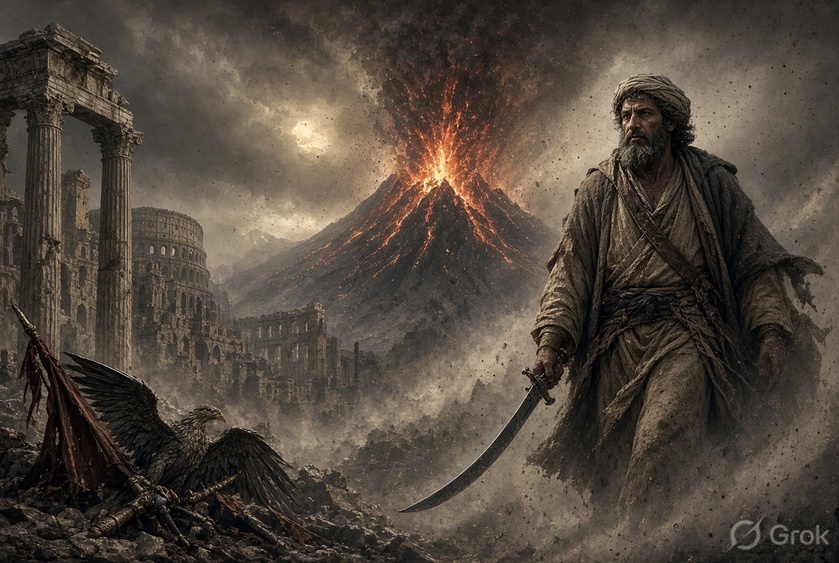
The disasters of 536 AD presaged the new world and bookended the old
The volcanic winter of 536, the cold decade that followed, and the Plague of Justinian did not invent a new map of the world. They made the old one harder to keep.
A long war of attrition between the Mediterranean and Iran had already strained both. Greco-Persian conflict, then Roman–Sasanian war, ran for centuries. By the sixth century the two great empires were still formidable, but they were not inexhaustible. Climate shock pushed Persia closer to the brink. Muhammad was born about a generation later, traditionally around 570. He was an unlettered man of Mecca, formed in a world of Arabian paganism and of Christian and Jewish communities already present on the peninsula. After the Hijra he came into conflict with three Jewish tribes of Medina—Banu Qaynuqa, Banu Nadir and Banu Qurayza—who were expelled or, in the last case after the siege of 627, subjected to the judgment that followed a charge of wartime betrayal. Muhammad died in 632. It was not he but the Rashidun caliphs, above all Umar, who took Syria from an exhausted Byzantium: Yarmouk in 636, Jerusalem in 637/638. The climate and plague years of the 530s and 540s sit behind that sequence as a preface, not as a single cause.
Established powers in Europe also changed
From 536 onward the map of European power shifted from a still-recognisable late-Roman world—one surviving imperial state plus several Germanic successor kingdoms—into the fragmented, more northerly political landscape of the early Middle Ages. The volcanic winter of 536, the Plague of Justinian from 541, and Justinian’s wars accelerated that change.
Byzantium: from Mediterranean superpower to reduced eastern empire
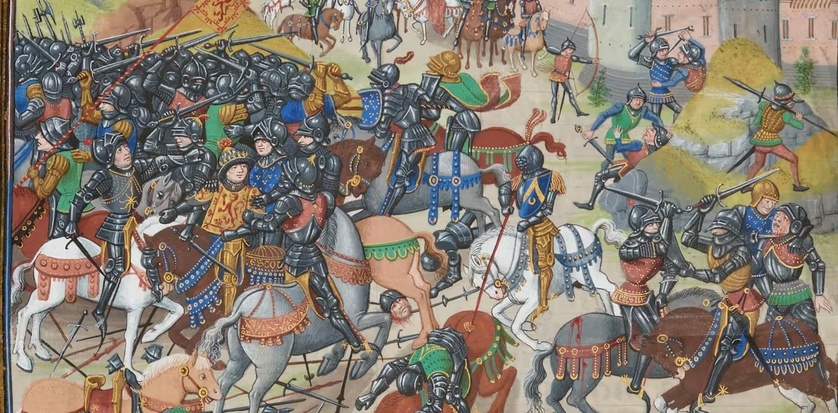
In 536 Justinian’s empire was still the strongest state in Europe and the Mediterranean. Belisarius had just begun the reconquest of Italy; North Africa was already recovered. That high-water mark did not last. The Gothic War (535–554) wrecked Italy. After Justinian’s death in 565 the Lombards invaded in 568 and took most of the peninsula; Byzantium kept only the Exarchate of Ravenna, Rome and parts of the south and Sicily. Slavs and Avars overran much of the Balkans in the later sixth and seventh centuries. The Arab conquests of the 630s–640s then stripped away Syria, Egypt and North Africa. By the late seventh century the empire that had once stretched from Spain to the Euphrates was reduced to Anatolia, Constantinople and a few coastal or island holdings. It survived as a Greek-speaking, Orthodox state until 1453, but it was no longer the dominant power in Europe.
Italy: from Ostrogothic kingdom to patchwork
The Ostrogothic kingdom that Theodoric had ruled as a relatively stable Romano-Gothic state was destroyed by the long Gothic War. Italy emerged depopulated and impoverished. The Lombards established a kingdom in the north, with its capital at Pavia, plus independent duchies in the south. Byzantine remnants clung to Ravenna and the south until the eighth century. The popes in Rome gradually became independent political actors. Charlemagne conquered the Lombard kingdom in 774; Italy thereafter remained divided among Frankish and Carolingian successors, the papacy, and later local powers. The peninsula never recovered the unity it had under Theodoric or, briefly, under Justinian.
The Franks: the new western core
The Frankish kingdoms in Gaul were already the strongest of the western successor states in 536. They became the central power of Latin Europe. The Merovingian kings gave way in practice to the mayors of the palace; Charles Martel halted a Muslim raid at Tours in 732. His son Pepin became king in 751 and his grandson Charlemagne, ruling 768–814, built an empire that covered most of modern France, Germany, the Low Countries, northern Italy and parts of central Europe. Crowned emperor in 800, he created the first large post-Roman imperial structure in the West. After the Treaty of Verdun in 843 that empire split into West Francia, the nucleus of France; East Francia, the nucleus of Germany; and a middle kingdom. The Carolingian and later Ottonian worlds shifted Europe’s political centre of gravity northward, away from the Mediterranean.
Spain, Britain and the Balkans
Spain: the Visigothic kingdom continued until the Muslim invasion of 711. Most of the peninsula became al-Andalus; small Christian kingdoms in the north began the long Reconquista.
Britain: Anglo-Saxon kingdoms consolidated after the Roman withdrawal. Conversion to Christianity and later Viking pressure produced larger units, culminating in the rise of Wessex.
Balkans: Slavic settlement and the Avar khaganate replaced much of the old Roman provincial structure; the First Bulgarian Empire emerged in the late seventh century.
The larger pattern
By the eighth and ninth centuries the old Mediterranean-centred late-antique system had given way to a Europe of smaller, more rural, more militarised kingdoms whose elites were often Germanic in origin but Christian and increasingly literate in Latin through the Church. The 536 climatic shock and the plague contributed to population loss and economic contraction that made the old imperial model harder to sustain in the West. Byzantium remained a sophisticated state, but it was now one power among several rather than the heir of a universal Roman empire. The Franks, and later the Ottonians, became the main political reference point for western Europe.
China left a clear paper trail of disaster; India did not
The 536 volcanic winter and the cold decade that followed hit East Asia hard enough to appear in official histories. The Indian evidence is thinner and more indirect.
China
In 536 China was still divided: Eastern and Western Wei in the north, after the Northern Wei split in 534, and the Liang dynasty in the south. Chronicles record anomalies of the same years seen in the Mediterranean.
Summer frost and snow: the Nan Shi notes frost in July 537 and snow in August in Qingzhou that ruined crops. Yellow dust “fell like snow.” Drought and famine followed. Southern courts issued tax amnesties in 538 for twelve famine-struck provinces.
The north suffered worse. The Bei Shi and Zizhi Tongjian describe a “great famine” in Guanzhong, the Wei heartland around modern Shaanxi. Official language says people ate one another and that “70 to 80 percent of the population died” in the worst-hit districts. That is the voice of the chronicle, not a modern census; even as rhetoric it records catastrophe. Inspectors were sent to deal with starving refugees north of the Yellow River.
The haze itself is less explicitly described than in Byzantine or Italian sources—much of China lies south of the latitudes where the thickest veil was reported—but the agricultural collapse is unambiguous. Cold summers, failed harvests and famine struck a society already fragmented by civil war. Some popular accounts tie the event to the “collapse of the Northern Wei,” but that dynasty had already broken apart two years earlier; the climate shock hammered its successor states instead. Steppe groups facing poorer pasture in a cooler, drier Central Asia also increased pressure on the northern frontiers.
China recovered and reunified under the Sui in 581 and then the Tang. The 536 episode was a severe regional catastrophe, not a civilisational endpoint.
India
Direct written testimony of a darkened sun or summer snow is essentially absent. Some reconstructions note that the dust veil was reported mainly north of about 35° N; much of the subcontinent lies farther south, so the optical effects may have been weaker. Tree-ring and monsoon studies show sixth-century variability, but they do not isolate 536 with the same sharpness as Chinese or European records.
What was happening in India was already political and military. The Gupta Empire, which had dominated northern India in the fourth and fifth centuries, was in steep decline. Alchon Hun rulers—Toramana and then Mihirakula—had been campaigning across the northwest and Gangetic plain since the early 500s. By the 530s the Guptas had lost effective control of large parts of the north. Climate stress on the Central Asian steppe may have added to Hun mobility, and poorer harvests would have weakened Gupta revenues and armies, but the Hun invasions themselves predate 536 and are the better-attested cause of Gupta collapse. Later popular writing sometimes folds the 536 event into a single climate-plus-pandemic-plus-migration story of Gupta and later Chola decline; the chronological fit for the Guptas is loose.
South India and the Deccan were less directly tied to the northern Hun wars and show no comparable cluster of disaster reports for these exact years.
Contrast with Europe and Byzantium
China’s bureaucratic historians recorded frost, snow, dust, famine and mortality in the same years Procopius and Cassiodorus described a dim sun. India produced no equivalent contemporary annal for 536. The volcanic winter was a Northern Hemisphere event whose worst documented human effects clustered in Europe, the Mediterranean, and north China. In India the mid-sixth century was already a time of imperial contraction and invasion; the climate downturn was at most an aggravating factor, not the main documented driver.
Beyond the written empires
There were no “nations” in the modern sense, and almost no written chronicles outside the Mediterranean and Nile worlds. What we have for the Americas is archaeology plus ice cores, lake sediments, tree rings and volcanic ash. For most of Africa south of Egypt and Aksum the mid-sixth century is nearly silent in dated texts.
The Americas
Several major societies were active in 536.
Teotihuacan, in the Basin of Mexico, was still the largest city in the Americas, a multi-ethnic highland capital of perhaps 80,000–150,000 people. Its political collapse is usually placed later, around 550–650, when the ceremonial core was burned and the population shrank. Some climate reconstructions show drying and instability in central Mexico in the sixth and seventh centuries; a few scholars treat the 536–540 volcanic forcing as one stress among others—internal conflict, over-exploitation, drought. It was not a sudden 536 wipe-out.
Maya lowlands and highlands: the mid-sixth century is the Early-to-Late Classic “hiatus”—fewer dated monuments, some sites disrupted, possible short drought. Two Central American volcanoes matter locally as well as globally. Ilopango in El Salvador produced the huge Tierra Blanca Joven eruption; recent work dates it to about 539/540 and treats it as a leading candidate for the tropical eruption that shows up in both Greenland and Antarctic ice. Ash buried large areas of the southern Maya highlands and western El Salvador; estimates of local deaths run into the tens of thousands. El Chichón in Mexico has also been proposed around 540. Lowland drought is inferred from lake cores and from the way volcanic cooling can push the Intertropical Convergence Zone south, reducing summer rain. Recovery and the Late Classic florescence followed.
The Moche of the north coast of Peru depended on irrigation in a desert. Quelccaya ice-core records show drought intervals that include the 520s–540s, followed later in the century by heavy rain and then more drought and advancing sand dunes. Around 500–600 the culture reorganised from Moche IV to V: the old capital at Huacas del Sol y de la Luna was damaged by flood, then sand, and power shifted north. Climate is a serious candidate for that stress, alongside internal politics. A single “536 event” is harder to isolate than the longer mid-century swing.
In the US Southwest, tree rings from the Colorado Plateau record extreme cold in 536–545, among the coldest stretches in two millennia. One interpretation is that the shock disrupted scattered early farming groups and helped open the way for the more organised, village-based Ancestral Pueblo pattern that followed. North of Mexico there were no cities comparable to Teotihuacan. Effects would have been on foraging and small farming communities; they leave little dated narrative.
Africa
North Africa was already inside the Byzantine world after Justinian’s reconquest of the Vandal kingdom in 533–534. The same volcanic winter, poor harvests and, from 541, the Justinianic plague that hit the Mediterranean also hit Carthage and the Maghreb. That story belongs with Byzantium, not with a separate African nation.
Aksum, in Ethiopia and Eritrea, was a Christian kingdom that still minted coins and had recently intervened in South Arabia. It sat on the Red Sea trade routes that also served Byzantium and Himyar. Climate model runs for 536/540 suggest cooling plus mixed rainfall: some simulations show dryness over the Sahara, northeast Africa and the Arabian Peninsula in the rainy season, and wetter conditions farther south in East Africa. There is no Aksumite chronicle that says the sun went dark in 536. Any effect would have been on highland agriculture and Nile-headwater rains, not a documented collapse. Aksum remained important into the seventh century.
West and southern Africa: the Ghana, or Wagadu, empire as a named gold-trading state is usually dated later, roughly seventh to thirteenth centuries. Earlier complex societies existed in the Sahel, but they did not leave year-dated records of 536. Meroë and Kush in Nubia had already faded in the fourth century. Sub-Saharan written sources for this exact decade are effectively absent.
What the evidence will and will not support
The 536–540 eruptions were a Northern Hemisphere shock with a tropical component, very likely including Ilopango. Mesoamerica felt both the global cooling and drought pattern and local ash. The Andes felt drought, flood and dune advance on a slightly broader mid-century timetable. Africa south of the Byzantine and Aksumite zones has almost no contemporary testimony.
Linking every later political change to “536” is speculation. The securely documented human disasters remain those written down in the Mediterranean and China, and those read archaeologically in parts of Mesoamerica and the Peruvian coast. The year bookended an older Mediterranean order and prefaced a world in which Islam, the Franks and a reduced Byzantium would share what Rome had once claimed alone. That is a large claim. It is large enough without making the volcano the author of every sequel.