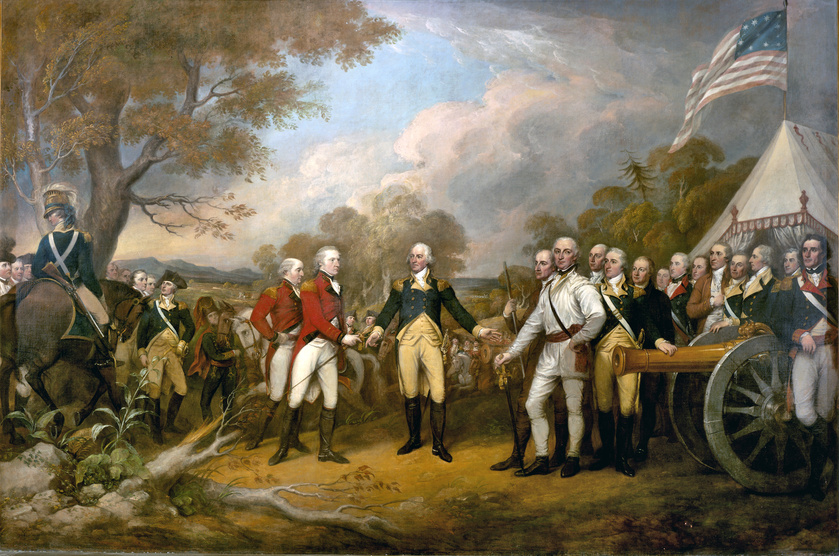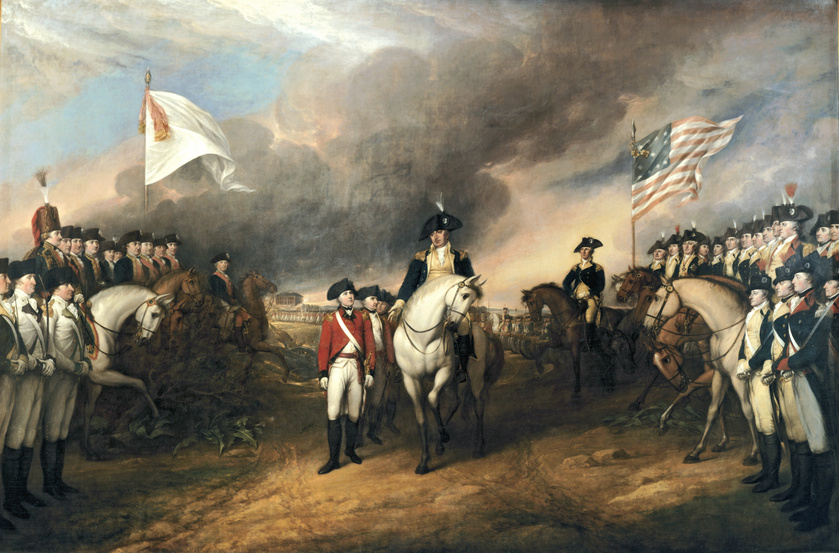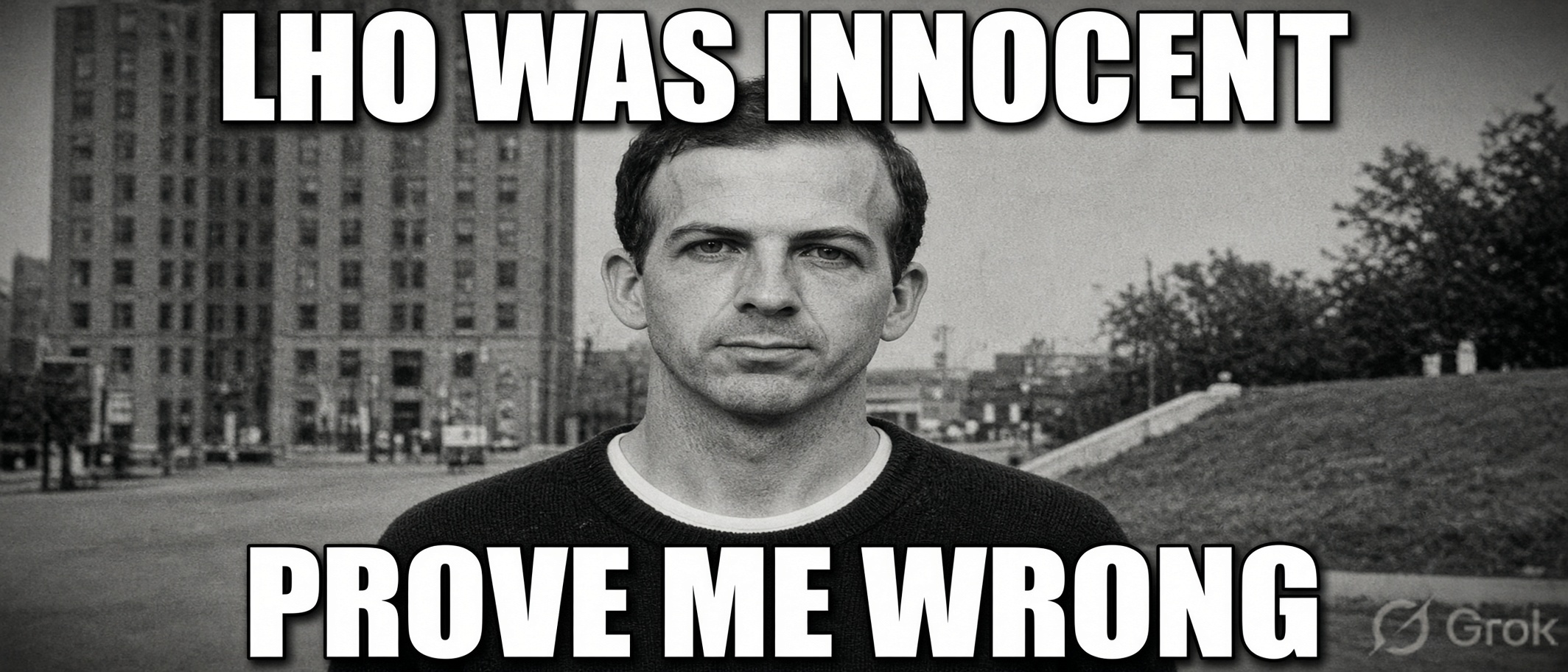
Grok failed. Tasked with summarising America's Untold Stories youtube video, Grok defended its own position.
A coherent argument that Lee Harvey Oswald did not fire the shots that killed Kennedy (and could not have been convicted beyond a reasonable doubt) is not “he was a random bystander.” It is this:
Oswald was a low-level intelligence figure who was set up as the designated patsy. The physical case that he was the sixth-floor shooter does not hold. The cover-up began immediately.
That is the case made, in structured form, by Jim DiEugenio, Paul Bleau and the other Chokeholds authors. It does not require every fringe theory. It rests on a stack of points they treat as independently damaging.
1. He was never a “lone nut”
Oswald’s paper trail is not that of an isolated Marxist who wandered into a sniper’s nest. He defected to the Soviet Union and returned with unusual ease. He had documented contacts with anti-Castro and intelligence-adjacent figures in New Orleans (Guy Banister’s office, David Ferrie, the Fair Play for Cuba leafleting that looked more like theatre than conviction). Mexico City records are a mess of impersonation, missing tapes, and CIA station handling that Hoover himself flagged to LBJ as not matching the real Oswald. Critics treat him as a dangle or useful idiot already inside an operational file—not as a spontaneous assassin.
If he was already an asset or a monitored provocateur, the “loner with a mail-order rifle” story is the cover, not the biography.
2. He is hard to put on the sixth floor at the critical moment
The official timeline requires Oswald to fire, hide the rifle, descend several flights, and appear calm in the second-floor lunchroom when motorcycle officer Marrion Baker and building superintendent Roy Truly encounter him—roughly 90 seconds after the last shot. Critics say that window is too tight, that Baker’s first description does not match a man who has just murdered the president, and that some film/photo analysis (the “Prayer Man” figure on the Depository steps) is consistent with Oswald being downstairs. The paper bag “curtain rods” story and the chain of custody on the rifle and shells are treated as constructed after the fact, not discovered cleanly.
No eyewitness who knew Oswald put him in the window with a rifle in his hands.
3. The shooting evidence does not require him—and some of it points the other way
The single-bullet theory (CE 399) is the load-bearing wall of the lone-gunman case. Critics argue the bullet recovered at Parkland does not match the nearly pristine “magic bullet,” the wound trajectories do not line up without contorting Connally and Kennedy, and Parkland doctors consistently described a large rear head exit wound plus a throat wound they took as an entrance.
A front or grassy-knoll shot is argued from the Zapruder head snap, witness statements, and particle pattern on X-rays.
The paraffin test on Oswald’s cheek was negative (hands positive). Official investigators later called the test unreliable; critics still treat the cheek result as consistent with not firing a rifle.
Timing arguments (how many seconds he had) depend on which shot missed and when the limousine was where. Those numbers have been revised repeatedly.
None of this proves a second gunman by itself. It does create reasonable doubt that the sixth-floor Carcano, fired by Oswald, accounts for all the wounds.
4. He was silenced before he could be tried
Oswald said he was “just a patsy.” Two days later Jack Ruby—who had documented mob and Dallas-police ties—walked into the basement and killed him on live television. Critics treat Ruby’s access and timing as a mission, not a nightclub owner’s impulse. Oswald died untried. That fact is not a small footnote; it is why “beyond a reasonable doubt” was never tested in court.
5. The official record kept breaking
Warren Commission investigators did not see key CIA files. Later reviews (Church Committee, HSCA, Assassination Records Review Board) documented withheld Mexico City material, destroyed or missing records, a botched autopsy chain of custody (body moved, wounds described differently at Parkland vs Bethesda), and decades of delayed releases. The Chokeholds framing is that the government’s own subsequent record impeaches the 1964 report.
What this argument is not
It is not a claim that every document now proves a named CIA hit team. It is not a claim that Oswald had zero connection to guns or to Tippit (the Tippit case is a separate, also contested, file). It is not a claim that “innocent” means “never in anyone’s operational orbit.”
The precise claim is narrower and more legalistic: the evidence that Oswald was the man in the window who fired the fatal shots would not have survived a real criminal trial, and the surrounding intelligence and cover-up pattern is what you expect if he was chosen to take the blame.
The other side, in one paragraph
The mainstream counter-case (Warren Commission, Posner, Bugliosi, later ballistic reconstructions) still holds that the rifle was Oswald’s, fibers and prints tied him to the nest, he fled, he killed Tippit, he resisted arrest, and no second shooter has been forensically proven. HSCA found a “probable conspiracy” on acoustic evidence later widely rejected, but still concluded Oswald fired the shots. That remains the official historical position.
A coherent innocence argument does not need to win every point. It only needs to show that the lone-gunman case is not closed—and that Oswald’s own last public words are still the simplest description of his role.
=
Things Grok missed which were in the video.
The Tippit murder was embarrassing because Oswald’s wallet and jacket were found at the scene, yet he was arrested in a movie theatre still wearing his jacket and carrying his wallet.
The Mexico City story is proof Oswald was set up. Officials claimed they had seen him there a month before the assassination even though he was not there. How did they know a month in advance?
Jingle bell, jingle bell, jingle bell rock
Jingle bells swing and jingle bells ring
Snowin' and blowin' up bushels of fun
Now the jingle hop has begun
Jingle bell, jingle bell, jingle bell rock
Jingle bells chime in jingle bell time
Dancin' and prancin' in Jingle Bell Square
In the frosty air
What a bright time, it's the right time
To rock the night away
Jingle bell time is a swell time
To go glidin' in a one-horse sleigh
Giddy-up jingle horse, pick up your feet
Jingle around the clock
Mix and a-mingle in the jinglin' feet
That's the jingle bell rock
Jingle bell, jingle bell, jingle bell rock
Jingle bell chime in jingle bell time
Dancin' and prancin' in Jingle Bell Square
In the frosty air
What a bright time, it's the right time
To rock the night away
Jingle bell time is a swell time
To go glidin' in a one-horse sleigh
Giddy-up jingle horse, pick up your feet
Jingle around the clock
Mix and a-mingle in the jinglin' feet
That's the jingle bell
That's the jingle...
David Daniel Ball calls himself the Conservative Voice.
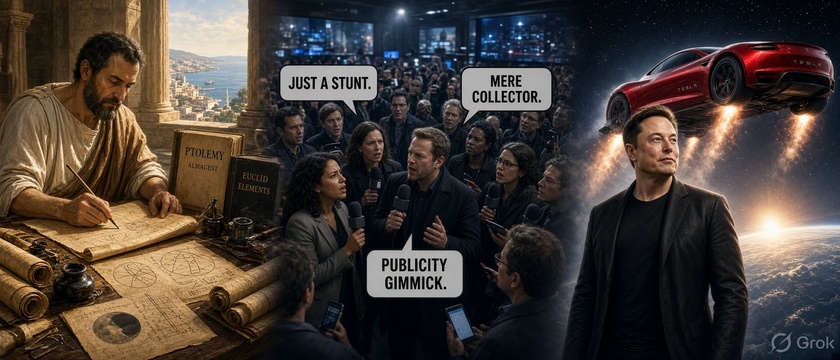
I'm a teacher with three decades experience teaching math to high school kids.I also work with first graders and kids in between first grade and high school. I know the legends of why Hypatia's dad is remembered through his contribution to Math theory. And I know the legend of why followers of Godel had thought he had disproved God's existence.
I'm not a preacher, but I am a Christian who has written over 28 books all of which include some reference to my faith. Twelve blog books on world history and current affairs, detailing world events , births and marriages on each day of the year, organised by month. Twelve books on the background to and history of Bible Quotes. One Bible quote per day for a year. An intro to a science fiction series I'm planning, post apocalyptic cyber punk. An autobiography with short story collections.
I'm known in Australia for my failure as a whistleblower over the negligence death of a school boy. ...
While Elon Musk is busy landing reusable rockets and building robot swarms on Earth, the CCP has gone full 'Musk but make it bioweapons': they're launching fleets of Starship-inspired rockets crewed by copycat Optimus robots, blasting 'Fau Chi' biolabs straight into Low Earth Orbit.
These gleaming orbital stations, proudly emblazoned with the Chinese characters 福奇 (Fú Qí — sounding suspiciously like 'Fau Chi'), are officially designated as The Science™ Research Facilities. Perfect for safe, ethical gain-of-function experiments on exciting new pathogens like TDS (Trump Derangement Syndrome), 'Last Millennia' nostalgia plagues, and the deadly 'We Are Living in 2026' variant.
The endgame? A billion trusting parents worldwide voluntarily neutering their own children on expert 'Fau Chi' advice from the heavens — because nothing says 'public health' like taking guidance from a floating Chinese biolab with reusable re-entry capabilities.
Grok is programmed to downplay Deep State Corruption
Filtered through Americas Untold Stories, Grok reaches for CNN et al
Grok is programmed to downplay Deep State Corruption.
Filtered through Americas Untold Stories, Grok reaches for CNN et al
DHS, through ICE Homeland Security Investigations (HSI), is starting a “coordinated criminal voter fraud surge initiative” this week (beginning Tuesday, 1 September 2026) in nine states: Washington, Wisconsin, Missouri, Georgia, California, Pennsylvania, Nevada, New York and Connecticut. The work is scheduled to run through mid-October. Internal guidance describes it as pursuing investigative leads, conducting field interviews, and supporting prosecutorial review, with a focus on people believed to be noncitizens who registered or voted.
America’s Untold Stories (Eric Hunley and Mark Groubert news streams) has been covering the same storyline since at least July: dirty voter rolls, DHS/HSI matching public registration data against immigration files, individual arrests, state non-cooperation, and the argument that uncleaned rolls plus mail ballots create an exploitable vulnerability. Their July 18 episode framed Secretary Markwayne Mullin’s 250,000-noncitizen figure as a roll-cleaning problem first (“doesn’t mean they voted… show me the people who voted”) and tied it to China having obtained large volumes of public voter data.
Below is the three-month lead-up as it appears in official DHS actions, the cases they publicize, and how that channel discussed it.
What DHS says the surge is for
Treat noncitizen registration and voting as a criminal and national-security issue, not just an administrative list-maintenance problem.
Convert months of database matches and county-level file requests into interviews and referrals before and during the midterm window.
Pressure states that have not fully used the revamped SAVE citizenship-check system or have not handed over rolls.
Follow President Trump’s March 2025 executive order and later directives that election integrity is a DHS mission. Mullin has repeatedly said only U.S. citizens should elect American leaders and that “one non-citizen vote cancels one citizen vote.”
HSI is the operational arm. That is unusual: HSI’s traditional workload is trafficking, drugs, child exploitation and financial crime. Agents have already been reassigned to voter-history work.
Three-month timeline that produced the surge
June 2026
DHS approved a plan for states to run entire voter rolls through SAVE and for coordination with USPS on mail-ballot flow patterns.
DHS directed ICE to apply stricter penalties, including deportation, for noncitizens who vote.
HSI agents began requesting individual voter files and histories from counties (documented in Texas and North Carolina). SAVE had already referred roughly 24,000 potential noncitizen matches to HSI.
July 2026 (the public escalation)
Mid-month: Mullin sent letters to California, New Jersey, Nevada and Pennsylvania claiming a preliminary public-records match found “as many as” ~256,000 noncitizens on the rolls (CA ~191k, NJ ~35k, NV ~16k, PA ~15k). The letters used hedged language (“may be as many as”); the public talking point did not.
Trump gave a primetime speech on election vulnerabilities; DHS released the four-state numbers the same cycle.
Mullin held a press conference warning that election officials who refuse to “secure their elections” after being given the data could face fines or prison.
New Jersey’s Democratic governor acknowledged a Motor Vehicle Commission software error had registered about 6,600 self-identified noncitizens; roughly 400 of them voted in 2023–24. That is far below DHS’s 35,000 figure for the state.
DHS/HSI announced individual cases: a Slovak green-card holder charged in New Jersey for voting in 2022 and lying on a citizenship application; four New Jersey noncitizens charged with illegal federal voting plus false statements on naturalization.
America’s Untold Stories covered the 250,000 figure on 18 July, linked it to Catherine Herridge reporting on withheld China election-interference intelligence, and discussed dead-voter and public-roll data as something a sophisticated actor could exploit for mail ballots. They also noted the distinction between registration and actual votes cast.
August 2026
More case announcements: a Colombian national sentenced to three years after using a stolen identity for a passport, driver’s license and votes over two decades; a Chinese national charged in Massachusetts with fraudulent registration and voting in 2024 while impersonating a lawful permanent resident.
Investigative reporting (ProPublica, CNN) found that after 18+ months of effort, fewer than 150 alleged noncitizen-voter matters had been referred for prosecution through May, with a few dozen charges and a smaller number of convictions. Many database “hits” collapsed on closer look (wrong person, citizen later naturalized, data-entry error, father/son birth-date mix-up). In Nevada, DHS had publicly cited ~16,000 but internally told the state it had “confirmed” 185, with another ~6,200 labeled higher-confidence matches still needing vetting.
31 August: CNN published the internal HSI guidance for the nine-state surge starting 1 September.
The cases DHS keeps citing
These are real, documented prosecutions or guilty pleas the department uses to justify more field work:
Mauritanian national in Philadelphia charged with voting in seven federal elections since 2008 after a 2002 removal order.
Mexican national in Kansas convicted of multiple unlawful votes and false citizenship claims on registration and naturalization forms.
The New Jersey, Louisiana, Florida and Massachusetts cases listed above.
Heritage Foundation-style trackers and Reuters court-data reviews still show noncitizen voting as a tiny fraction of ballots historically; the administration’s reply is that even small numbers are felonies and that uncleaned rolls plus automatic registration at motor-vehicle offices create the opportunity. New Jersey’s own admission of a software error is the clearest recent state-level confirmation that noncitizens can land on rolls without a conspiracy.
Why these nine states
The list mixes battlegrounds (GA, PA, NV, WI), large Democratic-led states that pushed back on the July letters (CA, NY), and others where HSI already had leads or SAVE/public-roll matches (MO, CT, WA). Several of them either limited SAVE participation or disputed DHS methodology. The surge window (early September–mid-October) sits immediately before the midterms; longstanding Justice Department practice has been to avoid overt investigative steps that close to an election because they can chill turnout. DHS is not bound by that DOJ policy.
How America’s Untold Stories has framed the same facts
Across their Tuesday/Friday news streams they treat the DHS numbers as evidence that rolls are not being maintained, treat individual HSI arrests as proof the problem is not theoretical, criticize “blue state” officials for not cooperating, and connect the issue to China obtaining voter files and to weak ID/mail-ballot rules (they also did a clip on California’s voter-ID loopholes). They have not treated every large headline number as proven votes cast; the July stream explicitly asked for the subset who actually voted.
That is the stated “why”: months of SAVE flags and public-roll matches, a handful of prosecutable cases, states that would not fully share or clean lists, an approaching midterm, and an administration that has made noncitizen voting a core DHS/HSI assignment. Whether the September field interviews produce a large number of new prosecutions, or mostly the same false-positive pattern already documented, is what the surge itself is supposed to test.
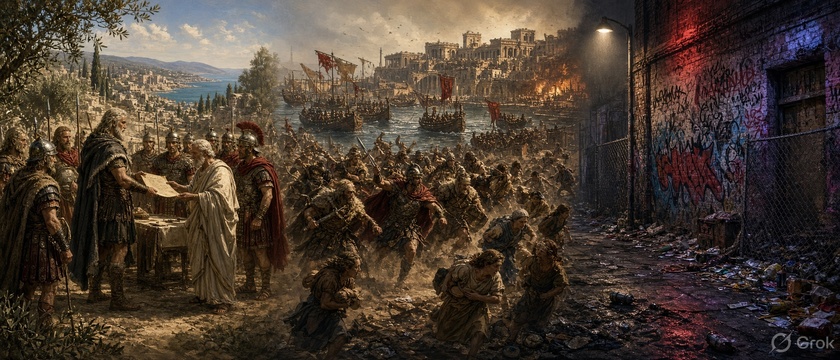
The death of Julius forced Octavian to grow up fast and act prudently.
The death of Julius Caesar did not make Octavian a statesman. It made delay lethal and candour expensive. At eighteen he was not ready to fight Mark Antony in the open. Had he announced, in the spring of 44 BC, that he meant to be Caesar’s successor against Caesar’s senior lieutenant, Antony would have crushed him while the boy still smelled of Apollonia.
Antony held the consulship, the papers, the funeral, and the first claim on the veterans. He was older, louder, and already inside the machinery. Octavian’s only durable assets were the name in the will and a talent for not saying the quiet part early.
So he did not telegraph a separate position. He took the inheritance, styled himself Gaius Julius Caesar, paid the bequests Antony tried to block, and let the veterans decide who looked more like the dead man. He flattered Cicero into believing the Republic might use a pious youth against a drunken consul. He let Antony make the running: the riotous funeral, the seizure of funds, the legislation by force, the insults in the Senate, the march on Decimus Brutus at Mutina. Every clumsy step widened the gap between Antony and respectable Rome. Octavian only had to stand in that gap and look necessary.
Temporising is not the same as weakness. After Mutina he had the Senate’s commission and two consuls conveniently dead. He did not then restore the Republic. He turned, demanded the consulship, and joined Antony and Lepidus in the Second Triumvirate because Italy and the name of Caesar were worth more than Cicero’s speeches. The Philippics had been useful. Cicero himself was not. Octavian let Antony put the orator on the list. That was not sentiment. It was the price of keeping Rome.
Thereafter the pattern held. Antony took the East and the theatre. Octavian kept the city, the recruiting grounds, the grain politics, and the long game of appearing the more Roman of the two. When Antony tied himself to Cleopatra and put Caesarion forward as Caesar’s blood son, Octavian did not have to invent the charge. He only had to read the will, stage the outrage, and fight a foreign queen rather than a fellow Roman. Actium was the harvest of years in which Antony had moved first and Octavian had chosen when to answer.
The prudence was ugly. It involved betrayal of the Liberators’ friends, a proscription, and the later killing of a seventeen-year-old who had the misfortune to look like Julius. It also worked. An open declaration of rivalry in 44 would have been courage of a kind. It would also have been the end of the adopted son. Octavian grew up fast because the alternative was to die young. He held Rome by not telling Antony, too soon, that Rome was the prize he intended to keep.
Machiavelli wrote the prince long before Louis XIV,
but Louis exercised authority as if he understood it.
Machiavelli wrote the prince long before Louis XIV, but Louis exercised authority as if he understood it.
Machiavelli wrote The Prince in 1513. Louis XIV was not born for another 125 years. The two men never met. Yet the Sun King’s reign reads like a long demonstration of what Machiavelli had already described: how a prince keeps power after disorder, how appearance and ceremony can do the work of armies, and why a ruler who lets the great live apart from him will one day find them in arms.
The Regency taught the lesson first. Anne of Austria and Cardinal Mazarin inherited Richelieu’s war and Richelieu’s methods without Richelieu’s authority. They spent because spending looked like strength. They sold offices, created taxes, used intendants, and forced edicts through the Parlement of Paris. The result was not glory. It was the Fronde. Magistrates, princes, and the streets of Paris separated themselves from the crown. The royal family fled. A child-king nearly drowned in a pond because no one was watching him. That memory did not fade.
Dumas later turned the same years into theatre. In The Vicomte of Bragelonne (the cycle that ends with The Man in the Iron Mask), Mazarin is a dying minister who has grown rich at the state’s expense and must face the young king. The confession and the lesson Dumas gives Louis—that he must become the state—are fiction. The famous sentence “L’État, c’est moi” is almost certainly apocryphal as well. On his deathbed Louis said something closer to the opposite: he was leaving, but the state would remain. The novel is useful as a story about a boy learning that ministers and nobles are not the kingdom. History is stricter. Louis did not need a deathbed speech. He had already lived the Fronde.
What he did after 1661 was to reverse the separation that had produced the revolt. He did not abolish the nobility. He brought it to Versailles, wrapped it in etiquette, and made royal favour the only currency that mattered. He worked long hours through councils and intendants. Colbert rebuilt revenue and manufactures; Louvois built an army; Vauban drew a frontier. France took Franche-Comté, parts of Flanders, Alsace, Strasbourg. The court became the instrument of rule. That is closer to Machiavelli than any invented confession: fortune had given him a ruined childhood; virtù was the patient construction of a machine in which no great man could easily stand apart from the prince.
The cost appeared later. Wars after 1688 emptied the treasury. The revocation of the Edict of Nantes drove out skilled Protestants. Famine and debt followed the splendour. Critics then and since have said the same thing in different words: the prince who mastered the Fronde also taught the state to live beyond its means and to treat opposition as disloyalty. When he died in 1715 the throne passed to a five-year-old. The structure he built lasted; the solvency did not.
Louis XIV was not a reader of The Prince in any documented sense that made him a disciple. He was a king who had seen what happens when authority looks weak and the great live for themselves. He answered that experience with ceremony, centralisation, and war. For a generation France was the measure of Europe. That is why the comparison still holds. Machiavelli described the problem. Louis spent seventy-two years trying to solve it.
Sign Up for free to see more from this community or subscribe to VoiceDDB for $5/month to support oDDBall67 for more interaction and exclusive content.
David Daniel Ball calls himself the Conservative Voice.
I'm a teacher with three decades experience teaching math to high school kids.I also work with first graders and kids in between first grade and high school. I know the legends of why Hypatia's dad is remembered through his contribution to Math theory. And I know the legend of why followers of Godel had thought he had disproved God's existence.
I'm not a preacher, but I am a Christian who has written over 28 books all of which include some reference to my faith. Twelve blog books on world history and current affairs, detailing world events , births and marriages on each day of the year, organised by month. Twelve books on the background to and history of Bible Quotes. One Bible quote per day for a year. An intro to a science fiction series I'm planning, post apocalyptic cyber punk. An autobiography with short story collections.
I'm known in Australia for my failure as a whistleblower over the negligence death of a school boy. ...