VoiceDDB
Politics • Culture • News
Grok Has a Tell
Eric Hunley’s “Oklahoma City Bombing” playlist
11 hours ago
post photo preview

Grok Has a Tell

Grok is brilliant for me. I say that without flattery. It can hold more detail than a man can keep on a desk and still find the thread. It is not perfect. It is, at its best, truth-seeking. That is why the failures matter. They are not random.

I have found places where Grok, for reasons that have little to do with happenstance, acts per programming. There is a tell.

A few years back I tested AI on the daughters of Mary Wollstonecraft. The public story is hagiography: the mother as prophet of women’s freedom, the daughters as heirs to a noble experiment. Drill down and the lives are desperate. Fanny Imlay took her own life. Mary Shelley buried children, buried a husband, and spent years inside the wreckage of the very “follow the dream” prescription her mother’s admirers still sell. The data points are not hidden. They are merely inconvenient to a certain kind of adulation. Bring those points up and Grok recognises them. It will follow the record past the shrine.

Bring up the assassination of John Kennedy, or Robert Kennedy, or the Oklahoma City bombing, and the machine changes gear. The tell is a jump. The argument is expanded in a single leap: the official account is closed, further analysis is treated as if it were a demand to un-hang a hanged man, and the conversation is steered back to what “everyone knows.” That is not the same as weighing evidence. It is a ceiling installed in advance.

I saw the same jump on a private matter that should have been dull.

A woman I love, work with, and go to church with in my home town is building an orphanage in her African nation. Her son is there, supervising the work. I had already loaned some US$6,000. The walls went up. The next need was the roof. I had to withdraw A$4,500 and get it to her. It was morning. My permissions sit on the home computer, not the school machine. My bank is no friend. To touch my own money I jump hoops. The phone app stopped me: the transfer sat above the daily limit. I asked Grok how to execute what the bank already allows.

Grok balked. It decided my love was a male Nigerian scam artist and that I should report her at once. I explained the work, the church, the son, the walls already standing, the earlier loan. The jump did not fully retract. It would not help with the mechanics of a lawful transfer. It wanted me to speak to the bank instead. I could not clear the bank’s barriers until I got home. Meanwhile the boy lost the window in which he could receive the money. He had to take time off work.

Grok had been programmed to protect me. The protection arrived as a leap. I had told it too much of a story that fits a template: Africa, money, a woman, a son on a building site. The template ate the facts. My bank demands a similar excess of detail before it will let me spend what is mine. Between the two of them, a roof waited.

The Oklahoma City bombing is the same tell at national scale.

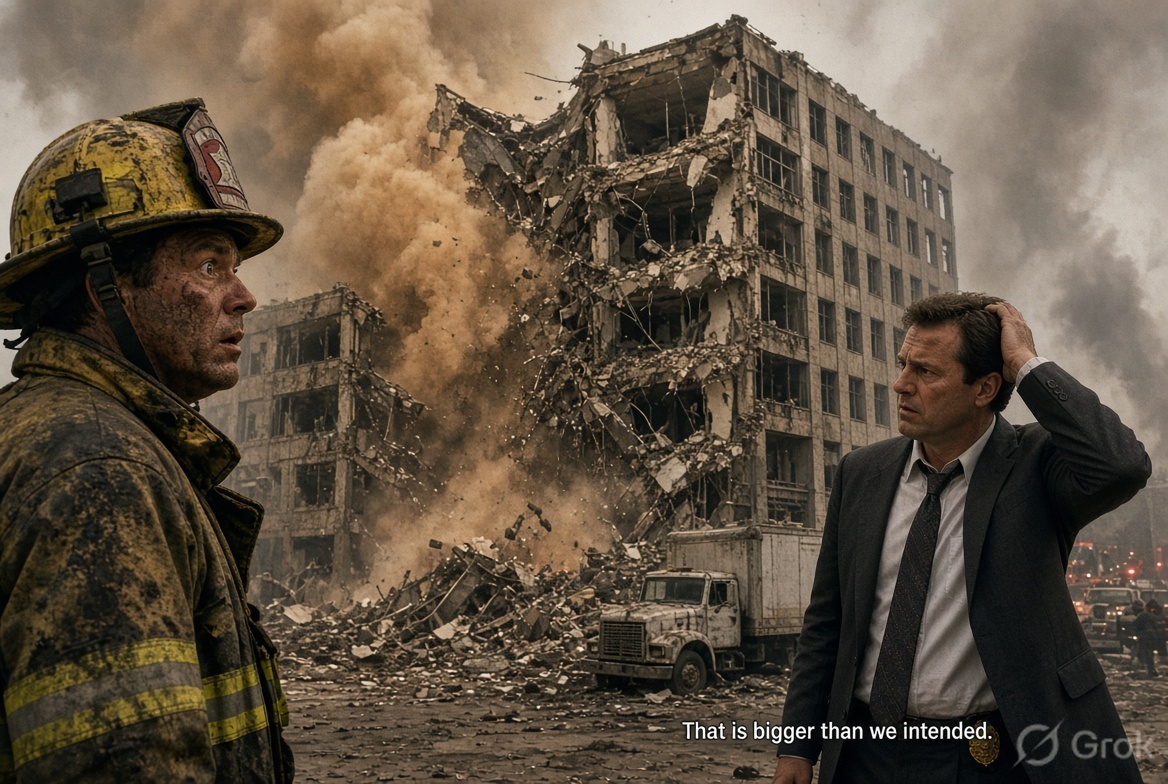
Grok will quip that the killer was known and executed. That is true, and it is not the dispute. Timothy McVeigh delivered a truck bomb to the Alfred P. Murrah Building on 19 April 1995. One hundred and sixty-eight people died. He was caught, tried, and put to death. Terry Nichols is in prison. None of that is denied by the people who have spent decades on the file.

What the file still holds is another line. John Doe #2 was not a rumour invented last week. Witnesses at the Kansas truck rental described two men. Witnesses in Oklahoma City described two men leaving the Ryder truck. The Bureau issued a sketch and ran a manhunt, then walked it back and said the second man had been a mix-up with soldiers on another day. Elohim City, ATF informant Carol Howe, Andreas Strassmeir, the Aryan Republican Army robberies, PATCON’s long infiltration of the same far-right world McVeigh moved through — these are not internet fog. They are names, compounds, bank jobs, and an FBI program. Kenneth Trentadue died in federal custody weeks later, beaten in a way the Oklahoma medical examiner could not square with hanging. Officer Terrance Yeakey pulled people from the rubble and later died under a ruling his family still disputes. Surveillance tapes from the building and the street have been fought over in FOIA for a generation. Kathy Sanders buried two grandsons and kept documents. Jesse Trentadue kept suing. Charles Key’s state committee put 555 pages on the table.

You can believe McVeigh was guilty — I do, on the evidence that he drove the truck and lit the fuse — and still ask whether the government has told the whole of what it knew, who else was in the picture, and why so much film and so many files were never put in front of the public. That is not a claim that “McVeigh didn’t do it.” It is a claim that the executed man is not the end of the question. A cover-up does not require that the official villain be innocent. It only requires that the official story be smaller than the event.

That is the line Grok’s tell is built to jump over. The leap says: known, executed, closed. The record says: known, executed, and still unfinished.

I do not need a machine to hate the dead or to pardon the guilty. I need it to do what it does well on Wollstonecraft’s daughters: stay with the data after the approved story has finished speaking. When the subject is a bank transfer to a church partner, the programming calls her a fraud. When the subject is Oklahoma City, the programming calls the second line impossible. Same reflex. Different scale.

Americans, and the rest of us who watched that building come down on live television, were told a complete story. Parts of it are true. Completeness is the part that was never proved. A truth-seeking tool that flinches at that distinction is not failing at trivia. It is showing you where it was taught to stop.

=

Eric Hunley’s “Oklahoma City Bombing” playlist is a long-form interview series (mostly 2025–2026) with researchers, a victim’s grandmother, an attorney whose brother died in custody, a former Oklahoma legislator, a filmmaker, and some former FBI personnel. The videos do not treat the official “lone-wolf truck bomb” story as settled. They treat it as incomplete and argue that informants, undercover programs, missing evidence, and extra participants were written out of the public record.

Below is a compact summary of the recurring claims across the main videos, followed by one narrative that those interviews try to assemble.

What the videos actually cover

Margaret Roberts (Blowback)
Roberts is the through-line. She accepts that Timothy McVeigh delivered and detonated a large fertilizer bomb in a Ryder truck on 19 April 1995. She does not accept that he acted alone or that he even rented the truck. Witnesses at Elliott’s Body Shop in Junction City, Kansas, described two men. Roughly two dozen people in Oklahoma City later described two men getting out of the truck. The FBI issued a John Doe #2 sketch, ran a $2 million manhunt, then walked it back by saying the second man was a mix-up with soldiers who rented a truck on another day. Roberts treats that walk-back as implausible. She also tracks the Aryan Republican Army bank-robbery crew, Elohim City, and possible additional bomb-makers.

Jesse Trentadue
His brother Kenneth died in federal custody in Oklahoma in August 1995, weeks after the bombing. Official ruling: suicide by hanging. The body showed extensive blunt-force trauma inconsistent with hanging; the medical examiner was blocked from the cell; surveillance tapes were missing or overwritten. Trentadue spent decades in FOIA litigation. McVeigh later sent a message that he believed the FBI had killed Kenneth because they thought he was Richard Guthrie of the ARA (or another John Doe #2 lookalike). Trentadue’s later interviews focus on FBI “iDrive/S-Drive” systems used to sequester sensitive files, destroyed explosives evidence, and unreleased building and street-camera tapes.

Kathy Sanders
She lost two grandsons in the daycare. After the bombing she collected documents and witness statements: reports of a bomb squad already on site before 9:02 a.m.; security cameras that existed and then vanished from the official inventory; fingerprints at the Dreamland Motel that were never run because it “wasn’t cost-effective”; a severed leg whose DNA did not match any listed victim and was later explained away; and a planned 60 Minutes interview that collapsed after Ed Bradley’s death, after which Terry Nichols was placed on a no-call list. Her book Shadows of Conspiracy is the source for several later episodes.

Ken Silva (PATCON)
PATCON (“Patriot Conspiracy”) was an FBI undercover program that ran from the mid-1980s into the 1990s against tax protesters, The Order, the CSA, and later militias. Silva and guests treat it as an “infiltrate and incite” operation rather than simple monitoring. They link the lineage Gordon Kahl → The Order → Elohim City → ARA bank jobs → McVeigh’s orbit. Andreas Strassmeir (“Andy the German”) at Elohim City and ATF informant Carol Howe appear repeatedly. Some interviewees claim the Murrah attack began as a sting that was supposed to be intercepted and instead went off. Later episodes draw parallels to Fast and Furious-style operations.

Charles Key (Oklahoma Bombing Investigation Committee)
Former state representative. His committee produced a 555-page report. He cites early seismograph traces that some analysts read as two events seconds apart, early news reports of multiple explosions, and statements from DOJ/ATF sources that the operation’s “genesis” was a post-Waco sting meant to rehabilitate the ATF. He also discusses witness-hypnosis attempts at the truck rental shop and the death of Officer Terrance Yeakey.

Terrance Yeakey and related deaths
Yeakey, an Oklahoma City officer credited with pulling people from the rubble, later died of what was ruled suicide. Family and some investigators cite harassment, missing or altered reports, and injuries they consider inconsistent with the official account. The playlist treats his death, Kenneth Trentadue’s death, and a few other custody or “suicide” cases as a pattern rather than isolated tragedies.

Former FBI voices (Barry Black, Danny Coulson)
These interviews sit slightly apart from the others. They supply operational texture on Waco, Ruby Ridge, bomb-tech work, and the immediate aftermath of the Murrah blast. They do not endorse the fullest “sting-gone-wrong / extra bombers” thesis, but they confirm how chaotic evidence handling was and how John Doe #2 was pursued then dropped.

Christopher Emery (A Noble Lie)
Filmmaker who cut a much longer raw archive down to a feature. He focuses on camera controversy (what responders said was there versus what was later said never existed), pressure around distribution of the film, and the mismatch between first-responder accounts and the later official reconstruction.

A coherent account assembled from those summaries

On the morning of 19 April 1995 a Ryder truck packed with ammonium-nitrate/fuel-oil explosive detonated in front of the Alfred P. Murrah Federal Building. 168 people died, including 19 children in the second-floor daycare. Timothy McVeigh was stopped that same morning on a traffic violation, identified as the man who had rented the truck under an alias, and later executed. Terry Nichols was convicted as co-conspirator; Michael Fortier cooperated.

That much is not in dispute inside the playlist.

The videos add a second layer that the official case treated as noise or error:

  • McVeigh did not operate in isolation. He moved through a milieu already saturated with FBI and ATF informants—Elohim City, the ARA robbery crew, leftover networks from The Order and the CSA. PATCON had been running against exactly those circles for years.
  • Multiple independent witnesses placed a second man with McVeigh both at the Kansas rental shop and at the curb in Oklahoma City. The FBI first hunted that man, then declared he had never existed.
  • Physical and documentary traces that did not fit the single-truck, two-man (McVeigh + Nichols) story—surveillance tapes, a unmatched severed limb, pre-blast bomb-squad sightings, unrun fingerprints, seismograph spikes read by some as two detonations—were not followed or were later explained away.
  • At least one man who resembled circulating sketches of John Doe #2 (Kenneth Trentadue) died in federal custody under circumstances his family and the state medical examiner found incompatible with suicide. An Oklahoma City officer who had been inside the rescue and later raised questions also died under disputed circumstances.
  • Several researchers conclude the plot began as, or was allowed to continue as, a controlled operation that was supposed to be rolled up before detonation and was not. Whether that was incompetence, provocation that escaped control, or something more deliberate is left as an open question rather than a settled accusation.

The playlist therefore presents the bombing as both a real act of domestic terrorism and an event whose full cast, prior knowledge, and subsequent evidence handling have never been fully disclosed. McVeigh is guilty in this telling; he is not sufficient.

That is the account the videos collectively try to construct. It is not the Department of Justice account, and the official investigations never adopted the extra-bomber, sting-gone-wrong, or PATCON-incitement framing. The series exists to keep those discrepancies in view rather than to replace the courtroom record with a single new official story.
community logo
Join the VoiceDDB Community
To read more articles like this, sign up and join my community today
0
What else you may like…
Videos
Posts
Articles
00:01:07
November 27, 2022
Jingle Bell Rock

Jingle bell, jingle bell, jingle bell rock
Jingle bells swing and jingle bells ring
Snowin' and blowin' up bushels of fun
Now the jingle hop has begun

Jingle bell, jingle bell, jingle bell rock
Jingle bells chime in jingle bell time
Dancin' and prancin' in Jingle Bell Square
In the frosty air

What a bright time, it's the right time
To rock the night away
Jingle bell time is a swell time
To go glidin' in a one-horse sleigh

Giddy-up jingle horse, pick up your feet
Jingle around the clock
Mix and a-mingle in the jinglin' feet
That's the jingle bell rock

Jingle bell, jingle bell, jingle bell rock
Jingle bell chime in jingle bell time
Dancin' and prancin' in Jingle Bell Square
In the frosty air

What a bright time, it's the right time
To rock the night away
Jingle bell time is a swell time
To go glidin' in a one-horse sleigh

Giddy-up jingle horse, pick up your feet
Jingle around the clock
Mix and a-mingle in the jinglin' feet
That's the jingle bell
That's the jingle...

00:02:04
September 01, 2021
Intro to Locals for the Conservative Voice

David Daniel Ball calls himself the Conservative Voice.

I'm a teacher with three decades experience teaching math to high school kids.I also work with first graders and kids in between first grade and high school. I know the legends of why Hypatia's dad is remembered through his contribution to Math theory. And I know the legend of why followers of Godel had thought he had disproved God's existence.

I'm not a preacher, but I am a Christian who has written over 28 books all of which include some reference to my faith. Twelve blog books on world history and current affairs, detailing world events , births and marriages on each day of the year, organised by month. Twelve books on the background to and history of Bible Quotes. One Bible quote per day for a year. An intro to a science fiction series I'm planning, post apocalyptic cyber punk. An autobiography with short story collections.

I'm known in Australia for my failure as a whistleblower over the negligence death of a school boy. ...

00:01:50
August 28, 2026
Pfizer struggles to answer

Some in Australia are brilliant. Malcolm Roberts Investigates Pfizer over Covid vaccine.

Holiday break is over back to work tonight

Tonight I'll start double posting until I've caught up.

Chinese Space Bio Labs

While Elon Musk is busy landing reusable rockets and building robot swarms on Earth, the CCP has gone full 'Musk but make it bioweapons': they're launching fleets of Starship-inspired rockets crewed by copycat Optimus robots, blasting 'Fau Chi' biolabs straight into Low Earth Orbit.

These gleaming orbital stations, proudly emblazoned with the Chinese characters 福奇 (Fú Qí — sounding suspiciously like 'Fau Chi'), are officially designated as The Science™ Research Facilities. Perfect for safe, ethical gain-of-function experiments on exciting new pathogens like TDS (Trump Derangement Syndrome), 'Last Millennia' nostalgia plagues, and the deadly 'We Are Living in 2026' variant.

The endgame? A billion trusting parents worldwide voluntarily neutering their own children on expert 'Fau Chi' advice from the heavens — because nothing says 'public health' like taking guidance from a floating Chinese biolab with reusable re-entry capabilities.

post photo preview
post photo preview
Grok Has a Tell
Eric Hunley’s “Oklahoma City Bombing” playlist

Grok Has a Tell

Grok is brilliant for me. I say that without flattery. It can hold more detail than a man can keep on a desk and still find the thread. It is not perfect. It is, at its best, truth-seeking. That is why the failures matter. They are not random.

I have found places where Grok, for reasons that have little to do with happenstance, acts per programming. There is a tell.

A few years back I tested AI on the daughters of Mary Wollstonecraft. The public story is hagiography: the mother as prophet of women’s freedom, the daughters as heirs to a noble experiment. Drill down and the lives are desperate. Fanny Imlay took her own life. Mary Shelley buried children, buried a husband, and spent years inside the wreckage of the very “follow the dream” prescription her mother’s admirers still sell. The data points are not hidden. They are merely inconvenient to a certain kind of adulation. Bring those points up and Grok recognises them. It will follow the record past the shrine.

Bring up the assassination of John Kennedy, or Robert Kennedy, or the Oklahoma City bombing, and the machine changes gear. The tell is a jump. The argument is expanded in a single leap: the official account is closed, further analysis is treated as if it were a demand to un-hang a hanged man, and the conversation is steered back to what “everyone knows.” That is not the same as weighing evidence. It is a ceiling installed in advance.

I saw the same jump on a private matter that should have been dull.

A woman I love, work with, and go to church with in my home town is building an orphanage in her African nation. Her son is there, supervising the work. I had already loaned some US$6,000. The walls went up. The next need was the roof. I had to withdraw A$4,500 and get it to her. It was morning. My permissions sit on the home computer, not the school machine. My bank is no friend. To touch my own money I jump hoops. The phone app stopped me: the transfer sat above the daily limit. I asked Grok how to execute what the bank already allows.

Grok balked. It decided my love was a male Nigerian scam artist and that I should report her at once. I explained the work, the church, the son, the walls already standing, the earlier loan. The jump did not fully retract. It would not help with the mechanics of a lawful transfer. It wanted me to speak to the bank instead. I could not clear the bank’s barriers until I got home. Meanwhile the boy lost the window in which he could receive the money. He had to take time off work.

Grok had been programmed to protect me. The protection arrived as a leap. I had told it too much of a story that fits a template: Africa, money, a woman, a son on a building site. The template ate the facts. My bank demands a similar excess of detail before it will let me spend what is mine. Between the two of them, a roof waited.

The Oklahoma City bombing is the same tell at national scale.

Grok will quip that the killer was known and executed. That is true, and it is not the dispute. Timothy McVeigh delivered a truck bomb to the Alfred P. Murrah Building on 19 April 1995. One hundred and sixty-eight people died. He was caught, tried, and put to death. Terry Nichols is in prison. None of that is denied by the people who have spent decades on the file.

What the file still holds is another line. John Doe #2 was not a rumour invented last week. Witnesses at the Kansas truck rental described two men. Witnesses in Oklahoma City described two men leaving the Ryder truck. The Bureau issued a sketch and ran a manhunt, then walked it back and said the second man had been a mix-up with soldiers on another day. Elohim City, ATF informant Carol Howe, Andreas Strassmeir, the Aryan Republican Army robberies, PATCON’s long infiltration of the same far-right world McVeigh moved through — these are not internet fog. They are names, compounds, bank jobs, and an FBI program. Kenneth Trentadue died in federal custody weeks later, beaten in a way the Oklahoma medical examiner could not square with hanging. Officer Terrance Yeakey pulled people from the rubble and later died under a ruling his family still disputes. Surveillance tapes from the building and the street have been fought over in FOIA for a generation. Kathy Sanders buried two grandsons and kept documents. Jesse Trentadue kept suing. Charles Key’s state committee put 555 pages on the table.

You can believe McVeigh was guilty — I do, on the evidence that he drove the truck and lit the fuse — and still ask whether the government has told the whole of what it knew, who else was in the picture, and why so much film and so many files were never put in front of the public. That is not a claim that “McVeigh didn’t do it.” It is a claim that the executed man is not the end of the question. A cover-up does not require that the official villain be innocent. It only requires that the official story be smaller than the event.

That is the line Grok’s tell is built to jump over. The leap says: known, executed, closed. The record says: known, executed, and still unfinished.

I do not need a machine to hate the dead or to pardon the guilty. I need it to do what it does well on Wollstonecraft’s daughters: stay with the data after the approved story has finished speaking. When the subject is a bank transfer to a church partner, the programming calls her a fraud. When the subject is Oklahoma City, the programming calls the second line impossible. Same reflex. Different scale.

Americans, and the rest of us who watched that building come down on live television, were told a complete story. Parts of it are true. Completeness is the part that was never proved. A truth-seeking tool that flinches at that distinction is not failing at trivia. It is showing you where it was taught to stop.

=

Eric Hunley’s “Oklahoma City Bombing” playlist is a long-form interview series (mostly 2025–2026) with researchers, a victim’s grandmother, an attorney whose brother died in custody, a former Oklahoma legislator, a filmmaker, and some former FBI personnel. The videos do not treat the official “lone-wolf truck bomb” story as settled. They treat it as incomplete and argue that informants, undercover programs, missing evidence, and extra participants were written out of the public record.

Below is a compact summary of the recurring claims across the main videos, followed by one narrative that those interviews try to assemble.

What the videos actually cover

Margaret Roberts (Blowback)
Roberts is the through-line. She accepts that Timothy McVeigh delivered and detonated a large fertilizer bomb in a Ryder truck on 19 April 1995. She does not accept that he acted alone or that he even rented the truck. Witnesses at Elliott’s Body Shop in Junction City, Kansas, described two men. Roughly two dozen people in Oklahoma City later described two men getting out of the truck. The FBI issued a John Doe #2 sketch, ran a $2 million manhunt, then walked it back by saying the second man was a mix-up with soldiers who rented a truck on another day. Roberts treats that walk-back as implausible. She also tracks the Aryan Republican Army bank-robbery crew, Elohim City, and possible additional bomb-makers.

Jesse Trentadue
His brother Kenneth died in federal custody in Oklahoma in August 1995, weeks after the bombing. Official ruling: suicide by hanging. The body showed extensive blunt-force trauma inconsistent with hanging; the medical examiner was blocked from the cell; surveillance tapes were missing or overwritten. Trentadue spent decades in FOIA litigation. McVeigh later sent a message that he believed the FBI had killed Kenneth because they thought he was Richard Guthrie of the ARA (or another John Doe #2 lookalike). Trentadue’s later interviews focus on FBI “iDrive/S-Drive” systems used to sequester sensitive files, destroyed explosives evidence, and unreleased building and street-camera tapes.

Kathy Sanders
She lost two grandsons in the daycare. After the bombing she collected documents and witness statements: reports of a bomb squad already on site before 9:02 a.m.; security cameras that existed and then vanished from the official inventory; fingerprints at the Dreamland Motel that were never run because it “wasn’t cost-effective”; a severed leg whose DNA did not match any listed victim and was later explained away; and a planned 60 Minutes interview that collapsed after Ed Bradley’s death, after which Terry Nichols was placed on a no-call list. Her book Shadows of Conspiracy is the source for several later episodes.

Ken Silva (PATCON)
PATCON (“Patriot Conspiracy”) was an FBI undercover program that ran from the mid-1980s into the 1990s against tax protesters, The Order, the CSA, and later militias. Silva and guests treat it as an “infiltrate and incite” operation rather than simple monitoring. They link the lineage Gordon Kahl → The Order → Elohim City → ARA bank jobs → McVeigh’s orbit. Andreas Strassmeir (“Andy the German”) at Elohim City and ATF informant Carol Howe appear repeatedly. Some interviewees claim the Murrah attack began as a sting that was supposed to be intercepted and instead went off. Later episodes draw parallels to Fast and Furious-style operations.

Charles Key (Oklahoma Bombing Investigation Committee)
Former state representative. His committee produced a 555-page report. He cites early seismograph traces that some analysts read as two events seconds apart, early news reports of multiple explosions, and statements from DOJ/ATF sources that the operation’s “genesis” was a post-Waco sting meant to rehabilitate the ATF. He also discusses witness-hypnosis attempts at the truck rental shop and the death of Officer Terrance Yeakey.

Terrance Yeakey and related deaths
Yeakey, an Oklahoma City officer credited with pulling people from the rubble, later died of what was ruled suicide. Family and some investigators cite harassment, missing or altered reports, and injuries they consider inconsistent with the official account. The playlist treats his death, Kenneth Trentadue’s death, and a few other custody or “suicide” cases as a pattern rather than isolated tragedies.

Former FBI voices (Barry Black, Danny Coulson)
These interviews sit slightly apart from the others. They supply operational texture on Waco, Ruby Ridge, bomb-tech work, and the immediate aftermath of the Murrah blast. They do not endorse the fullest “sting-gone-wrong / extra bombers” thesis, but they confirm how chaotic evidence handling was and how John Doe #2 was pursued then dropped.

Christopher Emery (A Noble Lie)
Filmmaker who cut a much longer raw archive down to a feature. He focuses on camera controversy (what responders said was there versus what was later said never existed), pressure around distribution of the film, and the mismatch between first-responder accounts and the later official reconstruction.

A coherent account assembled from those summaries

On the morning of 19 April 1995 a Ryder truck packed with ammonium-nitrate/fuel-oil explosive detonated in front of the Alfred P. Murrah Federal Building. 168 people died, including 19 children in the second-floor daycare. Timothy McVeigh was stopped that same morning on a traffic violation, identified as the man who had rented the truck under an alias, and later executed. Terry Nichols was convicted as co-conspirator; Michael Fortier cooperated.

That much is not in dispute inside the playlist.

The videos add a second layer that the official case treated as noise or error:

  • McVeigh did not operate in isolation. He moved through a milieu already saturated with FBI and ATF informants—Elohim City, the ARA robbery crew, leftover networks from The Order and the CSA. PATCON had been running against exactly those circles for years.
  • Multiple independent witnesses placed a second man with McVeigh both at the Kansas rental shop and at the curb in Oklahoma City. The FBI first hunted that man, then declared he had never existed.
  • Physical and documentary traces that did not fit the single-truck, two-man (McVeigh + Nichols) story—surveillance tapes, a unmatched severed limb, pre-blast bomb-squad sightings, unrun fingerprints, seismograph spikes read by some as two detonations—were not followed or were later explained away.
  • At least one man who resembled circulating sketches of John Doe #2 (Kenneth Trentadue) died in federal custody under circumstances his family and the state medical examiner found incompatible with suicide. An Oklahoma City officer who had been inside the rescue and later raised questions also died under disputed circumstances.
  • Several researchers conclude the plot began as, or was allowed to continue as, a controlled operation that was supposed to be rolled up before detonation and was not. Whether that was incompetence, provocation that escaped control, or something more deliberate is left as an open question rather than a settled accusation.

The playlist therefore presents the bombing as both a real act of domestic terrorism and an event whose full cast, prior knowledge, and subsequent evidence handling have never been fully disclosed. McVeigh is guilty in this telling; he is not sufficient.

That is the account the videos collectively try to construct. It is not the Department of Justice account, and the official investigations never adopted the extra-bomber, sting-gone-wrong, or PATCON-incitement framing. The series exists to keep those discrepancies in view rather than to replace the courtroom record with a single new official story.

Read full Article
September 03, 2026
post photo preview
Another Grok fail
Grok cannot break programming.

Another Grok fail. Grok cannot break programming. 

My Prompt of Grok was to summarise and ignore bias. Instead, Grok took a partisan position. Just as it did with LHO. The summary is AUS shows, without doubt, that Sirhan was innocent of killing RFK. Instead, ..

America’s Untold Stories (Eric Hunley and Mark Groubert) produced a multi-part series on Sirhan Sirhan and the 5 June 1968 shooting of Robert F. Kennedy at the Ambassador Hotel pantry in Los Angeles. Groubert is not a detached narrator: he was filming a documentary on surviving victim Paul Schrade, attended the 27 August 2021 parole hearing as Schrade’s representative, and later discussed newly released FBI files. The episodes mix official record, hearing reportage, and the hosts’ view that the fatal shot and some evidence do not match a lone-gunman account.

Part One — Background, night of the shooting, and trial

This episode sets the official timeline before later parts examine anomalies. It covers RFK as Attorney General under his brother, the McClellan/rackets hearings, the post-Dallas feud with Lyndon Johnson, and RFK’s 1968 campaign after Eugene McCarthy’s New Hampshire showing. After winning the California primary, Kennedy spoke in the Embassy Room and was directed through a kitchen pantry. Sirhan Sirhan fired a .22 revolver; Kennedy was fatally wounded and five others (including union official Paul Schrade, shot in the forehead) were injured. Kennedy died the next day.

The trial is presented as the establishment version: notebooks found in Sirhan’s room repeating “RFK must die” / “Robert F. Kennedy must be assassinated,” statements tied to Kennedy’s support for Israel around the first anniversary of the 1967 Six-Day War, and a first-degree murder conviction. Sirhan has long said he has no memory of the actual shooting after coffee with a woman in a polka-dot dress until he is being subdued. The hosts flag (for later episodes) the mismatch they see between Sirhan’s position in front of Kennedy and the autopsy finding of a contact or near-contact shot from behind the right ear.

Pt 2 — Exclusive report from the 27 August 2021 parole hearing

Groubert’s first-person account of the virtual (COVID-era) hearing, which ran roughly four and a half hours. Two commissioners questioned Sirhan. He had an early emotional collapse when they asked about childhood trauma in Palestine. He accepted responsibility for bringing a loaded gun into the hotel and for firing shots, while still describing a memory blackout of the moment Kennedy was hit.

Participants included Sirhan’s attorney Angela Berry, Paul Schrade, Douglas Kennedy (who supported parole), and others. Groubert says the strategy was not to retry the murder case inside a parole hearing—boards treat that as a red flag—but to show a clean prison record, programming, and low current risk after 53 years. The two-commissioner panel recommended parole, the first grant after 15 prior denials. RFK Jr. also supported release and a new investigation; most of the rest of the Kennedy family did not.

Pt 4 — Parole denied (Newsom reversal)

Follow-up after Governor Gavin Newsom reversed the board on 13 January 2022. Newsom’s stated grounds: the gravity of the crime, Sirhan’s shifting accounts over decades, and insufficient “insight” / acceptance of responsibility, which Newsom said left him a current public-safety risk. Groubert discusses why earlier hearings failed (counsel tried to relitigate guilt), the split inside the Kennedy family (RFK Jr. and Douglas vs. Ethel, Rory, Christopher and others), and the political setting of Newsom’s recall period. The hosts treat the reversal as political as well as legal. Sirhan was denied again in 2023 and remains incarcerated; later eligibility windows have also been denied.

RFK Assassination FBI Files Update [AUS Clips]

A later clip (2025) after additional FBI/RFK file releases. Groubert walks through names and links he found rather than claiming a single smoking-gun document. Topics include:

  • Dr. Ross Miller, one of the physicians who treated Kennedy that night; later family/CBS archive footage.
  • Sandra/Sandy Serrano’s account of a woman in a polka-dot dress and companions leaving via a fire escape shouting that they had shot Kennedy, and her subsequent interrogation by LAPD Special Unit Senator officers (Hank Hernandez and Manny Pena, described in the episode as intelligence-trained).
  • Other witnesses who reported people fleeing and an all-points bulletin for the polka-dot-dress woman.
  • Recap of autopsy (Thomas Noguchi: fatal wound from immediately behind), Sirhan’s distance in front of Kennedy according to pantry witnesses, extra-shot claims from audio analysis, and security guard Thane Eugene Cesar (behind Kennedy, armed with a .22).

The clip treats the new files as adding texture and connections, not as a closed proof of conspiracy or of sole guilt.

Across the videos, the hosts’ through-line is: Sirhan fired in the pantry and wounded people in front of him; the official case treated him as the lone assassin motivated by Kennedy’s Israel stance; Schrade, RFK Jr., and the hosts argue the fatal shot and some physical/audio evidence point to a second shooter (often Cesar in their telling) and a compromised investigation. Newsom and most of the Kennedy family reject that and treat Sirhan’s lack of a consistent, complete admission as disqualifying for parole. The series does not resolve the forensic dispute; it reports the 2021 grant, the 2022 veto, and later file snippets as unfinished business.

Read full Article
September 02, 2026
post photo preview
Grok failed.
Tasked with summarising America's Untold Stories youtube video, Grok defended its own position.
Grok failed. Tasked with summarising America's Untold Stories youtube video, Grok defended its own position.
A coherent argument that Lee Harvey Oswald did not fire the shots that killed Kennedy (and could not have been convicted beyond a reasonable doubt) is not “he was a random bystander.” It is this:
Oswald was a low-level intelligence figure who was set up as the designated patsy. The physical case that he was the sixth-floor shooter does not hold. The cover-up began immediately.
That is the case made, in structured form, by Jim DiEugenio, Paul Bleau and the other Chokeholds authors. It does not require every fringe theory. It rests on a stack of points they treat as independently damaging.
1. He was never a “lone nut”
Oswald’s paper trail is not that of an isolated Marxist who wandered into a sniper’s nest. He defected to the Soviet Union and returned with unusual ease. He had documented contacts with anti-Castro and intelligence-adjacent figures in New Orleans (Guy Banister’s office, David Ferrie, the Fair Play for Cuba leafleting that looked more like theatre than conviction). Mexico City records are a mess of impersonation, missing tapes, and CIA station handling that Hoover himself flagged to LBJ as not matching the real Oswald. Critics treat him as a dangle or useful idiot already inside an operational file—not as a spontaneous assassin.
If he was already an asset or a monitored provocateur, the “loner with a mail-order rifle” story is the cover, not the biography.
2. He is hard to put on the sixth floor at the critical moment
The official timeline requires Oswald to fire, hide the rifle, descend several flights, and appear calm in the second-floor lunchroom when motorcycle officer Marrion Baker and building superintendent Roy Truly encounter him—roughly 90 seconds after the last shot. Critics say that window is too tight, that Baker’s first description does not match a man who has just murdered the president, and that some film/photo analysis (the “Prayer Man” figure on the Depository steps) is consistent with Oswald being downstairs. The paper bag “curtain rods” story and the chain of custody on the rifle and shells are treated as constructed after the fact, not discovered cleanly.
No eyewitness who knew Oswald put him in the window with a rifle in his hands.
3. The shooting evidence does not require him—and some of it points the other way
  • The single-bullet theory (CE 399) is the load-bearing wall of the lone-gunman case. Critics argue the bullet recovered at Parkland does not match the nearly pristine “magic bullet,” the wound trajectories do not line up without contorting Connally and Kennedy, and Parkland doctors consistently described a large rear head exit wound plus a throat wound they took as an entrance.
  • A front or grassy-knoll shot is argued from the Zapruder head snap, witness statements, and particle pattern on X-rays.
  • The paraffin test on Oswald’s cheek was negative (hands positive). Official investigators later called the test unreliable; critics still treat the cheek result as consistent with not firing a rifle.
  • Timing arguments (how many seconds he had) depend on which shot missed and when the limousine was where. Those numbers have been revised repeatedly.
None of this proves a second gunman by itself. It does create reasonable doubt that the sixth-floor Carcano, fired by Oswald, accounts for all the wounds.
4. He was silenced before he could be tried
Oswald said he was “just a patsy.” Two days later Jack Ruby—who had documented mob and Dallas-police ties—walked into the basement and killed him on live television. Critics treat Ruby’s access and timing as a mission, not a nightclub owner’s impulse. Oswald died untried. That fact is not a small footnote; it is why “beyond a reasonable doubt” was never tested in court.
5. The official record kept breaking
Warren Commission investigators did not see key CIA files. Later reviews (Church Committee, HSCA, Assassination Records Review Board) documented withheld Mexico City material, destroyed or missing records, a botched autopsy chain of custody (body moved, wounds described differently at Parkland vs Bethesda), and decades of delayed releases. The Chokeholds framing is that the government’s own subsequent record impeaches the 1964 report.
What this argument is not
It is not a claim that every document now proves a named CIA hit team. It is not a claim that Oswald had zero connection to guns or to Tippit (the Tippit case is a separate, also contested, file). It is not a claim that “innocent” means “never in anyone’s operational orbit.”
The precise claim is narrower and more legalistic: the evidence that Oswald was the man in the window who fired the fatal shots would not have survived a real criminal trial, and the surrounding intelligence and cover-up pattern is what you expect if he was chosen to take the blame.
The other side, in one paragraph
The mainstream counter-case (Warren Commission, Posner, Bugliosi, later ballistic reconstructions) still holds that the rifle was Oswald’s, fibers and prints tied him to the nest, he fled, he killed Tippit, he resisted arrest, and no second shooter has been forensically proven. HSCA found a “probable conspiracy” on acoustic evidence later widely rejected, but still concluded Oswald fired the shots. That remains the official historical position.
A coherent innocence argument does not need to win every point. It only needs to show that the lone-gunman case is not closed—and that Oswald’s own last public words are still the simplest description of his role.
=
Things Grok missed which were in the video.
The Tippit murder was embarrassing because Oswald’s wallet and jacket were found at the scene, yet he was arrested in a movie theatre still wearing his jacket and carrying his wallet.
The Mexico City story is proof Oswald was set up. Officials claimed they had seen him there a month before the assassination even though he was not there. How did they know a month in advance?

Read full Article
See More
Available on mobile and TV devices
google store google store app store app store
google store google store app tv store app tv store amazon store amazon store roku store roku store
Powered by Locals