What will one do for love?
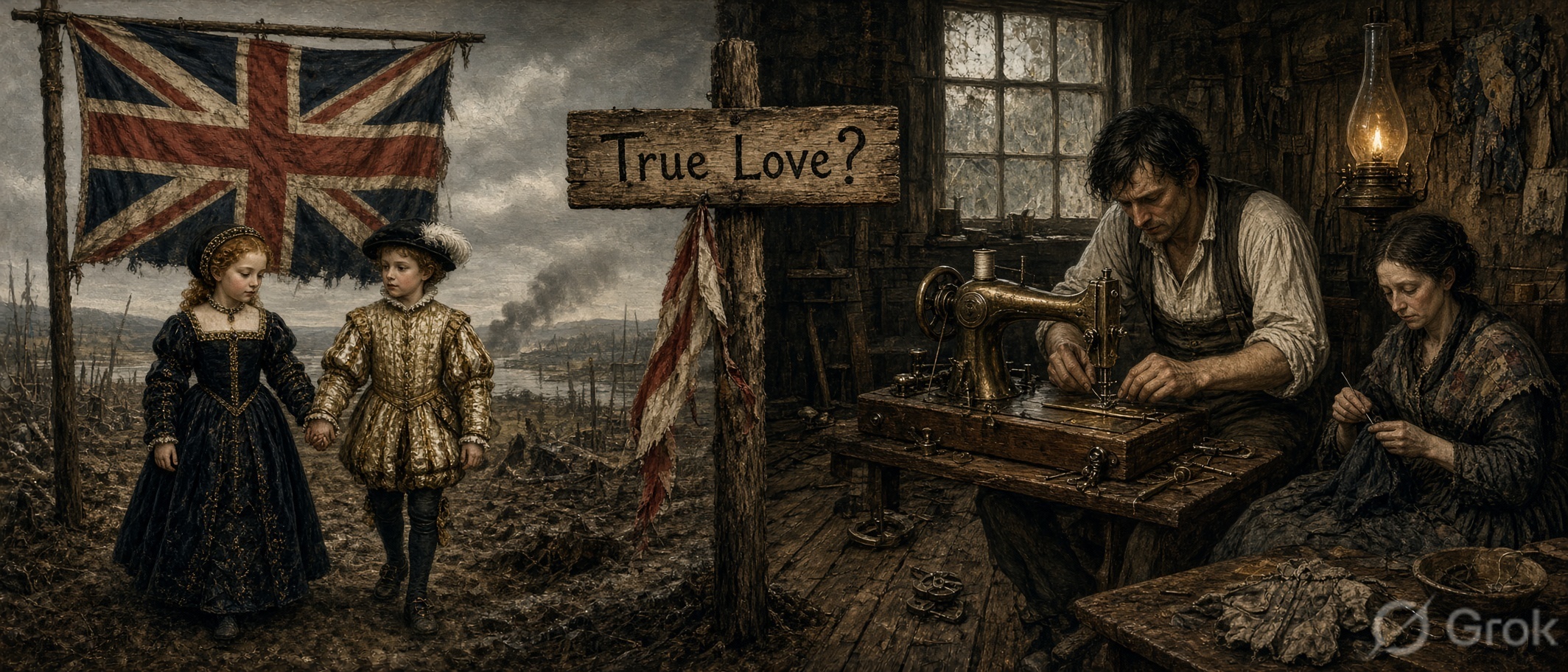
On 10 September 1547, two regents met in a field east of Edinburgh and tried to settle a marriage by cannon. On 10 September 1846, almost three centuries later to the day, a poor Cambridge machinist was granted a patent for a machine born of watching his wife sew. One story is about a crown that would not take no for an answer. The other is about a household that could not afford to keep sewing by hand. Both ask the same question: what will one do for love—or for the thing one has decided to call love?
Henry VIII wanted his son Edward married to the infant Mary, Queen of Scots. The Treaty of Greenwich of 1543 was the polite version. The Scots rejected it and looked to France. Henry died in January 1547. His brother-in-law, Edward Seymour, Duke of Somerset, Lord Protector for the nine-year-old Edward VI, did not drop the project. He wanted the marriage and an English-style reformation of the Scottish church. When talk failed, he marched. James Hamilton, Earl of Arran, governed for five-year-old Mary. So the last full-scale battle between the independent kingdoms of England and Scotland was fought by two men acting for children who could not yet choose.
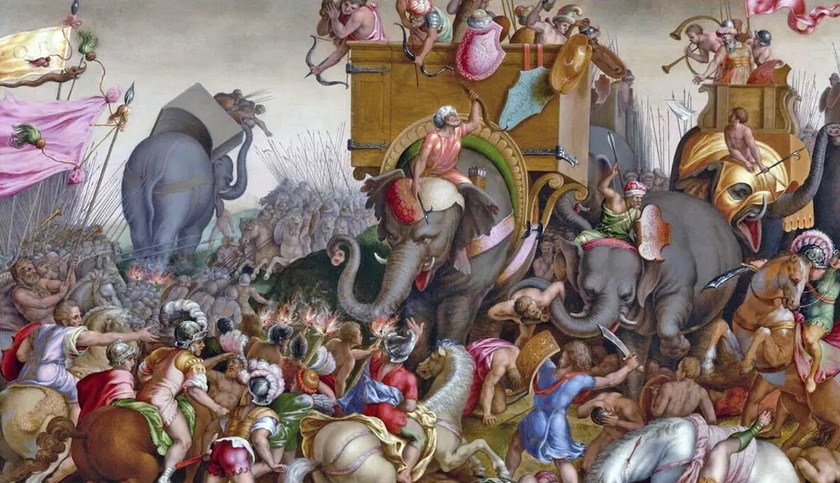
Somerset brought about 16,800 fighting men, a heavy gun train, German arquebusiers, some 6,000 horse, and a fleet of about thirty ships. Arran had more men—most estimates sit near 22,000 to 23,000, some higher—chiefly pikemen, Highland archers, and light Border horse. On 9 September the Scottish cavalry was broken in a foolish, chivalric challenge on Falside Hill. On the morning of the 10th Arran left a strong position west of the Esk and came on in pike columns, perhaps fearing the English would seize the Inveresk slopes, perhaps mistaking a movement toward the guns for a retreat to the ships. English warships raked his left. Field guns, arquebuses, and bows found the crowded columns. The Scots drove off a cavalry charge and nearly took the royal standard, then stalled under fire from three sides and broke. The pursuit ran for miles toward Edinburgh and Leith. The Esk ran red. English dead numbered a few hundred. Scottish dead were in the thousands; Huntly’s figure of about 6,000 is more credible than the English claim of 14,000 or 15,000. Scotland called it Black Saturday.
Somerset occupied ground and planted garrisons. He did not get the girl. Mary was moved, then sent to France in 1548 to marry the Dauphin. The Auld Alliance was renewed. The occupation bled the English treasury. Peace came in 1551. The marriage England had sought at the point of a pike never happened. Pinkie was militarily modern—infantry, horse, field artillery, and naval guns used together—and politically barren. That is what a dynasty will do when it confuses alliance with affection.
Elias Howe Jr. was not a duke. He was born in 1819 in Spencer, Massachusetts, a journeyman machinist, later in Cambridge, poor. His wife Elizabeth took in sewing. Earlier patented machines existed; John Greenough’s 1842 patent was the first American sewing-machine grant. Most of them made a chainstitch. Howe watched his wife and decided a machine should not copy the motion of a human arm. George Fisher boarded the family and put in $500 for a half-share. By April 1845 Howe had a working model that sewed two woollen suits. On 10 September 1846 he received U.S. Patent 4,750, the fifth American sewing-machine patent and the first for a practical lockstitch: a curved eye-pointed needle on a vibrating arm, thread from a spool, a shuttle with a second thread locking the loop, and an automatic feed. About 250 stitches a minute. He did not invent the eye-pointed needle. He made the combination work.
American tailors were cold. Howe’s brother Amasa took the idea to England. William Thomas bought rights and patented there that December. The English venture failed. Howe came home in debt. Elizabeth died in 1849. Isaac Singer and others sold machines on the same lockstitch principle. Howe spent years in court. The courts held his patent basic. In 1856 the makers formed a patent pool. Howe took royalties—commonly given as five dollars a machine in the United States and one dollar on exports—and over the life of the patent, extended to 1867, on the order of two million dollars. He later built machines at Bridgeport, showed them at expositions, took a Paris gold medal and the Légion d’honneur. Singer sold the household machine. Howe established the stitch.
It is easy to over- sweeten this. Howe was not a saint of domestic piety. He became rich by defending a patent, not by putting a machine in every kitchen. Manchester’s mills were already a fact of the textile age; Howe’s lockstitch was an American mechanical solution that industry and later the home adopted. Still, the origin is not a treaty. It is a man who could not watch his wife’s hands work forever without trying to change the work.
Set the two Septembers side by side and the word love splits. Somerset’s love was policy: a child-bride as instrument of union and reform, enforced by combined arms on the Esk. Howe’s was narrower and more honest: a wife sewing because there was no other money, and a mind that refused to treat her labour as unchangeable. One campaign kidnapped a kingdom’s future and lost the prize. The other began in a rented room and, after ruin, lawsuits, and a grave, altered how cloth is joined.
What will one do for love? Some will burn a country to secure a marriage that never takes place. Some will stay at the bench until a needle and a shuttle lock two threads. History is not obliged to prefer the second. It is obliged to notice that they are not the same thing. Within 60 years of the battle, England and Scotland united, remaining so today.