When an illegitimate son seized England whole
William the Conqueror took a kingdom in a day and spent twenty-one years holding it. He also left a new ruling culture, a wrecked north, a survey of every hide of land, and sons who turned on each other before the incense at his funeral had cleared. That is the whole story of 1066 and after: not only the victory, but the bill.
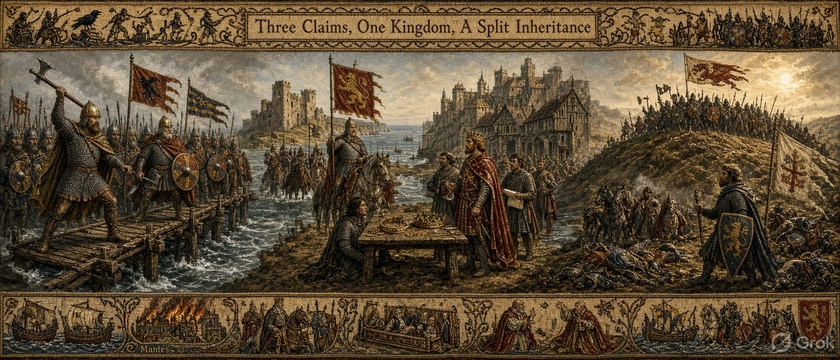
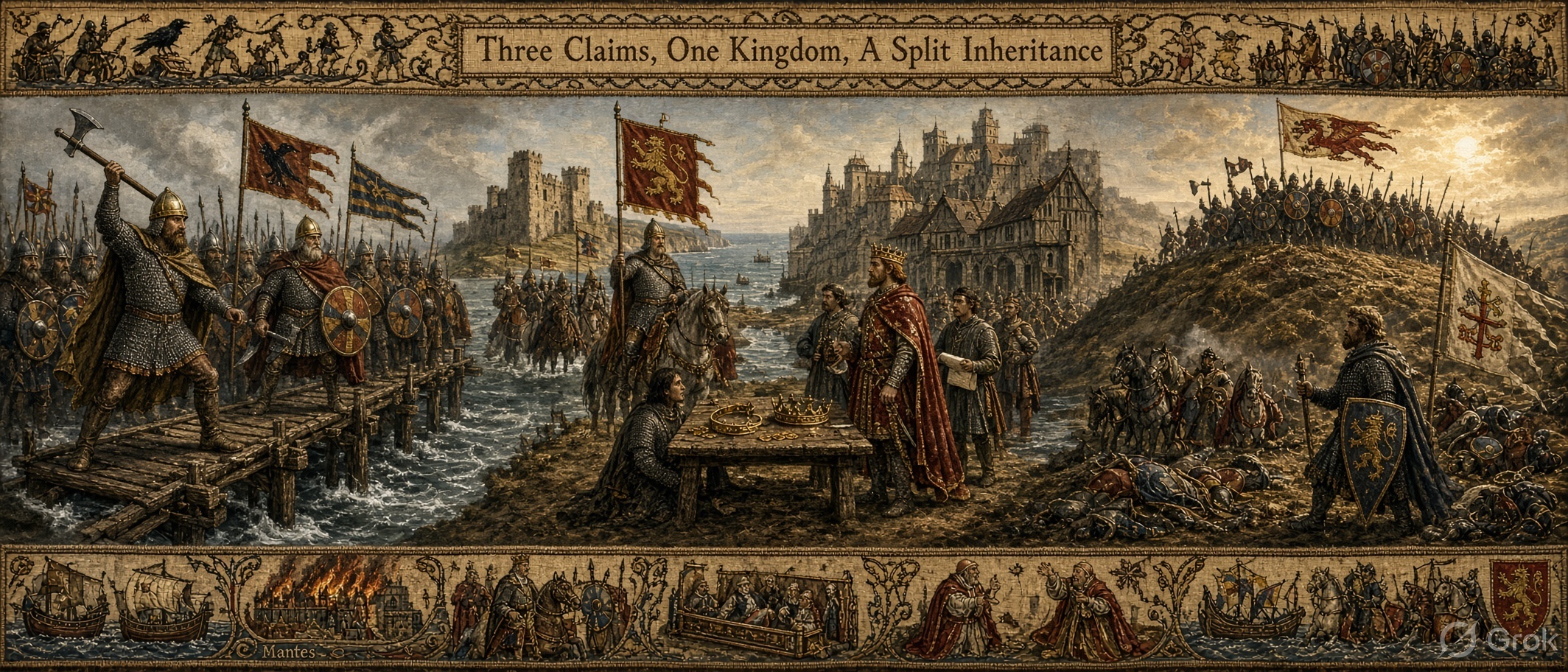
He was born about 1028 at Falaise, the son of Duke Robert of Normandy and Herleva, a tanner’s daughter. Illegitimacy was not a romantic footnote. It was a political fact. When Robert died in 1035, a child of seven inherited a duchy that ate weak dukes. William survived plots and rebellions, then made Normandy one of the hardest-run states in western Europe. Distance of blood from Edward the Confessor was enough, in his mind, to make the English crown his. Harold Godwinson had the Witan and the deathbed. Harald Hardrada had an old Norse claim and Harold’s exiled brother Tostig. Three men, one throne.
Harold settled the northern account first. At Stamford Bridge on 25 September 1066 he killed Hardrada and Tostig. It was a famous English victory. It was also the wrong battle to win first. Two days later the wind changed. William landed at Pevensey, moved to Hastings, and burned until Harold had to come south with tired housecarls and a militia that had already marched the length of the country.
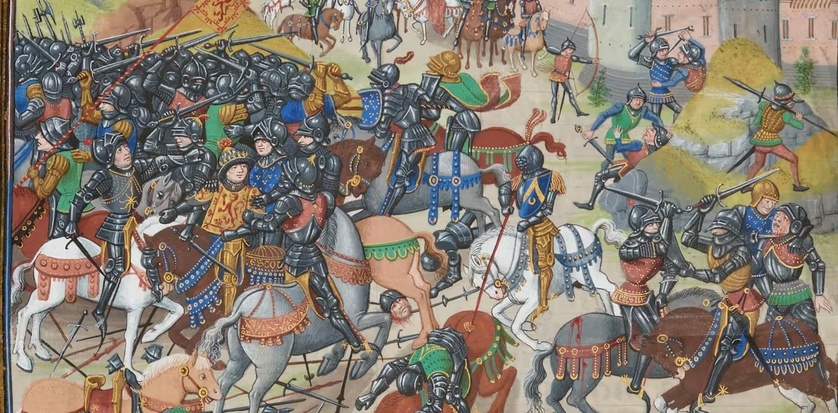
On 14 October, on Senlac Hill — the ridge now marked by Battle Abbey — Harold held the high ground in a shield wall. William had to attack uphill with infantry, archers, and cavalry. Early assaults failed. A rumour that William was dead ran through his line; he lifted his helmet and showed his face. Feigned retreats then broke the English discipline. Men left the wall to chase, and were cut down below. Gyrth and Leofwine fell. Late in the day Harold fell — an arrow in the tradition of the Bayeux Tapestry, four knights in an early Norman account, perhaps both. Command died with him. William had three horses killed under him and still kept a combined force in hand. That, more than any single shaft, decided England.
Hastings did not hand him the island. The Witan named the boy Edgar the Ætheling. William marched on London, took the city’s submission, and was crowned at Westminster on Christmas Day 1066. The rest was enforcement. Castles. A new aristocracy. A remade church. The Harrying of the North in 1069–70, famine used as policy. In 1086, Domesday: not a book of wonders, a ledger of who owned what and what it owed. English became the language of the yard; French the language of the hall. The split is still in the vocabulary — cow and swine on the farm, beef and pork on the table.
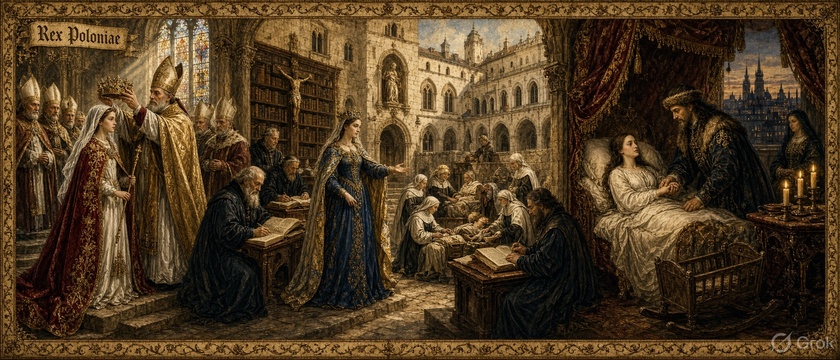
He did not die a hero’s death. By 1087 he was nearly sixty and hugely fat, more often in Normandy than in England. Philip of France mocked him as a man lying-in at Rouen. William burned Mantes for the insult. One account says the pommel of the saddle burst his belly when the horse stumbled in the wreckage. Another says heat and exhaustion simply finished him. He was carried to the priory of Saint-Gervais outside Rouen and spent five weeks dying: gifts to churches, prisoners freed, the succession divided like a farm.
Robert Curthose, the eldest son he had fought and never trusted, received Normandy. William Rufus received England. Henry received money. The two halves of the conquest were at war within a year. Children fought because the father would not, or could not, leave one heir both crowns.
Even the burial was a judgment. Attendants stripped the death chamber and left the king nearly naked on the floor. A country knight named Herluin paid to take the body to Caen, to the abbey William had founded. Fire met the bier. At the grave a man claimed the ground under the church had been stolen from his father. The coffin was too small. They forced the bloated corpse in; Orderic says the bowels burst and incense could not hide it. The clergy hurried the rest and left.
William still lies at Saint-Étienne in Caen, in a tomb later wars smashed. He had won the contest of 1066. He could not command his own funeral, or keep his sons from inheriting his method: take what you can hold, and hold it against your own blood. That is the culture he left, and the dispute.