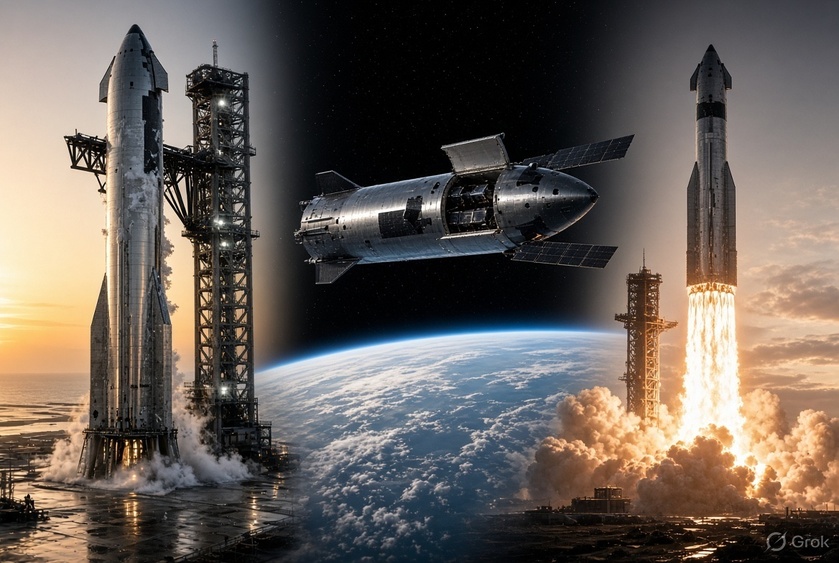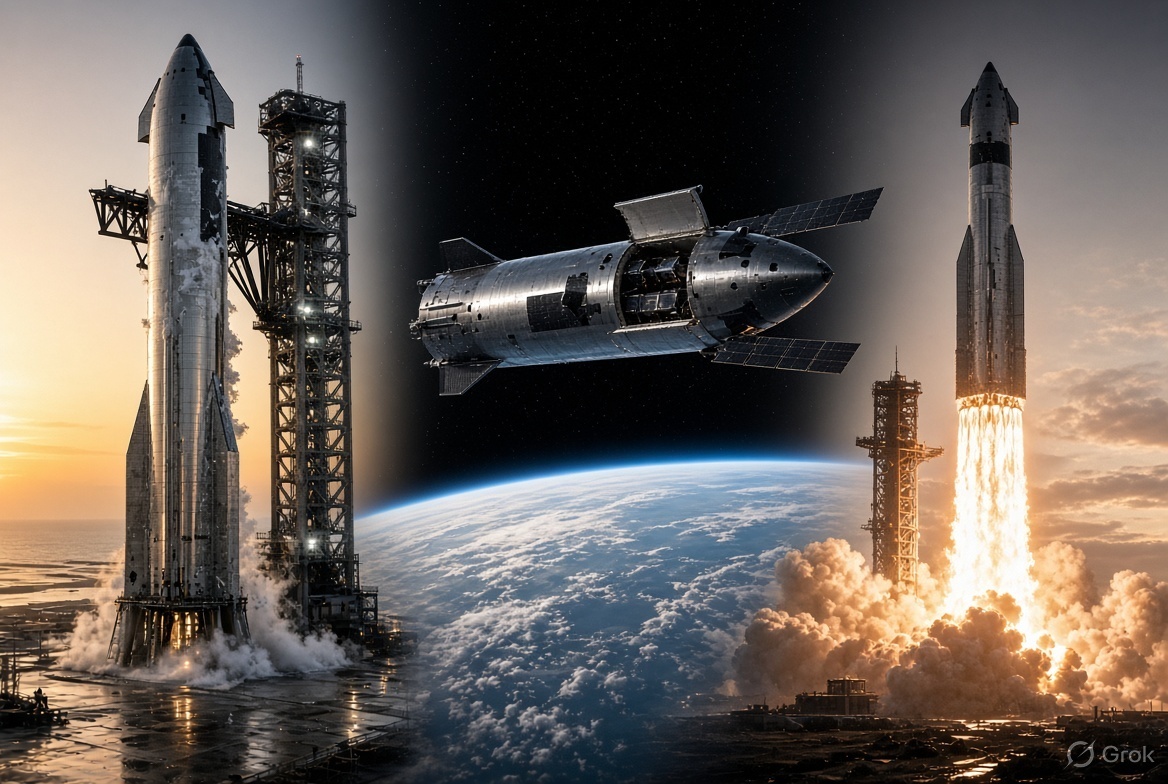
On Monday, 28 September 2026, at about ten o’clock at night Darwin time, Starship reached orbit.
It was Flight 14: Super Heavy Booster 21 and Ship 41, the V3 stack, off Pad 2 at Starbase. Liftoff was 12:48 UTC. One Raptor on the ship shut down early. Controllers still called the insertion burn. The vehicle went into low Earth orbit for the first time. Then it did the thing previous flights had only rehearsed: it opened the bay and put up a working payload — twenty-six Starlink V3 satellites, all of them contacted, all of them operating. SpaceX cut the mission from a planned ten hours to about three. The booster made a controlled splashdown in the Gulf. The ship came down north of Hawaii on a landing burn, then tipped and burned off residual propellant in the water, as ocean recoveries of this vehicle usually do. No chopsticks this time. That first is still ahead.
Starship is not a finished article. V3 will become ordinary, then give way to V4. Falcon will shrink in the manifest because these satellites are too large for Falcon 9 and because one ship can, in time, put up the capacity of many Falcon loads. This flight flew twenty-six, not a full sixty. The capacity added is on the order of ten times a typical Falcon 9 flight of V2 Mini birds. Direct-to-cell is a different Starlink line; what went up on Monday is the heavy V3 broadband layer. Mobile coverage will ride the constellation as a whole, not this batch alone.
Still: first orbit. First operational payload. Firsts still owed — a ship caught in the tower, a double launch, a tanker rendezvous. Those will come. The night of the 28th was the hinge.
Congratulations to Elon Musk, to SpaceX, and to X, which carried the argument and the pictures while the vehicle was still in the air.
For 30 September
These eight moments sit on the last days of September — most of them on the 30th — and they share a family resemblance: a second blow, a baggage train lost, a crown claimed, a city burned, an opera that outlived its composer.
489 — Battle of Verona.
Theoderic’s Ostrogoths had already beaten Odoacer at the Isonzo on 28 August. A month later they met again outside Verona. English sources put the fight on 30 September; some Italian accounts say the 28th. Theoderic charged when his line wavered. Odoacer fled to Ravenna. The Western Empire had fallen in 476; Verona decided who would wear what was left of Italy.
737 — Battle of the Baggage.
Asad ibn Abdallah al-Qasri raided Khuttal. Suluk’s Türgesh came down. The Arabs got the army back across the Oxus. They did not get the baggage. On 30 September the train and its escort were taken. Hold on the upper Oxus collapsed. Kharistan later reversed the campaign. The baggage fight had already shown how thin the caliphate’s reach had become.
1399 — Henry IV proclaimed.
Richard II signed a formal abdication on the 29th. On the 30th an assembly sitting as Parliament accepted the deposition and acclaimed Henry of Bolingbroke. Coronation followed on 13 October. Lancaster began as a usurpation in legal dress. Richard was dead within months. The doubt over the title ran through the reign and into Shakespeare.
1541 — De Soto and the Tula.
The column had crossed the Mississippi in June. By autumn it was in western Arkansas among the Tula — likely Caddoan speakers. The fighting is usually placed in October near present-day Fort Smith, not on a single September day. It was hard enough that de Soto turned east and wintered at Utiangue. He died the next May at Guachoya. The gold was never there.
1551 — Tainei-ji.
On 28 September Sue Takafusa marched on Yamaguchi. Ōuchi Yoshitaka had tried to move Emperor Go-Nara and the court west and make the city a second Kyoto. His captains would not have it. The city burned. Weather drove Yoshitaka back from the coast. On 30 September he committed seppuku at Tainei-ji with a handful of men left. The courtiers who had followed him were killed. Ming official trade, which the Ōuchi had held, broke off.
1744 — Madonna dell’Olmo.
Outside Cuneo, 30 September, War of the Austrian Succession. Conti’s Franco-Spanish army held the convent and the road. Charles Emmanuel III came up from Saluzzo, lost the field, and withdrew in order. Cuneo did not fall. Rain and empty magazines sent the Bourbons back over the Alps. A win that did not open Piedmont.
1791 — Die Zauberflöte and the Constituent Assembly.
Same calendar day, two rooms. In Vienna, Mozart conducted the first night of The Magic Flute at Schikaneder’s Freihaus-Theater auf der Wieden. Schikaneder played Papageno. Mozart was dead on 5 December. The piece kept running. In Paris the National Constituent Assembly dissolved on 30 September. The Constitution of 1791 was in force. Robespierre and Pétion left the hall as “incorruptible patriots” because they had barred themselves from the next house. The Legislative Assembly met the next day. The constitutional monarchy lasted less than a year.
What holds the list together is not a theme so much as a hinge: second battles after first ones, a train of loot taken, a crown taken, a court that never arrived, an opera that did. Late September keeps producing those. Orbit, this week, was another.