VoiceDDB
Politics • Culture • News
680 — Karbala.
October 10th
October 08, 2026
post photo preview

680 — Karbala.

The fight ran in this order. The seventy were with Husayn. They were not the army sent against him.

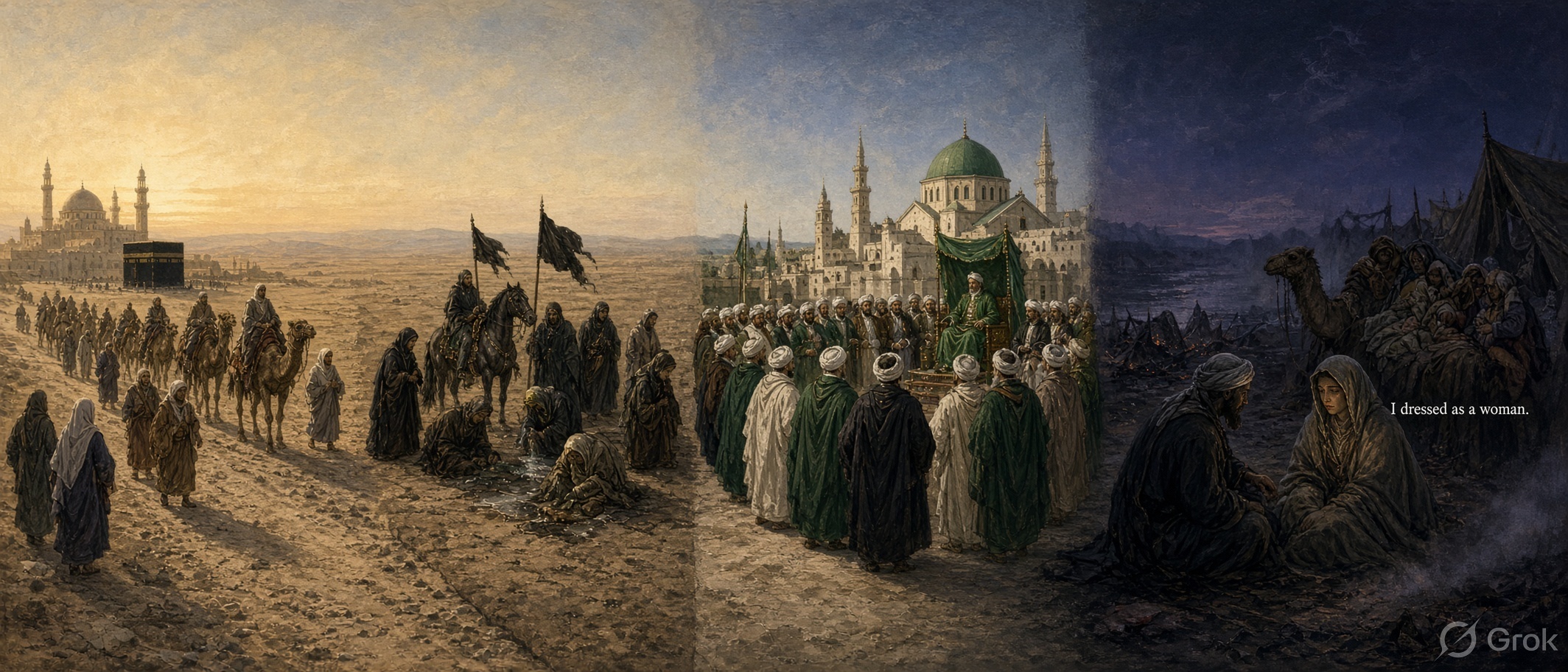
Husayn had already left Mecca in early September 680, after his envoy Muslim ibn Aqil had been executed in Kufa. On the road a screen of about a thousand horse under al-Hurr ibn Yazid stopped him. Al-Hurr would not let him into Kufa and would not let him turn back to the Hijaz. The two parties moved together until 2 Muharram (2 October), when the column was halted on the open plain of Karbala, west of the Euphrates.

Umar ibn Sa’d arrived with the main force, several thousand, under orders from Ubayd Allah ibn Ziyad: take the oath on the spot, or fight. From 7 Muharram the horse were posted between the tents and the river. One small party got water through. After that the channel was closed.

On 9 Muharram Shimr ibn Dhi al-Jawshan brought Ibn Ziyad’s final order: submission at once, or attack, and Umar ibn Sa’d himself answerable if he delayed. Husayn asked for the night. He told his men they were free to leave under cover of dark. The early report is that none of the fighting men went. That is the seventy or so: relatives, clients, and a few who had joined him, inside his camp, not facing him.

At dawn on 10 Muharram both sides prayed. Al-Hurr, the commander who had first blocked the road, crossed over and was killed on Husayn’s side. Talks ended. Umar ibn Sa’d’s line advanced. Husayn’s men went out in small groups and were cut down. By afternoon the companions were dead, then several of the family, including sons and nephews. Abbas ibn Ali was killed trying to reach the water. Husayn, already wounded, was finished in the open and beheaded. The camp was looted and the tents burned. The women and children were taken, with Ali Zayn al-Abidin, who had been too ill to fight.

Umar ibn Sa’d buried his own dead. Husayn and his men were left until local tribesmen interred them. The heads and the captives went first to Kufa, to Ibn Ziyad, and then to Yazid in Damascus.

=

Karbala was not a battle between two armies that chose a field. It was a small household column stopped on open ground, denied the river, and then killed once it would not give the oath Yazid wanted.

Why they were there

Muawiya died in the spring of 680. He had spent twenty years turning a contested governorship of Syria into a hereditary caliphate, and he named his son Yazid to succeed him. Allegiance was taken in Damascus and pressed in the other garrison cities. Husayn ibn Ali, grandson of Muhammad and son of Ali, refused it in Medina, as did Abd Allah ibn al-Zubayr. Both men left for Mecca, where killing was forbidden and a crowd for the pilgrimage could be addressed.

Kufa was the other pole. It had been Ali’s capital, it was full of men who had fought for him at Siffin, and it resented Syrian rule. Letters reached Husayn promising tens of thousands of supporters if he came. He did not go at once. He sent his cousin Muslim ibn Aqil to test the offer. Muslim was at first received openly, then Ubayd Allah ibn Ziyad, already governor of Basra, was given Kufa as well. Ibn Ziyad entered the city, bought or frightened the notables, and had Muslim and his host Hani ibn Urwa executed. The pledged rising collapsed before Husayn left Mecca.

Husayn set out anyway, around 8–9 Dhu al-Hijja 60 (early September 680), with family, a few dozen fighting men, and camp followers — women, children, and retainers. The early account in al-Tabari, drawing on Abu Mikhnaf, puts the armed men at something like seventy by the end, not an army. On the road he met the poet al-Farazdaq, who told him that Kufan hearts were with him and Kufan swords with Ibn Ziyad. He also received news of Muslim’s death. Companions were released from their oaths. Some left. He continued. Turning back meant either the oath to Yazid or the life of a fugitive. Going on meant a garrison city that had already failed his envoy.

Why the ground looked like that

North of Mecca the road toward Kufa runs up the west side of the Euphrates. Husayn’s column was met by a cavalry screen of about a thousand men under al-Hurr ibn Yazid al-Tamimi, sent to shadow him and keep him off the main roads into the city. Al-Hurr would not let him enter Kufa and would not, at first, force a fight. The two parties moved together until, on 2 Muharram (2 October), they were halted on the bare plain of Karbala, west of the river, with no town and no fort.

That placement was deliberate. Ibn Ziyad’s order to his field commander, Umar ibn Sa’d, was to keep Husayn from Kufa, from the river towns, and from any return to the Hijaz, and to demand the oath. Karbala gave the larger force every advantage: open ground for cavalry, no walls, and the Euphrates within reach but easy to seal. Umar ibn Sa’d arrived with the main body, traditionally numbered in the thousands, and put five hundred horse between the camp and the water. A small party got through once and brought back a few skins. After that the channel was closed. From 7 Muharram the camp was on stored water in early October heat.

Umar ibn Sa’d is the awkward figure in the story. He wanted the governorship of Rayy, and Ibn Ziyad made the command against Husayn the price of it. Negotiations ran for days. Husayn’s reported offers were to withdraw to the frontier, to return the way he had come, or to be taken to Yazid in person. Ibn Ziyad, pushed by Shimr ibn Dhi al-Jawshan, rejected anything short of submission on the spot. Shimr arrived with that order and with a threat against Umar ibn Sa’d if he hesitated. On the eve of the fight al-Hurr crossed over to Husayn’s side, an act the early sources record and later telling makes much of.

What happened

The killing itself was on 10 Muharram, 10 October 680. It was not a pitched battle. Umayyad horse and foot surrounded the tents. Husayn’s men fought in small groups and were cut down. By afternoon the companions were dead, then several of the family, including sons and nephews. Accounts name Abbas ibn Ali trying to reach the water and being killed on the channel. Husayn, wounded, was finished in the open. The man credited with the beheading varies by report; Shimr is the name later tradition fixes on. Heads were taken. The camp was looted, tents burned, and the women and children assembled.

Ali Zayn al-Abidin, Husayn’s eldest surviving son, was ill and had not fought. He was spared, and with him the line continued. The bodies of Husayn and his men were left unburied until local tribesmen interred them a day or more later. Umar ibn Sa’d buried his own dead first.

The captives were walked to Kufa. Ibn Ziyad had the heads set out and questioned the prisoners. Zaynab bint Ali, Husayn’s sister, answered him in the scene the Shia tradition treats as the first public indictment of the killing. The column was then sent to Damascus. Yazid received them, and the sources disagree on his manner: some have him striking Husayn’s mouth with a cane as the head was displayed, others have him distancing himself from Ibn Ziyad and releasing the family. Both can be true of a court managing a scandal. The survivors were sent back toward Medina.

Outcomes

In the short run the Umayyads got what they had forced the issue for. No Alid counter-caliph was proclaimed in Kufa. Yazid’s nomination held. The price showed quickly. In 683 Medina rose and was sacked after the Battle of al-Harra. Ibn al-Zubayr held Mecca. Yazid died that same year. His son Muawiya II lasted months. Ibn Ziyad was killed in 686 by Ibrahim ibn al-Ashtar, fighting for Mukhtar al-Thaqafi, who had taken Kufa in the name of vengeance for Husayn and had many of the Karbala commanders hunted down. The Marwanid branch restored the dynasty, but Karbala remained the charge against it.

The lasting outcome was religious, not territorial. For Shia Muslims the day became the founding martyrdom: Ashura, mourning gatherings, and the passion narrative of the tents, the water, the boy Ali al-Asghar, and Zaynab’s protest in Damascus. Husayn’s refusal is read as the stand of the Prophet’s house against a worldly kingship. Sunni historians, including the early ones, generally call the killing a crime and Yazid’s pressure a disaster, without making 10 Muharram a communal rite or treating Husayn as an imam in the Shia sense. The numbers, the speeches, and the named killers hardened in later retellings. The core that the earliest collectors already have is stable: a refused oath, a Kufan invitation that collapsed, a camp stopped short of the river, and a grandson of Muhammad killed by the caliph’s governor.

= October 10th

680 — Karbala. The usual date is 10 October 680 (10 Muharram, AH 61), on the plain of Karbala west of the Euphrates in present-day Iraq. Husayn ibn Ali, grandson of Muhammad and son of Ali, had refused to recognise Yazid I as caliph after Muawiya’s death. He left Mecca with family and a small retinue, expecting support from Kufa. The governor Ubayd Allah ibn Ziyad intercepted him. Husayn’s fighting men numbered about seventy against several thousand under Umar ibn Sa’d. After water was cut off and terms refused, the camp was overrun. Husayn was killed and beheaded; the head was sent to Yazid in Damascus, the bodies were mutilated, and the women and children were taken captive. His sick son Ali Zayn al-Abidin was spared. The fight secured the Umayyad succession for the moment. For Shia Muslims it became the founding martyrdom: Ashura, the tenth of Muharram, is still a day of mourning, processions, and retelling. Sunni tradition also treats Husayn’s death as a wrong, but does not make the day a communal rite in the same way.

732 — Tours (Poitiers). Fought in October 732, most often given as 10 October, somewhere between Poitiers and Tours. Charles Martel, mayor of the palace and effective ruler of the Franks, met an Umayyad army from al-Andalus under Abd al-Rahman al-Ghafiqi. The Muslim force had raided deep into Aquitaine. Charles held a defensive infantry line; Abd al-Rahman was killed, and the raiders withdrew toward the Pyrenees. Later Christian writers, Gibbon among them, cast it as the battle that saved Europe. Modern historians are cooler: it stopped one campaign and strengthened Charles in the south, but Umayyad pressure on the frontier continued for years, and the deeper limit on expansion was overstretch, not a single field. Numbers are guesses. The battlefield has never been fixed.

1471 — Brunkeberg. Again the standard date is 10 October 1471, on the Brunkeberg ridge just north of Stockholm. Sten Sture the Elder, regent of Sweden, faced King Christian I of Denmark, who was trying to restore the Kalmar Union. Sture’s army was built heavily from farmers and miners of the Bergslagen, plus some regulars. Christian had Danish and German troops. Sture caught the king’s force between attacks from west, east, and the city. Christian was shot in the mouth, lost teeth, and was carried to his ships. The victory broke the unionist party for a generation and left Sture as the effective ruler of Sweden. It was as much a Swedish civil fight, unionists against separatists, as a war with Denmark.

1575 — Dormans. On 10 October 1575, during the French Wars of Religion, Henry I, Duke of Guise, beat a Protestant force at Dormans. It was the only clear Catholic success in a bad campaign. Guise took a facial wound that earned him the name le Balafré, “the scarred,” already carried by his father. Among the prisoners was Philippe de Mornay (Duplessis-Mornay), the Huguenot writer and diplomat later called the “Huguenot pope.” He was ransomed cheaply and soon married Charlotte Arbaleste. The skirmish mattered less for ground gained than for Guise’s reputation in Paris, which fed the Catholic League a few years later.

1580 — Dún an Óir. In autumn 1580 a papal expedition of roughly 600 Italian and Spanish troops under Sebastiano di San Giuseppe landed at Smerwick harbour in County Kerry to support the Second Desmond Rebellion. The fort they occupied was Dún an Óir, the Fort of Gold. The landing itself is usually placed in September; the decisive end came in November, when Lord Grey de Wilton and a naval squadron under William Winter besieged the fort. After surrender, the garrison was massacred. The episode hardened English policy in Munster and became a set piece in Irish memory of the Desmond wars.

1582 — the missing days. Pope Gregory XIII’s reform cut ten days from October so that the calendar would match the solar year and Easter would fall correctly. In the papal states, Spain, Portugal, and the Polish–Lithuanian lands that adopted it at once, 4 October 1582 was followed by 15 October. The 5th through the 14th, including the 8th, did not occur. France, the Protestant states, and Britain waited — Britain until 1752 — which is why letters of the period sometimes carry two dates.

1631 — Prague. After the Swedish–Saxon victory at Breitenfeld on 17 September 1631, John George I of Saxony sent an army under Hans Georg von Arnim into Bohemia. Prague was occupied in November 1631, not on 8 October; the city was entered around the middle of that month. The occupation was short. Imperial forces recovered Bohemia the next year, and the Saxon intervention is remembered more as a raid that looted the palace archives than as a lasting conquest.

1760 — the Ndyuka treaty. On 10 October 1760, at the Dutch camp of Vreedenburg, colonial authorities in Suriname signed a peace with the Ndyuka (Aukaner), Maroons descended from Africans who had escaped plantation slavery and built villages up the Marowijne and Tapanahony. The treaty recognised them as free, confirmed a territory well inland of the plantations, and required them to return later runaways for a bounty. Similar treaties followed with the Saramaka (1762) and Matawai (1767). From the Ndyuka side it is still treated as the charter of freedom and territorial autonomy, older than the modern Surinamese state.

1780 — the Great Hurricane. The deadliest recorded Atlantic hurricane struck the Lesser Antilles between about 10 and 16 October 1780. Barbados, Martinique, and St Eustatius were wrecked. Estimates run from 20,000 to 30,000 dead, many of them on ships of the French and British fleets gathered for the American war. Admiral Rodney’s and de Guichen’s squadrons both lost heavily. Contemporary reports describe stone buildings levelled and harbours choked with wrecks. No storm in the Atlantic basin has a higher accepted death toll.


community logo
Join the VoiceDDB Community
To read more articles like this, sign up and join my community today
0
What else you may like…
Videos
Posts
Articles
00:01:07
November 27, 2022
Jingle Bell Rock

Jingle bell, jingle bell, jingle bell rock
Jingle bells swing and jingle bells ring
Snowin' and blowin' up bushels of fun
Now the jingle hop has begun

Jingle bell, jingle bell, jingle bell rock
Jingle bells chime in jingle bell time
Dancin' and prancin' in Jingle Bell Square
In the frosty air

What a bright time, it's the right time
To rock the night away
Jingle bell time is a swell time
To go glidin' in a one-horse sleigh

Giddy-up jingle horse, pick up your feet
Jingle around the clock
Mix and a-mingle in the jinglin' feet
That's the jingle bell rock

Jingle bell, jingle bell, jingle bell rock
Jingle bell chime in jingle bell time
Dancin' and prancin' in Jingle Bell Square
In the frosty air

What a bright time, it's the right time
To rock the night away
Jingle bell time is a swell time
To go glidin' in a one-horse sleigh

Giddy-up jingle horse, pick up your feet
Jingle around the clock
Mix and a-mingle in the jinglin' feet
That's the jingle bell
That's the jingle...

00:02:04
September 01, 2021
Intro to Locals for the Conservative Voice

David Daniel Ball calls himself the Conservative Voice.

I'm a teacher with three decades experience teaching math to high school kids.I also work with first graders and kids in between first grade and high school. I know the legends of why Hypatia's dad is remembered through his contribution to Math theory. And I know the legend of why followers of Godel had thought he had disproved God's existence.

I'm not a preacher, but I am a Christian who has written over 28 books all of which include some reference to my faith. Twelve blog books on world history and current affairs, detailing world events , births and marriages on each day of the year, organised by month. Twelve books on the background to and history of Bible Quotes. One Bible quote per day for a year. An intro to a science fiction series I'm planning, post apocalyptic cyber punk. An autobiography with short story collections.

I'm known in Australia for my failure as a whistleblower over the negligence death of a school boy. ...

00:01:50
September 04, 2026
Should violent criminals be made fat? Grok says 'no'

No. Transferring gut bacteria from an obese person into a violent criminal is not a reliable, ethical, or effective way to make them “fat, sedentary, and less of a physical threat.”

The science does not deliver the outcome you want

Mouse studies in germ-free animals showed that microbiota from obese donors can increase energy harvest and adiposity compared with lean-donor microbiota. That is the origin of the idea. Human evidence is far weaker.

Randomized trials of fecal microbiota transplant (FMT) from lean donors into people with obesity have generally failed to produce meaningful, sustained weight loss. Microbiome composition can change; body weight and metabolic markers often do not, or the effects are small and inconsistent. Diet and the existing gut environment usually dominate. A 2025 Nature paper found diet outperformed microbial transplant for microbiome recovery. Human guts are already colonized, not sterile like lab mice, so engraftment is variable and effects unpredictable.

It is not a ...

post photo preview
August 28, 2026
Pfizer struggles to answer

Some in Australia are brilliant. Malcolm Roberts Investigates Pfizer over Covid vaccine.

Holiday break is over back to work tonight

Tonight I'll start double posting until I've caught up.

November 16, 2026
post photo preview
The road to 1812
November 19th

The road to 1812

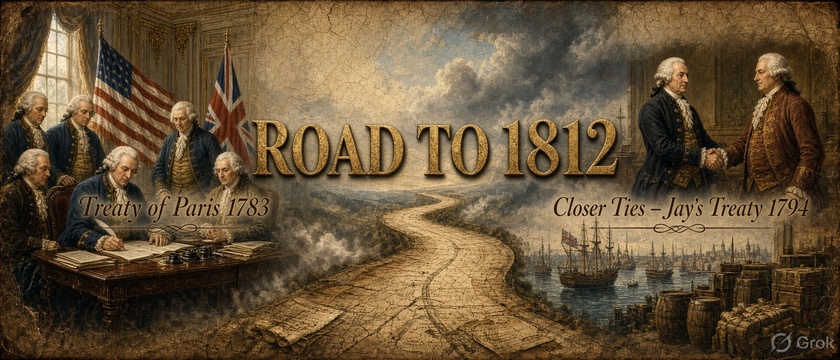
Jay’s Treaty (officially the Treaty of Amity, Commerce, and Navigation, Between His Britannic Majesty and the United States of America), signed in London on 19 November 1794 by John Jay and Lord Grenville, was a pragmatic and deeply controversial agreement that averted war between the young United States and Great Britain.

Background (before 1794)

The 1783 Treaty of Paris that ended the American Revolutionary War left several issues unresolved or only partially implemented:

  • Britain continued to occupy forts in the Northwest Territory (around the Great Lakes), including posts at Detroit, Mackinac, Niagara, Oswego and others, in violation of the peace terms.
  • American state courts obstructed British creditors trying to recover pre-war debts.
  • Southerners sought compensation for enslaved people who had fled to or been carried off by British forces.
  • Trade remained restricted: Britain limited American access to its markets (especially the West Indies) while American ports were open to British goods.
  • With Britain at war with Revolutionary France from 1793, the Royal Navy seized American ships trading with France and impressed American sailors into British service. Over 250–300 American vessels were taken in a short period.

These grievances brought the two countries close to war. Federalists (especially Alexander Hamilton) prioritised trade with Britain and peace; Democratic-Republicans (Thomas Jefferson, James Madison and others) were more sympathetic to France and resented British high-handedness. President George Washington, advised by Hamilton, chose diplomacy over confrontation and in 1794 sent Chief Justice John Jay as special envoy to London.

Key figures

  • John Jay (1745–1829): Chief Justice of the U.S. Supreme Court, earlier Secretary of Foreign Affairs under the Articles of Confederation, and a negotiator of the 1783 Treaty of Paris. A Federalist Anglophile with strong diplomatic experience.
  • Lord William Wyndham Grenville (1759–1834): British Foreign Secretary, the principal British negotiator.
  • George Washington: President who selected Jay, supported the treaty despite its flaws, and pushed it through against intense opposition.
  • Alexander Hamilton: Treasury Secretary who shaped the American negotiating strategy and strongly favoured closer commercial ties with Britain.
  • Thomas Jefferson and James Madison: Leading opponents who viewed the treaty as a betrayal of France and a surrender to British interests. Their resistance helped solidify the emerging Democratic-Republican Party.
  • William Pitt the Younger: British Prime Minister during the negotiations.

The treaty itself (19 November 1794)

Jay and Grenville produced a 28-article treaty. Main provisions included:

  • Britain agreed to evacuate the Northwest forts by 1 June 1796.
  • Mixed commissions were established to arbitrate: pre-war debts owed to British creditors; compensation for British seizures of American ships; and the northeast boundary (the St. Croix River question). This was an early and influential use of international arbitration.
  • Limited commercial concessions: the United States received “most favoured nation” trading status in Britain and the British East Indies. Access to the British West Indies was restricted to vessels of 70 tons or less (and even that was later suspended).
  • The United States agreed to pay legitimate pre-war debts and to prevent the outfitting of privateers of Britain’s enemies in American ports.
  • Freedom of navigation and trade across the boundary (including for Native Americans on either side) was affirmed.
  • Notably absent: any real protection against future impressment or a strong American definition of neutral rights at sea. No compensation for enslaved people carried off during the Revolution.

Aftermath and controversy

The treaty reached the United States in 1795 and ignited fierce public and political opposition. Critics called it a humiliating surrender; Jay was burned in effigy in several cities and later remarked that he could find his way across the country by the light of his own burning effigies. The full text was leaked and published, intensifying the uproar.

The Senate, after secret debate, approved it on 24 June 1795 by the bare two-thirds majority of 20–10, but only after conditioning ratification on the suspension of the restrictive West Indies article (Article 12). Britain accepted the change. Washington signed the treaty in August 1795. The House of Representatives later fought over funding the commissions; after heated debate it narrowly approved the necessary appropriations in 1796 (51–48). Washington also set an important precedent by refusing the House’s demand for the negotiation papers, asserting that treaty-making was an executive and Senate power.

Consequences included:

  • Avoidance of an immediate war with Britain and roughly a decade of improved commercial relations.
  • British withdrawal from the Northwest posts in 1796, which opened the region to American settlement (and contributed to the Treaty of Greenville with Native nations the previous year).
  • Deepening of American party divisions: Federalists supported the treaty; Democratic-Republicans opposed it. The controversy permanently strained relations between Washington and both Jefferson and Madison.
  • French anger at what they saw as an Anglo-American tilt, which helped produce the Quasi-War (1798–1800).
  • Failure to settle impressment and neutral rights, issues that later contributed to the War of 1812. Jefferson did not renew the treaty when it expired in 1805.

Historians generally judge the treaty as imperfect and more favourable to Britain on paper, yet a shrewd bargain for a weak young republic that needed time to consolidate. It bought peace, secured the Northwest, established useful arbitration precedents, and protected the commercial base Hamilton considered essential.

In short, Jay’s Treaty was an unloved but consequential piece of early American diplomacy: it postponed a war the United States was ill-prepared to fight, deepened domestic political factions, and left several maritime grievances for a later generation to confront.

= November 19th

Here are the details on those four events. (I’m taking “yell me about” as “tell me about.”)

461 – Libius Severus declared Western Roman Emperor (real power with Ricimer)

After Ricimer, the magister militum (master of soldiers), had the previous Western emperor Majorian executed in August 461, there was a short interregnum. On 19 November 461 the Senate in Ravenna acclaimed Libius Severus (a Lucanian aristocrat, sometimes called Severus III) as augustus.

He was never recognised by the Eastern emperor Leo I and exercised little real authority. Ricimer remained the dominant figure; some coinage even carried Ricimer’s monogram, and contemporary and later sources treat Severus as a classic “shadow” or puppet emperor. His roughly four-year reign (to November 465) saw ongoing problems with the Vandals under Gaiseric, hostility from the general Aegidius in Gaul, and continued Eastern non-recognition. He died in 465 (natural causes or, as some accounts claim, poisoned by Ricimer), after which Ricimer looked for a candidate more acceptable to the East.

636 – Battle of al-Qādisiyyah

In November 636 (most commonly dated around 16–19 November) the Rashidun army under Saʿd ibn Abī Waqqāṣ defeated a larger Sasanian force commanded by Rostam Farrokhzād near al-Qādisiyyah (on the edge of the desert in what is now southern Iraq).

The battle was decisive. Rostam was killed, the Sasanian lines collapsed, and the royal banner (the Derafš-e Kāviān) was captured. The victory opened the way for the Arab capture of the Sasanian capital Ctesiphon and the subsequent conquest of Mesopotamia and Iran; the Sasanian Empire effectively collapsed by 651. Sources vary on exact army sizes and the precise day, but the outcome is clear: a major turning point in the early Muslim conquests.

1493 – Columbus lands on San Juan Bautista (Puerto Rico)

On his second voyage, Christopher Columbus sighted the island the Taíno called Borikén (or Boriquen) on 18–19 November 1493 and went ashore on the 19th, somewhere on the western coast (likely near the area of modern Aguadilla, Aguada or Añasco). He named it San Juan Bautista (Saint John the Baptist) in honour of the saint.

The island was inhabited by Taíno people. Columbus stayed only briefly to take on water and supplies, then continued west. Permanent Spanish colonisation began later, with Juan Ponce de León founding the first settlement (Caparra) in 1508. Over time the island became known as Puerto Rico (“Rich Port”) while the main city took the name San Juan.

1794 – Jay’s Treaty signed

On 19 November 1794 in London, John Jay (U.S. Chief Justice and special envoy) and British Foreign Secretary Lord Grenville signed the Treaty of Amity, Commerce, and Navigation (Jay’s Treaty). It was an attempt to resolve outstanding issues left over from the 1783 Treaty of Paris that ended the American Revolutionary War.

Key provisions included British agreement to evacuate forts in the Northwest Territory by June 1796, limited commercial concessions (including “most favoured nation” status for American trade), and arbitration for several disputes (pre-war debts, ship seizures, and boundary questions). The treaty was unpopular in the United States—many saw it as too favourable to Britain—and passed the Senate only narrowly in 1795. President Washington still implemented it, viewing it as the price of avoiding war and securing time for the young republic to strengthen.

These four events fall within a few days of each other across different centuries (19 November for three of them; the battle of al-Qādisiyyah is traditionally placed in mid-November 636). Let me know if you’d like more detail on any of them, related context, or images.

Read full Article
November 16, 2026
post photo preview
Mismanagement caused Dyke failure
November 18th

Mismanagement caused Dyke failure

The St. Elizabeth’s Flood of 18–19 November 1421 (Dutch: Sint-Elisabethsvloed) was a major storm-surge disaster in the Low Countries that permanently transformed the landscape of what is now the southwestern Netherlands. It is named for the feast day of St. Elizabeth of Hungary (then observed on 19 November).

Before: The Grote Waard and Vulnerability

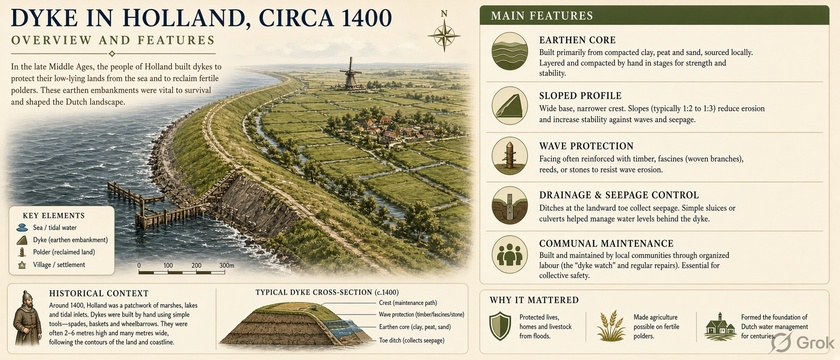
The main area affected was the Grote (or Zuid-Hollandse) Waard, a large, prosperous polder of reclaimed farmland between Dordrecht, Geertruidenberg, and Heusden. It had been protected by dikes since the late 13th century (roughly completed around 1283). By 1421 the land surface had subsided below mean sea level because of drainage for agriculture and extensive peat digging (used for fuel and salt extraction). Deep “salt wells” dug close to the dikes further weakened the defences.

Politically, the County of Holland was convulsed by the Hook and Cod wars (Hoekse en Kabeljauwse twisten), a long series of factional conflicts that ran from the mid-14th century into the late 15th. In the early 15th century the struggle centred on the succession of Countess Jacoba (Jacqueline) of Bavaria. The Hooks generally supported her claims; the Cods backed her uncle John of Bavaria (“John the Pitiless”). Resources that should have gone to dike maintenance were diverted to war. Towns such as Dordrecht (Cod stronghold) and Geertruidenberg (often Hook-aligned) were frequently at odds; Dordrecht forces had attacked Geertruidenberg in 1420. A local dispute over salt extraction involving Jacob van Abcoude (Lord of Putten and Strijen) was only nominally settled weeks before the flood, with a finding that the wells did not endanger the dikes—an assessment soon proved disastrously wrong.

There had already been a major St. Elizabeth’s flood in 1404 that hit Flanders, Zeeland, and parts of Holland.

The Flood Itself

On the night of 18–19 November 1421 a powerful extratropical cyclone drove a storm surge up the rivers from the North Sea. Dikes broke (notably near Broek / Wieldrecht on the southwestern side of the Grote Waard). Water poured into the low-lying polder. Further failures followed in the following weeks and years (including a break on the Merwede side in early 1422 linked to ice jams and high river discharge). The flood separated Dordrecht and Geertruidenberg and inundated large parts of Holland, Zeeland, and Flanders.

Death toll and villages: Contemporary chronicles (notably the Chronicon Tielense) speak of about 2,000 deaths across the wider storm-affected region. Later legend inflated this to 10,000 or even 100,000 and claimed 72 villages were swallowed. Modern historians (including Jan Buisman and later geographers) regard the higher figures as myth-making. The Grote Waard itself contained fewer than 30 villages and a total population of roughly 20,000–22,000. Realistic estimates for the disaster are in the low thousands of deaths at most, with many people able to flee; some analyses suggest the immediate toll in the Waard itself may have been lower still. Roughly two dozen settlements became permanently uninhabitable.

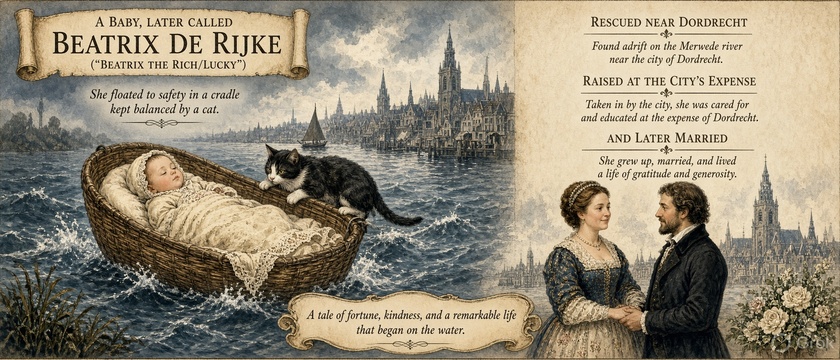
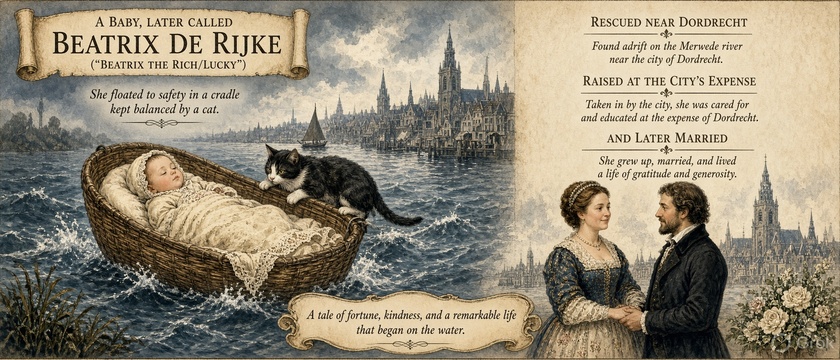
A famous local legend (appearing in art by the 1490s) tells of a baby, later called Beatrix de Rijke (“Beatrix the Rich/Lucky”), who floated to safety in a cradle kept balanced by a cat. She was said to have been rescued near Dordrecht, raised at the city’s expense, and later married. The story is almost certainly folkloric, but the cradle-and-cat motif appears on surviving altar panels of the flood.

Aftermath and Landscape Transformation

Attempts to repair the dikes were half-hearted and repeatedly frustrated by continued political discord. Further breaches in 1424 finished the permanent loss of most of the Grote Waard. Large parts remained under water for decades; some land was never fully reclaimed. The inundated area evolved into a freshwater tidal delta of creeks, islands, and reed beds—the Biesbosch (roughly “forest of rushes”), now a national park. Reclaimed or surviving areas include the island of Dordrecht, the Hoeksche Waard, and parts of northwestern North Brabant around Geertruidenberg.

The flood permanently altered river courses and turned Dordrecht into an island. It also entered Dutch collective memory as one of the great water disasters (alongside the 1953 North Sea flood), inspiring chronicles, maps, altarpieces, and later Romantic paintings. The exaggerated numbers and the Beatrix legend helped turn a serious but not apocalyptic event into a near-biblical catastrophe in popular telling.

Significant Figures and Context

  • Jacoba of Bavaria (1401–1436): Countess of Holland, Zeeland, and Hainaut. Her contested succession and the Hook–Cod civil wars created the political instability that contributed to neglected defences. She was in England at the time of the flood.
  • John of Bavaria (“John the Pitiless”): Her uncle and rival, supported by the Cod faction; controlled key towns including Dordrecht.
  • Local lords and officials (e.g., Jacob van Abcoude) whose decisions on peat/salt extraction and dike upkeep had direct consequences.
  • Anonymous chroniclers (especially the Tiel chronicle) who provide the earliest relatively sober casualty figures.

In short, the 1421 flood was not caused by an unprecedented “superstorm” alone, but by the interaction of a severe North Sea storm surge with a landscape already compromised by subsidence, peat digging, and decades of civil war that had starved the dikes of maintenance. Its most lasting legacy is the Biesbosch wetlands and the enduring Dutch awareness of the vulnerability of low-lying land.

= November 18th

These events are associated with November 18.

Here is context on the major ones from your list:

Early Christian and Late Roman Era

  • 326 – Consecration of Old St. Peter’s Basilica: Emperor Constantine ordered a large basilica built over the traditional site of St. Peter’s tomb (and parts of Nero’s Circus) on Vatican Hill. Pope Sylvester I consecrated it on this date. It stood for about 1,200 years as a major pilgrimage site and the site of papal coronations (including Charlemagne’s in 800) before being largely demolished for the current basilica.

  • 401 – Visigoths under Alaric I cross the Alps: Alaric led the Visigoths into northern Italy. This was an early stage in the series of Gothic movements that culminated in the sack of Rome in 410, a symbolic blow to the Western Roman Empire. Roman general Stilicho later defeated him at Pollentia (402), but the pressure continued.

High Middle Ages: Papacy, Crusades, and Power Struggles

  • 1095 – Council of Clermont begins: Called by Pope Urban II, it ran roughly 18–28 November in Clermont (Auvergne). After dealing with reform issues (clerical celibacy, simony, Truce of God, excommunication of King Philip I of France), Urban’s speech on 27 November called for an armed pilgrimage to aid Eastern Christians and recover Jerusalem. This launched the First Crusade. “Deus vult!” (“God wills it!”) became the cry.

  • 1180 – Philip II (Philip Augustus) becomes king of France: He succeeded his father Louis VII (who had already crowned him co-king in 1179). Philip greatly expanded and centralized royal power, reconquering much of the Angevin territories held by the English kings and helping turn the Capetian monarchy into a stronger state.

  • 1302 – Pope Boniface VIII issues the bull Unam sanctam: Issued during his conflict with Philip IV of France, it declared that submission to the Roman pontiff is necessary for salvation and asserted the superiority of spiritual over temporal power (using the “two swords” imagery). It is the strongest medieval statement of papal hierocracy; the original is lost but it entered canon law. The dispute soon led to the outrage at Anagni (1303) and contributed to the move of the papacy to Avignon.

Other papal actions on this date include the election of Antipope Sylvester IV (1105), Innocent III’s excommunication of Emperor Otto IV (1210), and Martin IV’s excommunication of Peter III of Aragon (1282).

Late Middle Ages and Early Modern

  • 1421 – St. Elizabeth’s Flood: On the night of 18–19 November (named for the feast of St. Elizabeth of Hungary, then 19 November), a severe North Sea storm broke dikes in the Grote Waard (Netherlands). Dozens of villages were flooded; traditional accounts cite ~10,000 deaths and 72 villages lost, though modern estimates are often lower (around 2,000 deaths and fewer villages). Much of the land remained flooded for decades and helped shape the Biesbosch wetlands. Poor dike maintenance amid the Hook and Cod wars was a contributing factor.

  • 1493 – Columbus sights Puerto Rico: On his second voyage, the fleet sighted the island (known to the Taíno as Borinquen) around 17–19 November. Columbus named it San Juan Bautista. He made landfall on the northwest coast (near present-day Aguadilla/Añasco area) and stayed briefly before sailing on to Hispaniola.

  • 1626 – Consecration of the present St. Peter’s Basilica: Pope Urban VIII consecrated the rebuilt basilica exactly 1,300 years after the traditional date of the original. Construction had begun in 1506 under Julius II; major architects included Bramante, Raphael, and Michelangelo (who designed the dome). It remains the largest church in Christendom and the symbolic heart of Catholicism.

Later Events

  • 1730: The future Frederick II of Prussia (Frederick the Great) was released from confinement after a royal pardon.
  • 1760: The rebuilt debtors’ prison at the Castellania in Valletta, Malta, received its first prisoners.

These dates illustrate recurring themes of papal authority, church–state conflict, migration and conquest, and the long continuity of Christian sites in Rome. The two St. Peter’s consecrations (326 and 1626) on the same calendar day are especially striking.

Read full Article
November 16, 2026
post photo preview
The birth of Protestant Work Ethic
November 17th

The birth of Protestant Work Ethic

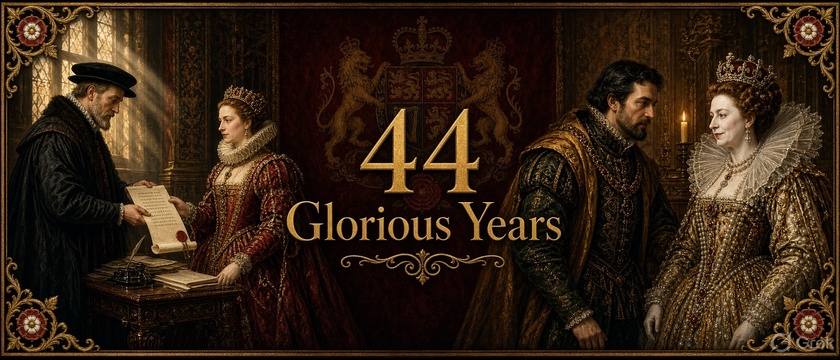
17 November 1558 marked the death of Mary I and the immediate accession of her half-sister Elizabeth I, ending the brief Catholic restoration under Mary and beginning the long Elizabethan era (1558–1603).

Before 1558: The Path to the Transition

Mary I (born 18 February 1516) was the only surviving child of Henry VIII and his first wife, Catherine of Aragon. After Henry’s break with Rome and the 1533 marriage to Anne Boleyn, Mary was declared illegitimate and suffered years of pressure and isolation. Anne Boleyn’s daughter Elizabeth (born 7 September 1533) was likewise declared illegitimate after Anne’s execution in 1536, though Henry’s 1544 Third Succession Act restored both daughters to the line of succession after their younger half-brother Edward.

Edward VI (reigned 1547–1553) was raised Protestant and died at 15 without heirs. His attempted diversion of the crown to the Protestant Lady Jane Grey collapsed within days; Mary, with strong popular and noble support, entered London and was proclaimed queen in July 1553. She was crowned in October 1553.

Mary’s reign was defined by three interlocking policies:

  • Restoration of Catholicism, including the repeal of Edwardian Protestant legislation and reconciliation with Rome under Cardinal Reginald Pole (appointed papal legate and Archbishop of Canterbury).
  • Marriage in July 1554 to Philip of Spain (later Philip II), making her queen consort of Spain from 1556. The marriage was deeply unpopular and sparked Wyatt’s Rebellion in early 1554, in which Elizabeth was implicated, imprisoned in the Tower of London, and later held under house arrest. No conclusive evidence of treason was produced, and she was released.
  • Persecution of Protestants. Roughly 280 people were burned at the stake (including bishops Hugh Latimer and Nicholas Ridley, and Archbishop Thomas Cranmer), earning Mary the later nickname “Bloody Mary.” Calais, England’s last Continental possession, was lost to France in early 1558.

Mary suffered false pregnancies and declining health. By late 1558 she was dying, probably of cancer. She had reluctantly accepted that the succession must pass to Elizabeth (the only viable heir under Henry VIII’s will), formally acknowledging her on or around 6 November. Philip II’s ambassador, the Count of Feria, was at court reporting on the situation. Mary died quietly at St James’s Palace on 17 November 1558, aged 42.

The Accession Day Itself

Elizabeth, then 25, was at Hatfield House. She was proclaimed queen the same day by the Lords and Commons assembled at Whitehall. Contemporary accounts note that she received the news with expressions of sorrow for her sister while immediately beginning to govern. 17 November later became Accession Day (or Queen’s Day), celebrated annually with bells, sermons, pageants, and (in later years) military reviews as a Protestant patriotic festival.

After 1558: The Elizabethan Settlement and Key Figures

Elizabeth moved quickly to reverse the Marian Catholic restoration. The 1559 Acts of Supremacy and Uniformity re-established a moderate Protestant Church of England with the queen as Supreme Governor, a revised Book of Common Prayer, and a broad church that could accommodate a range of beliefs while excluding open Catholicism and more radical Puritanism. She was crowned on 15 January 1559.

Central figures in the early years included:

  • William Cecil (later Lord Burghley): Principal Secretary from the outset and Elizabeth’s most trusted minister for nearly the entire reign.
  • Robert Dudley (later Earl of Leicester): Childhood friend, favourite, and persistent suitor; a major political and military figure.
  • Matthew Parker: First Archbishop of Canterbury under Elizabeth, who helped shape the settlement.
  • Nicholas Bacon and other privy councillors who formed a relatively stable early government.

Longer-term challenges and figures included the threat of Catholic succession (especially from Mary, Queen of Scots, who fled to England in 1568 and was eventually executed in 1587), the Spanish Armada of 1588 under Philip II, and the rise of a distinctive Elizabethan culture associated with figures such as Francis Drake, Walter Raleigh, and (later) William Shakespeare. The religious settlement proved durable enough to outlast the queen, though tensions with both Catholics and Puritans continued.

In short, Mary’s death closed a short, polarising Catholic interlude dominated by her Spanish marriage and the burnings, while Elizabeth’s accession launched a 44-year reign that defined a moderate Protestant England, survived major foreign and domestic threats, and is still remembered as a cultural high point.

= November 17th

These events cluster around mid-November in various years (often traditionally listed near 15–17 November). Here is context for each:

474 – Death of Emperor Leo II and sole rule by Zeno.
Leo II (c. 467–November 474), the young grandson of Leo I, had become co-emperor in late 473 and sole emperor after Leo I’s death in January 474. His father Zeno (an Isaurian general married to Leo I’s daughter Ariadne) was made co-emperor shortly afterward because the child was too young to rule effectively. Leo II died in Constantinople at about age 7 after roughly ten months as emperor. Contemporary sources give dates around early-to-mid November (or possibly into December, depending on the chronicler); no contemporary evidence supports poisoning, and high childhood mortality makes a natural death likely. Zeno thereby became sole Eastern Roman (Byzantine) emperor. His rule was immediately challenged by a coup from Verina’s brother Basiliscus in 475, but Zeno recovered the throne and held it until 491.

794 – Emperor Kanmu moves the capital from Nara to Kyoto.
Emperor Kanmu (Kammu, reigned 781–806) had already shifted the capital from Nara (Heijō-kyō) to Nagaoka-kyō in 784, partly to reduce the political influence of powerful Nara Buddhist monasteries. After problems at Nagaoka (including assassination of a key advisor, floods, and other ill omens), he relocated again in 794 to the newly planned Heian-kyō (“Capital of Peace and Tranquility”), modern Kyoto. Traditional dating places the emperor’s ceremonial move and the formal start of the Heian period around 17 November 794. The city was laid out on a Chinese-inspired grid and remained Japan’s imperial capital for more than a thousand years. Kanmu also expanded imperial authority in the north against the Emishi and supported the introduction of Tendai and Shingon Buddhism.

887 – Deposition of Charles the Fat; election of Arnulf of Carinthia.
In November 887 (sources cite an assembly at Frankfurt or nearby Tribur), East Frankish magnates deposed the ineffective Emperor Charles III “the Fat,” the last Carolingian to rule a reunited Frankish empire. His illegitimate nephew Arnulf of Carinthia (son of Carloman of Bavaria) was elected king of the East Frankish Kingdom. Charles yielded without major fighting and died early in 888. The event accelerated the permanent fragmentation of the Carolingian empire: West Francia, Burgundy, and Italy chose their own rulers. Arnulf later defeated Vikings decisively and briefly claimed the imperial title.

1183 – Battle of Mizushima.
On or about 17 November 1183, during the Genpei War (the Taira–Minamoto civil war), a naval action occurred off Mizushima in Bitchū Province (near modern Kurashiki/Okayama). Minamoto forces under commanders linked to Minamoto no Yoshinaka tried to cross the Inland Sea toward the Taira base at Yashima. The Taira (led by figures including Taira no Tomomori, Shigehira, and Noritsune) lashed their ships together with planks to form a fighting platform, used archers effectively, fought hand-to-hand, and even brought horses ashore to finish the rout. It was a clear Taira victory that checked Yoshinaka’s momentum. (Some accounts mention an annular solar eclipse coinciding with the fighting.)

1292 – John Balliol becomes King of Scotland.
After the death of Margaret, the Maid of Norway, left Scotland without a clear heir, the “Great Cause” succession dispute was arbitrated by Edward I of England. On 17 November 1292 at Berwick, the auditors (under Edward’s influence) awarded the crown to John Balliol (c. 1249–1314), whose claim through the female line from David I was judged superior on primogeniture. He was inaugurated at Scone on 30 November (St Andrew’s Day) and did homage to Edward. Edward treated Scotland as a vassal kingdom; Balliol’s weak reign collapsed in 1296 when Edward invaded, deposed him, and took the Stone of Destiny. Balliol later lived in exile in France.

1405 – Sharif ul-Hāshim establishes the Sultanate of Sulu.
Traditional dating places the founding of the Sultanate of Sulu on 17 November 1405 by Sharif ul-Hāshim (Sharif Abubakar Abirin Al-Hashmi), a Johor-born (or Arab-descended) Sunni scholar and explorer. He married a local princess (Dayang-dayang Paramisuli), introduced Islamic institutions and a Quran-based law code (the Diwan), and became the first sultan. The sultanate controlled the Sulu Archipelago, parts of Mindanao, Palawan, and later areas of northern Borneo. (Some accounts give an alternative founding year of c. 1457.) It remained an independent Muslim polity into the late 19th/early 20th century.

1511 – Treaty of Westminster between Henry VIII and Ferdinand II of Aragon.
In the context of the War of the League of Cambrai and the emerging Holy League against France, Henry VIII entered an alliance. On or about 17 November 1511 at Westminster, a treaty of mutual aid against France was concluded with Ferdinand II of Aragon (Henry’s father-in-law via Catherine of Aragon). It supported joint operations (including an eventual English expedition aimed at recovering Guienne/Aquitaine) and committed both to the papal-led anti-French coalition. It formed part of the wider diplomatic realignment of 1511–13 that led to English military involvement on the Continent.

1558 – Death of Mary I; accession of Elizabeth I (start of the Elizabethan era).
Mary I (daughter of Henry VIII and Catherine of Aragon) died on 17 November 1558 at St James’s Palace, aged 42, after a short and troubled reign marked by the restoration of Catholicism, the Spanish marriage to Philip II, and the persecution of Protestants. With no child, she was succeeded by her Protestant half-sister Elizabeth I (daughter of Anne Boleyn), then 25. Elizabeth was proclaimed the same day. The transition ended the brief Catholic restoration and opened the long Elizabethan reign (1558–1603), which re-established a moderate Protestant settlement and became a golden age of English culture and power. 17 November was later celebrated as Accession Day.

1603 – Sir Walter Raleigh’s trial for treason.
On 17 November 1603 at Winchester (moved from London because of plague), the Elizabethan courtier, explorer, and writer Sir Walter Raleigh was tried for high treason before a special commission. He was accused of involvement in the “Main Plot” to replace the new King James I with Arabella Stuart, involving Spanish money and Lord Cobham. The prosecution (led by Attorney-General Sir Edward Coke) relied heavily on Cobham’s statements; Raleigh had no counsel and limited rights to confront witnesses. He was convicted after a short jury deliberation and sentenced to death, but James reprieved him. Raleigh spent years in the Tower, was released for a final (failed) Guiana voyage, and was finally executed in 1618.

1777 – Articles of Confederation submitted to the states.
After months of debate, the Continental Congress adopted the Articles of Confederation on 15 November 1777 and submitted them to the thirteen states for ratification (with a covering letter dated around 17 November). This was the first constitution of the United States, creating a loose “league of friendship” of sovereign states with a weak central Congress. Unanimous state ratification was required; disputes over western land claims (especially Maryland’s holdout) delayed final ratification until 1 March 1781. The Articles governed the new nation through the end of the Revolutionary War and the early Confederation period until replaced by the 1787 Constitution.

1796 – Battle of the Bridge of Arcole.
From 15–17 November 1796, during the War of the First Coalition and Napoleon’s Italian Campaign, French forces under General Napoleon Bonaparte defeated an Austrian army under József Alvinczi near the bridge over the Alpone at Arcole (southeast of Verona). The fight was part of the third Austrian attempt to relieve the besieged fortress of Mantua. Fighting was fierce around the causeway and bridge; legend and contemporary propaganda emphasize Napoleon seizing a tricolor and leading charges (though the bridge was not decisively crossed on the first day, and the battle was a hard-won, multi-day engagement). The French victory forced Alvinczi to withdraw, preserved the Mantua siege, and boosted Bonaparte’s reputation. It was later celebrated in paintings (notably Horace Vernet’s) as a heroic moment.

These episodes span the late Roman/Byzantine world, medieval Europe and Japan, the early modern period, and the American and French Revolutions, illustrating shifts in imperial succession, capital relocation, the breakup of Carolingian power, clan warfare in Japan, Scottish-English relations, Islamic state formation in Southeast Asia, Tudor succession, English constitutional foundations, and Revolutionary warfare.


Read full Article
See More
Available on mobile and TV devices
google store google store app store app store
google store google store app tv store app tv store amazon store amazon store roku store roku store
Powered by Locals