Ordinances of 1311, Edward II
On Oct 11th, a failed king was hobbled
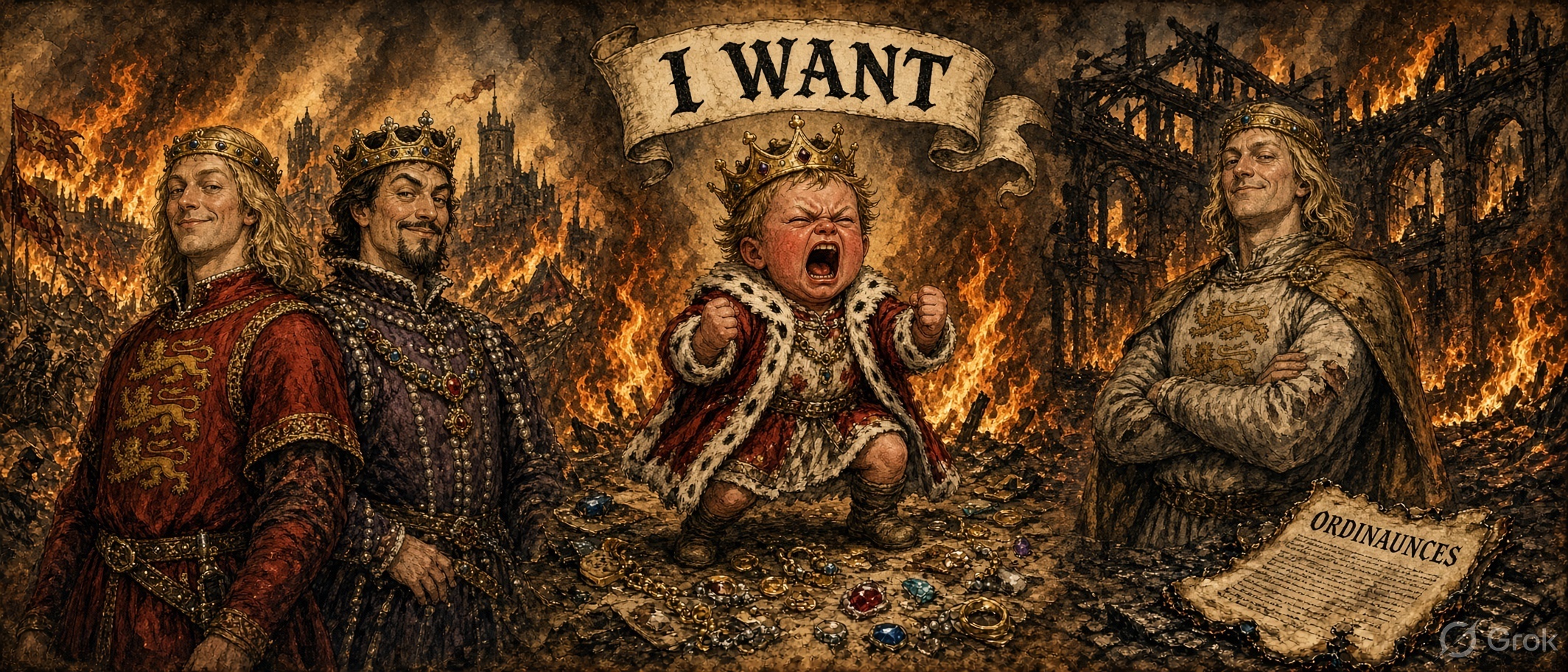
The Ordinances of 1311 were the barons’ attempt to put Edward II back inside the cage his grandfather and great-uncle had already built: a king who ruled with counsel, spent through the Exchequer, and did not hand the realm to a favourite. Edward signed them because he had no army and no money. He never accepted them, and the fight over them ran until Thomas of Lancaster’s head came off at Pontefract in 1322.
What came before
Edward I died at Burgh-on-Sands on 7 July 1307, still marching against Robert Bruce. His son recalled Piers Gaveston at once. Edward I had already banished the Gascon from England earlier that year, after a quarrel in which Gaveston and the young prince had been too conspicuous. Within weeks of the accession Gaveston was Earl of Cornwall, a title normally kept for royal kin, and married to Margaret de Clare, the king’s niece.
The grievance was older than Gaveston. Edward I had left a kingdom taxed hard for Wales, Gascony and Scotland, with prise and purveyance — the compulsory purchase of food and carts for the household and the army — widely hated. The magnates also had a constitutional memory. The Provisions of Oxford in 1258, and Simon de Montfort’s brief regime, had already tried to put royal appointments and the household under baronial supervision. At the coronation in February 1308 a new clause was added to the oath: the king was to uphold the laws and customs which the community of the realm would choose. The Ordainers later treated that as their warrant.
Gaveston made the abstract complaint personal. He was given the late king’s jewels, dominated tournaments, and nicknamed the earls — Warwick was “the black dog of Arden.” In 1308 the earls forced a second exile. Edward sent him to Ireland as lieutenant, which looked like promotion, and brought him back in 1309. By February 1310 the earls of Lancaster, Warwick, Hereford and Pembroke were accusing the king in parliament of wasting his inheritance and ruining the kingdom. On 16 March 1310 Edward agreed to a commission of twenty-one: eight earls, seven bishops and six barons, to ordain for the reform of realm and household, their work to be finished by Michaelmas 1312. Those were the Lords Ordainers.
Henry de Lacy, Earl of Lincoln, was the senior and the brake. He died in February 1311. His estates and the leadership passed to his son-in-law, Thomas of Lancaster. Lancaster was the king’s first cousin, holder in time of the earldoms of Lancaster, Leicester, Lincoln and Salisbury, and the richest subject in England. He was also rigid, absentee, and convinced the ordinances were a permanent constitution.
The ordinances themselves
Edward spent the winter of 1310–11 on a useless Scottish campaign. He met the Ordainers at Westminster in August 1311. About forty-one articles were presented; he sealed them under pressure in late September and early October. Publication is conventionally dated 11 October. Gaveston was to be out of every land of the king by All Saints, 1 November, on pain of being treated as a public enemy.
The rest was a programme, not a single grudge. Gifts made since the appointment of the Ordainers were revoked. The king was not to leave the realm or make war without baronial assent. Great offices — chancellor, treasurer, chief justices, household steward, keeper of the wardrobe — needed baronial approval, and the holders had to swear to the ordinances. Revenue was to pass through the Exchequer, not the wardrobe. Prise was restricted. Foreign merchants and royal bankers, especially the Italian firms, were targets. Parliament was to meet at least once a year, and a baronial committee was to hear complaints against royal servants. Customs were not to be levied without consent. It looked back to 1258 more than it looked forward.
The people who mattered
Edward II was not a fool, but he was stubborn, loyal to his own household, and bored by the business his father had lived for. He would not sacrifice a friend to keep a council.
Piers Gaveston, a Gascon knight’s son raised in Edward I’s household, was brave, extravagant and unable to stop scoring points. The sexual rumour is medieval as well as modern; what the ordinances actually charge is that he drew royal power to himself, sent treasure out of the realm, and estranged the king from his liege men. He had already been exiled twice.
Thomas of Lancaster became the ordinances’ embodiment. After 1314 he often refused to attend council unless the ordinances were enforced word for word, and he governed badly when he had the chance.
Guy Beauchamp, Earl of Warwick, was the hard edge. He seized Gaveston and saw the execution through.
Aymer de Valence, Earl of Pembroke, was the moderate who broke. He took Gaveston under safe conduct in 1312; Warwick kidnapped the prisoner. Pembroke treated that as an attack on his honour and spent the rest of his life trying to hold a middle line between king and Lancaster.
Humphrey de Bohun, Earl of Hereford, Edward’s brother-in-law, stood with the Ordainers, then died at Boroughbridge fighting the king.
Gilbert de Clare, Earl of Gloucester, the greatest Marcher and Gaveston’s brother-in-law, was killed at Bannockburn in 1314. His death removed the last great earl who might have balanced Lancaster.
Robert Winchelsey, Archbishop of Canterbury, gave the programme its clerical cover until his death in 1313. Walter Langton, Edward I’s treasurer and Edward II’s enemy, was an early victim of the new reign and a symbol of the household the barons wanted back under control.
What followed
Gaveston left, then returned around Christmas 1311. In May 1312 he was besieged in Scarborough and surrendered to Pembroke on terms. Warwick took him at Deddington. On 19 June, on Lancaster’s land at Blacklow Hill, two Welshmen ran him through and cut off his head. A form of trial was staged on the ground that he had broken the ordinances. Edward never forgave it. The body lay embalmed until burial at the Dominican house at Kings Langley in 1315.
Pardons were patched up in 1313. Then Bannockburn, 24 June 1314, destroyed the king’s remaining authority. Lancaster dominated the next four years. Scottish raids reached Yorkshire, the Great Famine bit in 1315–17, and Lancaster’s insistence on the letter of the ordinances produced stalemate rather than government. The Treaty of Leake in 1318, brokered by Pembroke and a group later called the Middle Party, put a standing council around the king and papered over the split.
Edward then acquired a new favourite, Hugh Despenser the Younger, with his father beside him. The Despensers grabbed Marcher lands. In 1321 Lancaster, Hereford and the Marchers forced the pair into exile. Edward struck back that winter, recalled them, and broke the opposition at Boroughbridge on 16 March 1322. Hereford was killed; Lancaster was taken and beheaded at Pontefract on 22 March.
In May 1322 the parliament at York repealed the ordinances by the Statute of York. The statute drew a distinction the Ordainers had refused: things touching the king and the realm needed the assent of king, prelates, earls, barons and the community of the realm in parliament, not a baronial committee appointed over the king’s head. Edward then ruled through the Despensers with executions, confiscations and forced loans. That regime lasted until Isabella and Roger Mortimer landed in 1326. Edward was deposed in January 1327 and killed at Berkeley in September.
The ordinances failed as a constitution. They were imposed, not agreed, and Lancaster could not govern through them. What survived was the claim that custom, parliament and the community could bind a king — the same claim that reappeared, in different language, against Edward’s great-grandson.
= October 11th
These are the events of 11 October, running from a medieval earthquake to a North Sea fleet action.
1138 — Aleppo earthquake. A shock, often rated around magnitude 7.1, struck northern Syria on 11 October, after a foreshock the day before. Contemporary chroniclers, including Ibn al-Qalanisi in Damascus, describe damage across Aleppo, the Crusader citadel at Harem, and country toward Edessa and Antioch. The often-quoted toll of about 230,000 dead comes from the fifteenth-century historian Ibn Taghribirdi and is now treated as a conflation of this quake with events in 1137 and the Ganja earthquake of 1139. Aleppo itself was partly emptied by the foreshock; the countryside and smaller forts took the worst of it. Aftershocks continued into early November.
1142 — Treaty of Shaoxing. During the Jin–Song wars a Jin envoy appeared at the Southern Song court and the peace was formally ratified. The Song emperor accepted vassal status, annual tribute of silver and silk, and a frontier roughly along the Huai River. North China stayed with the Jurchen Jin; the Song kept the south. The arrangement held, with interruptions, for most of the rest of the century.
1311 — Ordinances of 1311. The Lords Ordainers, a committee of peers and clergy forced on Edward II after the baronial crisis of 1310, published a set of regulations that stripped the king of much of his freedom to appoint, spend, and make war. Piers Gaveston was to be exiled again. Edward accepted the ordinances under pressure and spent the next decade trying to undo them. He succeeded in 1322, after Boroughbridge.
1531 — Death of Huldrych Zwingli. At the Second Battle of Kappel the Catholic forest cantons broke the Zurich force. Zwingli, who had gone out with the army as chaplain, was killed, aged 47. His body was quartered and burned. Zurich’s Reformation survived him, but the Swiss confederation stayed split between Catholic and Reformed cantons.
1582 — A day that did not exist. When the Gregorian reform was adopted, Thursday 4 October was followed by Friday 15 October in Italy, Poland, Portugal and Spain. The ten days from 5 to 14 October, including the 11th, were simply omitted. England did not make the change until 1752.
1614 — New Netherland Company. Adriaen Block, just back from charting the coast between the Hudson and Cape Cod (and giving his name to Block Island), joined twelve Amsterdam merchants in petitioning the States General for a monopoly on trade between the 40th and 45th parallels. They were granted three years. The name “New Netherland” on Block’s map is the first known use of it for that coast.
1634 — Burchardi flood. On the night of 11–12 October a North Sea storm tide, the second Grote Mandrenke, overran neglected dikes in North Frisia, Dithmarschen and south-west Jutland. Estimates run from 8,000 to 15,000 dead. The island of Strand was largely destroyed; what remained became Nordstrand, Pellworm and a scatter of halligen. On Strand alone more than 6,000 people and about 50,000 cattle were lost, and 17 of 21 churches were wiped out.
1649 — Sack of Wexford. After a siege from 2 October, Cromwell’s New Model Army stormed Wexford on the 11th when a castle captain opened a gate during talks. Roughly 1,500 to 2,000 soldiers and civilians were killed, several hundred of them drowned trying to cross the Slaney; about 3,000 were taken. Parliamentarian losses were about twenty. Cromwell reported it to London as judgement for 1641 and for the privateers who had used the harbour, and regretted mainly that the town was too wrecked for winter quarters. The port and its ships were lost to the Confederate–Royalist cause.
1727 — Coronation of George II. George II and Caroline of Ansbach were crowned at Westminster Abbey. Handel’s coronation anthems, including Zadok the Priest, were written for the day. George had been Prince of Wales in open feud with his father; Caroline remained the sharper political partner until her death in 1737.
1767 — Mason–Dixon line. Charles Mason and Jeremiah Dixon finished the survey that settled the Maryland–Pennsylvania boundary, begun in 1763 after decades of dispute between the Calvert and Penn proprietors. The line later became the symbolic divide between slave and free states, which is not what the two English surveyors were hired to draw.
1776 — Battle of Valcour Island. On Lake Champlain, Benedict Arnold’s scratch fleet of gunboats and gundalows fought Guy Carleton’s squadron in the narrows west of Valcour Island. The Americans were beaten: most of the vessels were taken or burned, and about 200 men were lost against roughly 40 British. Arnold slipped the survivors past the British that night. The delay kept Carleton from pushing down toward the Hudson before winter, and the 1777 campaign opened instead with Burgoyne — and Saratoga.
1797 — Battle of Camperdown. Admiral Adam Duncan caught the Batavian fleet under Jan Willem de Winter off Kamperduin on the Dutch coast. Duncan broke the line in two divisions. Eleven Dutch ships were taken, none British lost; Dutch casualties were about 540 killed and nearly 3,800 captured, British about 200 killed and 600 wounded. De Winter offered his sword aboard Venerable; Duncan refused it and shook his hand. A sailor, Jack Crawford, nailed the fallen admiral’s flag back to the mast under fire and became “the Hero of Camperdown.” It was the sharpest Anglo-Dutch fleet action since the seventeenth century, and it ended the threat of a Dutch sortie in support of a French invasion.