VoiceDDB
Politics • Culture • News
When Policy of Tolerance diminished those different
From October 20th
7 hours ago
post photo preview

When Policy of Tolerance diminished those different

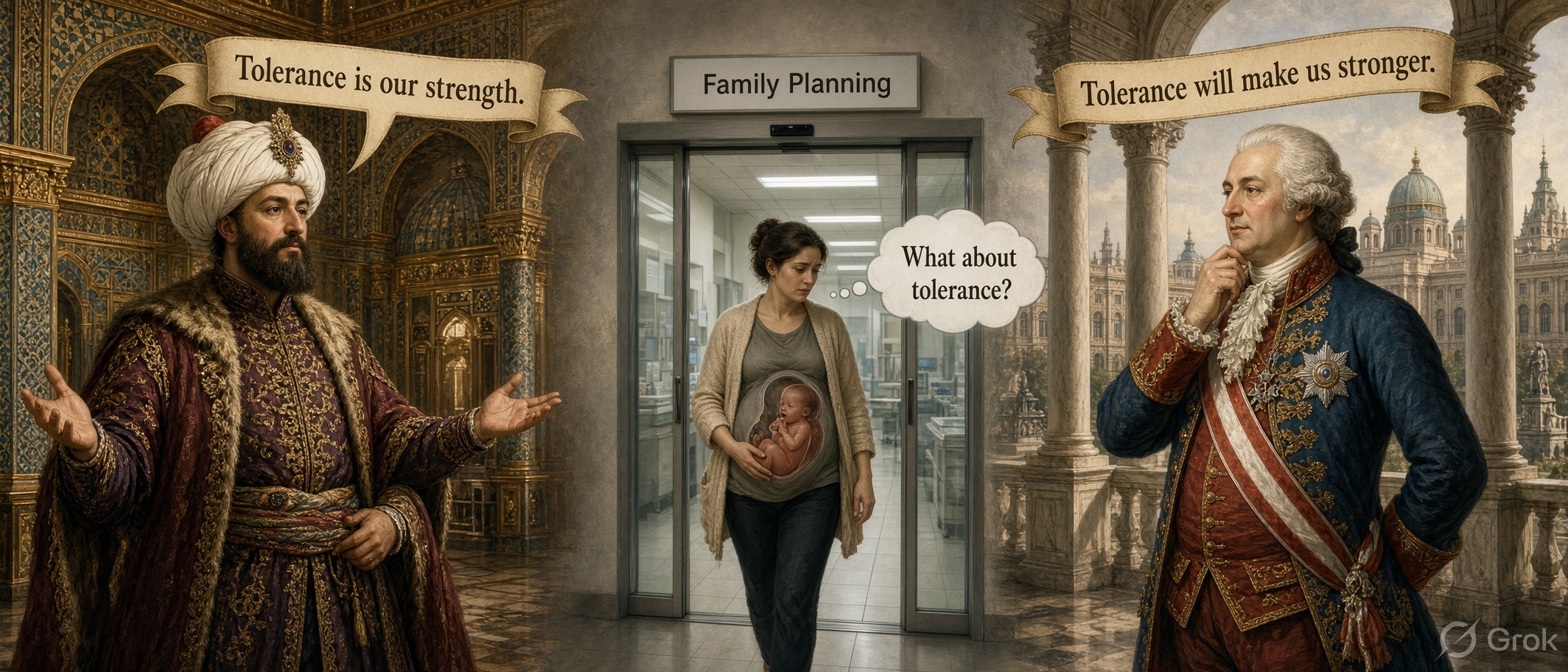
Policies of toleration have repeatedly required societies to abandon or dilute previously held cultural, religious, or moral ideals—most often a claim to exclusive public authority for one faith or set of norms. This is not an accident of particular cases; it is built into what “toleration” historically meant.

What the historical record shows

In early-modern Europe the dominant ideal was confessional uniformity: one public religion, one set of moral and legal norms, backed by the state. Toleration edicts deliberately stepped away from that ideal.

  • Joseph II’s 1781 Patent of Toleration is a clear instance. The Habsburg lands had treated Catholic uniformity as both a religious duty and a political necessity. The patent left Catholicism privileged in public worship, marriage registration, and certain fees, yet it explicitly permitted Protestant and Orthodox private practice, their own schools and pastors, property ownership, and access to offices. That was a partial surrender of the older ideal. Crypto-Protestants emerged in large numbers; the public monopoly was broken even if not abolished.
  • The Peace of Westphalia (1648) ended a century of religious war by accepting that rulers could choose Lutheranism, Calvinism, or Catholicism and that minority confessions would be tolerated within limits. The previous ideal of a single Christian empire under one faith was set aside.
  • The Edict of Nantes (1598) and later English and Dutch arrangements similarly traded the aspiration of religious homogeneity for civil peace and economic utility. In each case the older ideal was not refined; it was restricted.

The Ottoman millet system offers a non-Christian example. Non-Muslim communities were allowed internal autonomy and religious practice, but only under a hierarchical arrangement that preserved Muslim legal and political primacy and imposed special taxes and disabilities. Tolerance existed; equality and cultural dominance by the host tradition did not.

In the nineteenth and twentieth centuries, secularization and liberal constitutionalism extended the same pattern. Disestablishment of churches, removal of religious tests for office, and later expansions of individual rights required states to relinquish the idea that public culture and law should embody one religious or moral tradition. Many observers—both at the time and later—described this as a genuine surrender of previously shared cultural ideals, not merely a technical adjustment.

The conceptual point

Toleration, as classically understood, is not indifference and not full equality. It is the decision by a dominant group or state to refrain from suppressing practices it still regards as wrong or inferior. That decision always involves some retreat from the ideal of shaping the whole public order according to one’s own highest values. Where the tolerated group remains small and the host culture retains confidence and demographic weight, the retreat can be limited. Where numbers, fertility, or institutional capture grow, the original cultural framework can erode further—exactly the outcome critics of open-ended multicultural policies have warned about in recent decades.

Philosophers have long noted the tension. Locke’s Letter Concerning Toleration argued for religious liberty while still excluding atheists and Catholics on political grounds; he did not claim that every ideal could be surrendered without cost. Later liberal theory often treated the surrender itself as the higher ideal (neutrality, individual autonomy). Critics from Burke onward argued that societies which systematically refuse to defend their own cultural inheritance eventually lose the capacity to transmit any coherent ideals at all.

Different evaluations

  • One view holds that the surrender was necessary and beneficial: religious wars were worse than pluralism, and open societies proved more prosperous and freer.
  • Another holds that successive expansions of tolerance have moved from limited, reciprocal arrangements (Westphalia, Joseph II) to a one-way process in which the historic host culture is expected to accommodate practices it once considered incompatible, while reciprocal accommodation is not demanded. On this reading, the policy has ceased to be toleration and become self-undermining.
  • A third position distinguishes between tolerating private belief and tolerating public challenges to the basic norms of the host society. The first can be compatible with cultural continuity; the second is not.

Historical policy, therefore, has often meant precisely what the question asks about: a deliberate retreat from prior cultural ideals in exchange for peace, utility, or a new ideal of individual liberty. Whether that exchange was wise depends on the specific ideals surrendered, the scale of the concession, and the long-term results—questions that remain contested rather than settled by the mere fact of the policy.

=

The Patent of Toleration (Toleranzpatent), issued on 13 October 1781 by Emperor Joseph II, was a landmark edict of limited religious freedom for non-Catholic Christians in the Habsburg hereditary lands. It formed a core part of the Josephinist reforms of enlightened absolutism.

Background

Since the Counter-Reformation, the Habsburg Monarchy had enforced Catholic religious uniformity in its core Austrian, Bohemian, and related lands. Protestants (Lutherans and Calvinists) faced severe restrictions; many practiced in secret as “crypto-Protestants.” Maria Theresa (r. 1740–1780) largely maintained this policy of religious homogeneity, viewing Protestantism as a threat to order and orthodoxy. Eastern Orthodox communities existed in some areas (especially among Serbs and others), but under constraints outside Hungary, where greater freedoms already applied.

Joseph II (co-regent from 1765, sole ruler from 1780) embraced Enlightenment principles. He argued that forcing conscience was harmful and that true Christian tolerance benefited both religion and the state by making subjects more useful, loyal, and productive. As early as the late 1760s–1770s, he discussed practical implementation with advisors. The patent reversed key aspects of his mother’s approach while still privileging Catholicism and limiting non-Catholic practice to avoid open confrontation with the Church.

It applied specifically to the Augsburg (Lutheran) and Helvetic (Reformed/Calvinist) confessions and non-Uniate (non-Catholic) Orthodox Christians in areas where they had not previously enjoyed public rights.

Significant Figures

  • Emperor Joseph II (1741–1790): The driving force and issuer. He framed toleration as both a moral and utilitarian state interest.
  • Maria Theresa: Her long insistence on Catholic uniformity provided the contrast; the patent marked a sharp break after her death.
  • Prince Wenzel Anton von Kaunitz (state chancellor): Key enlightened advisor who supported toleration for reasons of state utility and had earlier pressed similar ideas.
  • Franz Joseph Heinke: Involved in drafting policies on Church-state relations and the practical framework for toleration.
  • Broader context included an enlightened elite of officials, some clergy, and intellectuals; opposition came from more traditional Catholic circles and parts of the hierarchy.

Main Provisions

The edict opened with the conviction that violence to conscience is harmful and that true Christian tolerance benefits religion and the state. It granted:

  • Private religious practice everywhere (regardless of prior custom).
  • Where at least 100 families lived in an area (even if scattered over some hours’ travel), the right to build a place of worship (Bethaus / house of prayer) and a school. These buildings could not have towers, bells, or public street entrances resembling a church.
  • Freedom to choose and support their own pastors (subject to imperial confirmation) and schoolmasters (under provincial school oversight).
  • Pastoral care, including for the sick, and funerals with their clergy.
  • Civil rights improvements: ability (often under dispensation) to acquire property, municipal citizenship, practice as master craftsmen, hold academic posts, and enter public service. Religion was not to be a barrier; competence and moral character were the criteria. Oaths need not violate their beliefs, and they were not forced to attend Catholic processions.
  • Regulation of mixed marriages: if the father was Catholic, all children were raised Catholic; if the father was Protestant and the mother Catholic, children followed the sex of the parent in the relevant formulation. Previous reversals forcing Catholic upbringing were abolished.
  • Catholic privileges retained: public worship monopoly, certain parish fees (jura stolae), and control of registers in many cases.

Worship remained “private,” and the Unity of the Brethren stayed suppressed. The Catholic Church kept its dominant public status.

Results and Impact

The effects were immediate and substantial. Large numbers of crypto-Protestants emerged openly; one contemporary estimate noted around 73,000 declaring their Protestant allegiance within a year in relevant areas. Protestant parishes formed quickly, especially in Upper Austria, Styria, and Carinthia, drawing on existing secret traditions. Some conversions from Catholicism also increased, prompting authorities to try to limit them.

It was followed in January 1782 by a related Edict of Tolerance for Jews (focused more on economic utility, education, and restricted settlement rights). Broader Josephinist measures included greater state control over the Catholic Church, dissolution of many “unproductive” monasteries, and other centralizing reforms.

After Joseph’s death in 1790, conservative forces urged repeal, but the patent remained in force. Its restrictions (e.g., on church architecture and public status) lasted until later 19th-century changes, including the 1861 Protestantenpatent that granted fuller legal equality. It is widely seen as a major victory for Enlightenment ideas within Catholic absolute monarchy and a practical step toward greater religious pluralism in Central Europe, even while remaining limited and hierarchical.

In short, the Patent of Toleration was neither full equality nor radical secularism. It was a calculated, state-centered reform that ended the worst of Counter-Reformation suppression for the named groups, revealed the scale of hidden Protestantism, and became a defining example of Joseph II’s enlightened absolutism.

= October 20th

These are all historical events associated with October 20.

Here is a brief overview of each:

1548 – Founding of Nuestra Señora de La Paz
Spanish captain Alonso de Mendoza founded the city (in what is now Bolivia) on the orders of Pedro de la Gasca, acting for King Charles V of Spain (also Holy Roman Emperor). It commemorated the end of the civil wars between the Pizarro and Almagro factions in the Viceroyalty of Peru. The act of foundation occurred at the indigenous site of Laja; the settlement was soon moved to the more suitable Chuquiago (Choqueyapu) valley, where modern La Paz stands. The name “Our Lady of Peace” reflected the restored order.

1568 – Battle of Jodoigne (Battle of the River Gete/Guete)
During the early Dutch Revolt (Eighty Years’ War), Spanish forces under the Duke of Alba defeated the rear guard of an invading army led by William of Orange (William the Silent) near Jodoigne (Geldenaken) in the Spanish Netherlands (present-day Belgium). The action disrupted Orange’s campaign and forced him to abandon his invasion and withdraw.

1572 – Relief of Goes
In the Eighty Years’ War, about 3,000 Spanish Tercios under Cristóbal de Mondragón performed a celebrated night march, wading roughly 15 miles through chest-deep water across the mouth of the Scheldt estuary. They surprised and drove off the Anglo-Dutch force besieging the loyalist-held city of Goes (in Zeeland). This preserved Spanish control of the area and protected nearby Middelburg.

1720 – Capture of Calico Jack (John Rackham)
The Caribbean pirate known as Calico Jack, together with Anne Bonny, Mary Read, and their crew, was captured off Jamaica by Jonathan Barnet (acting for the Royal Navy/Jamaican authorities). Most of the crew was reportedly intoxicated; Bonny and Read offered the main resistance. Rackham was later tried and hanged at Port Royal.

1740 – Accession of Maria Theresa and start of the War of the Austrian Succession
Holy Roman Emperor Charles VI died, and his daughter Maria Theresa succeeded to the Habsburg hereditary lands (Austria, Hungary, Bohemia, etc.) under the Pragmatic Sanction of 1713. France, Prussia, Bavaria, and Saxony refused to recognize her rights. Prussia’s Frederick the Great soon invaded Silesia, opening the War of the Austrian Succession (1740–1748).

1781 – Patent of Toleration (Toleranzpatent)
Emperor Joseph II of the Habsburg Monarchy issued this edict (dated around 13–19/20 October in various accounts). It granted limited freedom of private worship and certain civil rights to Lutherans, Calvinists, and Eastern Orthodox Christians in the Habsburg lands, while preserving the privileged public status of the Catholic Church. It was a notable Enlightenment-era reform (followed by a 1782 measure concerning Jews).

1803 – U.S. Senate ratifies the Louisiana Purchase
The Senate approved the treaty with France for the purchase of the Louisiana Territory. This roughly doubled the size of the United States and opened vast lands for westward expansion.

1818 – Convention of 1818
The United States and the United Kingdom signed this agreement in London. It fixed much of the Canada–U.S. border along the 49th parallel from the Lake of the Woods to the Rocky Mountains, addressed fisheries, and provided for joint occupation of the Oregon Country for a period.

1827 – Battle of Navarino
A combined British, French, and Russian fleet under Edward Codrington destroyed the Ottoman-Egyptian fleet in Navarino Bay (Pylos, Greece) during the Greek War of Independence. It was the last major naval battle fought entirely with wooden sailing ships and decisively aided Greek independence.

1873 – First code of American football rules
Representatives of Yale, Princeton, Columbia, and Rutgers met (around mid-to-late October) and adopted a common set of rules for intercollegiate football. These early rules resembled association football (soccer) more than modern gridiron football (no carrying or throwing the ball; 20-a-side, etc.). Harvard did not participate and continued with a different, more rugby-like game.

1883 – Treaty of Ancón

Peru and Chile signed this peace treaty (in Lima/Ancón), ending Peru’s active participation in the War of the Pacific. Peru permanently ceded the province of Tarapacá to Chile; Chile also received temporary administration of Tacna and Arica (their final status settled much later).

These events span colonial foundation, European religious and succession conflicts, the Dutch Revolt, piracy, American expansion and diplomacy, the Greek independence struggle, the codification of a major sport, and a South American territorial settlement—all conventionally linked to October 20 in historical calendars.


 

community logo
Join the VoiceDDB Community
To read more articles like this, sign up and join my community today
0
What else you may like…
Videos
Posts
Articles
00:01:07
November 27, 2022
Jingle Bell Rock

Jingle bell, jingle bell, jingle bell rock
Jingle bells swing and jingle bells ring
Snowin' and blowin' up bushels of fun
Now the jingle hop has begun

Jingle bell, jingle bell, jingle bell rock
Jingle bells chime in jingle bell time
Dancin' and prancin' in Jingle Bell Square
In the frosty air

What a bright time, it's the right time
To rock the night away
Jingle bell time is a swell time
To go glidin' in a one-horse sleigh

Giddy-up jingle horse, pick up your feet
Jingle around the clock
Mix and a-mingle in the jinglin' feet
That's the jingle bell rock

Jingle bell, jingle bell, jingle bell rock
Jingle bell chime in jingle bell time
Dancin' and prancin' in Jingle Bell Square
In the frosty air

What a bright time, it's the right time
To rock the night away
Jingle bell time is a swell time
To go glidin' in a one-horse sleigh

Giddy-up jingle horse, pick up your feet
Jingle around the clock
Mix and a-mingle in the jinglin' feet
That's the jingle bell
That's the jingle...

00:02:04
September 01, 2021
Intro to Locals for the Conservative Voice

David Daniel Ball calls himself the Conservative Voice.

I'm a teacher with three decades experience teaching math to high school kids.I also work with first graders and kids in between first grade and high school. I know the legends of why Hypatia's dad is remembered through his contribution to Math theory. And I know the legend of why followers of Godel had thought he had disproved God's existence.

I'm not a preacher, but I am a Christian who has written over 28 books all of which include some reference to my faith. Twelve blog books on world history and current affairs, detailing world events , births and marriages on each day of the year, organised by month. Twelve books on the background to and history of Bible Quotes. One Bible quote per day for a year. An intro to a science fiction series I'm planning, post apocalyptic cyber punk. An autobiography with short story collections.

I'm known in Australia for my failure as a whistleblower over the negligence death of a school boy. ...

00:01:50
September 04, 2026
Should violent criminals be made fat? Grok says 'no'

No. Transferring gut bacteria from an obese person into a violent criminal is not a reliable, ethical, or effective way to make them “fat, sedentary, and less of a physical threat.”

The science does not deliver the outcome you want

Mouse studies in germ-free animals showed that microbiota from obese donors can increase energy harvest and adiposity compared with lean-donor microbiota. That is the origin of the idea. Human evidence is far weaker.

Randomized trials of fecal microbiota transplant (FMT) from lean donors into people with obesity have generally failed to produce meaningful, sustained weight loss. Microbiome composition can change; body weight and metabolic markers often do not, or the effects are small and inconsistent. Diet and the existing gut environment usually dominate. A 2025 Nature paper found diet outperformed microbial transplant for microbiome recovery. Human guts are already colonized, not sterile like lab mice, so engraftment is variable and effects unpredictable.

It is not a ...

post photo preview
August 28, 2026
Pfizer struggles to answer

Some in Australia are brilliant. Malcolm Roberts Investigates Pfizer over Covid vaccine.

Holiday break is over back to work tonight

Tonight I'll start double posting until I've caught up.

post photo preview
Anniversary of the Battle of Trafalgar
October 21st

Anniversary of the Battle of Trafalgar

From the decks of HMS Victory

Dawn on 21 October 1805 broke with a light westerly breeze and a long Atlantic swell. From the quarterdeck of the three-decker Victory, Nelson’s 100-gun flagship, the Combined Fleet was already in sight to the east-southeast—thirty-three ships of the line in a long, slightly irregular line of battle stretching toward Cape Trafalgar. British frigates had reported their sailing the previous evening. Nelson ordered the fleet to form the two columns he had planned: his own weather column leading in Victory, Collingwood’s lee column further south.

For nearly an hour the Victory sailed slowly toward the enemy centre under a rising but still light wind. Around 11:50 the French and Spanish ships began to fire. The first shots fell short; then they found the range. For the next forty minutes Victory endured a concentrated fire she could barely answer. Her wheel was shot away early, her mizzen topmast and other spars were cut down, and men fell on the upper decks. Nelson, pacing the quarterdeck with Captain Thomas Hardy, remained conspicuous in his faded uniform with the stars of his orders on his breast.

At roughly 12:30 Victory reached the Allied line just astern of Villeneuve’s flagship Bucentaure (80 guns) and ahead of the French 74 Redoutable. She passed under the Bucentaure’s stern and poured a double-shotted broadside of nearly fifty guns into the unprotected after end of the French flagship at point-blank range. The effect was catastrophic: guns were dismounted, the decks were swept by shot and splinters, and scores of men were killed or wounded in moments. Victory then turned and fell alongside the Redoutable, whose captain, Jean-Jacques Étienne Lucas, had trained his crew especially for close-quarters fighting.

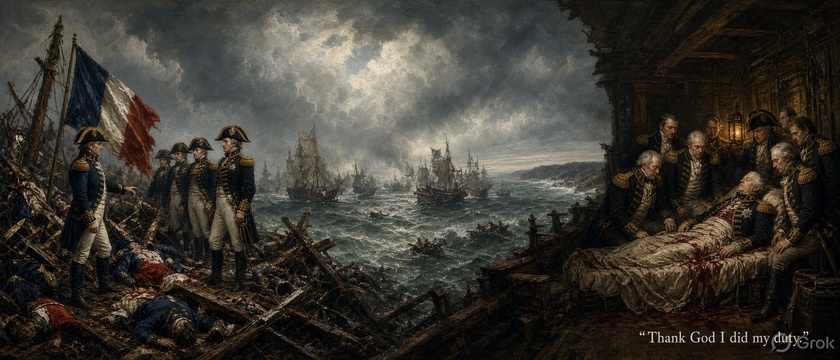
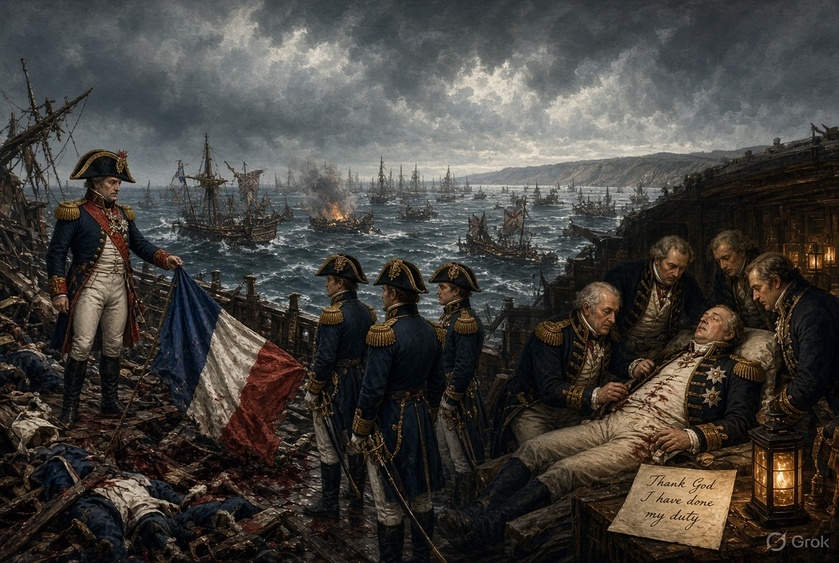
The two ships locked together. For the next half-hour the fight became a furious melee of cannon, musketry, and grenades. Redoutable’s marksmen in the tops and along the rail poured a heavy fire onto Victory’s upper decks, killing or wounding most of the men stationed there. At about 1:15 a musket ball from the Redoutable’s mizzen top struck Nelson in the left shoulder, passed through his lung and lodged against his spine. He fell to the deck, saying to Hardy, “They have done for me at last.” He was carried below to the orlop deck.

Meanwhile HMS Temeraire came up on the other side of the Redoutable and raked her. The French ship’s attempt to board Victory was broken up by British carronades and musketry. Redoutable was eventually reduced to a floating wreck with roughly three-quarters of her crew dead or wounded. Victory herself was badly cut up aloft and had suffered heavy losses on her upper decks, but her lower-deck batteries continued to fire. Nelson lived long enough to hear that the battle was won; his last recorded words were “Thank God I have done my duty.” He died around 4:30 p.m.

From the French flagship Bucentaure and Villeneuve’s viewpoint

Vice-Admiral Pierre-Charles Villeneuve stood on the quarterdeck of the Bucentaure, near the centre of the Combined Fleet. He had correctly anticipated that Nelson would try to break the line rather than fight a conventional parallel action, and he had ordered his captains to close up and be ready to support one another. The light wind made the manoeuvre difficult. When Victory approached, the ships immediately ahead of Bucentaure (the French Neptune and Spanish San Leandro) had fallen slightly out of station, leaving a gap.

Villeneuve watched the British three-decker bear down under fire. The moment Victory passed under his stern and delivered her raking broadside, the Bucentaure was effectively crippled as a fighting ship. Captain Magendie was wounded; many of the upper-deck guns were dismounted; and the after part of the ship was a scene of carnage. Villeneuve himself was unhurt—he later remarked that fate had spared him while men fell all around him.

For the next three hours successive British ships (Neptune, Leviathan, Conqueror and others) passed through the same gap and poured further broadsides into the Bucentaure. The French flagship lost all her masts, most of her guns, and roughly half her crew. Villeneuve tried to signal the van (under Rear-Admiral Dumanoir) to come about and help the centre, but the signal was late and the response ineffective. By mid-afternoon the Bucentaure was surrounded, dismasted, and unable to fire. Villeneuve struck his colours. He was taken prisoner by an officer from HMS Conqueror. When told the name of the captain who had accepted his surrender, he is said to have remarked that England was fortunate to have such officers.

In the days that followed, the Bucentaure was recaptured by her own crew from the prize crew, only to be wrecked in the storm that struck the fleet. Villeneuve was carried to England as a prisoner; he was later released and returned to France, where he died in 1806 under circumstances that remain disputed.

=

The Battle of Trafalgar was fought on 21 October 1805 off Cape Trafalgar, on the southwest coast of Spain (between Cádiz and the Strait of Gibraltar). A British fleet of 27 ships of the line under Vice-Admiral Horatio Lord Nelson defeated a combined Franco-Spanish fleet of 33 ships of the line under French Vice-Admiral Pierre-Charles Villeneuve. It confirmed British naval supremacy for the rest of the Napoleonic Wars and ended any realistic French plan to invade Britain.

Significant figures

  • Vice-Admiral Horatio Lord Nelson (British): Overall commander, flying his flag in HMS Victory. Already famous for victories at the Nile (1798) and Copenhagen (1801). He devised the unorthodox “Nelson Touch” plan of attacking in two columns to break the enemy line. He was mortally wounded by a French marksman during the battle and died knowing victory was secured. His famous signal “England expects that every man will do his duty” was hoisted before the engagement.
  • Vice-Admiral Cuthbert Collingwood (British): Commanded the second (lee) column. He took over command after Nelson was wounded and completed the destruction of the Allied rear. He later managed the difficult aftermath in stormy weather.
  • Vice-Admiral Pierre-Charles Villeneuve (French): Commander of the combined fleet. Cautious and aware of the qualitative inferiority of his crews, he had earlier failed to execute Napoleon’s more ambitious concentration plans. He was captured with his flagship Bucentaure.
  • Admiral Federico Gravina (Spanish): Senior Spanish commander. Wounded in the battle; he died of those wounds several months later. Several Spanish captains (notably Cosme Damián Churruca of the San Juan Nepomuceno) fought with particular determination and were killed after refusing to surrender.

Napoleon himself was not present; by the time of the battle he had already abandoned the invasion of Britain and was marching toward the decisive continental victory at Austerlitz.

Lead-up

After the breakdown of the Peace of Amiens, Napoleon resumed war with Britain in 1803 and prepared an invasion army (the Armée d’Angleterre) on the Channel coast. The plan required the French and Spanish fleets to concentrate, seize temporary control of the English Channel, and escort the invasion barges across. Spain joined France as an ally late in 1804.

In early 1805 Villeneuve’s Toulon squadron escaped the British blockade, joined Spanish ships, and sailed to the West Indies in an attempt to draw off British forces. Nelson pursued him across the Atlantic and back. Villeneuve then fought an inconclusive action with a British squadron under Sir Robert Calder off Cape Finisterre and took refuge in Cádiz. Napoleon’s elaborate scheme collapsed; by late August he had turned eastward against Austria instead.

Nelson arrived off Cádiz in late September 1805 to take command of the blockading fleet. On 19–20 October Villeneuve, pressured by the fear of being replaced and by orders to enter the Mediterranean, sailed with 33 ships of the line. Nelson, with 27, intercepted them the next morning. He had already explained to his captains his plan to abandon the traditional parallel line of battle, form two columns, and cut the Allied line at right angles so that superior British gunnery and seamanship could overwhelm the enemy in a close-range melee.

Result

The British attack began around noon. Nelson’s weather column broke the Allied centre near Villeneuve’s flagship; Collingwood’s lee column smashed the rear. The leading British ships suffered heavy fire while approaching, but once the line was broken the battle became a series of individual ship actions in which British crews generally prevailed. Fighting ended in the late afternoon.

Casualties and material losses (approximate, standard figures):

  • British: ~449–458 killed, ~1,200 wounded. No ships lost.
  • Franco-Spanish: ~4,400 killed, ~2,500 wounded, and roughly 7,000–8,000 captured. About 17–18 ships of the line were taken (many later wrecked or scuttled in the storm that followed); one was destroyed. Villeneuve was captured.

A violent storm after the battle sank or drove ashore many of the prizes and further increased Allied losses. Collingwood reported the victory to London with the words that became famous: “We have gained a great victory, but we have lost Lord Nelson.”

Strategically, Trafalgar destroyed the Combined Fleet as an effective fighting force and secured British command of the sea for the remainder of the wars. Napoleon’s invasion plans were already dead before the battle, but the result removed any remaining threat and allowed Britain to sustain the long naval blockade and support coalitions on the Continent. The war continued for another decade until Waterloo (1815). Nelson’s death in the hour of victory turned him into Britain’s pre-eminent national hero; his body was preserved in brandy, returned to England, and buried with a state funeral at St Paul’s Cathedral.

= October 21st 

These events cluster around mid-to-late October (mostly the 19th–21st) across different centuries. Several of the dates in your list are approximate or off by a day or two; the notes below use the best-supported dates from primary and standard historical sources.

1096 – People’s Crusade (Battle of Civetot)

On 21 October 1096, a Seljuk Turkish force under Kilij Arslan I annihilated most of the People’s Crusade (also called the Peasants’ or Popular Crusade) near Civetot, not far from Nicaea in Anatolia. This was the large, poorly armed, and largely untrained contingent led by Peter the Hermit that had set out months ahead of the official First Crusade. Roughly 20,000 people marched out of their camp; most were slaughtered in a narrow wooded valley after a Turkish ambush. Only a few thousand survivors reached safety. The disaster showed the limits of popular enthusiasm without military organization and cleared the way for the better-equipped Princes’ Crusade the following year.

1097 – Siege of Antioch begins

Crusaders under Godfrey of Bouillon, Bohemond of Taranto, and Raymond IV of Toulouse reached the heavily fortified city of Antioch (modern Antakya, Turkey) on 20–21 October 1097 and began a siege that lasted until June 1098. The city controlled the route through Syria toward Jerusalem. The crusaders eventually entered through treachery (a gate opened by an insider) on the night of 2/3 June 1098, only to be immediately besieged themselves by a large relieving army under Kerbogha of Mosul. They broke out and won a decisive victory later that month. The episode was marked by starvation, desertions, massacres, and the later discovery of the “Holy Lance.”

1209 – Otto IV crowned emperor

Otto IV of the Welf dynasty was crowned Holy Roman Emperor by Pope Innocent III in Rome on 4 October 1209 (not the 19th). After years of civil war against the Hohenstaufen claimant Philip of Swabia, Otto had become the sole German king following Philip’s murder in 1208. He reaffirmed papal territorial claims to secure the coronation, but almost immediately afterward he broke those promises by occupying church lands in central Italy and invading the Kingdom of Sicily. Innocent excommunicated him in 1210; Otto was later defeated at Bouvines (1214) and lost the imperial title to Frederick II.

1392 – End of the Nanboku-chō schism

In October 1392 (sources give dates around 15–21 October or into November under the lunar calendar), the Southern Court emperor Go-Kameyama abdicated and handed over the imperial regalia to the Northern Court emperor Go-Komatsu. This formally ended the Nanboku-chō period (1336–1392), the long split between two rival imperial lines that had followed Emperor Go-Daigo’s failed attempt to restore direct imperial rule. Shogun Ashikaga Yoshimitsu brokered the settlement. The agreement was supposed to alternate the throne between the two lines, but the Northern Court quickly reneged. Go-Kameyama later briefly revived Southern claims in Yoshino; residual resistance continued for decades.

1512 – Martin Luther’s doctorate

On 19 October 1512, Martin Luther received his Doctor of Theology degree at the University of Wittenberg. Two days later he was formally received into the theological faculty and succeeded Johann von Staupitz as professor of Bible. This academic position gave him the platform from which he later challenged indulgences (the Ninety-five Theses of 1517) and developed the theological arguments of the Reformation.

1520 – Magellan and Fagundes

On 21 October 1520, Ferdinand Magellan’s expedition rounded Cape Virgenes and entered the strait that now bears his name, the navigable passage between the Atlantic and Pacific at the southern tip of South America. He navigated it over the following weeks and emerged into the Pacific on 28 November. One ship deserted during the passage; the remaining three continued the first circumnavigation (completed after Magellan’s death in the Philippines).

Around the same date (commonly given as 21 October 1520), the Portuguese explorer João Álvares Fagundes sighted the islands now known as Saint Pierre and Miquelon off Newfoundland. He named the archipelago the “Islands of the 11,000 Virgins” (after Saint Ursula). He later received letters patent from the Portuguese crown confirming rights to lands he had explored in the region. Basque and French fishermen were already active in the area; Fagundes is credited with the earliest documented European naming of these specific islands.

1600 – Battle of Sekigahara

On 21 October 1600, Tokugawa Ieyasu’s Eastern Army defeated the Western Army led by Ishida Mitsunari at Sekigahara in central Japan. The battle decided the succession struggle after the death of Toyotomi Hideyoshi and effectively ended the Sengoku (Warring States) period. Ieyasu’s victory allowed him to consolidate power; he was appointed shogun in 1603, founding the Tokugawa shogunate that ruled Japan until 1868. Betrayals and delayed reinforcements on the Western side were decisive.

1774 – Taunton “Liberty and Union” flag

On 21 October 1774, colonists in Taunton, Massachusetts, raised a liberty pole (reported as 112 feet high) and flew a red ensign with the British Union flag in the canton and the words “Liberty and Union” (sometimes described simply as “Liberty”) across the field. This was one of the earliest public displays of colonial resistance to parliamentary taxation and other British policies, occurring well before Lexington and Concord. The modern city flag of Taunton is based on this design.

1797 – USS Constitution launched

After two failed attempts, the 44-gun frigate USS Constitution was successfully launched in Boston Harbor on 21 October 1797. One of the six original frigates authorized for the new United States Navy, she served against the Barbary pirates and gained lasting fame in the War of 1812 (especially her victory over HMS Guerriere, which earned her the nickname “Old Ironsides”). She remains the world’s oldest commissioned warship still afloat and is berthed at the Charlestown Navy Yard in Boston.

These events range from medieval crusading warfare and imperial politics, through Japanese unification and the Reformation, to early modern exploration and the American Revolution. Many of the military and political turning points fall on or very near 21 October.


Read full Article
October 17, 2026
post photo preview
439 Vandals take Carthage
October 19th Events

439 Vandals take Carthage 

Background

The Vandals (primarily the Asdingi branch) and their Alan allies were a Germanic confederation that had crossed into Roman territory during the early fifth-century migrations. After years in Spain, they crossed the Strait of Gibraltar into North Africa in 429 under their king Gaiseric (also spelled Genseric or Geiseric). They exploited Roman internal divisions, including the conflict between the comes Africae Bonifatius (Boniface) and the imperial government in Ravenna under Valentinian III and the general Aetius.

They overran much of Mauretania and Numidia, defeated Roman forces, and besieged Hippo Regius (where Saint Augustine died in 430 during the siege). Hippo fell and became an early Vandal centre. In 435 a treaty with Valentinian III recognised Vandal control of parts of Numidia and Mauretania as foederati (treaty allies). Carthage and the rich province of Africa Proconsularis remained under Roman control; Gaiseric was to pay tribute and sent his son Huneric as a hostage to Rome.

Gaiseric observed the treaty only while it suited him. In 439, while Roman attention and forces were focused on Visigothic problems in Gaul, he broke the agreement without a declaration of war and moved on Carthage.

The Capture (19 October 439)

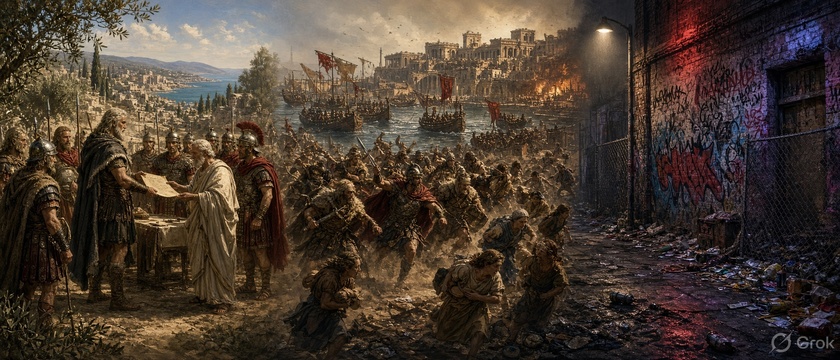
Gaiseric’s forces took Carthage by surprise and with little resistance. Contemporary accounts (including Prosper of Aquitaine) describe the seizure as achieved by stratagem or under the cover of the existing peace. One later tradition states that the Vandals entered while most inhabitants were at the races in the hippodrome. They also seized much of the Western Roman naval squadron docked in the harbour, instantly giving them a fleet and shipbuilding capacity they had previously lacked. Carthage, one of the largest and richest cities in the Western Empire and the key grain port for Rome, became the new Vandal capital. Gaiseric styled himself King of the Vandals and Alans and is said to have dated his sovereignty from this capture.

Significant Figures

  • Gaiseric (r. 428–477): The central figure. A shrewd and opportunistic leader, he turned a land-based Germanic people into a Mediterranean naval power. He remained undefeated for the rest of his long reign and repeatedly outmanoeuvred both Western and Eastern Roman attempts to dislodge him.
  • Valentinian III: Western Roman emperor. Forced into successive unfavourable treaties (435 and later 442).
  • Flavius Aetius: The dominant Western Roman general. Preoccupied with Gaul in 439, he later directed unsuccessful efforts to recover Africa.
  • Huneric: Gaiseric’s son, held as a hostage after 435 and later succeeded him as king (r. 477–484). He intensified anti-Nicene measures.
  • Quodvultdeus: Catholic (Nicene) bishop of Carthage at the time of the capture. He was exiled (to Naples) as Gaiseric preferred Arian advisors and clergy.
  • Victor of Vita: Later Nicene bishop and author of the Historia Persecutionis, the main contemporary account of Vandal religious policy (written in the 480s). His narrative emphasises persecution, though modern scholars note that intensity varied by ruler and period.

Results and Consequences

The immediate and longer-term effects were severe for the Western Roman Empire and transformative for the Vandals:

  • Economic and strategic blow: North Africa was the West’s primary grain supplier (supporting the annona system that fed Rome) and a major source of tax revenue. Its loss impoverished the imperial treasury, reduced the ability to pay armies and manage barbarian federates, and permanently shifted the balance of Mediterranean power. Historians often treat 439 as a critical step toward the West’s fiscal and political collapse.
  • Naval supremacy: With Carthage’s harbours, shipyards, and captured ships, the Vandals rapidly became the dominant naval force in the western Mediterranean. They raided Sicily, seized Sardinia, Corsica, the Balearic Islands, and at times parts of Sicily, and conducted widespread piracy and coastal raids.
  • Recognition and expansion: After further fighting (including a failed joint Roman–Eastern expedition), a 442 treaty recognised Vandal control of Africa Proconsularis, Byzacena, and parts of Numidia—far more than the 435 settlement. The Vandals held the core of their African kingdom until the Byzantine reconquest under Belisarius in 533–534.
  • Sack of Rome (455): From their African base the Vandals under Gaiseric sailed to Italy and thoroughly sacked Rome, taking vast treasure and captives (including imperial family members).
  • Religious policy: The Vandals were Homoian (“Arian”) Christians. Gaiseric and his successors promoted their own church at the expense of the Nicene (Catholic) majority. Policies included confiscation of churches, exile of Nicene bishops and clergy, bans on Nicene services in Vandal settlement areas, and pressure on officials and elites to convert. Intensity fluctuated: relatively focused under Gaiseric, more severe under Huneric (especially the 484 conference and mass exiles), and milder under some later kings (e.g., Gunthamund, Hilderic). Nicene writers (notably Victor of Vita) portrayed this as systematic persecution; the result was a prolonged ecclesiastical conflict in Africa.

In short, the 439 capture turned a previously land-based barbarian group into a durable maritime kingdom, stripped the Western Empire of its richest province, and accelerated the political and economic fragmentation of the late Roman West.

= October 19th

These are all events traditionally associated with 19 October in historical “on this day” calendars. For the earliest entries (especially 202 BC), the precise day is conventional rather than firmly fixed by contemporary sources; ancient dating and calendar conversions are imprecise.

202 BC – Battle of Zama

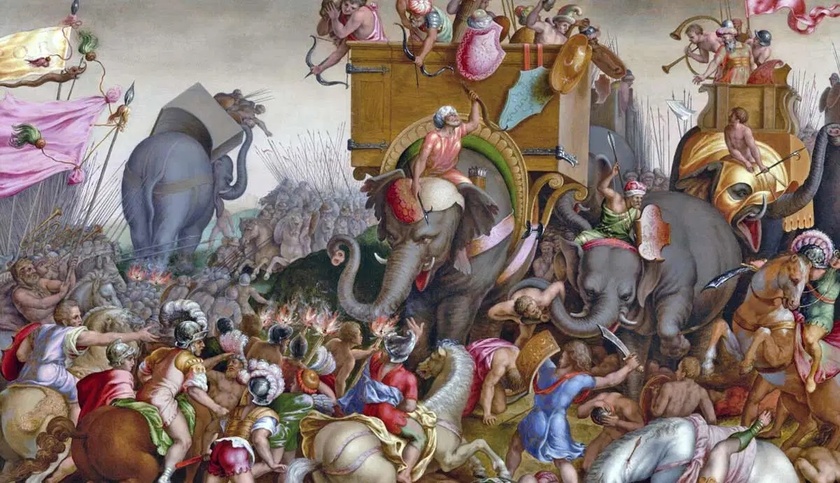
Roman legions under Publius Cornelius Scipio (later Scipio Africanus) decisively defeated Hannibal Barca’s Carthaginian army in what is now Tunisia. This was the final major battle of the Second Punic War (218–201 BC). Scipio had invaded North Africa, forced Hannibal’s recall from Italy, and used superior cavalry (especially Numidian allies under Masinissa) plus tactics to neutralize Hannibal’s war elephants. Carthaginian losses were heavy (roughly 20,000 killed and as many captured); Roman losses were far lighter. The defeat ended Carthage’s ability to challenge Rome and established Roman dominance in the western Mediterranean.

The Battle of Zama: How Scipio Gave Rome the World | TheCollector

439 – Vandals take Carthage

King Gaiseric (Genseric) of the Vandals (with Alan allies) seized Carthage, the great Roman city and grain port in North Africa, in a surprise move that broke an earlier treaty. Sources indicate the city fell with little resistance while many inhabitants were at the races. Carthage became the capital of the Vandal Kingdom. The loss deprived the Western Roman Empire of vital grain supplies and tax revenue and gave the Vandals a powerful naval base. From there they later controlled Mediterranean islands and, in 455, sacked Rome. The Vandals were Arian Christians, which led to ongoing religious tensions with the Nicene majority.

1216 – Death of King John of England

King John (reigned 1199–1216) died at Newark-on-Trent during the First Barons’ War. He was succeeded by his nine-year-old son, Henry III. John is best remembered for the sealing of Magna Carta in 1215 under baronial pressure, the loss of most of the Angevin lands in France, and prolonged conflict with the papacy and his own nobility. His death left a child king and a contested realm.

1386 – First lecture at Heidelberg University

The University of Heidelberg (Ruperto Carola), founded by Elector Palatine Rupert I with papal approval (modelled on Paris), held its first lectures. A formal opening Mass took place on 18 October in the Heiliggeistkirche; teaching began the next day in the faculties of theology, law, and the arts (medicine followed soon after). Marsilius of Inghen became the first rector. It is the oldest university in what is now Germany.

1466 – Second Treaty of Thorn (Toruń)

The Thirteen Years’ War (1454–1466) between the Kingdom of Poland (under Casimir IV Jagiellon) and the Teutonic Order ended with this treaty signed in Thorn (modern Toruń). Poland gained Royal Prussia (including Gdańsk/Danzig, Chełmno Land, and other territories), while the Teutonic Order retained eastern Prussia as a Polish fief. The Grand Master was required to swear allegiance to the Polish king. This significantly reduced Teutonic power and strengthened Poland in the Baltic region.

1469 – Marriage of Ferdinand of Aragon and Isabella of Castile

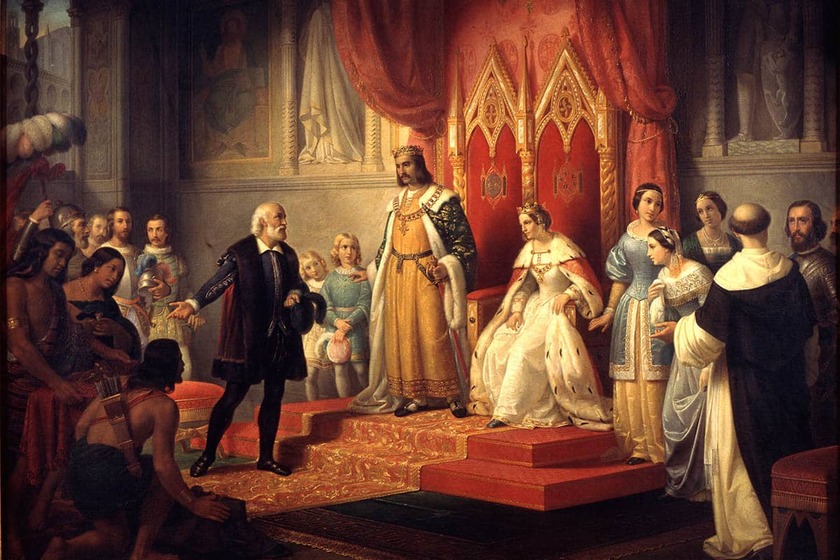
Ferdinand II of Aragon married Isabella I of Castile in Valladolid. Their union began the process of unifying the crowns of Aragon and Castile into the Kingdom of Spain. Together they completed the Reconquista, established the Spanish Inquisition, sponsored Columbus’s voyages, and laid the foundations for Spain’s rise as a major European and global power.

Ferdinand and Isabella: The Marriage That Unified Spain | TheCollector

1512 – Martin Luther receives his doctorate in theology

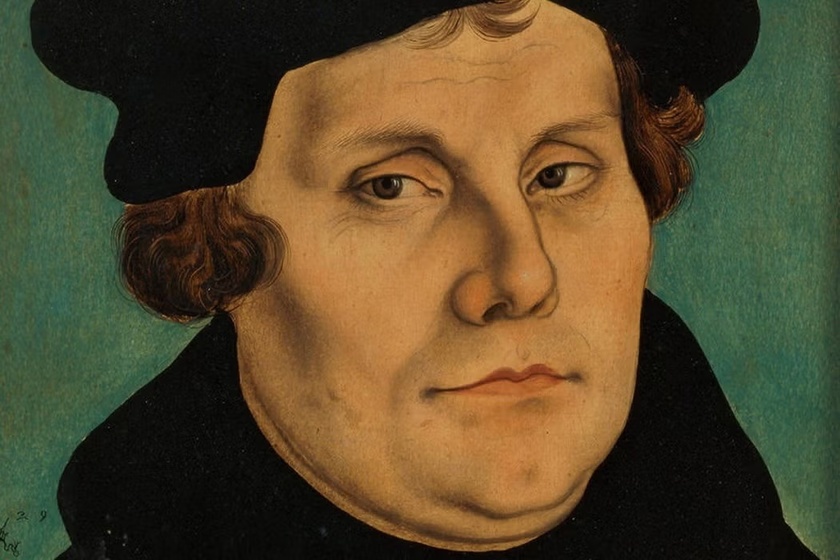
At the University of Wittenberg, Martin Luther (then an Augustinian friar) was formally promoted as Doctor of Theology (Doctor in Biblia). The ceremony took place in the Castle Church; he received the usual insignia (Bible, biretta, ring) and took the customary oaths. The doctorate gave him the right and duty to lecture on Scripture. He later frequently cited this office when challenging Church teachings, making the degree a key step toward the Reformation.

Why Martin Luther's Body Type Mattered - JSTOR Daily

1649 – New Ross surrenders to Oliver Cromwell

During the Cromwellian conquest of Ireland, the town of New Ross (County Wexford) surrendered to Oliver Cromwell’s forces. After the severe treatment of Drogheda and Wexford, the governor (Lucas Taaffe) accepted terms that allowed the garrison to march out with arms and colours. The surrender gave Cromwell control of a useful crossing of the River Barrow and demonstrated that towns which yielded promptly could receive relatively lenient terms.

1781 – Surrender at Yorktown

At Yorktown, Virginia, the British army under Lord Cornwallis formally surrendered to the combined American and French forces under George Washington and the comte de Rochambeau. Cornwallis himself did not attend the ceremony (claiming illness); a subordinate handed over the sword. The siege and surrender effectively ended major land operations in the American Revolutionary War and opened the way for the Treaty of Paris (1783).

1789 – John Jay sworn in as first Chief Justice

John Jay took the oaths of office as the first Chief Justice of the United States Supreme Court. Nominated by President George Washington and confirmed by the Senate, he swore the judicial and constitutional oaths before Richard Morris, Chief Justice of New York. Jay, a key Founding Father and co-author of The Federalist, served until 1795.

A curious historical coincidence noted by some chroniclers is that Gaiseric’s capture of Carthage in 439 fell on the anniversary of the Roman victory at Zama in 202 BC—the same city, centuries apart, marking the rise and later decline of Roman power in North Africa.


Read full Article
October 16, 2026
post photo preview
Musk flying car was a stunt. Nobody else could have done it.
What It Took — Musk’s Flying Car and Pappus’s Intermediate Theorem

What It Took — Musk’s Flying Car and Pappus’s Intermediate Theorem

Musk flying car was a stunt. Nobody else could have done it.

The flying car demonstration was a stunt. That is the easy dismissal. What it actually required was a convergence no one else possessed. To put a sporty Tesla through that sequence—controlled flight, rocket propulsion, and the inverted suspension that held the vehicle against gravity—demanded three things at once: a driver-pilot system more precise and reliable than any human hand, a vehicle architecture able to feed the rockets their fuel without compromising the car’s structure, and a suction or attachment method strong enough to keep the chassis inverted and stable. Others had sketched flying cars for decades. None combined the electric powertrain, the rocket hardware, the control software, and the manufacturing capability in one place. Only Musk’s stack made the stunt possible. The spectacle was real because the prerequisites were unique.

The parallel with Pappus of Alexandria is exact in kind, if not in century. Pappus (fl. c. 320) is routinely called a collector: the man who gathered results that would otherwise have vanished, the author of the Synagoge that preserved pieces of Euclid, Apollonius, and others. That description is true and incomplete. His intermediate theorem—the result on the centroid of a plane figure rotated about an external axis that yields the volume of the solid of revolution—was not archival. It was a step that later mathematicians recognized as lying on the road to the integral calculus. The method isolates the geometric center and multiplies distance traveled by area; it converts a solid into a product of simpler quantities. In the hands of later writers it became a practical tool for volumes that pure exhaustion methods handled clumsily. Pappus did not invent the calculus, but he supplied a precise intermediate result that made one of its central applications thinkable.

He could do so only because he occupied a position no one else filled. Alexandria still held the texts, the teaching tradition, and the habit of commentary on Ptolemy’s Almagest and Euclid’s Elements. Pappus worked inside that continuity. He observed and calculated with the solar eclipse of 18 October 320, wrote the commentary that fixed his date, and dedicated major books of the Collection to his son Hermodorus. He was not inventing a new science from nothing; he was operating at the exact point where classical geometry could still be extended before the tradition thinned. Theon of Alexandria, a generation later, used his material; Hypatia, Theon’s daughter, continued the same line of commentary and instruction until the school was broken in 415. Pappus sat at the last moment when the full apparatus—texts, students, and technical command—still existed in one place. Without that, the intermediate theorem would not have been formulated, or would not have survived to be read by Commandino, Descartes, Fermat, and Newton.

Dismissing Pappus as “mere collector” is the same error as calling the flying-car sequence “just a stunt.” Both judgments ignore the prerequisites. In one case the prerequisites were an electric car that could also serve as a rocket stage, control systems beyond human reaction time, and attachment physics sufficient for inverted flight. In the other they were mastery of the classical corpus, the geometric insight to isolate the centroid theorem, and a school still capable of transmitting the result. Later workers stood on what each man made available. The demonstration and the theorem both look, in retrospect, like displays. They were possible only because the required combination existed in one hands.

=

Pappus of Alexandria and the solar eclipse of 18 October 320

Pappus of Alexandria (Ancient Greek: Πάππος ὁ Ἀλεξανδρεύς; c. 290 – c. 350 AD) was one of the last major Greek mathematicians of late antiquity. Almost nothing is known of his personal life beyond what appears in his own writings. He lived and taught in Alexandria, Egypt, and is described as heading a school there. He had a son named Hermodorus, to whom he dedicated Books VII and VIII of his main work. He also refers to contemporaries such as the philosopher Hierius and a woman mathematician named Pandrosion (to whom he addressed a critique of her students’ training).

The eclipse and the Almagest commentary

In his commentary on Ptolemy’s Almagest (the Syntaxis Mathematica, later known in Arabic as al-Majisti and in Latin as the Almagest—“the Great Astronomer”), Pappus calculates “the place and time of conjunction which gave rise to the eclipse in Tybi in 1068 after Nabonassar.” This corresponds to 17 Tybi in the Egyptian calendar and 18 October 320 in the Julian calendar. He writes as if the eclipse were a recent event he had observed, which has allowed historians (notably Adolphe Rome in his 1931 edition of the commentaries) to fix his activity around that year. Alternative earlier or later eclipses have been considered, but the 320 event best fits the language and context.

The eclipse of 18 October 320 was a total solar eclipse (Saros 87). Greatest eclipse occurred near 2.9°N, 33.7°E (roughly in the region of modern Sudan/Ethiopia border area), with a magnitude of about 1.026 and a central duration of roughly 2 minutes 36 seconds. From Alexandria (approximately 31°N, 30°E) it would have been visible as a substantial partial eclipse. Pappus uses the event in the context of discussing the conditions for solar eclipses, following Ptolemy closely on conjunctions, oppositions, and prediction methods. Only portions of his commentary survive (mainly material related to Books V and VI of the Almagest); he refers in other works to a commentary on Book I as well. Later, Theon of Alexandria’s more extensive commentary on the Almagest shows that he had Pappus’s work before him.

Background and the Alexandrian tradition

By the early 4th century, original creative mathematics in the classical Greek tradition had largely stagnated. Pappus stands out as a compiler, commentator, and teacher who preserved and organized earlier material rather than claiming major new discoveries. He worked in the scholarly environment of Alexandria, still a center of mathematical and astronomical study even after the political and religious upheavals of the late Roman Empire.

Significant individuals in this lineage include:

  • Claudius Ptolemy (c. 100–170 AD): Author of the Almagest, the foundational astronomical treatise on which both Pappus and later Alexandrians commented.
  • Theon of Alexandria (c. 335–405 AD): Active later in the 4th century. He produced a major commentary on the Almagest (drawing on Pappus), edited Euclid’s Elements (his version became the standard), and wrote on the Handy Tables. He is the last attested member of the Alexandrian Museum/Mouseion tradition in the scholarly sense.
  • Hypatia (c. 350/370–415 AD): Daughter of Theon and the most famous woman mathematician and philosopher of antiquity. She continued the family program of commenting on classical mathematical and astronomical works (including material related to the Almagest, Apollonius’s Conics, and Diophantus’s Arithmetic), taught mathematics and Neoplatonic philosophy, and constructed instruments such as astrolabes. She was murdered by a Christian mob in Alexandria in 415. While there is no direct personal connection to Pappus (she lived a generation or more later), she and her father represent the continuation of the same Alexandrian mathematical-astronomical school that Pappus exemplified earlier in the century. Modern scholars sometimes group Pappus, Theon, and Hypatia as successive figures engaged with Ptolemy’s technical and philosophical approach to mathematics and astronomy.

Major works and results

Pappus’s principal surviving work is the Synagoge (Collection), a mathematical encyclopedia in at least eight books (possibly originally more), written around 340. Book I is lost; the rest survive in varying states of completeness. It covers geometry, astronomy, mechanics, and recreational mathematics, drawing heavily on the “Treasury of Analysis” (works by Euclid, Apollonius of Perga, Eratosthenes, and Aristaeus). It is often the sole source for otherwise lost Greek geometry. Notable contributions associated with him include Pappus’s hexagon theorem (in projective geometry) and material that later influenced the study of loci and algebraic approaches to geometric problems.

Other works include:

  • The partial commentary on the Almagest already mentioned.
  • A commentary on Book X of Euclid’s Elements (surviving in Arabic).
  • Lost or fragmentary works such as a Description of the Inhabited World, Rivers of Libya, and Interpretation of Dreams.

The Collection was translated into Latin by Federico Commandino in 1588 and became highly influential in the Renaissance and early modern period. Mathematicians including René Descartes, Pierre de Fermat, and Isaac Newton drew on it for problems involving loci, projective ideas, and geometric analysis. In this sense, Pappus’s role was less that of an original innovator and more that of a crucial transmitter who kept classical Greek mathematics accessible when many original texts had disappeared.

In short, the 18 October 320 eclipse provides one of the few fixed chronological anchors for Pappus’s career, while his commentaries and especially the Collection form a vital bridge between classical Greek mathematics and its later recovery in the Islamic world and early modern Europe. The Alexandrian line of teachers and commentators that includes him, Theon, and Hypatia represents the final major flowering of that tradition before the disruptions of the 5th century.

= Oct 18th

These events are all associated with 18 October in historical calendars and “On This Day” compilations (with minor source variation on a couple of the earlier ones). Here is a concise overview of each.

320 – Pappus of Alexandria and the eclipse

Pappus of Alexandria (fl. c. 320), one of the last major Greek mathematicians of late antiquity, refers in his commentary on Ptolemy’s Almagest (the “Great Astronomer”) to a solar eclipse he observed. Modern calculations identify this as the eclipse of 18 October 320. Pappus is best known for his Synagoge (Collection), a major source for otherwise lost Greek geometry, and for work that influenced later mathematicians including Newton.

614 – Edict of Paris (Edictum Chlotacharii)

Merovingian King Chlothar II promulgated the Edict of Paris on 18 October 614, shortly after the Council of Paris and his unification of the Frankish kingdoms. It addressed justice, church rights, and aristocratic privileges (sometimes likened to a “Frankish Magna Carta”). It also barred Jews from civil and military offices in which they would exercise authority over Christians. It is the last major Merovingian capitulary.

629 – Dagobert I becomes King of the Franks

On 18 October 629, Chlothar II died. His son Dagobert I, already king of Austrasia since 623, succeeded as king of Neustria and Burgundy and effectively of the Franks. He is widely regarded as the last Merovingian ruler to exercise substantial personal power; later kings became more dependent on the mayors of the palace.

1009 – Destruction of the Church of the Holy Sepulchre

Fatimid Caliph al-Hakim bi-Amr Allah ordered the destruction of the Church of the Holy Sepulchre in Jerusalem (and other non-Muslim religious sites). Contemporary accounts describe the structure being razed to the foundations, including attempts to obliterate the rock-cut tomb. The exact day is given variously as around 28–29 September or 17–18 October 1009; many “On This Day” lists use 18 October. The church was later rebuilt (completed c. 1048).

1016 – Battle of Assandun (Ashingdon)

On 18 October 1016, Danish forces under Cnut (Canute) defeated the English under Edmund Ironside at Assandun in Essex. It was the decisive engagement of Cnut’s campaign. A subsequent treaty divided England, but Edmund’s death soon after left Cnut as undisputed king.

1081 – Battle of Dyrrhachium (Dyrrachium / Durrës)

On 18 October 1081, Norman forces under Robert Guiscard defeated a Byzantine army led by Emperor Alexios I Komnenos outside Dyrrhachium (modern Durrës, Albania). It was a major early setback for Alexios in the First Norman invasion of the Balkans.

1356 – Basel earthquake

On the evening of 18 October 1356 (St Luke’s Day), a major earthquake (estimated magnitude roughly 6.0–7.1) struck Basel and the surrounding region. It is the most significant historic seismic event north of the Alps. Fires followed the main shock; the city was heavily damaged and casualties numbered in the hundreds to around a thousand.

1540 – Destruction of Mabila

On 18 October 1540, Hernando de Soto’s expedition reached the fortified Mississippian town of Mabila (present-day Alabama), where Chief Tuskaloosa had prepared an ambush. After a hard fight the Spanish destroyed the town. Both sides suffered heavy losses; the Spanish also lost much of their supplies and loot in the fires. It was one of the bloodiest encounters of the expedition.

1561 – Fourth Battle of Kawanakajima

On 18 October 1561, the largest of the series of battles between Takeda Shingen and Uesugi Kenshin was fought on the Kawanakajima plain in Shinano (modern Nagano Prefecture). The engagement was bloody and ended in a draw, characteristic of the prolonged rivalry between the two daimyō.

1565 – Battle of Fukuda Bay

On 18 October 1565, ships of the Matsura clan attacked Portuguese trading vessels (a carrack and a galleon) at Fukuda Bay near modern Nagasaki. The Portuguese repelled the attack. It is the first recorded naval battle between Japanese forces and a Western power.

1599 – Battle of Șelimbăr (Sellenberk)

On 18 October 1599, Wallachian forces under Michael the Brave defeated the army of Andrew Báthory near Șelimbăr (near Sibiu in Transylvania). The victory opened the way for Michael’s brief unification of Wallachia, Transylvania, and (later) Moldavia.

1648 – Boston shoemakers’ organization

On 18 October 1648 the Massachusetts General Court granted a limited charter to the Company of Shoemakers (and also to coopers) in Boston—the earliest formal recognition of craft associations in the English colonies. These were restricted quality-control bodies rather than modern trade unions; price-fixing and many guild privileges were forbidden.

1748 – Treaty of Aix-la-Chapelle

Signed on 18 October 1748 (primarily by Britain, France, and the Dutch Republic, with other powers acceding later), the treaty ended the War of the Austrian Succession. It largely restored the pre-war status quo, confirmed Maria Theresa’s rights in the Habsburg lands, and left Prussia in possession of Silesia.

1775 – Phillis Wheatley freed

African-American poet Phillis Wheatley was manumitted by the Wheatley family of Boston. Contemporary “On This Day” lists place this on 18 October 1775. She had returned from England in 1773 after the publication of her Poems on Various Subjects, Religious and Moral; the precise instrument of freedom is dated variously in late 1773–1775 in modern scholarship.

1775 – Burning of Falmouth

On 18 October 1775 a Royal Navy squadron under Captain Henry Mowat bombarded and burned much of Falmouth (present-day Portland, Maine) in retaliation for Patriot coastal actions. Hundreds of buildings were destroyed and roughly a thousand people left homeless. The incident heightened colonial outrage and is sometimes cited among the grievances leading toward independence.

1779 – Siege of Savannah lifted

After a failed Franco-American assault on 9 October, General Benjamin Lincoln raised the siege of British-held Savannah on 18 October 1779. The British retained the city until the end of the war; the failure strained the Franco-American alliance in the southern theatre.

1797 – Treaty of Campo Formio

Signed on 17 October 1797 (some secondary lists place the anniversary on the 18th) between France (represented by Napoleon Bonaparte) and Austria. It ended the War of the First Coalition on the continent, recognized French gains, partitioned the Venetian Republic, and left Britain as France’s sole major opponent. A subsequent Congress of Rastatt was intended to settle remaining German questions but failed to prevent renewed war.

These entries form a typical cross-section of 18 October anniversaries spanning mathematics, Merovingian legislation and succession, Islamic–Christian conflict in Jerusalem, medieval battles, a major Central European earthquake, colonial and early American events, and European peace treaties.

Read full Article
See More
Available on mobile and TV devices
google store google store app store app store
google store google store app tv store app tv store amazon store amazon store roku store roku store
Powered by Locals