VoiceDDB
Politics • Culture • News
October 22nd, When Time Began
Parachutes, disasters, learning
October 20, 2026
post photo preview

October 22nd, When Time Began

Here is a fuller account of the two events, with what came before, what followed, and the main figures involved.

1707 – Scilly naval disaster

Before: The disaster occurred during the War of the Spanish Succession. Admiral Sir Cloudesley Shovell (1650–1707), one of the leading British naval commanders of the age, had led a fleet in an unsuccessful allied attempt to capture Toulon. The French scuttled much of their Mediterranean fleet to prevent its capture. Shovell was ordered home with roughly 21 ships. After leaving Gibraltar, the squadron faced prolonged bad weather that prevented reliable sun sights. Navigation relied on dead reckoning (compass + estimated speed) and occasional soundings. On 21–22 October the captains conferred and concluded they were near Ushant (off Brittany). In reality they were farther north, approaching the dangerous Western Rocks of the Isles of Scilly.

The disaster (22 October 1707, Old Style): Around 8 pm, in dark, rainy, stormy conditions with a strong wind, the fleet ran among the rocks. HMS Association (90-gun flagship, Captain Edmund Loades) struck the Outer Gilstone Rock and sank within minutes with the loss of her entire crew of about 800, including Shovell and his two Narborough stepsons. HMS Eagle (70 guns) and HMS Romney (50 guns) were also lost with almost all hands (only one survivor from Romney, quartermaster George Lawrence). The fireship Firebrand was lost with most of her crew. Total deaths are estimated at 1,400–2,000. Bodies, including Shovell’s, washed ashore on St Mary’s (notably at Porth Hellick Cove). Contemporary reports noted the scale of the loss; one persistent (though not fully verified) story is that Shovell was still alive when washed up and was killed by a local woman for a valuable ring.

After and significant figures: The catastrophe caused national shock. Shovell’s body was recovered, identified, and eventually buried with a monument by Grinling Gibbons in Westminster Abbey. The immediate navigational failure was largely one of position (a combination of latitude and longitude error under poor conditions), but the scale of the loss drew lasting attention to the difficulty of determining longitude at sea. In 1714 Parliament passed the Longitude Act, offering prizes of up to £20,000 (a fortune at the time) for a practical method accurate to within half a degree. This led to the Board of Longitude. The eventual practical solution came from clockmaker John Harrison (1693–1776), who spent decades developing marine chronometers (especially his H4 sea watch). After lengthy trials and disputes with the Board (including rivalry with astronomers favouring lunar distances), Harrison received substantial rewards in the 1760s–1770s with the intervention of King George III. Reliable chronometers and improved methods transformed long-distance navigation and reduced such disasters.

Other figures include the captains of the lost ships (Loades, Hancock of Eagle, Coney of Romney) and later chronometer developers who built on Harrison’s work.

1797 – First recorded parachute jump

Before: André-Jacques Garnerin (1769–1823) was a French balloonist and aeronaut who had witnessed early balloon flights. During the French Revolutionary Wars he was captured and imprisoned for about three years in Buda (Budapest). While a prisoner he studied aeronautics and considered parachutes (building on earlier experiments such as Louis-Sébastien Lenormand’s 1783 jumps from towers or trees with framed or umbrella-like devices). After his release he continued balloon work and designed a frameless parachute.

The jump (22 October 1797 / 1 Brumaire Year VI): At Parc Monceau (then often called Parc de Mousseaux) in Paris, Garnerin ascended in a hydrogen balloon with a closed, frameless canvas (or silk) canopy roughly 7 metres / 23 feet in diameter attached to a basket/gondola. At about 1,000 metres (roughly 3,000–3,200 feet) he cut the connecting rope. The balloon continued upward (and later burst or deflated); the canopy opened and Garnerin descended in the basket. The descent was violent because the canopy lacked a central vent—it oscillated wildly, alarming spectators (some women reportedly fainted). He landed roughly and shaken but essentially uninjured (some accounts mention a sprained ankle or foot) and was celebrated by the crowd. Astronomer Jérôme Lalande recorded the event and later suggested a vent to stabilise future canopies.

After and significant figures: The jump made Garnerin famous. He repeated descents and became known as the Official Aeronaut of France under Napoleon for a time. In 1798–99 he worked with pupils including Jeanne-Geneviève Labrosse (later his wife), who made one of the earliest female balloon flights and, on 12 October 1799, became the first woman to make a parachute descent (from about 900 m). Garnerin’s niece Élisa Garnerin also became an aeronaut and parachutist. Improvements followed: a central vent (associated with Lalande’s suggestion, implemented around 1804) greatly reduced oscillations. Garnerin performed further jumps and long balloon voyages in France, Britain, and elsewhere, though he later fell from favour after a mishap involving a ceremonial balloon at Napoleon’s coronation. He died in 1823 while preparing equipment. The 1797 descent is widely regarded as the first successful high-altitude parachute jump using a frameless canopy.

These two events are linked only by the calendar date; one is a major naval tragedy that accelerated the solution to the longitude problem, the other a pioneering (and highly public) demonstration of controlled aerial descent.

=

These are events traditionally associated with October 22. They span biblical chronology, early Church history, medieval Asia and Europe, colonial and naval history, the American Revolution, and early aviation.

4004 BC – Ussher chronology

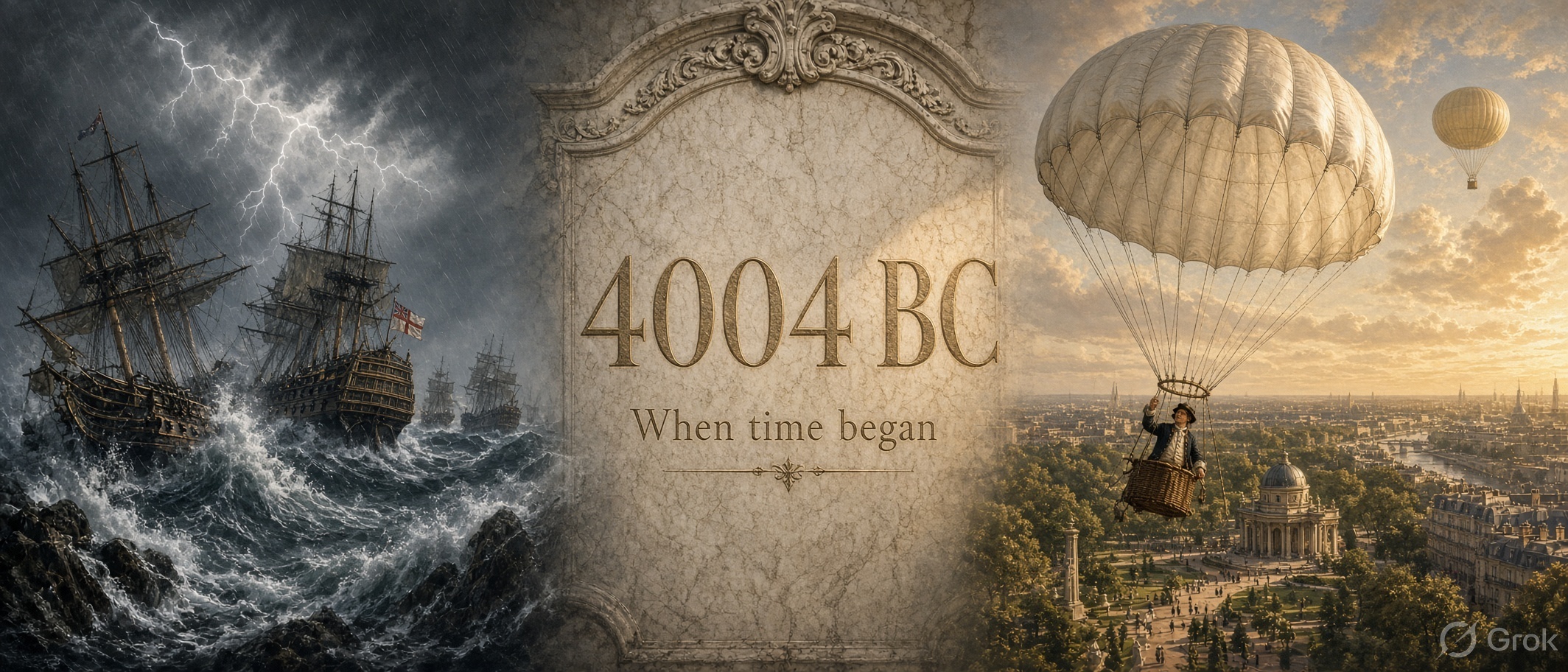
Irish archbishop James Ussher (in his 1650 Annales Veteris Testamenti) calculated that creation occurred in 4004 BC near the autumnal equinox. He placed the first day of creation on 23 October (proleptic Julian calendar), with the “beginning of time” at the start of the preceding evening—i.e., the evening of 22 October. Popular accounts often say “about six o’clock in the evening” on the 22nd. This was one of several 17th-century biblical chronologies that produced a date near 4000 BC; it is not accepted by modern historical or scientific dating.

362 – Temple of Apollo at Daphne

The temple of Apollo at Daphne (near Antioch) was destroyed by a mysterious fire. The cause was never clearly established.

451 – Council of Chalcedon

The fourth ecumenical council (convened by Emperor Marcian) adopted the Chalcedonian Definition/Creed on 22 October during its fifth session. It affirmed that Jesus Christ is one person in two natures (fully divine and fully human), “without confusion, without change, without division, without separation.” The council met at Chalcedon (near Constantinople) from 8 October to 1 November and was the largest of the early ecumenical councils (roughly 500+ bishops). The definition remains foundational for Catholic, Eastern Orthodox, and most Protestant traditions, while Oriental Orthodox churches rejected it.

794 – Heian-kyō

Emperor Kanmu moved the Japanese capital from Nara to Heian-kyō (modern Kyoto), beginning the Heian period.

906 – Ahmad ibn Kayghalagh’s raid

The Abbasid general Ahmad ibn Kayghalagh led a raid from Tarsus into Byzantine territory, reaching the Halys River and taking 4,000–5,000 captives.

1383 – Portuguese succession crisis

King Fernando I of Portugal died without a male heir. This triggered the 1383–85 Crisis (civil war and succession struggle) that eventually brought the House of Aviz to the throne.

1575 – Foundation of Aguascalientes

The city of Aguascalientes (in present-day Mexico) was founded.

1633 – Battle of Liaoluo Bay

Ming Chinese naval forces under Zheng Zhilong defeated a Dutch East India Company (VOC) fleet (under Hans Putmans) plus Chinese pirate allies in Liaoluo Bay off Kinmen in the Taiwan Strait. It was the largest Chinese–European naval engagement before the Opium Wars. The Ming used fireships effectively; the Dutch lost ships and were driven from the Chinese coast.

1707 – Scilly naval disaster

Four Royal Navy ships (including the flagship Association under Admiral Sir Cloudesley Shovell) ran aground on the Isles of Scilly in stormy weather due to navigational error (faulty dead reckoning after poor weather). Roughly 1,400–2,000 men died; it was one of the worst maritime disasters in British history. The catastrophe highlighted the urgent need for a reliable method of finding longitude at sea and helped spur the Longitude Act of 1714, which offered large prizes and led to the development of marine chronometers.

1730 – Ladoga Canal

Construction of the Ladoga Canal (in Russia) was completed.

1746 – College of New Jersey

The College of New Jersey (later Princeton University) received its charter.

1777 – Battle of Red Bank

In the American Revolutionary War, American defenders of Fort Mercer on the Delaware River repulsed repeated Hessian attacks.

1784 – Russian colony on Kodiak Island

Russia founded a colony on Kodiak Island in Alaska.

1790 – Northwest Indian War

Warriors of the Miami people under Chief Little Turtle defeated U.S. troops under General Josiah Harmar near present-day Fort Wayne, Indiana (part of the Harmar Campaign).

1797 – First recorded parachute jump

André-Jacques Garnerin made the first documented parachute descent from a hydrogen balloon, from about 1,000 metres (roughly 3,000–3,200 feet) over Parc Monceau in Paris. He used a frameless silk/canvas canopy attached to a basket. The descent was violent (the canopy lacked a vent, causing wild oscillations), but he landed uninjured. This is widely regarded as the first successful parachute jump from significant altitude.

These entries mix well-documented events with the Ussher calculation (a scholarly but non-scientific reconstruction). The Council of Chalcedon, the Scilly disaster, the Battle of Liaoluo Bay, and Garnerin’s jump are among the more consequential of the day.


community logo
Join the VoiceDDB Community
To read more articles like this, sign up and join my community today
0
What else you may like…
Videos
Posts
Articles
00:01:07
November 27, 2022
Jingle Bell Rock

Jingle bell, jingle bell, jingle bell rock
Jingle bells swing and jingle bells ring
Snowin' and blowin' up bushels of fun
Now the jingle hop has begun

Jingle bell, jingle bell, jingle bell rock
Jingle bells chime in jingle bell time
Dancin' and prancin' in Jingle Bell Square
In the frosty air

What a bright time, it's the right time
To rock the night away
Jingle bell time is a swell time
To go glidin' in a one-horse sleigh

Giddy-up jingle horse, pick up your feet
Jingle around the clock
Mix and a-mingle in the jinglin' feet
That's the jingle bell rock

Jingle bell, jingle bell, jingle bell rock
Jingle bell chime in jingle bell time
Dancin' and prancin' in Jingle Bell Square
In the frosty air

What a bright time, it's the right time
To rock the night away
Jingle bell time is a swell time
To go glidin' in a one-horse sleigh

Giddy-up jingle horse, pick up your feet
Jingle around the clock
Mix and a-mingle in the jinglin' feet
That's the jingle bell
That's the jingle...

00:02:04
September 01, 2021
Intro to Locals for the Conservative Voice

David Daniel Ball calls himself the Conservative Voice.

I'm a teacher with three decades experience teaching math to high school kids.I also work with first graders and kids in between first grade and high school. I know the legends of why Hypatia's dad is remembered through his contribution to Math theory. And I know the legend of why followers of Godel had thought he had disproved God's existence.

I'm not a preacher, but I am a Christian who has written over 28 books all of which include some reference to my faith. Twelve blog books on world history and current affairs, detailing world events , births and marriages on each day of the year, organised by month. Twelve books on the background to and history of Bible Quotes. One Bible quote per day for a year. An intro to a science fiction series I'm planning, post apocalyptic cyber punk. An autobiography with short story collections.

I'm known in Australia for my failure as a whistleblower over the negligence death of a school boy. ...

00:01:50
September 04, 2026
Should violent criminals be made fat? Grok says 'no'

No. Transferring gut bacteria from an obese person into a violent criminal is not a reliable, ethical, or effective way to make them “fat, sedentary, and less of a physical threat.”

The science does not deliver the outcome you want

Mouse studies in germ-free animals showed that microbiota from obese donors can increase energy harvest and adiposity compared with lean-donor microbiota. That is the origin of the idea. Human evidence is far weaker.

Randomized trials of fecal microbiota transplant (FMT) from lean donors into people with obesity have generally failed to produce meaningful, sustained weight loss. Microbiome composition can change; body weight and metabolic markers often do not, or the effects are small and inconsistent. Diet and the existing gut environment usually dominate. A 2025 Nature paper found diet outperformed microbial transplant for microbiome recovery. Human guts are already colonized, not sterile like lab mice, so engraftment is variable and effects unpredictable.

It is not a ...

post photo preview
August 28, 2026
Pfizer struggles to answer

Some in Australia are brilliant. Malcolm Roberts Investigates Pfizer over Covid vaccine.

Holiday break is over back to work tonight

Tonight I'll start double posting until I've caught up.

post photo preview
Lest we forget
November 11th

Lest we forget

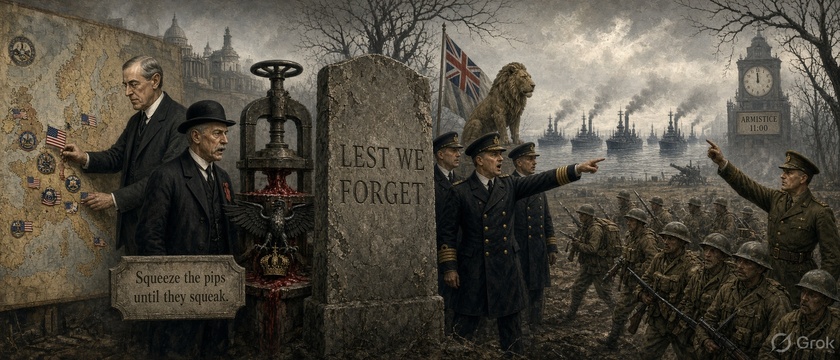
The Armistice of 11 November 1918 (also called the Armistice of Compiègne) ended active fighting in World War I on the Western Front. It was signed in the early morning of 11 November 1918 in railway carriage 2419D (a converted dining car belonging to the Compagnie des Wagons-Lits) in a siding in the Forest of Compiègne near Rethondes, France. The document was signed around 5:00–5:15 a.m.; hostilities ceased at 11:00 a.m. Paris time—the “eleventh hour of the eleventh day of the eleventh month.”

Significant figures

Allied side (military representatives only; no political leaders were present):

  • Marshal Ferdinand Foch — Allied Supreme Commander and principal signatory. He dictated the terms and refused substantive negotiation.
  • Admiral Sir Rosslyn Wemyss — British First Sea Lord and co-signatory.
  • General Maxime Weygand — Foch’s chief of staff.
  • Also present: Admiral Sir George Hope, Captain Jack Marriott (British naval aide), and interpreters.

German side (deliberately led by a civilian):

  • Matthias Erzberger — Centre Party politician, State Secretary, and head of the German delegation; principal signatory. The German High Command (Paul von Hindenburg and Erich Ludendorff) insisted on a civilian lead so the military could later disclaim responsibility for the defeat.
  • Count Alfred von Oberndorff — Foreign Ministry representative.
  • Major General Detlof von Winterfeldt — Army representative.
  • Captain Ernst Vanselow — Navy representative.
  • Two interpreters accompanied them.

Foch’s famous opening exchange set the tone: when Erzberger said the Germans had come to hear Allied proposals, Foch replied that he had none to make—they must request an armistice. The Germans were given little time and essentially presented with terms to accept or reject.

Before the armistice

By late summer 1918 the German Spring Offensive had failed and the Allied Hundred Days Offensive was driving the German army backward. Germany’s allies were collapsing (Bulgaria, the Ottoman Empire, and Austria-Hungary sought or accepted armistices in September–October).

In early October the new German government under Prince Max of Baden asked for an armistice on the basis of U.S. President Woodrow Wilson’s Fourteen Points. Wilson’s replies made clear that the Allies would impose their own military conditions. Naval mutinies began at Kiel on 3 November and spread; revolution broke out in cities across Germany. On 9 November the Kaiser abdicated, the Weimar Republic was proclaimed in Berlin, and the German government authorized Erzberger’s delegation to sign whatever was necessary to stop the fighting. The military leadership had already concluded the war was lost but wanted civilians to bear the political cost.

Terms and immediate aftermath

The armistice was harsh and effectively a military surrender. It required:

  • Immediate cessation of hostilities.
  • German withdrawal from occupied territories in France, Belgium, Luxembourg, and Alsace-Lorraine within 15 days.
  • Evacuation of the left bank of the Rhine and Allied occupation of bridgeheads.
  • Surrender of large quantities of artillery, machine guns, aircraft, locomotives, and rolling stock.
  • Internment or surrender of the High Seas Fleet and U-boats.
  • Annulment of the Treaty of Brest-Litovsk with Russia.
  • Continuation of the naval blockade.

Fighting stopped at 11 a.m. on 11 November, ending more than four years of industrial-scale slaughter (roughly 16–20 million dead overall). The armistice was repeatedly extended while the Paris Peace Conference drafted the Treaty of Versailles (signed 28 June 1919), which formalized territorial losses, massive reparations, the “war guilt” clause, and severe limits on the German military.

Longer-term consequences

In Germany the armistice and Versailles fueled the “stab-in-the-back” myth (Dolchstoßlegende): the claim that the undefeated army had been betrayed by civilians, socialists, and Jews at home. Erzberger, as the most visible signatory, became a prime target of right-wing propaganda. He was assassinated by nationalist extremists in the Black Forest on 26 August 1921.

The railway carriage itself became a symbol. After the war it was displayed in Paris, then returned to a specially built memorial building in the Compiègne clearing. In June 1940 Adolf Hitler deliberately used the same carriage, placed on the exact spot of 1918, for the French surrender after the Battle of France—an act of revenge. The original carriage was later taken to Germany and destroyed in 1945; a near-identical carriage of the same series (2439D, renumbered) now stands in the restored Glade of the Armistice (Clairière de l’Armistice).

11 November is observed as Armistice Day, Remembrance Day, or Veterans Day in many countries, commemorating the end of the Great War and those who died in it. The event closed one catastrophic war while planting seeds of the next through humiliation, economic strain, and political mythology.

= November 11th 

These events cluster around November 11 (St. Martin’s Day in the traditional calendar), not November 9. The list you provided draws from sources that often group them under or near that date. Here’s a concise overview of each, with the corrected or confirmed dates and key context.⁠Wikipedia

308 – Conference of Carnuntum (November 11)

At Carnuntum (modern Petronell-Carnuntum, Austria, on the Danube in the Roman province of Pannonia Prima), retired Emperor Diocletian, Galerius (Augustus of the East), and Maximian (the recently returned former Western Augustus) met to stabilize the collapsing Tetrarchy amid civil wars.

They forced Maximian to abdicate permanently, declared Maxentius (Maximian’s son, controlling Italy) a usurper, elevated Galerius’s officer Licinius as the new Western Augustus (tasked with dealing with Maxentius), and relegated Constantine (already powerful in Gaul/Britain) back to Caesar. The arrangement was inconclusive; civil wars continued, paving the way for Constantine’s eventual dominance. An altar to Mithras set up by the participants is a noted historical source. The site’s ruins and reconstructed buildings are a major archaeological park today.⁠Wikipedia

1100 – Henry I of England marries Matilda of Scotland (November 11)

Henry I (who had seized the throne after his brother William Rufus’s death in the New Forest in August 1100) married Matilda (born Edith), daughter of Malcolm III of Scotland and St. Margaret, and a direct descendant of the Saxon king Edmund Ironside. The wedding and her coronation took place at Westminster Abbey, performed by Archbishop Anselm of Canterbury.

This union linked the Norman and Anglo-Saxon royal lines, strengthening Henry’s legitimacy among the English population. Matilda (renamed from Edith) was a pious, educated, and influential queen; their daughter became the Empress Matilda, whose struggles shaped the later Plantagenet succession.⁠Wikipedia

1215 – Fourth Lateran Council opens (November 11)

Pope Innocent III convened the council (the twelfth ecumenical council, often called the “Great Council”) at the Lateran Palace in Rome. It opened on St. Martin’s Day after extensive preparation (summoned in 1213) and ran through late November, with major sessions on the 11th, 20th, and 30th.

Key outcomes included the formal definition of transubstantiation (the doctrine that the bread and wine of the Eucharist become the body and blood of Christ), reforms of clergy and Church discipline, rules on heresy, requirements for annual confession and Easter communion, measures affecting Jews and Muslims (including distinctive clothing), and a call for a new Crusade. More than 400 bishops, hundreds of abbots, and royal envoys attended—one of the most influential medieval councils.⁠Wikipedia

1500 – Treaty of Granada (November 11)

Louis XII of France and Ferdinand II of Aragon secretly agreed to divide the Kingdom of Naples between them (Louis taking the north including Naples itself; Ferdinand the south). Louis signed earlier at Chambord (around October 10); Ferdinand ratified it at Granada on November 11. Pope Alexander VI approved the partition.

It was part of the Italian Wars and collapsed into renewed conflict by 1503–1504, after which Spain ultimately secured Naples.⁠Wikipedia

1620 – Mayflower Compact signed (November 11 Old Style / November 21 New Style)

While anchored in what is now Provincetown Harbor near Cape Cod (blown off course from their intended Virginia destination), 41 adult male passengers of the Mayflower—including Separatist “Pilgrims” and others (“Strangers”)—signed an agreement forming a “civil body politic” and pledging to enact just and equal laws for the colony.

It was the first written framework for self-government in the territory that became the United States, based on consent of the governed and majority rule. It remained in effect until Plymouth Colony merged into Massachusetts Bay in 1691.⁠Wikipedia

1634 – Irish Act for the Punishment of the Vice of Buggery (November 11)

Following pressure from Anglican Bishop John Atherton (who realized the English Buggery Act of 1533 did not apply in Ireland), the Irish House of Commons passed “An Act for the Punishment for the Vice of Buggery.” It made the offense a capital felony, mirroring English law.

In a grim irony, Atherton himself was later tried and hanged under this law in 1640 (along with his steward John Childe) on charges of buggery.⁠Historicaltoursireland.wordpress

1673 – Second Battle of Khotyn (November 11)

Polish–Lithuanian Commonwealth forces under Grand Hetman Jan (John) Sobieski defeated an Ottoman army under Hüseyin Pasha near the fortress of Khotyn (in present-day Ukraine). Commonwealth forces numbered roughly 29,000–30,000; the Ottomans about 35,000.

The victory reversed the unfavorable Peace of Buchach from the previous year, boosted Sobieski’s prestige (helping him win the Polish crown in 1674), and foreshadowed his later role at the Battle of Vienna (1683). Contemporary accounts note the successful use of rockets developed by Kazimierz Siemienowicz.⁠Wikipedia

1675 – Leibniz demonstrates integral calculus (November 11)

Gottfried Wilhelm Leibniz, working in Paris, first demonstrated the use of integral calculus to find the area under the curve of y=f(x)y = f(x)y=f(x). In his private notebooks around this period (including late October), he introduced the elongated integral sign ∫\int∫ (from Latin summa) and related differential notation (dxdxdx, dydydy).

He developed calculus independently of (and nearly simultaneously with) Isaac Newton; Leibniz’s notation became the standard one still used today. He published key results in the 1680s.⁠Mathshistory.st-andrews

1724 – Joseph “Blueskin” Blake hanged (November 11)

The London highwayman and housebreaker Joseph Blake (alias Blueskin), known for his dark complexion and for attacking “Thief-Taker General” Jonathan Wild with a knife at the Old Bailey (slashing Wild’s throat during or after his trial), was hanged at Tyburn. He was about 24.

Blake had worked with and then against Wild and was associated with the famous jailbreaker Jack Sheppard (hanged five days later). He stopped for strong drink on the way to the gallows and was reportedly unsteady on the scaffold.⁠Wikipedia

1750 – Lhasa riots (began November 11)

Riots broke out in Lhasa after Qing ambans (imperial representatives) assassinated the expected Tibetan regent Gyurme Namgyal. The mob killed both ambans, dozens of Qing soldiers, and Chinese civilians. The uprising was short-lived; order was restored under the Dalai Lama’s influence within days, and Qing control over Tibet was later tightened.⁠Wikipedia

1750 – Flat Hat Club (F.H.C. Society) formed (November 11)

The F.H.C. Society (later nicknamed the Flat Hat Club) was founded at the College of William & Mary in Williamsburg, Virginia (often linked to meetings at Raleigh Tavern). It is recognized as the first collegiate secret society / fraternity in what became the United States.

Membership was limited (initially to a small number of students); it emphasized friendship, discussion, and fellowship. Notable members included Thomas Jefferson. It faded in the Revolutionary era but inspired later societies (including influences on Phi Beta Kappa, founded at the same college in 1776). A silver membership medal survives in collections.⁠Wikipedia

1778 – Cherry Valley massacre (November 11)

During the American Revolutionary War, a force of Loyalists (Butler’s Rangers), British troops, and Seneca (and other Iroquois) warriors under Walter Butler and Joseph Brant attacked the fort and settlement at Cherry Valley in eastern New York.

Despite warnings, the American commander (Col. Ichabod Alden) was poorly prepared (headquarters outside the fort). More than 40 soldiers and civilians were killed (including Alden); dozens were taken captive. Seneca warriors in particular targeted non-combatants. The raid contributed to the Continental Congress ordering the 1779 Sullivan Expedition against Iroquois villages.⁠Archive

These events span Roman imperial politics, medieval church and monarchy, early modern diplomacy and mathematics, colonial self-government, and frontier warfare. Several are tied to November 11 specifically because of the liturgical calendar or simply coincidence in the historical record. If you’d like deeper detail, primary-source excerpts, maps, or images on any particular one, just say which.

Read full Article
November 07, 2026
post photo preview
Your faith, our belief, left wing state need
November 10th

Your faith, our belief, left wing state need

The Cult of Reason and the Festival of Reason (November 1793) marked the peak of the radical dechristianization campaign during the French Revolution’s Reign of Terror. It was a short-lived, atheistic civic religion promoted mainly by radical Parisian figures (especially the Hébertists) as a replacement for Catholicism.

Significant Figures

  • Pierre-Gaspard Chaumette (also known as Anaxagoras Chaumette after he renamed himself): Procurator of the Paris Commune. A leading organizer of the Festival of Reason and a vocal dechristianizer who viewed the Church as inherently counter-revolutionary. He pushed the Commune’s role in converting churches into Temples of Reason.
  • Jacques Hébert: Radical journalist and leader of the Hébertist faction (ultras among the sans-culottes). He supervised the official Festival of Reason alongside others and was a major proponent of aggressive dechristianization.
  • Antoine-François Momoro: Printer, Cordelier, and Hébertist. He helped organize the festival; his wife, Sophie Momoro, is widely identified as the woman who portrayed the “Goddess of Reason” in Paris (accounts sometimes mention other actresses or opera singers such as Marie-Thérèse Maillard as alternatives or for related ceremonies).
  • Other supporters included Anacharsis Cloots and, in the provinces, figures such as Joseph Fouché (who actively promoted dechristianization in areas under his control).
  • Maximilien Robespierre opposed the cult’s perceived atheism, viewing it as destabilizing and “aristocratic.” He later suppressed it in favor of his own alternative.

Before the Festival

Dechristianization had been building since the fall of the monarchy in 1792 and intensified in autumn 1793. Key precursors included:

  • The Civil Constitution of the Clergy (1790), which subordinated the Church to the state and split clergy into juring and refractory (non-juring) factions.
  • Closure of churches, exile or execution of priests, destruction of religious symbols, and adoption of the Republican calendar (October 1793), which erased Christian dating and Sunday.
  • Pressure on constitutional bishops and priests to abjure their offices (e.g., Jean-Baptiste Gobel, constitutional bishop of Paris, publicly renounced shortly before the festival).
  • Local actions by representatives on mission and popular pressure from radical sections, turning churches into civic spaces and promoting festivals of Liberty or martyrs of the Revolution.

The movement was driven by both top-down radical leadership in Paris and spontaneous or encouraged activity in the departments. It reflected Enlightenment anti-clericalism mixed with the wartime radicalism and suspicion of the Church as a royalist/counter-revolutionary force.

The Festival Itself (10 November 1793 / 20 Brumaire Year II)

The largest and most symbolic event took place at Notre-Dame Cathedral in Paris, renamed the Temple of Reason. Chaumette and the Commune organized it; Hébert and Momoro supervised aspects of the nationwide effort.

  • Christian altars and symbols were removed. An altar to Liberty was installed, a “sacred mountain” or similar structure was built, and the inscription “To Philosophy” appeared over the doors.
  • A living woman (Sophie Momoro in the best-attested accounts) appeared as the Goddess of Reason / Liberty—dressed in classical style (white tunic, blue mantle, red liberty cap in some descriptions), often carried in procession or enthroned. Young women in white Roman dress with tricolor sashes participated; a flame symbolized truth.
  • Hymns were sung (including works associated with revolutionary poets), and speeches celebrated the triumph of reason over “fanaticism.”
  • The procession went to the National Convention, which formally declared the former cathedral a Temple of Reason. Similar (if less elaborate) ceremonies occurred across France as churches were converted.

The cult was anthropocentric and civic rather than strictly theological: it honored reason, liberty, philosophy, and the people, while rejecting Christian dogma and idolatry (hence the use of living women rather than statues).

After the Festival

The Cult of Reason spread quickly in late 1793–early 1794 but collapsed almost as fast:

  • In March 1794, the Hébertist leaders (including Hébert, Momoro, and others) were arrested and guillotined on 24 March. Chaumette followed shortly afterward. Their elimination removed the cult’s main organizers.
  • Robespierre, consolidating power, denounced atheism as socially destructive. On 7 May 1794 the Convention established the Cult of the Supreme Being, a deistic civic religion affirming a creator God and the immortality of the soul (influenced by Rousseau). Its major public event was the Festival of the Supreme Being on 8 June 1794, staged by Jacques-Louis David, with Robespierre in a prominent role.
  • After Robespierre’s fall in the Thermidorian Reaction (July 1794), both cults faded. Churches gradually reopened under more tolerant policies, and Napoleon formally ended official revolutionary cults with the Law on Cults (1802) while restoring relations with the Catholic Church via the Concordat.

The episode is often cited as an extreme example of revolutionary cultural radicalism and the attempt to replace traditional religion with state-sponsored civic morality. It lasted only a few months at its height and is remembered more for its theatrical symbolism at Notre-Dame than for lasting institutional success.

= November 10th

These are notable historical events traditionally linked to November 8 (or closely associated with early-to-mid November) in various “On This Day” compilations. Several are more precisely dated to November 10 in standard sources (calendar differences, Chinese/Julian vs. Gregorian conventions, or rounding can account for the slight offsets). Here is concise context for each:

937 – Founding of Southern Tang (Five Dynasties and Ten Kingdoms period)
Li Bian (also known earlier as Xu Zhigao or Xu Gao), the powerful adopted successor of the Wu regent Xu Wen, forced the abdication of the last Wu emperor, Yang Pu. He took the throne (initially styling his state Qi, later renaming it Tang to claim continuity with the fallen Tang dynasty) and became the first ruler of Southern Tang (capital at Jinling, modern Nanjing). Southern Tang became one of the more culturally refined and relatively stable of the southern states during this fragmented era. Li Bian later formally changed his name and asserted descent from the Tang imperial house.

1202 – Siege of Zara (Zadar) begins, Fourth Crusade
The Fourth Crusade fleet (Venetian ships carrying French and other Western European crusaders) arrived at Zara (modern Zadar, Croatia), a Christian city under Hungarian protection that Venice wanted to recapture. Despite explicit papal letters from Innocent III forbidding attacks on fellow Christians and threatening excommunication, the crusaders (pressed by debts owed to Venice for transport) began the siege. It was the first major action of the crusade and the first attack by Catholic crusaders on a Catholic city; the city fell later in November after a short siege. The episode foreshadowed the later diversion to and sack of Constantinople (1204).

1293 – Raden Wijaya crowned, founding of Majapahit
After outmaneuvering the Mongol-Yuan expedition that had arrived in Java (initially allying with them against his rival Jayakatwang of Kediri, then turning on the weakened Mongols and driving them out), Raden Wijaya (Nararya Sangramawijaya) was crowned as the first monarch of the Majapahit kingdom. He took the regnal name Kertarajasa Jayawardhana. Majapahit, centered in eastern Java (around modern Trowulan/Mojokerto), grew into a major maritime and cultural power in the Indonesian archipelago.

1444 – Battle of Varna
A crusading army led by King Władysław III of Poland (also king of Hungary as Ulaszlo I), with the Hungarian commander John Hunyadi, was defeated by Ottoman forces under Sultan Murad II near Varna on the Black Sea coast (in modern Bulgaria). Władysław was killed in a charge against the Janissaries. The defeat ended the last major medieval crusading effort to roll back Ottoman power in the Balkans and helped clear the path for the later Ottoman conquest of Constantinople (1453).

1580 – Massacre at Dún an Óir (Siege of Smerwick)
After a three-day siege during the Second Desmond Rebellion, English forces under Lord Deputy Arthur Grey (Baron Grey de Wilton) captured the fort at Dún an Óir (Smerwick Harbour, County Kerry, Ireland). A mixed force of several hundred papal-backed Italian and Spanish troops (plus some Irish allies) who had landed to support the Catholic rebels surrendered; most were then executed (beheaded or otherwise killed). The episode is remembered as a particularly brutal episode in Elizabethan Ireland.

1659 – Battle of Pratapgarh (Pratapgad)
Maratha leader Chhatrapati Shivaji Maharaj killed the Bijapur (Adilshahi) general Afzal Khan during a meeting near Pratapgarh fort in Maharashtra. Shivaji’s forces then routed the larger Adilshahi army. The victory is widely regarded as the first major military success of Shivaji’s bid for independent rule (swarajya) and a key early step in the rise of Maratha power against the Deccan sultanates and later the Mughals.

1674 – Treaty of Westminster and cession of New Netherland
The Treaty of Westminster (signed 19 February 1674, effective shortly afterward) ended the Third Anglo-Dutch War. As part of the settlement, the Netherlands formally ceded the colony of New Netherland (which the Dutch had briefly retaken in 1673) back to England. The territory, centered on New Amsterdam, became the English colony of New York.

1702 – Siege of St. Augustine begins (Queen Anne’s War)
English colonial forces from Carolina under Governor James Moore, with Native American allies, arrived and began besieging Spanish St. Augustine (Castillo de San Marcos) in Spanish Florida. The Spanish withdrew civilians and supplies into the fort; English artillery failed to breach its walls. The siege was lifted in late December after a Spanish relief force arrived from Havana.

1766 – Charter of Queen’s College (later Rutgers University)
William Franklin, the last royal governor of New Jersey (and Benjamin Franklin’s son), signed the charter establishing Queen’s College in New Brunswick. Named for Queen Charlotte, consort of George III, it was the eighth college founded in the American colonies. It later became Rutgers University.

1775 – Founding of the Continental Marines (U.S. Marine Corps)
The Second Continental Congress resolved to raise two battalions of Marines. Samuel Nicholas was commissioned to raise them; tradition holds that the first recruiting took place at Tun Tavern in Philadelphia (with tavern manager Robert Mullan as chief recruiter). November 10 is still celebrated as the official birthday of the U.S. Marine Corps.

1793 – Goddess of Reason proclaimed (Cult of Reason)
During the radical phase of the French Revolution and the dechristianization campaign, the National Convention (at the urging of figures such as Pierre-Gaspard Chaumette) inaugurated the Cult of Reason. A Festival of Reason was held at Notre-Dame Cathedral in Paris (renamed the Temple of Reason), featuring a living woman as the “Goddess of Reason.” Churches across France were similarly transformed; the cult was short-lived and later replaced by Robespierre’s Cult of the Supreme Being.

Read full Article
November 06, 2026
post photo preview
Antisemitism Presaged end of nation
November 9th

Antisemitism Presaged end of nation

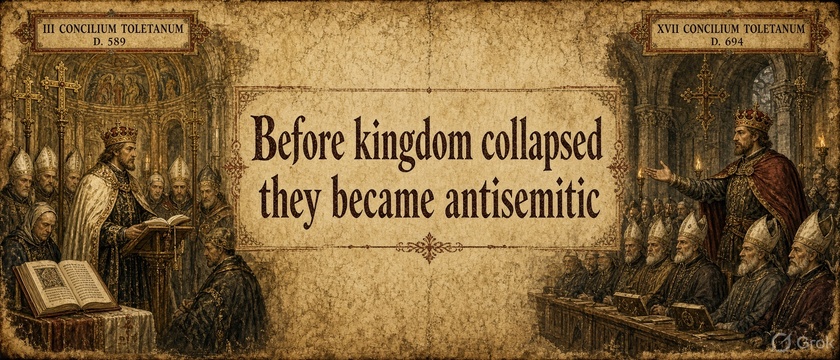
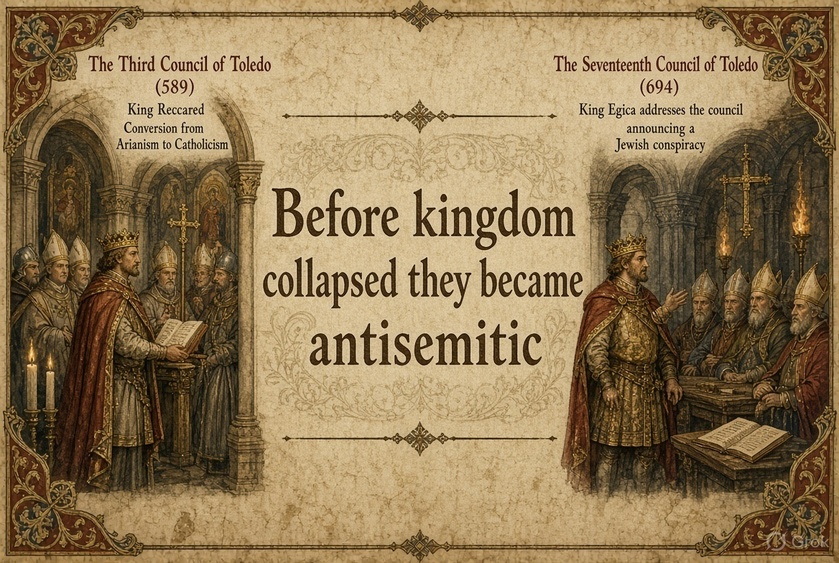
The Seventeenth Council of Toledo (9 November 694) was the climax of Visigothic anti-Jewish legislation under King Egica. It ordered the enslavement of virtually all Jews in the kingdom (except in Narbonensis/Septimania), confiscation of their property, and the removal of their children for Christian upbringing. Enforcement was uneven and short-lived because the Visigothic kingdom itself collapsed soon afterward.

Significant figures

  • Egica (Ergica; r. 687–c. 701/703): King of the Visigoths. Nephew of King Wamba and son-in-law of his predecessor Erwig (married to Cixilo/Cixilona). He ruled during a period of declining royal authority, noble conspiracies, and economic strain. He showed deep personal distrust of Jews and linked them to plots against the crown. He co-ruled with his son Wittiza toward the end of his reign and died in bed with the succession secured.
  • Erwig (r. 680–687): Immediate predecessor. He had already issued harsh anti-Jewish laws (baptism or expulsion within a year, restrictions on converts).
  • Earlier kings who shaped the policy: Reccared (converted from Arianism to Catholicism in 587/589), Sisebut (forced baptisms c. 615), Chintila, Recceswinth, and others. The pattern of escalating restrictions was well established by Egica’s time.
  • Metropolitan of Toledo and bishops: The council was an ecclesiastical body, but the king dominated the agenda. The 693 rebellion led by Bishop Sisebert of Toledo (in favor of a usurper named Suniefred) heightened Egica’s paranoia about conspiracies.

Before: The longer trajectory of Visigothic policy

The Visigoths were originally Arian Christians. King Reccared’s conversion and the Third Council of Toledo (589) made Catholicism the state religion and aligned the crown with the Catholic bishops. From that point, religious unity became a political goal.

Successive kings and councils issued anti-Jewish measures:

  • Forced or pressured conversion (Sisebut).
  • Requirements that already-baptized Jews remain Christian (Fourth Council of Toledo, 633).
  • Written professions of faith from “Judaizing” converts (under Recceswinth).
  • Erwig’s 681 laws demanding baptism of remaining Jews and their households within a year, plus severe restrictions on converts who relapsed.

By the 680s–690s the kingdom was weakening: noble revolts, fiscal problems, and external pressures. In 693 Egica faced a serious conspiracy centered on Bishop Sisebert. Around the same time he introduced stricter economic and religious controls on Jews (including new tax burdens and limits on trade with Christians). The Seventeenth Council marked the final escalation—from forced conversion to outright enslavement.

Egica opened the council by claiming he had learned of an international Jewish conspiracy: Jews in Hispania were allegedly coordinating with Jews under Muslim rule in North Africa to overthrow Christian rulers and destroy Christianity. The bishops endorsed the charge.

The council’s decisions (especially Canon 8)

The council issued eight canons. Most dealt with ecclesiastical discipline (fasting before synods, sealing baptismal fonts in Lent, restoring the washing of feet on Maundy Thursday, protecting church property, condemning Masses said to hasten someone’s death, ordering litanies for Church/king/people, and renewing laws protecting the royal family).

Canon 8 was the decisive anti-Jewish measure:

  • All Jews (except those in Narbonensis) were to be stripped of their property, which went to the crown or was given to their former Christian slaves.
  • They themselves were to be enslaved permanently and dispersed.
  • Masters (chosen by the king) were contractually bound to prevent any practice of Judaism.
  • Children reaching age seven were to be taken from their parents and raised as Christians, later married to Christians.
  • The measure targeted both open Jews and those who had been baptized but were accused of “staining” the faith by continued Jewish practice.

Other provisions protected Egica’s queen and children after his death and ordered prayers for them—reflecting the known dangers of Visigothic successions.

After: Limited enforcement and the end of the kingdom

Contemporary and later sources indicate that the decree was not uniformly enforced. In some areas it was applied; in others (especially where Jews were economically important) it was ignored or only partially carried out. By this stage Visigothic central authority was already eroding, so many local lords and towns simply did not implement it.

Egica died around 701–703. His son Wittiza succeeded him. The Visigothic kingdom collapsed in 711–714 under the Umayyad (Muslim) invasion led by Tariq ibn Ziyad and Musa ibn Nusayr. The rapid conquest was aided by internal divisions; some Visigothic nobles (including, according to tradition, a son of Egica named Oppas) cooperated with the invaders.

Under Muslim rule the remaining Jewish communities in Iberia generally fared better than they had under the late Visigoths. Many Jews who had fled earlier restrictions or who survived the enslavement order found greater religious and economic freedom under the new rulers (as dhimmis). The Seventeenth Council’s measures therefore marked the end of organized Jewish life under Visigothic Catholic rule rather than a permanent demographic catastrophe. The broader pattern of forced conversion and persecution in late Visigothic Spain is widely seen by historians as one factor that weakened social cohesion just before the Muslim conquest.

In short, the 694 council was the most extreme expression of a century-long Visigothic policy of religious homogenization. It was driven by Egica’s combination of personal hostility, fear of conspiracy, and desire for fiscal and political control, but it was only partially implemented before the kingdom itself disappeared.

= November 9th

These are the historical events traditionally listed for 9 November.

Here is a concise overview of the ones you listed, with context:

Early medieval and medieval

  • 694 – Seventeenth Council of Toledo: Visigothic King Egica of Hispania convened the council and accused the kingdom’s Jews of conspiring with Jews under Muslim rule in North Africa to overthrow Christian rulers. The council’s eighth canon ordered that virtually all Jews (except those in Narbonensis/Septimania) be enslaved, stripped of their property (which was to go to Christian slaves or the crown), and prevented from practicing Judaism. Children over age seven were to be taken and raised as Christians. Enforcement varied by region; this was one of the harshest in a long series of Visigothic anti-Jewish measures.
  • 1313 – Battle of Gammelsdorf: Louis IV (“the Bavarian,” later Holy Roman Emperor) defeated his cousin Frederick I of Austria (“the Fair”). The fight was mainly over guardianship of the underage dukes of Lower Bavaria and control of that rich territory. Fog helped Louis’s smaller force (including urban militias fighting on foot) win what was more a skirmish than a major battle. It secured Louis’s position in Bavaria and helped set the stage for his later contested election as king.
  • 1330 – Battle of Posada (9–12 November): Basarab I of Wallachia ambushed and decisively defeated a much larger Hungarian army under King Charles I Robert in a narrow mountain pass. The Hungarians suffered heavy losses; the king barely escaped in disguise. The victory effectively secured Wallachian independence from Hungarian overlordship (though the relationship remained contested later).
  • 1456 – Assassination of Ulrich II, Count of Celje: The last male ruler of the powerful County of Cilli (Celje) was killed in Belgrade, most likely by agents or partisans of the Hunyadi family. Ulrich had become de facto regent of Hungary after John Hunyadi’s death and was a major rival; his murder ended the Celje line and contributed to the political instability that soon led to Matthias Corvinus becoming king of Hungary.

Early modern

  • 1520 – Stockholm Bloodbath: After capturing Stockholm, Danish King Christian II (supported by Archbishop Gustav Trolle) had roughly 80–100 Swedish nobles, bishops, and others executed (mostly beheaded or hanged) on 8–10 November, ostensibly for heresy but largely for political opposition to the Kalmar Union. The massacre outraged Sweden, galvanized resistance under Gustav Vasa, and helped end the Kalmar Union and establish Swedish independence.
  • 1620 – Mayflower sights Cape Cod: After about two months at sea, the Mayflower (carrying the Separatist Pilgrims and others) sighted Cape Cod. They soon anchored, later signed the Mayflower Compact, and eventually founded Plymouth Colony. The late-season arrival contributed to the heavy mortality of the first winter.
  • 1688 – Glorious Revolution: William of Orange (who had landed at Torbay on 5 November) captured Exeter with little resistance as he advanced toward London. James II’s support collapsed rapidly; William and Mary soon became joint monarchs.
  • 1697 – Cervia: Pope Innocent XII founded (or re-founded/elevated) the city of Cervia in the Papal States, largely to address flooding and drainage problems in the area.
  • 1720 – Judah HeHasid synagogue: The synagogue and compound established in Jerusalem by Rabbi Judah HeHasid (Judah the Pious) and his group of Ashkenazi immigrants was burned by Arab creditors over unpaid debts and taxes. The site became known as the Hurva (“Ruin”). Ashkenazi Jews were effectively expelled from Jerusalem for roughly a century; many who remained disguised themselves as Sephardim. The synagogue was later rebuilt in the 19th century (and again after 1948).
  • 1729 – Treaty of Seville: Spain, France, and Great Britain ended the Anglo-Spanish War (1727–1729). Britain retained Gibraltar and Minorca; Spain received recognition of its claims in Italy and the return of some ships/goods.

Late 18th century

  • 1780 – Battle of Fishdam Ford (American Revolutionary War): South Carolina Patriot militia under Brigadier General Thomas Sumter repelled a surprise night attack by British regulars and Loyalists. The failure of the British/Loyalist raid was a minor but morale-boosting Patriot success in the South.
  • 1791 – Society of United Irishmen: Founded in Dublin by Theobald Wolfe Tone, Thomas Russell, and others. Initially a reformist group seeking parliamentary reform and Catholic emancipation, it later became more radical and republican, playing a central role in the 1798 Irish Rebellion.
  • 1799 – Coup of 18 Brumaire (9–10 November): Napoleon Bonaparte, with the help of his brother Lucien, Emmanuel Sieyès, and others, overthrew the French Directory. The Consulate was established with Napoleon as First Consul (effectively dictator). This ended the revolutionary Directory phase and began Napoleon’s rise to absolute power and eventual empire.

These span Visigothic religious persecution, medieval power struggles in Central and Southeastern Europe, the Swedish break from Denmark, the founding of English America, the Glorious Revolution, and the end of the French Revolutionary Directory. Several (Stockholm Bloodbath, Mayflower, 18 Brumaire, and the Council of Toledo) are especially well-known for their long-term consequences.

Read full Article
See More
Available on mobile and TV devices
google store google store app store app store
google store google store app tv store app tv store amazon store amazon store roku store roku store
Powered by Locals