Beginnings tend to define the shape of things to come.
That is why the first of these late-September dates still matters more than its calendar slot. On the tenth of Bagayādiš — 29 September 522 BC by the usual conversion — Darius, son of Hystaspes, killed a king. Everything after that in Achaemenid history depends on who that king was. We still do not know. The uncertainty is not a modern flourish. It is the original condition of the throne.
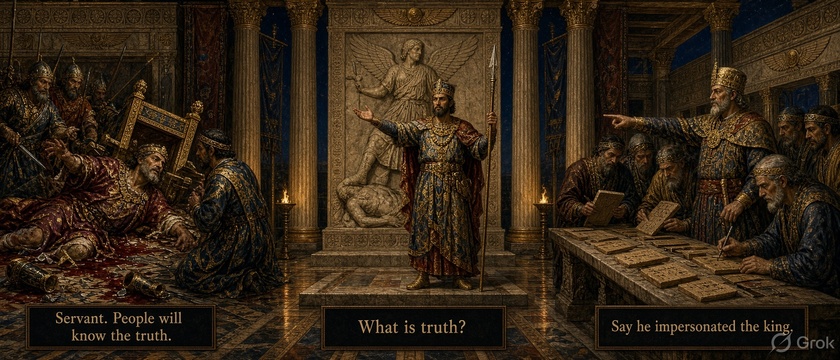
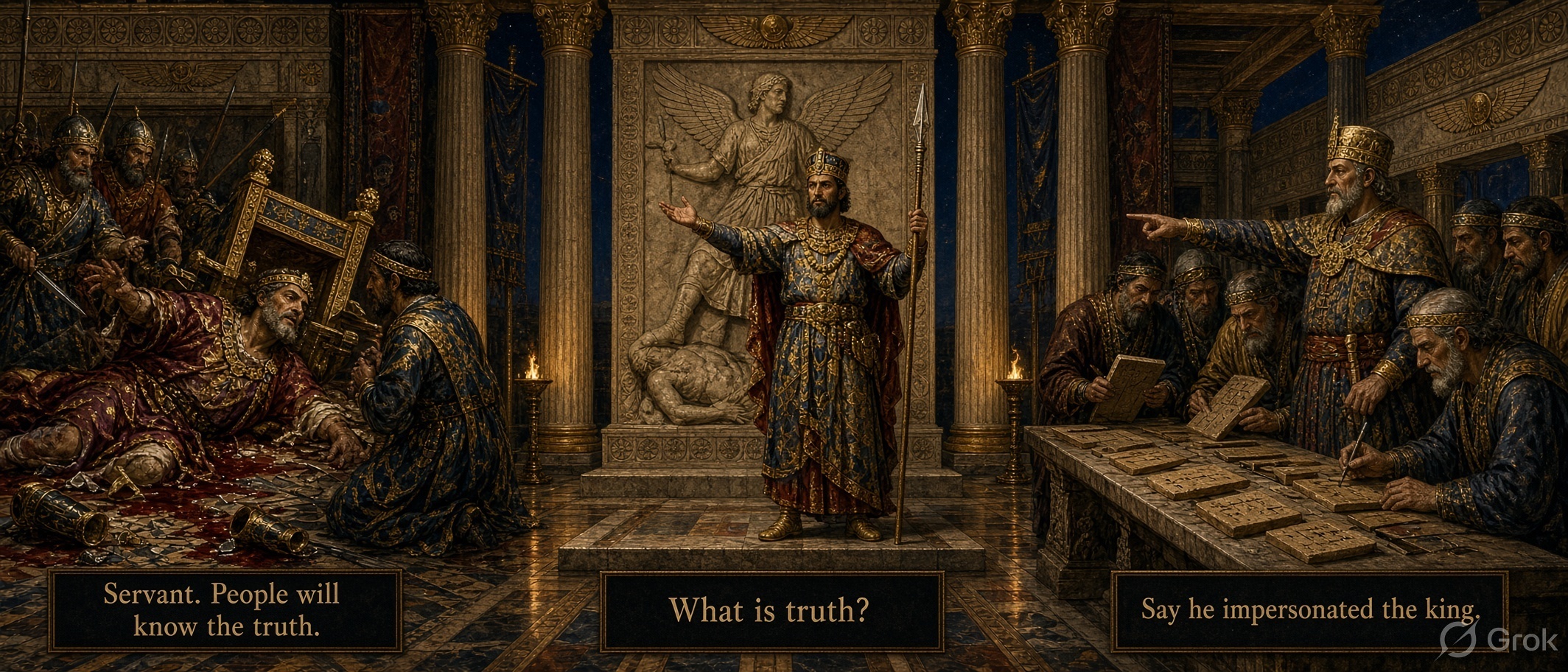
Darius’s own version is carved high on the rock at Behistun, in Old Persian, Elamite and Babylonian, where travellers on the road from Babylon to Ecbatana could see the relief even if they could not read the letters. Cambyses, he says, secretly murdered his brother Bardiya before leaving for Egypt. The murder was hidden. While the king was away, “the Lie” spread in Persia, Media and the other lands. A Magian named Gaumāta rose on 11 March 522 in a mountain country called Arakadriš, in Paishiyāuvādā, and told the people: “I am Bardiya, son of Cyrus, brother of Cambyses.” The empire went over to him. On 1 July he seized the kingship. Then Cambyses “died his own death” — five words that have been argued over since the nineteenth century. No one dared move against the Magian. He killed those who had known the real prince, so that the fraud would hold. Temples were wrecked; pastures, herds, households and domains were taken from the people. On 29 September, Darius says, he prayed to Ahuramazda, went with a few men to the fortress of Sikayauvatiš in the Median district of Nisaya, and slew Gaumāta and his chief followers. “I dispossessed him of the kingdom. By the grace of Ahuramazda I became king.” Then he restored what had been stolen and put the dynasty back on its foundation.
That is a complete political theology in a few paragraphs. The enemy is not merely a rival. He is drauga, the Lie. The new king is the agent of arta, Truth and right order. The killing is not a coup. It is a cosmic correction. The relief makes the claim visible: Darius stands over a prostrate figure labelled Gaumāta, the other rebels roped in a file before him. Captions name them. The rock does not invite discussion. It invites assent.
Herodotus, writing in the next century, tells a story that rhymes with Behistun and then adds the details a court chronicle would never carve. In his version the false Smerdis is a Magian, set up by a Magian brother, Patizeithes. The new king never leaves the citadel and never summons the great Persians. Otanes is the first to smell the fraud. His daughter Phaedyme is in the harem — inherited, as the royal women were, from Cambyses. She cannot even ask Atossa, Cyrus’s daughter, who the man is, because the king has separated the women. Otanes sends a third message: when he sleeps, feel for his ears. Cyrus, for some old offence, had cut the ears off this Magian. Phaedyme does it, at the risk of her life, and finds none. Seven nobles form the plot. Darius, arriving late, is the seventh. They storm the palace. Darius helps kill the pretender. Five days later the seven debate monarchy, oligarchy and a kind of equality; monarchy wins; they agree that the one whose horse neighs first at dawn shall be king; Darius’s groom arranges it.
Ctesias calls the impersonator Sphendadates. Justin uses Cometes. The names shift. The structure does not: a hidden death, a look-alike, a priestly or Median colour to the fraud, seven conspirators, Darius on top. The Greeks even remember a popular Smerdis, the one who remitted taxes and military service for three years, so that “all Asia except the Persians” missed him when he was gone. Darius remembers the opposite: a wrecker of temples and a thief of land. Both memories can be propaganda. Both can contain a sliver of a real policy. We cannot tell which.
The case against Darius is not a conspiracy theory invented on the internet. It is the majority instinct of a long line of modern specialists — Olmstead, Dandamaev, Briant and others — and it rests on awkward facts inside Darius’s own success. He was not Cyrus’s son. He was a collateral Achaemenid; his father Hystaspes was still alive and serving when the son took the crown. The man who sat on the throne in the summer of 522 was recognised in Babylonian business tablets as Barziya/Bardiya. Those tablets move from Cambyses to Bardiya without a civil-war gap. The great wave of revolts — Elam, Babylon, Media, Persia itself, Parthia, Margiana, Sagartia and the rest — explodes after Darius kills the sitting king, not during the quiet months of Bardiya’s recognised reign. A second Persian, Vahyazdāta, later rose in the homeland still claiming to be Bardiya, son of Cyrus, which is a strange thing to do if everyone already knew Bardiya had been unmasked as a Magian months before. Darius married Parmys, Bardiya’s daughter, a classic legitimising move. He never produced the corpse of the “real” Bardiya. He never staged a public unmasking that would have settled the identity beyond the rock. And the killing itself is placed at a Median fortress, not in a crowded palace where hundreds would have known the king’s face.
On that reading the deception is Darius’s, not Gaumāta’s. The sitting king was the son of Cyrus. A coalition of Persian nobles, with Darius as its sharpest member, murdered him because his policy — tax relief, interference with noble estates, a shift of weight toward Media, a threat to the men who had done well out of Cyrus’s conquests — could not be borne. The Magian story then does the work every usurper needs: it turns a dead legitimate prince into a fraud, and the assassins into restorers of the house. The Lie is relocated. The man who tells the official story becomes the champion of Truth.
The case for Darius is not foolish either. No surviving ancient author, Greek or otherwise, says in so many words that Darius killed the real Bardiya. The list of the Seven is almost the same in Behistun and in Herodotus. A secret fratricide by Cambyses is ugly, but Cambyses’s reputation in Egypt and in later memory could carry it. Imposture at the scale of an empire is rare; it is not impossible in a world without portraits in every house, where most subjects never saw the king, and where a prince could be kept off-stage for years. Magi were a Median priestly grouping in Greek memory; a Median restoration after Cyrus’s Persian conquest is a motive that does not require Darius to have invented the whole cast. Darius’s later insistence that lying voids divine favour is either sincere theology or the boldest kind of cover. Men have used both.
What cannot be disputed is the sequel, and the sequel is the editorial point. Whoever died at Sikayauvatiš, the empire did not accept the new reign as a restoration. Within weeks Elam and Babylon rose. Then Media, then Persia, then the east. Nine rebel “kings,” Darius says; nineteen battles; one year. Several of the rebels used the same weapon he had just used or just denounced: they put on a dead royal name. Nidintu-Bēl became Nebuchadnezzar. Vahyazdāta became Bardiya again. The Lie, once introduced as the explanation of a throne, proved contagious. Darius crushed them, mutilated the captives, and put their bodies into the same monument that justified the first killing. The administrative empire that follows — satrapies, roads, tribute, the king’s eye, the king’s inscribed Truth — is the shape of a beginning that had to be argued from a rock because it could not be taken for granted in the palaces.
That is why the deception still sits in the story. If Gaumāta was a fraud, the beginning is a warning about how easily a hidden murder and a borrowed face can take a world. If Bardiya was real, the beginning is a warning about how completely the winner can rename the dead. Either way the first act is the same: a small group of armed men, a fortress or a bedchamber, a body, and then a public sentence that turns the body into a principle. Empires are not only built with spears. They are built with the first authorised account of how the last man died.
We do not know which account is true. The tablets prove a king called Bardiya reigned. They do not prove whose blood he had. The Greeks prove that a story of ears and Magians travelled west. They do not prove the ears. The rock proves what Darius needed the world, and the gods, to believe. It does not prove he was believed in his own house on the night of the killing. Beginnings define the shape of things to come. This one defined an empire that would last two centuries, and a question that has already lasted twenty-five. The question is not an academic remainder. It is the price of a throne taken in the dark and explained in stone.