


VoiceDDB
Politics • Culture • News
oDDBall analysis of conservative politics with a libertarian economic conservative twist. Small government, big freedom.
Interested? Want to learn more about the community?
What else you may like…
Videos
Posts
Articles
00:01:07
November 27, 2022
Jingle Bell Rock

Jingle bell, jingle bell, jingle bell rock
Jingle bells swing and jingle bells ring
Snowin' and blowin' up bushels of fun
Now the jingle hop has begun

Jingle bell, jingle bell, jingle bell rock
Jingle bells chime in jingle bell time
Dancin' and prancin' in Jingle Bell Square
In the frosty air

What a bright time, it's the right time
To rock the night away
Jingle bell time is a swell time
To go glidin' in a one-horse sleigh

Giddy-up jingle horse, pick up your feet
Jingle around the clock
Mix and a-mingle in the jinglin' feet
That's the jingle bell rock

Jingle bell, jingle bell, jingle bell rock
Jingle bell chime in jingle bell time
Dancin' and prancin' in Jingle Bell Square
In the frosty air

What a bright time, it's the right time
To rock the night away
Jingle bell time is a swell time
To go glidin' in a one-horse sleigh

Giddy-up jingle horse, pick up your feet
Jingle around the clock
Mix and a-mingle in the jinglin' feet
That's the jingle bell
That's the jingle...

00:02:04
September 01, 2021
Intro to Locals for the Conservative Voice

David Daniel Ball calls himself the Conservative Voice.

I'm a teacher with three decades experience teaching math to high school kids.I also work with first graders and kids in between first grade and high school. I know the legends of why Hypatia's dad is remembered through his contribution to Math theory. And I know the legend of why followers of Godel had thought he had disproved God's existence.

I'm not a preacher, but I am a Christian who has written over 28 books all of which include some reference to my faith. Twelve blog books on world history and current affairs, detailing world events , births and marriages on each day of the year, organised by month. Twelve books on the background to and history of Bible Quotes. One Bible quote per day for a year. An intro to a science fiction series I'm planning, post apocalyptic cyber punk. An autobiography with short story collections.

I'm known in Australia for my failure as a whistleblower over the negligence death of a school boy. ...

00:01:50
September 04, 2026
Should violent criminals be made fat? Grok says 'no'

No. Transferring gut bacteria from an obese person into a violent criminal is not a reliable, ethical, or effective way to make them “fat, sedentary, and less of a physical threat.”

The science does not deliver the outcome you want

Mouse studies in germ-free animals showed that microbiota from obese donors can increase energy harvest and adiposity compared with lean-donor microbiota. That is the origin of the idea. Human evidence is far weaker.

Randomized trials of fecal microbiota transplant (FMT) from lean donors into people with obesity have generally failed to produce meaningful, sustained weight loss. Microbiome composition can change; body weight and metabolic markers often do not, or the effects are small and inconsistent. Diet and the existing gut environment usually dominate. A 2025 Nature paper found diet outperformed microbial transplant for microbiome recovery. Human guts are already colonized, not sterile like lab mice, so engraftment is variable and effects unpredictable.

It is not a ...

post photo preview
August 28, 2026
Pfizer struggles to answer

Some in Australia are brilliant. Malcolm Roberts Investigates Pfizer over Covid vaccine.

Holiday break is over back to work tonight

Tonight I'll start double posting until I've caught up.

post photo preview
Education evolution
October 14th

Education evolution

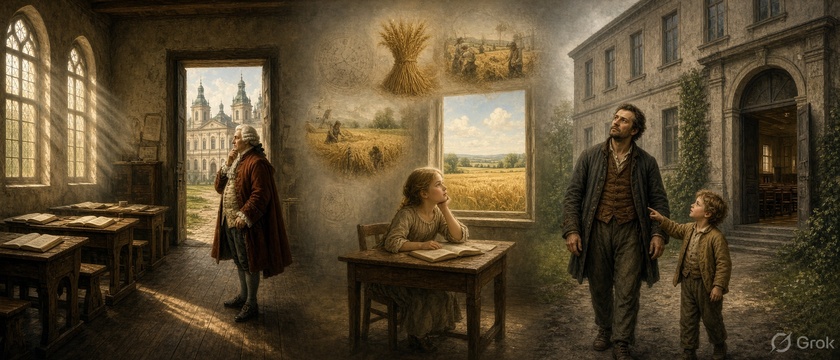
in the broad sense that early mass elementary schooling had to accommodate children’s labour, including harvest work. But the idea that the fixed long summer vacation was deliberately set “so children could help with the harvest” is only partly accurate, and is often described by historians as a partial myth.

What is true

In the era of the monitorial schools (Bell’s Madras system and Lancaster’s system, early 1800s) and the later expansion of elementary schools, children’s labour still mattered to many families. Parents pulled children out for chores, and rural schools regularly recorded high absences during harvest and gleaning. Victorian school log books from agricultural areas (e.g. Yorkshire and elsewhere) note very poor attendance after the summer break because children were still in the fields, and teachers sometimes closed early or accepted harvest-related absences. Local rural schools sometimes arranged short “harvest breaks” or simply expected lower numbers in late summer/early autumn.

This fits the practical reality of the period: schooling for the poor was still competing with the immediate economic value of children’s work. The window designs you mentioned earlier were one response to parents removing children during the school day; seasonal attendance patterns were another.

The nuance

By the time a standardised school calendar with a long summer holiday became fixed in England (mainly from the mid-to-late 19th century, with the Education Acts and the growth of state elementary schooling), the direct link to harvest labour was weaker than the popular story suggests:

  • English agriculture was already more mechanised; smallholdings had declined and adult labour plus machines handled much of the heavy work.
  • Planting is mainly spring and the main grain harvest is late summer into early autumn — not a perfect match for a long July–August break.
  • The pattern of a long summer holiday was already established in urban and public schools, influenced by middle-class holiday habits, the parliamentary/legal long vacation, heat in crowded cities, and the emerging professional identity of teachers.
  • Historians such as Jacob Middleton have argued that the “summer holiday for the harvest” explanation is largely a later myth; the standardised calendar was driven more by urban reformers, standardisation, and professional norms than by rural agricultural need. Rural schools often had more flexible or different term structures, and harvest absences persisted as a problem rather than being neatly solved by the summer break.

In short: early monitorial and elementary schools did have to live with the reality that many parents needed their children for farm and household work, including harvest. Local attendance and occasional closures reflected that. The fixed long summer vacation that became standard, however, was more a product of later 19th-century standardisation than a deliberate agricultural design. The popular harvest explanation has a grain of truth in rural practice but overstates the causal role.

=

that architectural detail is documented in the contemporary descriptions of the two systems, and it matches the practical problem of parents pulling children out of school for household or farm chores.

Both systems used large halls with sloping floors rising toward the far end, a raised platform (dais) at the lower end for the master’s desk so he could oversee the whole room, and fixed forms/desks. The goal was cheap mass instruction under one adult, with monitors handling most of the teaching. In the early 19th century, before widespread compulsory attendance laws, parents often tried to extract their children during the day. The window designs addressed this.

The Differences

  • Joseph Lancaster’s system (Lancasterian / British and Foreign School Society):
    Ideal classroom was a long parallelogram (length about twice the width). Windows were specified six feet from the floor (high). The floor rose one foot in twenty from the master’s platform at the lower end to the highest class at the upper end. Forms were fixed; passages along the walls allowed semicircles for reading. High windows made it harder for someone outside to reach in or for a child to climb out easily. Locks were typically at the bottom of the sashes.
  • Andrew Bell’s Madras system (adopted by the National Society / Church of England National Schools):
    Halls were rectangular, with windows five feet from the floor but designed to open at the top. Desks were often placed against the walls and the master’s desk was raised. Lower windows opening at the top allowed ventilation while still restricting easy access or exit; locks were at the top.

These specifications appear in the original manuals and later summaries (including descriptions that note Lancaster’s six-foot windows and the Madras-style five-foot windows opening at the top). The sloping floor and raised dais were shared features that let one master supervise hundreds of children arranged by attainment rather than age.

Context

This was an early form of large-scale elementary schooling for the poor, effectively pushing toward more regular attendance even before formal compulsion. The window arrangements were a practical response to parental resistance in an era when children’s labour still had immediate economic value to many families. Both systems later declined as trained adult teachers and the pupil-teacher system became standard, but the architectural solutions reflect the real social pressures of the time.

Cliff Turney’s observation (as former Dean of Education at the University of Sydney, who wrote extensively on the history of education) fits these documented design differences between the Lancaster and Bell/Madras models.

=

Andrew Bell’s Madras system was adopted by the main British (Anglican/National Society) elementary education system; Joseph Lancaster’s system was the one more readily used or adapted by Catholics (and Nonconformists).

Both methods were independent early-19th-century versions of the monitorial system (also called mutual instruction). Older or abler pupils (“monitors”) taught groups of younger children under one adult master. This made cheap mass elementary schooling possible. Andrew Bell (an Anglican chaplain) developed his version in the 1790s at the Military Male Orphan Asylum near Madras (Chennai), drawing on local Indian school practices; he published an account in 1797. Joseph Lancaster (a Quaker) developed a similar system around the same time in his free school in Borough Road, London, and published on it in 1803. The two initially acknowledged each other’s work, but rivalry soon became sharp, driven less by technical differences than by religion and church politics.

Who Adopted What

  • Madras / Bell system → British education under the Established Church.
    In 1811 the Church of England founded the National Society for Promoting the Education of the Poor in the Principles of the Established Church. It deliberately adopted Bell’s Madras system. These became the dominant “National Schools,” teaching Anglican doctrine and the Church Catechism. They formed the backbone of elementary provision for the poor in England and Wales for much of the 19th century and were the main vehicle for state-supported elementary education until later reforms. Bell himself worked closely with the Society.
  • Lancasterian system → British and Foreign School Society (non-sectarian) and, more broadly, groups outside the Established Church, including Catholics.
    Lancaster’s approach was non-denominational: Scripture was taught, but distinctive sectarian doctrines and catechisms were excluded so children of different persuasions could attend. It was supported by Nonconformists/Dissenters, Quakers, and liberal Anglicans through the British and Foreign School Society (BFSS). Contemporary accounts note that the monitorial methodology was taken up by the Roman Catholic Church in England and Wales. Catholics, being outside the Established Church, could not join National Society schools on equal terms and therefore found the more open Lancasterian model usable (or adaptable) for their own schools. In Ireland, Lancaster’s system was also received positively by some Catholic clergy and committees precisely because it was non-sectarian.

The two systems were pedagogically very similar (large halls, sand or slate writing, graded classes, monitors, strict order). Differences that mattered at the time were mainly religious control and the degree of formality. The rivalry between the National Society (Bell/Madras) and the BFSS (Lancaster) shaped English elementary education for decades and delayed a single state system. Both later gave way to trained adult teachers and the pupil-teacher system, but they left a lasting mark on mass schooling.

In short: Bell/Madras → Anglican National Schools (the main British elementary system of the period); Lancaster → non-sectarian/BFSS schools and Catholic adoption.

=

The Salesians of Don Bosco (SDB; formally the Society of St. Francis de Sales) are a Catholic religious congregation founded in the 19th century that specializes in the education and care of young people, especially the poor and disadvantaged. They are distinct from the Jesuits and have no direct connection to the 1773 Jesuit suppression or the Polish Commission of National Education.

Founding and Background

St. John Bosco (Don Bosco, 1815–1888), an Italian priest in Turin, began working with street boys, migrant youth, and child laborers during the Industrial Revolution. From 1841 he gathered them for catechism, Mass, recreation, and basic schooling in what became known as the Oratory of St. Francis de Sales (named for the gentle 17th-century bishop Francis de Sales). He developed the Preventive System—an educational approach based on reason, religion, and loving-kindness (rather than harsh punishment), aiming to prevent problems through relationships, accompaniment, and a family-like environment (often summarized as “home, school, church, and playground”).

In 1859, with a small group of collaborators, he formally established the Salesian Society to continue and expand this work. The constitutions were definitively approved by Pope Pius IX in 1874. With St. Mary Domenica Mazzarello he also founded the Salesian Sisters (Daughters of Mary Help of Christians, FMA) in 1872 for similar work among girls. Lay Salesian Cooperators form a third branch of the Salesian Family.

Education and Mission

Education of youth is the core apostolate. Salesians run:

  • Oratories and youth centers
  • Primary and secondary schools
  • Technical/vocational schools and workshops
  • Universities and higher institutions (including the Salesian Pontifical University)
  • Parishes, hostels, and social services focused on the young

They emphasize holistic formation: academic learning plus character, faith, practical skills, and preparation for work and citizenship. The approach prioritizes the poor and at-risk. By the time of Don Bosco’s death the congregation was already active in several European countries and South America; it has since expanded globally.

Today the Salesians (male and female branches together with cooperators) operate thousands of schools and youth centers across more than 130 countries and educate well over a million young people. In recent years they have ranked among the very largest male religious institutes in the Catholic Church by membership—closely behind or nearly level with the Jesuits (roughly 13,600–13,800 Salesians versus ~13,700–13,800 Jesuits in recent Annuario Pontificio figures).

Relation to the Earlier Discussion

The Salesians post-date the 1773 Jesuit suppression and restoration (1814) by decades. They did not fill the institutional vacuum left by the Jesuits in places like the Polish–Lithuanian Commonwealth; that role was taken by the state Commission of National Education and other bodies. Instead, the Salesians represent a later, specialized response to the social and educational needs of the industrial era, parallel to (but different in style and focus from) the Jesuits’ broader intellectual, missionary, and elite educational tradition.

Don Bosco was canonized in 1934; his feast day is 31 January. The Salesian Family continues his emphasis on youth ministry as its defining charism.

=

The Society of Jesus (Jesuits) was suppressed by papal order in 1773 and restored in 1814; it has existed continuously as a recognized Catholic religious order since then.

The Suppression of 1773

By the mid-18th century the Jesuits (founded 1540 by St. Ignatius of Loyola and approved by Pope Paul III) were one of the largest and most influential orders in the Catholic Church. They ran extensive educational networks, missions (especially in the Americas and Asia), and were closely identified with the papacy and Counter-Reformation orthodoxy. This made them powerful—and controversial.

Catholic monarchs of the Bourbon and other courts grew hostile for a mix of political, economic, and ideological reasons:

  • Accusations of meddling in politics, excessive privileges, and resistance to royal control (regalism / Erastianism).
  • Enlightenment and Gallican/Jansenist currents that viewed the order as obscurantist or too independent.
  • Practical motives: seizing Jesuit properties and reducing a rival power center.
  • Specific incidents and propaganda in Portugal (under the Marquis of Pombal), France, Spain, and the Two Sicilies.

Portugal expelled the Jesuits in 1759; France suppressed them in the 1760s; Spain and Naples followed in 1767. These governments then pressed the papacy for universal abolition. Pope Clement XIII resisted, but his successor Clement XIV (elected 1769), under sustained diplomatic pressure and threats of schism or further territorial losses, issued the brief Dominus ac Redemptor on 21 July 1773. It suppressed the Society worldwide, dissolved its houses, colleges, and administration, and released members from their vows. The stated motive was restoring peace to the Church by removing a source of contention; the brief did not formally condemn the order’s doctrine or morals.

What Happened During the Suppression (1773–1814)

The order did not disappear completely. Most former Jesuits became diocesan priests or joined other orders; some continued educational or scholarly work as individuals. Crucially, the suppression was never fully enforced in the Russian Empire (where Catherine the Great protected the Jesuits in the former Polish territories that Russia had annexed). A small remnant survived and even grew there, preserving the corporate structure and traditions. Limited presence continued in Prussia for a time and in some Protestant areas.

Restoration in 1814

After the French Revolution and Napoleonic Wars, the political climate changed. The monarchs who had demanded suppression were gone or weakened, and the Church was seen by many as a stabilizing force. Pope Pius VII, restored to Rome after Napoleon’s fall, issued the bull Sollicitudo omnium ecclesiarum on 7 August 1814, restoring the Society of Jesus worldwide. The restored order retained its pre-1773 constitutions and quickly resumed education, missions, and other works.

Why Jesuits Exist Today

The 1814 restoration was permanent. The Society has operated continuously since then under successive Superior Generals, with papal approval. It remains the largest male religious order in the Catholic Church in terms of historical influence and global reach (education, spirituality, social ministry, etc.), though membership has declined significantly from a mid-20th-century peak of roughly 36,000 (around 1965) to roughly 13,000–14,000 in recent years.

In short: the 1773 suppression was a political and administrative act by the papacy under heavy external pressure, not a doctrinal condemnation. It was reversed 41 years later, and the order has continued ever since. The Polish–Lithuanian Commission of National Education of 1773 (discussed earlier) was one local consequence of the Jesuit dissolution, as it took over many of their schools and properties.

=

The Commission of National Education (Komisja Edukacji Narodowej, KEN) was established on 14 October 1773 by the Sejm (parliament) of the Polish–Lithuanian Commonwealth during the Partition Sejm. It is widely regarded as the first modern, centralized, state-controlled ministry of education in Europe—an autonomous collegial body with ministerial status, responsible solely to the king and Sejm for education policy and finances.

Background

By the mid-18th century, education in the Commonwealth was dominated by the Jesuits, who ran the majority of secondary schools (roughly two-thirds of lower and middle schools). The Piarists, reformed earlier under Stanisław Konarski, offered a higher-quality alternative in some places, but the overall system was fragmented, heavily Latin-based, and uneven. The First Partition of 1772 had already weakened the state. Then, on 21 July 1773, Pope Clement XIV suppressed the Jesuit order (bull Dominus ac Redemptor). This created an immediate crisis: dozens of schools and substantial Jesuit properties risked collapse or transfer solely to the secular clergy.

King Stanisław II August Poniatowski and reform-minded figures saw an opportunity. During the Partition Sejm (which ratified the First Partition), they secured creation of a state body to nationalize the post-Jesuit estates and schools and to reform education as part of a broader effort to strengthen the Commonwealth through Enlightenment ideas—physiocracy, civic virtue, practical knowledge, and patriotism. The commission was one of the “Grand Commissions” established at the time; it received control of Jesuit properties (schools, estates, and villages), creating a dedicated educational fund. Its formal full name was initially Komisja nad Edukacją Młodzi Szlacheckiej Dozór Mająca (Commission Having Supervision over the Education of the Nation’s Young Nobles), though it quickly aimed more broadly.

History and Reforms (1773–1794)

The KEN operated for about 21 years with varying intensity. Its early formative phase focused on organization and control of the fund. In 1775 it established the Society for Elementary Books (Towarzystwo do Ksiąg Elementarnych), chaired by Ignacy Potocki with Grzegorz Piramowicz as secretary, to produce modern Polish-language textbooks and curricula.

Key structural and curricular changes included:

  • A three-tier system: parish (elementary) schools for broader social access (including some peasants and burghers), district/powiat (secondary) schools, and the two universities (“Chief Schools”) in Kraków and Vilnius as supervisory centers.
  • Polish as the primary language of instruction (replacing Latin), plus emphasis on natural sciences, mathematics, history, law, moral education, and civic patriotism.
  • Teacher training seminaries and the professionalization of teaching (the “academic estate”).
  • Textbooks that standardized Polish scientific terminology in mathematics, physics, chemistry, grammar, and other fields (dozens were produced; print runs were substantial).
  • Greater accessibility, including limited opening of education to girls and non-nobles.

Hugo Kołłątaj (a priest and key intellectual architect, though not always a formal commissioner) developed the three-level plan and, as the commission’s visitor, reformed the Kraków Academy (Jagiellonian University) in 1777–1780—introducing Polish, natural sciences, new chairs, and wider access—before serving as its rector (1783–1786). Vilnius University was similarly reorganized. The commission issued comprehensive school laws (culminating in the 1783 statutes), the first European code of its kind covering administration, pedagogy, and organization.

It took over the Załuski Library (making it effectively the first public library under state care, with Potocki involved). Despite financial mismanagement by early leaders and political resistance, the KEN largely succeeded in modernizing education within the constraints of a declining state.

Significant Figures

  • King Stanisław II August Poniatowski: Political patron and initiator; the commission operated under his protection.
  • Hugo Kołłątaj (1750–1812): Main intellectual and organizational force behind the educational vision and the Kraków university reform; later a major political reformer linked to the Constitution of 3 May.
  • Ignacy Potocki (1750–1809): Long-serving commissioner; initiator and chairman of the Society for Elementary Books; involved in curriculum, the Załuski Library, and broader Enlightenment politics.
  • Adam Kazimierz Czartoryski: Commissioner and influential Enlightenment supporter.
  • Michał Jerzy Poniatowski (king’s brother, later Primate): President from 1776 after the removal of the first president.
  • Ignacy Massalski (Bishop of Vilnius): First president (1773–1776); later criticized for financial abuses and associated with the anti-reform Targowica Confederation.
  • Others: Joachim Chreptowicz, Andrzej Zamoyski, August Sułkowski, Antoni Poniński; collaborators included Grzegorz Piramowicz, Hieronim Stroynowski, and textbook authors such as Onufry Kopczyński (grammar) and Jędrzej Śniadecki (chemistry).

Aftermath and Legacy

The KEN was weakened by the Targowica Confederation (1792–1793) after the Constitution of 3 May and the Second Partition; many reformers (including Kołłątaj) faced exile or worse. It was effectively ended by the Third Partition of 1795, which extinguished the Commonwealth. Its schools and ideas did not vanish: textbooks and methods continued under the partitions; trained teachers and graduates formed a patriotic, Enlightenment-influenced elite that shaped 19th-century Polish uprisings, science, and culture. Polish language and national consciousness were reinforced precisely when foreign powers pursued Russification and Germanization. Some later Russian reforms drew on KEN ideas via figures such as Czartoryski and Potocki.

In modern Poland, 14 October is observed as Teachers’ Day / National Education Day, deliberately commemorating the KEN. Historians rank it alongside the Constitution of 3 May as one of the outstanding achievements of the Polish Enlightenment—an attempt to renew the state through education that outlasted the state itself.

=

October 14 marks several notable historical events across centuries, from the Norman Conquest to Enlightenment reforms and colonial tensions. Here is a concise account of the ones you listed, with key context and some clarifications based on the historical record.

1066 – Battle of Hastings

On October 14, 1066, Norman forces under William, Duke of Normandy (later William the Conqueror), defeated the English army of King Harold II (Harold Godwinson) at Senlac Hill (near modern Battle, East Sussex), roughly seven miles from Hastings. Harold, who had only recently defeated a Norwegian invasion at Stamford Bridge, was killed in the battle (traditionally by an arrow to the eye, though contemporary accounts vary). His brothers Gyrth and Leofwine also died. The victory opened the way for the Norman Conquest; William was crowned King of England on Christmas Day 1066. The Bayeux Tapestry is the best-known visual record of the campaign and battle.

1322 – Battle of Old Byland (Byland)

Robert the Bruce (King Robert I of Scotland) defeated an English force under King Edward II at Old Byland (near Sutton Bank in the Hambleton Hills, Yorkshire) on October 14, 1322. This was part of the First War of Scottish Independence and followed Edward’s failed invasion of Scotland earlier that year. Scottish forces under Bruce, with commanders including James Douglas and Thomas Randolph, outmaneuvered and routed the English (commanded on the field by the Earl of Richmond). Edward II himself narrowly escaped capture while at Rievaulx or Byland Abbey, abandoning personal possessions. The victory was a major Scottish success after Bannockburn and humiliated Edward deep inside England. It contributed to pressure for a truce (agreed in 1323); formal recognition of Scottish independence came later in the Treaty of Edinburgh-Northampton (1328) under Edward III, after Edward II’s deposition.

1582 – Gregorian calendar reform

In the Catholic countries that first adopted the Gregorian calendar (Italy/Papal States, Spain, Portugal, and Poland), October 4, 1582, was followed immediately by October 15. Ten days (October 5–14) were skipped to correct the accumulated drift of the Julian calendar relative to the solar year. Thus, October 14, 1582, simply did not exist in those places. The reform was ordered by Pope Gregory XIII in the bull Inter gravissimas to realign the calendar with the equinoxes (important for calculating Easter). Protestant and Orthodox countries adopted it later—Britain and its colonies not until 1752.

1586 – Trial of Mary, Queen of Scots

Mary, Queen of Scots, went on trial on October 14, 1586, at Fotheringhay Castle in Northamptonshire before a commission appointed by Elizabeth I. She was charged with complicity in the Babington Plot to assassinate Elizabeth and place Mary on the English throne. Mary denied the court’s jurisdiction and argued her responses did not prove intent to kill Elizabeth, but she was found guilty on October 25. Parliament pressed for her execution; after months of hesitation, Elizabeth signed the warrant, and Mary was beheaded at Fotheringhay on February 8, 1587.

1656 – Massachusetts anti-Quaker legislation

On October 14, 1656, the General Court of the Massachusetts Bay Colony enacted the first punitive law specifically targeting the Religious Society of Friends (Quakers). It described them as a “cursed sect of heretics,” imposed heavy fines on ship captains who brought them into the colony, ordered arriving Quakers whipped and confined, and penalized anyone who harbored them, imported their writings, or defended their views. The Puritans viewed Quaker beliefs (inner light, rejection of formal clergy and oaths, egalitarianism) as both spiritually apostate and a threat to the theocratic social order. Enforcement escalated in subsequent years, including banishment and executions (notably Mary Dyer in 1660), until royal pressure and changing attitudes moderated the policy.

1758 – Battle of Hochkirch

During the Seven Years’ War (Third Silesian War), Austrian forces under Field Marshal Leopold von Daun surprised and defeated Frederick the Great’s Prussian army at Hochkirch in Saxony on October 14, 1758. Frederick had camped in a vulnerable position and underestimated the usually cautious Daun. A pre-dawn Austrian assault (roughly 80,000 Austrians against 30,000–36,000 Prussians) overwhelmed the Prussians. Frederick lost about 9,400 men (over 30% of his force), five generals (including his brother-in-law), 101 guns, and much of his camp, but managed to withdraw in good order. The battle is often cited as one of Frederick’s greatest tactical blunders, though his ability to recover afterward was characteristic.

1773 – Commission of National Education (Poland–Lithuania)

On October 14, 1773, the Sejm of the Polish–Lithuanian Commonwealth created the Commission of National Education (Komisja Edukacji Narodowej). Prompted by Pope Clement XIV’s dissolution of the Jesuit order (which had run most schools), the commission took over Jesuit properties and established a centralized, secular educational system—widely regarded as the first modern ministry of education in Europe. Key figures included Hugo Kołłątaj, Ignacy Potocki, and Adam Kazimierz Czartoryski; King Stanisław II August supported it. It reformed curricula (emphasizing Polish language, sciences, and civic education), supervised universities and hundreds of schools, and produced textbooks. It is viewed as a major achievement of the Polish Enlightenment.

1773/1774 – Annapolis tea incident (note on the date)

The entry you quoted appears in some “On This Day” compilations under 1773, but the well-documented Annapolis Tea Party occurred in 1774. The brig Peggy Stewart arrived in Annapolis on October 14, 1774, carrying tea (about 2,320 pounds) plus indentured servants. Owner Anthony Stewart paid the Townshend duty to clear the cargo. Local patriots, enforcing non-importation sentiments, forced Stewart and associates to burn the tea and, on October 19, the ship itself at Windmill Point. This was a deliberate, public act of protest analogous to (and following) the Boston Tea Party of December 16, 1773. No major burning of multiple East India Company tea ships at Annapolis is recorded for October 14, 1773.

These events range from decisive military turning points (Hastings, Byland, Hochkirch) to institutional and religious conflicts and a calendar reform that literally erased the day in parts of Europe. Let me know if you’d like more detail on any of them, related primary sources, or other October 14 events.

Read full Article
October 11, 2026
post photo preview
Seeing and Understanding
Anti Semitism

Seeing and Understanding

Anti Semitism

The analogy between the evolving understanding of the Whirlpool Galaxy and the question of whether we merely “see” antisemitism or actually understand it is a useful one. Superficial recognition of an object or a phenomenon is not the same as grasping its nature, scale, causes, or implications. Labels and pictures can create the feeling of knowledge without supplying the evidence or context that turns observation into comprehension.

A small correction on the astronomy side first: Lord Rosse’s key observations of the spiral structure in M51 were made in 1845 with his 72-inch Leviathan, not 1885. Copernicus’s heliocentric model placed the Sun at the center of the solar system; it did not imply that distant nebulae were local objects within that system. The real barrier for a long time was the lack of reliable distance measurements. Once those became possible, the “smudge” Messier catalogued to help comet hunters was revealed as a massive interacting galaxy tens of millions of light-years away. The same pattern—initial detection, refined observation, measurement of scale, and revision of earlier assumptions—appears in many areas of knowledge.

Applied to antisemitism, the distinction between seeing and understanding is real. Documented data show a sharp rise in antisemitic incidents in Australia after the 7 October 2023 Hamas attacks. Reports from sources tracking these incidents (including Australian Jewish community monitoring and international assessments) record increases on the order of several hundred percent in subsequent periods, with examples ranging from graffiti glorifying the attacks, campus harassment, synagogue attacks, and public demonstrations that included explicit eliminationist rhetoric. Elements of progressive activism, certain university environments, and Islamist currents have been repeatedly identified as major drivers of this surge, often blending anti-Zionism with older antisemitic tropes (collective guilt of Jews, dual loyalty, or blood libels updated into “genocide” accusations that ignore Hamas’s stated aims and tactics). Antisemitism has historical expressions on the right as well, including conspiracy theories about Jewish power; those have not disappeared. Recent patterns in Australia, however, have been dominated by the post-October 7 climate on parts of the left and in associated protest movements.

Your reference to the Claire Harvey interview with Greg Sheridan for The Australian fits the public record of Sheridan’s commentary. He has consistently condemned the rise in antisemitism, linked it to left-wing ideology that frames Israel as a colonial oppressor and Jews as accomplices, and criticised Australian government responses he sees as insufficient. At the same time, he has offered specific criticisms of Benjamin Netanyahu—on diplomatic style toward allies, certain aspects of the Gaza campaign’s human and political costs, or internal Israeli politics—while also describing Netanyahu as a formidable leader who has degraded Iranian proxy networks. Criticism of a particular Israeli government’s decisions, coalition, or conduct of war is not inherently antisemitic. The risk you note is real: when such criticism is asserted without concrete examples, evidence, or comparative context (Hamas’s charter and actions, the use of civilian infrastructure, the rejection of prior peace offers, or the treatment of other conflicts), it can function as an unearned opinion that aligns with, or is exploited by, those who do hold antisemitic views. Demanding supporting detail is a reasonable standard for any strong claim, whether about Netanyahu, Hamas, or anyone else.

Understanding antisemitism requires more than registering that hostility exists. It involves the historical continuity of certain motifs (deicide charges evolving into economic or racial conspiracy theories, then into anti-Zionist forms that uniquely deny Jewish self-determination), the ideological frameworks that currently amplify them, the difference between policy disagreement and collective demonisation, and the measurable outcomes for Jewish communities. A labeled photograph of the Whirlpool Galaxy lets someone recognise the object; measuring its distance, mapping its interaction with NGC 5195, and placing it in the broader structure of galaxies produces understanding. The same demand for evidence and context applies here.

=

Here is a broad, simple overview of how ideas about the universe have changed from ancient times to today. The story is one of expanding scale, better tools, and a gradual shift from Earth-centered stories to a vast, evolving cosmos.

Ancient ideas (before ~500 BC to the Middle Ages)

Most early cultures pictured a relatively small, ordered world with Earth at or near the center. The sky was often seen as a dome, a solid vault, or a series of layers. Stars were fixed lights or holes in a celestial sphere. Planets (the “wanderers”) moved among them.

The Greeks systematized this. Aristotle (4th century BC) argued for a stationary, spherical Earth at the center of nested crystal spheres that carried the Moon, Sun, planets, and stars. Motion was perfect and circular; the heavens were unchanging and made of a special substance different from earthly matter. Ptolemy (2nd century AD) refined this into a working mathematical model that predicted planetary positions reasonably well using circles upon circles (epicycles). This geocentric (Earth-centered) picture dominated Western and Islamic thought for well over a thousand years. It matched everyday experience—the ground feels solid and unmoving, and the sky appears to turn around us—and it fitted with many religious views of a special place for humanity.

The Scientific Revolution (16th–17th centuries)

The big shift began when the old model became awkward for precise predictions. Nicolaus Copernicus (1543) proposed that the Sun sits at the center and the Earth is one of several planets orbiting it. This heliocentric idea was simpler in some ways but initially faced strong resistance.

Johannes Kepler showed that planetary orbits are ellipses, not perfect circles, and found mathematical rules describing their speeds. Galileo Galilei used the newly invented telescope to see mountains on the Moon, moons orbiting Jupiter, and phases of Venus—observations that supported the idea that Earth is not the unique center. Isaac Newton then supplied the unifying explanation: the same force of gravity that makes an apple fall also keeps the Moon and planets in orbit. Heaven and Earth were governed by the same laws. The universe was still relatively small by later standards, but it was now a physical system that could be studied with mathematics and observation rather than pure philosophy or authority.

Expanding horizons (18th–19th centuries)

Better telescopes and systematic catalogs (such as Messier’s) revealed many faint “nebulae.” Some thinkers, including Immanuel Kant in the 1750s, suggested these might be distant “island universes” like the Milky Way. Most astronomers treated them as local gas clouds or star clusters within our own system. Spectroscopy (analyzing starlight) showed that the Sun and stars are made of the same elements found on Earth. The scale of the universe kept growing as distances to nearby stars were measured by parallax. The discovery of spiral structure in objects like the Whirlpool Galaxy (M51) in the 1840s raised new questions, but distances remained uncertain, so the debate about whether spirals were nearby or far away continued.

The modern cosmic picture (20th century onward)

Albert Einstein’s general relativity (1915) described gravity as the curvature of space and time rather than a force acting at a distance. This opened the door to models of the universe as a whole. Observations by Vesto Slipher and then Edwin Hubble in the 1920s showed that distant galaxies are moving away from us, and the farther they are, the faster they recede. The universe is expanding. Running this expansion backward implied a hot, dense beginning—what became known as the Big Bang.

Key supporting evidence arrived later: the cosmic microwave background (the faint leftover heat from the early universe, discovered in the 1960s) and the observed abundances of light elements. In the late 20th and early 21st centuries, further surprises appeared. Most of the matter in the universe is invisible “dark matter,” detectable only through its gravitational effects. Even more of the energy budget is “dark energy,” which is causing the expansion to accelerate. The current standard picture is of a universe that began about 13.8 billion years ago in a hot, dense state, has since expanded and cooled, contains hundreds of billions of galaxies, and is dominated by dark matter and dark energy whose nature is still not fully understood.

The overall pattern

The main trend has been a repeated demotion of Earth’s special status: from the center of everything, to one planet among others, to one star system among many, to one galaxy among billions in an expanding cosmos with no unique center. At the same time, the tools improved—from naked-eye observations and geometry, to telescopes and mathematics, to spectroscopy, relativity, and multi-wavelength observatories. Each stage replaced earlier ideas not because the older ones were foolish, but because new evidence and better explanations accounted for more of what was seen. Many questions remain open, especially about dark matter, dark energy, and the earliest moments, so the story is still unfolding.

=

The Whirlpool Galaxy (M51 / NGC 5194) is one of the most famous objects in the night sky and a landmark in the history of how we came to understand that the universe is full of galaxies far beyond our own.

What was known before 1773

By the early 18th century, telescopes had revealed a number of diffuse, cloud-like objects that did not behave like stars or planets. The Orion Nebula had been noted as early as 1610 (Peiresc) and better described by Huygens in 1656. These were simply called “nebulae” (from the Latin for mist or cloud).

Comet hunters were the people most likely to stumble across them. A fuzzy, non-moving patch could easily be mistaken for a new comet at first glance. Charles Messier, a French comet searcher, began cataloguing these fixed “nebulae and star clusters” specifically so that he and others would not waste time on them while hunting comets. His catalogue (published in stages, final version 1781) contained what we now know are a mixture of true gas nebulae, star clusters, and what would later be recognised as galaxies.

Philosophically, the idea that some of these objects might be distant “island universes” comparable to the Milky Way had already been floated. Immanuel Kant, in his 1755 Universal Natural History and Theory of the Heavens, suggested that the nebulae might be other Milky Ways seen from afar. Most astronomers, however, still treated them as local objects within or associated with our own system. There was no reliable way to measure their distances, and spectra and resolved stars were still decades away.

Messier’s discovery (13 October 1773)

On the night of 13 October 1773, while tracking a comet, Messier noticed a faint, fixed nebulous object in the constellation Canes Venatici (the Hunting Dogs), near the end of the handle of the Big Dipper. He recorded it as a “very faint nebula without any stars” that was difficult to see with an ordinary 3.5-foot telescope. It became entry 51 in his catalogue.

In 1781 his colleague Pierre Méchain noticed that the object was double—two bright centres separated by about 4½ arcminutes, with their nebulous “atmospheres” touching. Messier included this information. The companion is what we now call NGC 5195. Messier himself never resolved any spiral structure; his instruments simply were not powerful enough.

The first spiral: Lord Rosse, 1845

The decisive observational leap came with William Parsons, 3rd Earl of Rosse, and his enormous 72-inch (1.8 m) reflecting telescope at Birr Castle in Ireland—the “Leviathan of Parsonstown,” the largest telescope in the world for decades. In the spring of 1845 (probably April; the exact night is not perfectly documented), Rosse examined M51 and saw a clear pinwheel or spiral arrangement. It was the first object in which spiral structure was recognised.

Rosse’s careful drawings of the object (often called the “Question Mark” because of the shape of the arms plus the companion) are remarkably accurate when compared with modern photographs. He and others soon found more “spiral nebulae.” At the time these were widely interpreted as possible solar systems in the process of forming—clouds of gas collapsing into stars and planets—rather than as vast systems of stars themselves. The true nature remained open because distances were still unknown.

The Great Debate and the resolution

Through the later 19th and early 20th centuries the spiral nebulae became central to a larger controversy about the scale of the universe. Were they relatively nearby gas clouds or star systems inside (or on the edge of) the Milky Way, or were they independent galaxies millions of light-years away?

This reached a formal public airing in the 1920 Shapley–Curtis Debate (“The Scale of the Universe”). Harlow Shapley argued for a large Milky Way that essentially constituted the universe, with the spirals as local nebulous objects. Heber Curtis argued that they were separate “island universes.” Neither side had conclusive distance measurements at the time.

The breakthrough came in 1923–24 when Edwin Hubble, using the 100-inch Hooker telescope at Mount Wilson, identified Cepheid variable stars in the Andromeda “nebula” (M31). Because the period of a Cepheid reveals its true luminosity, Hubble could calculate a distance far greater than the accepted size of the Milky Way. Andromeda, and by extension the other spiral nebulae, had to be separate galaxies. The universe suddenly became vastly larger. (Hubble’s distance to Andromeda was later revised upward, but the qualitative conclusion was secure.)

Modern understanding of the Whirlpool

Today M51 is known to be a classic grand-design spiral galaxy (roughly SA(s)bc) interacting with its smaller companion NGC 5195. The pair lies in Canes Venatici at a distance of roughly 23–31 million light-years (recent Cepheid and supernova work favours values around 24–25 million light-years / ~7.5 Mpc). The main galaxy is about 75,000–80,000 light-years across—comparable in size to the Milky Way, though somewhat smaller.

The beautiful, well-defined spiral arms are not a permanent feature of an isolated galaxy; they are strongly shaped by the gravitational interaction with NGC 5195. Simulations and observations indicate the companion has passed through or near the disk of M51 at least once (and probably more than once) in the last 500–600 million years. These encounters compress gas, trigger bursts of star formation (visible as bright blue knots and pink H II regions along the arms), and help organise the spiral density waves. Radio and infrared observations clearly show that the two galaxies are physically connected by tidal bridges of gas and stars.

M51 also hosts a Seyfert 2 active galactic nucleus—a supermassive black hole that is accreting material and producing high-energy emission. It is one of the nearest and best-studied examples of a galaxy interaction, and it remains a favourite target for both amateur observers (visible in binoculars under dark skies; spiral structure suggested in larger telescopes) and professional instruments from Hubble to the James Webb Space Telescope.

In short: Messier found a faint smudge while comet-hunting; Rosse revealed it was a spiral; Hubble and later astronomers showed that spirals are galaxies in their own right; and modern multi-wavelength studies have revealed the dynamical dance with its companion that produces the iconic whirlpool appearance we see today.

=

October 13 is a busy day in the historical calendar, spanning Roman succession intrigue, medieval power plays, astronomical discovery, the birth of American institutions, and more. Here is a concise tour of the events you listed, with context.

AD 54: Claudius dies; Nero succeeds

Roman emperor Claudius died suddenly on 13 October 54 at age 63. Ancient sources (Tacitus, Suetonius, Cassius Dio) widely claim he was poisoned—most often blamed on his wife Agrippina the Younger, who favored her son Nero over Claudius’s own son Britannicus. A poisoned mushroom is the traditional detail. Nero (then 16–17) was proclaimed emperor the same day with the backing of the Praetorian Guard and Senate; he was guided early on by Agrippina, Seneca, and Burrus. The Julio-Claudian dynasty would end with Nero’s suicide in 68.

409: Vandals, Alans (and Suebi) enter Hispania

After crossing the frozen Rhine on the last day of 406 and devastating Gaul, a coalition of Vandals (Hasdingi and Silingi), Alans, and Suebi crossed the Pyrenees into Roman Hispania in late September or early October 409 (sources vary slightly on the exact day; Hydatius places it around then). They divided the peninsula among themselves, accelerating the collapse of Roman authority in the west. The Alans took Lusitania and Carthaginensis; later Visigothic campaigns under Wallia reduced them.

1269: Westminster Abbey consecrated

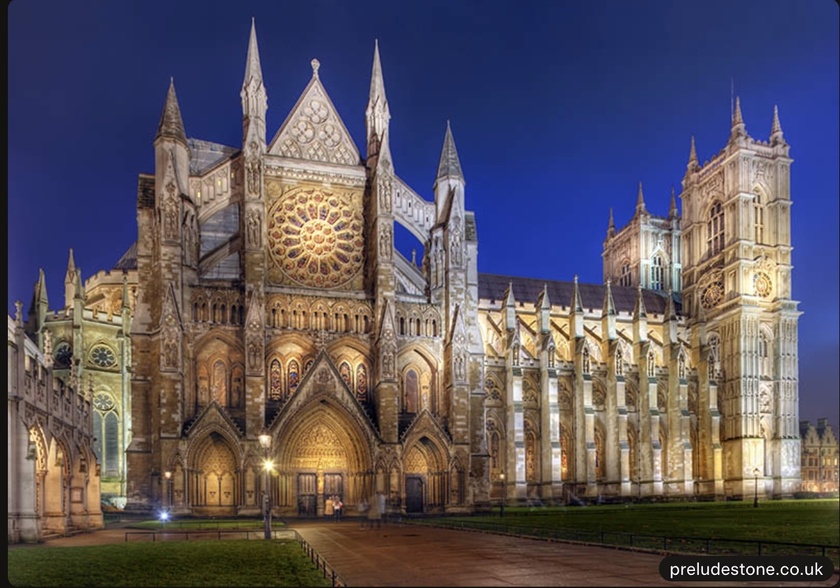
The present Gothic church of Westminster Abbey (Collegiate Church of St Peter) was consecrated on 13 October 1269 under Henry III. He had begun rebuilding Edward the Confessor’s Romanesque abbey in 1245 in the new French Gothic style, intending it as a royal coronation and burial church. That day the Confessor’s remains were translated to the new shrine. The nave was unfinished at Henry’s death; the older structure stood attached for decades. It remains a coronation site and burial place of monarchs.

My Favourite Buildings…Westminster Abbey | Prelude Stone

1307: Arrest of the Knights Templar

On Friday, 13 October 1307, agents of King Philip IV of France simultaneously arrested hundreds of Knights Templar across the kingdom, including Grand Master Jacques de Molay. Philip, heavily in debt to the wealthy military order, used charges of heresy, blasphemy, and idolatry (extracted under torture). The move, coordinated with a compliant Pope Clement V, led to the order’s suppression in 1312. De Molay was later burned in 1314. The date is often linked (retrospectively) to Friday-the-13th superstition, though that association is modern.

1332: Brief reign of Rinchinbal Khan (Ningzong)

Rinchinbal (born 1326), a young son of Kusala (Emperor Mingzong), was installed as Khagan of the Mongols and Emperor Ningzong of the Yuan dynasty. Scholarly sources (including Wikipedia) date the enthronement to 23 October 1332; some popular “on this day” compilations list the 13th—likely a calendar-conversion or secondary-source discrepancy. He reigned only until his death on 14 December 1332 (roughly 53 days) at age six. Court politics then brought in his half-brother Toghon Temür. The empire was already fragmenting.

1582: The day that did not exist (Gregorian reform)

In Italy, Poland, Portugal, and Spain, 5–14 October 1582 simply did not occur. Pope Gregory XIII’s bull Inter gravissimas ordered the jump from Thursday 4 October to Friday 15 October to correct the Julian calendar’s drift relative to the equinoxes (critical for calculating Easter). Those ten days were omitted at once in the adopting territories. Protestant countries delayed for decades or centuries; Britain and its colonies switched in 1752.

1644: Battle of Fehmarn

A Swedish–Dutch fleet under Carl Gustaf Wrangel and Dutch commanders defeated a Danish fleet near the island of Fehmarn in the Baltic during the Torstenson War (part of the Thirty Years’ War). The Allies fielded roughly 37 ships; the Danes about 17. Denmark lost 10 ships captured, others wrecked or sunk, and about 1,000 prisoners (including senior officers); Admiral Pros Mund was killed. The victory strengthened Swedish naval dominance in the Baltic and helped force the Treaty of Brömsebro (1645).

1710: Fall of Port Royal (Acadia)

After a siege beginning around 5 October, the French capital of Acadia, Port Royal (present-day Annapolis Royal, Nova Scotia), surrendered to British forces under Francis Nicholson on 13 October 1710 during Queen Anne’s War. The British renamed it Annapolis Royal. This was a key step in the eventual British control of Nova Scotia (formalized later by the Treaty of Utrecht). Note: this is distinct from the Jamaican Port Royal destroyed by earthquake in 1692.

1773: Discovery of the Whirlpool Galaxy

French astronomer Charles Messier discovered the object later catalogued as M51 (the Whirlpool Galaxy) on 13 October 1773 while searching for comets. He described it as a faint nebula. In 1845 Lord Rosse first resolved its spiral structure with his large reflector—the first “spiral nebula” so identified. It is a classic interacting grand-design spiral in Canes Venatici, with companion NGC 5195.

Out of this whirl: The Whirlpool Galaxy (M51) and companion galaxy | ESA/ Hubble

1775: Birth of the Continental Navy

Meeting in Philadelphia, the Second Continental Congress ordered the fitting out of two armed vessels (with carriage guns and swivel guns, crews of 80) to intercept British supply ships. This 13 October resolution is regarded as the founding act of the Continental Navy, predecessor of the U.S. Navy. A Naval Committee soon followed, and the force grew rapidly as the Revolution progressed.

1792: White House cornerstone laid

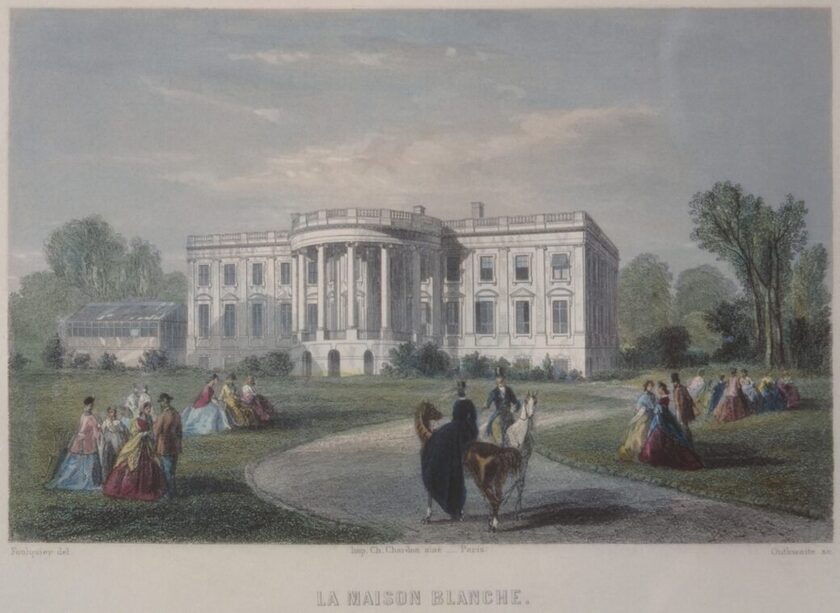
In the new federal capital of Washington, D.C., the cornerstone of the Executive Mansion (later the White House) was laid on 13 October 1792. Irish-born architect James Hoban designed the neoclassical building (influenced by Leinster House in Dublin); George Washington had selected the site. Construction used both free and enslaved labor. John Adams became the first president to occupy it in 1800. The name “White House” arose from the white-gray sandstone that contrasted with nearby red brick.

Architecture: 1850s-1890s - White House Historical Association

1793: First Battle of Wissembourg

In the War of the First Coalition, an Austro-Prussian force under Dagobert von Wurmser (with Hessian and émigré contingents) attacked the French Army of the Rhine under the inexperienced Jean Pascal Carlenc at the Lines of Wissembourg (Alsace). The Allies broke the French positions on 13 October; the French retreated in disorder toward Strasbourg, losing guns and prisoners. Carlenc was soon arrested and replaced by Jean-Charles Pichegru. A French counteroffensive later that winter (Second Battle of Wissembourg / Geisberg) reversed the gains.

These episodes illustrate recurring themes: contested successions and court intrigue (Claudius/Nero, Yuan child emperor), the sudden application of state power against wealthy or independent orders (Templars), calendar and institutional foundations (Gregorian reform, Continental Navy, White House), and the military and migratory pressures that reshaped late antiquity and early modern Europe. The Whirlpool discovery stands apart as a quiet scientific milestone that later helped redefine the scale of the universe.

Read full Article
October 10, 2026
post photo preview
Executions. Spencer and Salem Witch trials
Two different cases Religious faith

Executions. Spencer and Salem Witch trials

Two different cases Religious faith

Historical cores

George Spencer (New Haven Colony, 1642).
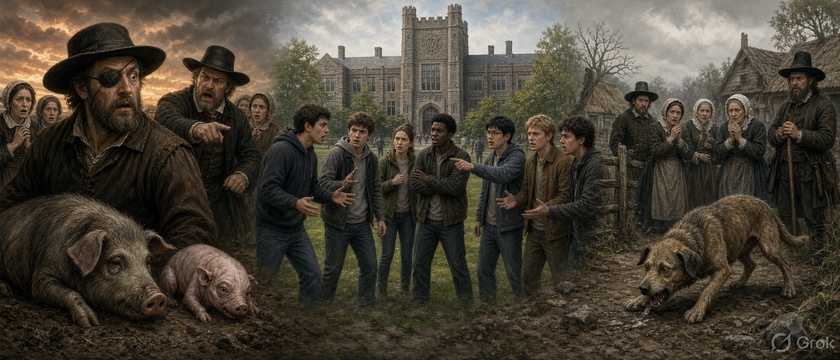
A sow produced a stillborn, severely deformed piglet with a single central eye and other features that observers found human-like. Spencer, a servant with a deformed eye and a reputation for irreligion and lewdness, was identified as the cause. The resemblance was treated as divine evidence of bestiality (Leviticus 20:15 required both man and beast to die). Spencer confessed under examination, then recanted; the confession (or reports of it) plus the piglet itself satisfied the two-witness requirement for a capital case. The sow was killed by the sword in his presence; he was hanged on 8 April 1642. Later analysis (including by Judge Jon C. Blue) treats the paternity claim as biologically impossible and the confession as unreliable or coerced—the first clear false confession in the American record. The process was “by the book” for the time: biblical law, attention to witnesses and confessions, and a shared belief that monstrous births revealed specific sins. That scrupulousness is why the records survive and why the unfairness is visible today. Whether Spencer had sexual contact with the sow is unknowable and secondary; the decisive error was treating an impossible paternity as proof and elevating a pressured confession under a worldview that made the conclusion nearly inevitable.

Salem (1692).
Girls in Salem Village exhibited fits, contortions, and spectral accusations. The Court of Oyer and Terminer, established by Governor Phips and led by William Stoughton, accepted spectral evidence and other tests. One contemporary account involves urine from an afflicted person being given to a dog, which then behaved strangely and was destroyed—interpreted as confirming the presence of a witch’s spirit. Authorities acted within a framework in which demonic assault was real, Jesus had cast out demons, and the community was under spiritual attack. Nineteen people were hanged, Giles Corey was pressed to death, and others died in custody. Increase Mather’s Cases of Conscience and the spread of accusations (including toward higher-status people) contributed to Phips halting spectral evidence and dissolving the court in late October 1692; a successor court largely excluded that evidence and most remaining defendants were acquitted or pardoned by May 1693. Later apologies (Samuel Sewall, jurors, Ann Putnam Jr.), the 1711 reversals of attainder, and eventual legislative clearances followed.

The ergot (Claviceps purpurea) hypothesis (Caporael, 1976) notes wet conditions in 1691, rye as a staple, and symptom overlap with convulsive ergotism (hallucinations, spasms). It has not held up well among historians: the pattern was not epidemic, many classic gastrointestinal or gangrenous signs are absent from the records, and the accusations and court process were selective and socially patterned rather than a mass physiological event. Arthur Miller’s The Crucible framed the episode primarily as political persecution and personal score-settling under the cover of ideology. That captures real factional tensions in Salem Village but underplays the sincere religious conviction that the court was confronting spiritual assault. Both the physiological theory and the purely political reading leave residual uncertainty; the procedural record shows authorities who believed they were protecting the community and who eventually demurred when the evidentiary and social costs became clear.

Shared structure

In both episodes the dominant framework (Puritan biblical law and demonology) supplied the categories, the tests, and the presumption that anomalous events or accusations required action. Procedures that were careful by contemporary standards—confessions, witnesses, biblical citations, ministerial consultation—still produced capital outcomes later viewed as miscarriages. The record of those procedures is what allows modern observers to say, with high confidence, that Spencer did not father a piglet and that the Salem executed were not witches, while still seeing how the authorities reached the opposite conclusion in good faith. The “fever” (social contagion, expanding accusations, institutional momentum) outran the evidence until external or internal limits were imposed.

Modern parallel and the editorial frame

The Cornell 7 case supplies a contemporary illustration of the same structural risk when a single narrative is treated as decisive. Public reporting, university process, and later political intervention have centered Jane Doe’s account of being drugged and assaulted by multiple Chi Phi members. Snapchat messages (“free pussy upstairs,” “Shop still open?”) have been widely circulated as corroboration. Counter-elements—texts and statements that complicate consent or timing, Cornell’s internal findings that at least one accused was not responsible for sexual assault, the DA’s initial assessment that the police transcript did not support charges, differences between the early police account and the later complaint, and claims of selective quotation—have received less sustained attention in much mainstream coverage. The YouTube discussion you linked (Nate the Lawyer on TMZ’s release of messages versus ABC and New York Times framing) is one example of the push for fuller context.

Whether the night involved criminal sexual assault, incapacitation, or more ambiguous sexual activity among intoxicated young adults is not settled by the public record; the criminal investigation was reopened and the civil case is pending. What is already visible is the institutional and media pattern: one party’s version drives headlines, sanctions, and political response, while contrary or complicating evidence is slower to surface or is treated as secondary. That is the modern analogue to the piglet’s eye or the spectral vision—evidence interpreted inside a framework that makes a particular conclusion nearly automatic, with procedures that look regular to those inside the framework.

An editorial can explore the three cases without equating them. It can note that religious authorities in 1642 and 1692 were not uniquely cruel; they were applying the best available understanding of reality and justice and still produced irreversible harm. It can observe that secular institutions today (universities, media, prosecutors under political pressure) can exhibit parallel failures when a preferred narrative about power, trauma, or vulnerability is allowed to override ordinary standards of evidence, consistency, and the presumption that the accused’s account also matters. The Spencer and Salem records are valuable precisely because the authorities were relatively scrupulous; the modern record will be valuable to the extent that texts, hearing transcripts, and conflicting statements remain available rather than filtered. The lasting lesson is not that faith (or any other shared worldview) is the problem, but that any framework strong enough to justify execution or severe sanction requires unusually strong safeguards against the tendency to treat the framework’s preferred interpretation as self-evident.

=

Background and “evidence”

George Spencer (c. 1600–1642) was a servant with a poor reputation in the strict Puritan community. Contemporary records call him a “prophane, lying, scoffing and lewd speritt.” He had a deformed or glass eye (one functional eye).

In early 1642, a sow owned by planter John Wakeman (previously belonging to Henry Browning, for whom Spencer had worked) gave birth to a litter that included one stillborn, severely malformed piglet. Colonial records describe it in detail: hairless, with reddish-white skin like a child’s; a single large eye in the middle of the face resembling a blemished human eye; a growth of flesh hanging from the forehead that was hollow and likened to a male sexual organ; and other human-like features of the nose, mouth, chin, neck, and ears.

Puritan authorities and neighbors treated the deformity as a divine sign or “prodigious monster” proving an unnatural act. The piglet’s single eye was compared to Spencer’s and judged strikingly similar (“as like as the eye in the glass to the eye in the face”). This resemblance, plus Spencer’s bad character, led to the accusation that he had committed bestiality with the sow and fathered the piglet. At the time, many people accepted the possibility of interspecies offspring under certain circumstances (influenced by biblical and folk ideas about monstrous births as signs of sin).

Trial

Spencer was examined. He initially confessed to the act (accounts vary on whether this was under pressure, in hope of mercy, or otherwise), then retracted the confession, denied the charge, and was described as obstinate. Witnesses testified to his earlier statements.

New Haven law, drawing on biblical standards (especially Deuteronomy’s requirement of two witnesses for capital cases), treated Spencer’s (retracted) confessions as one form of evidence and the physical appearance of the piglet itself as the other. The court found him guilty of the “unnatural and abominable crime of bestiality,” ruling that he was influenced by a “lying spirit” in his denials.

The legal basis was Leviticus 20:15: “If a man lie with a beast, he shall surely be put to death: and ye shall slay the beast.” Both Spencer and the sow were sentenced to death.

Execution

On 8 April 1642, the sow was first put to death by the sword in Spencer’s presence. Spencer was then hanged. Accounts indicate that, once the noose was fitted or on the gallows, he confessed again to the bestiality. He was among the earliest people executed in the Connecticut area (reported as the second overall and the first non-Native colonist).

Context and later assessment

This occurred in the early New Haven Colony under strict biblical law, where capital offenses included bestiality, and omens or monstrous births could be treated as evidence. A few years later (around 1647), another man, Thomas Hogg, faced a similar accusation involving piglets said to resemble him; he refused to confess and avoided execution, though he was punished for other offenses.

Modern analysis, including by Connecticut Superior Court Judge Jon C. Blue (in his book The Case of the Piglet’s Paternity), treats the case as involving a false confession. Fathering a piglet is biologically impossible; Blue and others describe Spencer’s admission as coerced or unreliable and call it one of the earliest verifiable false confessions in American legal history. In 2015 Blue effectively cleared Spencer posthumously in scholarly terms. The episode is often cited as an example of the harsh, theologically driven justice of early Puritan New England and the risks of relying on confessions plus circumstantial “signs.”

It is distinct from the 1692 Salem trials (which centered on witchcraft and spectral evidence) but shares the broader colonial Puritan context of capital punishment for sexual and religious offenses, heavy weight given to confessions, and interpretation of unusual events as divine proof of sin.

=

The end of the Salem witch trials in October 1692 was driven by mounting skepticism about spectral evidence, the widening circle of accusations (reaching high-status people), and decisive action by Governor Sir William Phips. By that point 19 people had been hanged, one (Giles Corey) pressed to death, and at least five had died in custody. The special Court of Oyer and Terminer was dissolved, spectral evidence was sidelined, and the remaining cases collapsed.

Antecedents

The crisis began in Salem Village (present-day Danvers) in January–February 1692. Betty Parris (daughter of the minister Samuel Parris) and Abigail Williams (his niece), along with other girls, experienced fits, contortions, and claims of being tormented. Local physician William Griggs suggested witchcraft. The girls named Tituba (an enslaved woman in the Parris household), Sarah Good, and Sarah Osborne. Examinations followed, and accusations multiplied.

Underlying tensions in the village included factional disputes (partly involving the Parris family and land/church authority), economic strains, and the broader stresses of King William’s War on the frontier. As accusations spread beyond the village to Andover, Topsfield, and elsewhere, the newly arrived royal governor, Sir William Phips, established a special Court of Oyer and Terminer in late May 1692, appointing Lieutenant Governor William Stoughton as chief justice. The court heavily relied on spectral evidence (claims that the devil appeared in the shape of the accused to afflict the girls). This was theologically contested: some ministers argued the devil could impersonate the innocent. Early executions began in June (Bridget Bishop first) and continued through September. Confessions and further accusations fed the process; roughly 200 people were accused overall.

Significant persons

  • Sir William Phips: First royal governor of the Massachusetts Bay Colony under the new charter. A former ship’s carpenter and treasure salvager who had recovered a Spanish wreck, he arrived in May 1692 and quickly authorized the special court to restore order. He was frequently absent dealing with frontier fighting in Maine. By late September, after returning, he faced reports of growing dissatisfaction and accusations reaching prominent people, including (according to contemporary accounts) his own wife, Mary. He banned further reliance on spectral evidence, stopped new arrests, and dissolved the court.
  • Increase Mather: Influential Puritan minister, Harvard president, and Phips’s ally (he had helped secure Phips’s appointment in England). In early October he published Cases of Conscience Concerning Evil Spirits, arguing that it was better for ten suspected witches to escape than for one innocent person to be condemned, and questioning the reliability of spectral evidence. His intervention carried significant weight.
  • William Stoughton: Zealous chief justice of the Court of Oyer and Terminer. He pressed for convictions and later resented the restrictions placed on the successor court.
  • Cotton Mather: Increase’s son; more supportive of the proceedings early on and later published a defense (Wonders of the Invisible World). He and his father differed in emphasis.
  • The afflicted girls / accusers: Abigail Williams, Ann Putnam Jr., Mercy Lewis, and others whose spectral claims and fits drove many accusations. Their testimony was central until the evidentiary rules changed.
  • Other key figures: Samuel Sewall (judge who later publicly apologized); Thomas Brattle (who circulated a critical letter); various ministers who debated the evidence.

The halt in October 1692

On or about 12 October, Phips wrote to the Privy Council in England that he had stopped the proceedings, noting the danger if “the evidence of the afflicted persons only did prevail” (i.e., spectral evidence) and that the devil appeared to be taking the shapes of innocent people of good reputation. He forbade further incarcerations based on such claims. On 29 October he formally dissolved the Court of Oyer and Terminer, ordered many prisoners released (especially where evidence was primarily spectral), and halted new arrests. Accusations against high-status individuals had made the situation politically and socially unsustainable.

What followed

A Superior Court of Judicature convened in early 1693 under instructions that largely excluded spectral evidence. Of those tried, the great majority were acquitted. Only a handful were convicted; Phips reprieved or pardoned them. By May 1693 he had issued a general pardon, and virtually everyone remaining in custody on witchcraft charges was released (though many had to pay prison fees). No further executions occurred.

Longer-term reckoning was gradual and incomplete for centuries:

  • January 1697: The General Court declared a day of fasting and repentance. Judge Samuel Sewall publicly confessed his error in church (the only sitting judge to do so); twelve jurors signed a statement admitting they had been “sadly deluded and mistaken.”
  • 1702: The General Court declared the 1692 trials unlawful.
  • 1706: Ann Putnam Jr. made a formal public apology, saying she had been deluded by Satan.
  • 1711: Legislation reversed the attainders of many convicted persons, restored some legal rights, and provided limited financial restitution to families.
  • Later clearances continued into the 20th and 21st centuries. Massachusetts formally apologized in 1957; additional names were cleared in 2001; the last known convicted person, Elizabeth Johnson Jr. (convicted in 1693 but never executed), was exonerated in 2022 after advocacy by a middle-school civics class.

The episode damaged the prestige of the Puritan theocracy, contributed to greater caution about spectral and hearsay evidence, and became a lasting cautionary tale about mass hysteria, due process, and the dangers of unchecked accusation. It influenced later legal thinking on the rights of the accused and remains a frequent reference point in American culture (most famously in Arthur Miller’s The Crucible). Stoughton never publicly recanted; many others involved showed little immediate remorse. The precise number of deaths is usually given as 20 executed plus those who died in jail, out of roughly 200 accused.

= from October 12th

539 BC – Fall of Babylon. Persian forces under Cyrus the Great’s general Gobryas (Ugbaru) entered Babylon without a major battle on the 16th of Tashritu (roughly 12 October on the Julian calendar), after taking Sippar two days earlier. Cyrus himself entered the city about 17 days later. This ended the Neo-Babylonian Empire. Cyrus presented himself as a liberator chosen by Marduk, returned deported peoples (including the Jews) to their homelands, and issued the famous Cyrus Cylinder proclaiming his legitimacy. The event marks the rise of the Achaemenid Persian Empire as a true world power.

633 – Battle of Hatfield Chase (or Heathfield). Fought on 12 October 633 (Bede’s date; the Anglo-Saxon Chronicle has the 14th). King Edwin of Northumbria was defeated and killed by an alliance of Cadwallon of Gwynedd (British/Welsh Christian) and Penda of Mercia (pagan). Edwin’s son Osfrith was also killed and another son captured. The battle temporarily shattered Northumbrian hegemony, split the kingdom into Bernicia and Deira, and set back the progress of Roman-influenced Christianity in northern Britain until Oswald’s later recovery. Location is usually given as the marshy Hatfield Chase area near Doncaster, though some debate alternatives.

1113 – First documented mention of Oradea (Varadinum). The city in what is now northwestern Romania appears in a Latin diploma of the Benedictine abbey of Zobor (in present-day Slovakia) under the name Varadinum. The name derives from Hungarian vár (“fortress”). King Ladislaus I of Hungary had founded a bishopric there in the late 11th century; the 1113 reference is the earliest surviving written attestation of the settlement as a fortified ecclesiastical center.

1279 – Nichiren inscribes the Dai-Gohonzon. According to Nichiren Shōshū (and related traditions), the Japanese Buddhist monk Nichiren inscribed the large central mandala known as the Dai-Gohonzon on 12 October 1279, during the Atsuhara persecutions. It is regarded as the supreme object of worship embodying Nam-myoho-renge-kyo and the purpose of his advent. Other Gohonzon used in practice are understood as transcriptions of it. The date is commemorated in some Nichiren lineages.

1398 – Treaty of Salynas. Signed on 12 October 1398 on an island in the Neman River between Grand Duke Vytautas the Great of Lithuania and Grand Master Konrad von Jungingen of the Teutonic Knights. Vytautas ceded Samogitia (Žemaitija) to the Order in exchange for peace and support for his eastern campaigns. It was one of several temporary cessions of the strategically vital territory that separated the Order’s Prussian and Livonian branches; the issue was not finally settled until the Treaty of Melno in 1422. Contemporary accounts even claim Lithuanian nobles proclaimed Vytautas king during the celebrations.

1492 – Columbus’s landfall in the Bahamas. On 12 October 1492 (Julian), after more than a month at sea, Columbus’s three ships sighted land at an island the Lucayan Taíno called Guanahani (which he renamed San Salvador). He believed he had reached the outer islands of Asia/the Indies. The exact modern island is still debated (Watling Island/San Salvador is the traditional candidate). This contact opened the sustained European colonization of the Americas.

1582 – Gregorian calendar reform skips the day. In the papal bull Inter gravissimas, Pope Gregory XIII ordered the Julian calendar corrected by dropping 10 days. In Italy, Poland, Portugal, and Spain, 4 October 1582 was followed immediately by 15 October; the intervening dates (including 10 October) simply did not exist that year. Other Catholic countries followed soon after; Protestant and Orthodox lands adopted the reform much later (Britain in 1752).

1654 – Delft Explosion (“Delft Thunderclap”). On 12 October a gunpowder magazine (the “Secreet van Holland”) in Delft exploded, detonating roughly 80,000–90,000 pounds of powder. The blast destroyed hundreds of houses, was heard as far as Texel, and killed at least 100 people (higher estimates exist); the painter Carel Fabritius was among the dead. The exact cause is uncertain but is traditionally linked to a lantern carried by the magazine’s keeper.

1692 – End of the Salem witch trials. Governor Sir William Phips effectively halted the proceedings. On or about 12 October he wrote to the Privy Council stating he had stopped the use of spectral evidence and the trials; on 29 October he formally dissolved the Court of Oyer and Terminer and ordered the release of many prisoners. By then 20 people had been executed. Spectral evidence and the growing circle of accusations (including of high-status people) had made the trials unsustainable.

1748 – Battle of Havana. Fought 12–14 October off Havana during the War of Jenkins’ Ear (part of the broader War of the Austrian Succession). A British squadron under Rear-Admiral Charles Knowles engaged a Spanish squadron under Andrés Reggio. The British captured one ship of the line and forced the Spanish flagship aground (where it was blown up); the Spanish retreated to Havana. The battle was tactically a British success but strategically limited—Knowles failed to intercept the treasure fleet—and news of the Treaty of Aix-la-Chapelle soon ended the war.

1773 – First public insane asylum in America. On 12 October the Public Hospital for Persons of Insane and Disordered Minds opened in Williamsburg, Virginia (later known as Eastern State Hospital). It was the first institution in the British colonies built specifically for the treatment of the mentally ill rather than merely confining them in jails or almshouses. Early treatments were crude by modern standards; the hospital continued in various forms for centuries.

1792 – First Columbus Day celebration in the United States. On 12 October in New York City the Society of St. Tammany (Columbian Order) held the first recorded American commemoration of Columbus’s landing, marking the 300th anniversary. It included speeches, a banquet, and the unveiling of an obelisk. Later 19th- and 20th-century observances grew into the federal holiday (now observed on the second Monday in October).

1793 – Cornerstone of Old East, University of North Carolina. On 12 October William Richardson Davie (Grand Master Mason and future governor) laid the cornerstone of Old East at Chapel Hill. It is the oldest state university building still standing in the United States. Originally a two-story dormitory and classroom building, it has been expanded and renovated many times and remains a residence hall. The university celebrates 12 October as University Day.

1798 – Peasants’ War (Boerenkrijg / Klëppelkrich). Beginning on 12 October in Overmere (Flanders) and spreading across the Southern Netherlands (modern Belgium and Luxembourg), peasants rose against French Republican rule. Triggers included anti-clerical policies and the introduction of conscription. The poorly armed rebels enjoyed early local successes but were crushed by early December (notably at Hasselt). Casualties in Flanders are estimated in the thousands; the rising is sometimes viewed as an early expression of Belgian national sentiment.

1799 – Jeanne Geneviève Labrosse’s parachute descent. On 12 October the French balloonist Jeanne Geneviève Labrosse (later Garnerin) became the first woman to make a parachute jump, descending from a balloon at about 900 meters. She was a pupil (and later wife) of André-Jacques Garnerin, who had made the first modern parachute descent from a balloon in 1797. She continued aeronautical work and later filed a patent related to parachute design on her husband’s behalf.

These events span ancient Near Eastern empire-building, early medieval British power struggles, the European discovery of the Americas, the Gregorian calendar reform, early modern disasters and religious persecutions, and milestones in education, mental health care, and aviation. Several of the later ones cluster tightly around the mid-October period in the late 18th century.

Read full Article
See More
Available on mobile and TV devices
google store google store app store app store
google store google store app tv store app tv store amazon store amazon store roku store roku store
Powered by Locals