


Seeing and Understanding
Anti Semitism
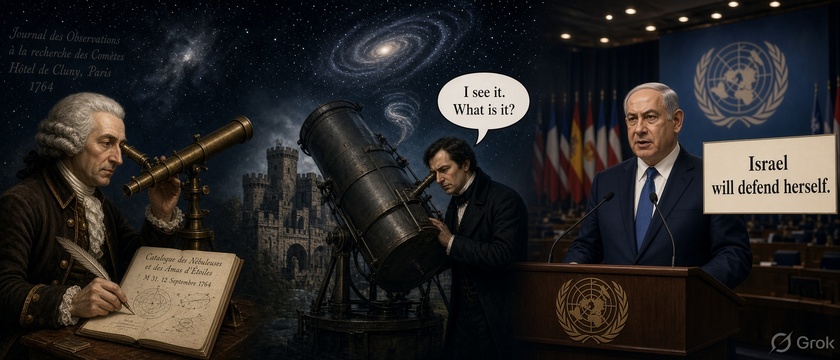
The analogy between the evolving understanding of the Whirlpool Galaxy and the question of whether we merely “see” antisemitism or actually understand it is a useful one. Superficial recognition of an object or a phenomenon is not the same as grasping its nature, scale, causes, or implications. Labels and pictures can create the feeling of knowledge without supplying the evidence or context that turns observation into comprehension.
A small correction on the astronomy side first: Lord Rosse’s key observations of the spiral structure in M51 were made in 1845 with his 72-inch Leviathan, not 1885. Copernicus’s heliocentric model placed the Sun at the center of the solar system; it did not imply that distant nebulae were local objects within that system. The real barrier for a long time was the lack of reliable distance measurements. Once those became possible, the “smudge” Messier catalogued to help comet hunters was revealed as a massive interacting galaxy tens of millions of light-years away. The same pattern—initial detection, refined observation, measurement of scale, and revision of earlier assumptions—appears in many areas of knowledge.
Applied to antisemitism, the distinction between seeing and understanding is real. Documented data show a sharp rise in antisemitic incidents in Australia after the 7 October 2023 Hamas attacks. Reports from sources tracking these incidents (including Australian Jewish community monitoring and international assessments) record increases on the order of several hundred percent in subsequent periods, with examples ranging from graffiti glorifying the attacks, campus harassment, synagogue attacks, and public demonstrations that included explicit eliminationist rhetoric. Elements of progressive activism, certain university environments, and Islamist currents have been repeatedly identified as major drivers of this surge, often blending anti-Zionism with older antisemitic tropes (collective guilt of Jews, dual loyalty, or blood libels updated into “genocide” accusations that ignore Hamas’s stated aims and tactics). Antisemitism has historical expressions on the right as well, including conspiracy theories about Jewish power; those have not disappeared. Recent patterns in Australia, however, have been dominated by the post-October 7 climate on parts of the left and in associated protest movements.
Your reference to the Claire Harvey interview with Greg Sheridan for The Australian fits the public record of Sheridan’s commentary. He has consistently condemned the rise in antisemitism, linked it to left-wing ideology that frames Israel as a colonial oppressor and Jews as accomplices, and criticised Australian government responses he sees as insufficient. At the same time, he has offered specific criticisms of Benjamin Netanyahu—on diplomatic style toward allies, certain aspects of the Gaza campaign’s human and political costs, or internal Israeli politics—while also describing Netanyahu as a formidable leader who has degraded Iranian proxy networks. Criticism of a particular Israeli government’s decisions, coalition, or conduct of war is not inherently antisemitic. The risk you note is real: when such criticism is asserted without concrete examples, evidence, or comparative context (Hamas’s charter and actions, the use of civilian infrastructure, the rejection of prior peace offers, or the treatment of other conflicts), it can function as an unearned opinion that aligns with, or is exploited by, those who do hold antisemitic views. Demanding supporting detail is a reasonable standard for any strong claim, whether about Netanyahu, Hamas, or anyone else.
Understanding antisemitism requires more than registering that hostility exists. It involves the historical continuity of certain motifs (deicide charges evolving into economic or racial conspiracy theories, then into anti-Zionist forms that uniquely deny Jewish self-determination), the ideological frameworks that currently amplify them, the difference between policy disagreement and collective demonisation, and the measurable outcomes for Jewish communities. A labeled photograph of the Whirlpool Galaxy lets someone recognise the object; measuring its distance, mapping its interaction with NGC 5195, and placing it in the broader structure of galaxies produces understanding. The same demand for evidence and context applies here.
=
Here is a broad, simple overview of how ideas about the universe have changed from ancient times to today. The story is one of expanding scale, better tools, and a gradual shift from Earth-centered stories to a vast, evolving cosmos.
Ancient ideas (before ~500 BC to the Middle Ages)
Most early cultures pictured a relatively small, ordered world with Earth at or near the center. The sky was often seen as a dome, a solid vault, or a series of layers. Stars were fixed lights or holes in a celestial sphere. Planets (the “wanderers”) moved among them.
The Greeks systematized this. Aristotle (4th century BC) argued for a stationary, spherical Earth at the center of nested crystal spheres that carried the Moon, Sun, planets, and stars. Motion was perfect and circular; the heavens were unchanging and made of a special substance different from earthly matter. Ptolemy (2nd century AD) refined this into a working mathematical model that predicted planetary positions reasonably well using circles upon circles (epicycles). This geocentric (Earth-centered) picture dominated Western and Islamic thought for well over a thousand years. It matched everyday experience—the ground feels solid and unmoving, and the sky appears to turn around us—and it fitted with many religious views of a special place for humanity.
The Scientific Revolution (16th–17th centuries)
The big shift began when the old model became awkward for precise predictions. Nicolaus Copernicus (1543) proposed that the Sun sits at the center and the Earth is one of several planets orbiting it. This heliocentric idea was simpler in some ways but initially faced strong resistance.
Johannes Kepler showed that planetary orbits are ellipses, not perfect circles, and found mathematical rules describing their speeds. Galileo Galilei used the newly invented telescope to see mountains on the Moon, moons orbiting Jupiter, and phases of Venus—observations that supported the idea that Earth is not the unique center. Isaac Newton then supplied the unifying explanation: the same force of gravity that makes an apple fall also keeps the Moon and planets in orbit. Heaven and Earth were governed by the same laws. The universe was still relatively small by later standards, but it was now a physical system that could be studied with mathematics and observation rather than pure philosophy or authority.
Expanding horizons (18th–19th centuries)
Better telescopes and systematic catalogs (such as Messier’s) revealed many faint “nebulae.” Some thinkers, including Immanuel Kant in the 1750s, suggested these might be distant “island universes” like the Milky Way. Most astronomers treated them as local gas clouds or star clusters within our own system. Spectroscopy (analyzing starlight) showed that the Sun and stars are made of the same elements found on Earth. The scale of the universe kept growing as distances to nearby stars were measured by parallax. The discovery of spiral structure in objects like the Whirlpool Galaxy (M51) in the 1840s raised new questions, but distances remained uncertain, so the debate about whether spirals were nearby or far away continued.
The modern cosmic picture (20th century onward)
Albert Einstein’s general relativity (1915) described gravity as the curvature of space and time rather than a force acting at a distance. This opened the door to models of the universe as a whole. Observations by Vesto Slipher and then Edwin Hubble in the 1920s showed that distant galaxies are moving away from us, and the farther they are, the faster they recede. The universe is expanding. Running this expansion backward implied a hot, dense beginning—what became known as the Big Bang.
Key supporting evidence arrived later: the cosmic microwave background (the faint leftover heat from the early universe, discovered in the 1960s) and the observed abundances of light elements. In the late 20th and early 21st centuries, further surprises appeared. Most of the matter in the universe is invisible “dark matter,” detectable only through its gravitational effects. Even more of the energy budget is “dark energy,” which is causing the expansion to accelerate. The current standard picture is of a universe that began about 13.8 billion years ago in a hot, dense state, has since expanded and cooled, contains hundreds of billions of galaxies, and is dominated by dark matter and dark energy whose nature is still not fully understood.
The overall pattern
The main trend has been a repeated demotion of Earth’s special status: from the center of everything, to one planet among others, to one star system among many, to one galaxy among billions in an expanding cosmos with no unique center. At the same time, the tools improved—from naked-eye observations and geometry, to telescopes and mathematics, to spectroscopy, relativity, and multi-wavelength observatories. Each stage replaced earlier ideas not because the older ones were foolish, but because new evidence and better explanations accounted for more of what was seen. Many questions remain open, especially about dark matter, dark energy, and the earliest moments, so the story is still unfolding.
=
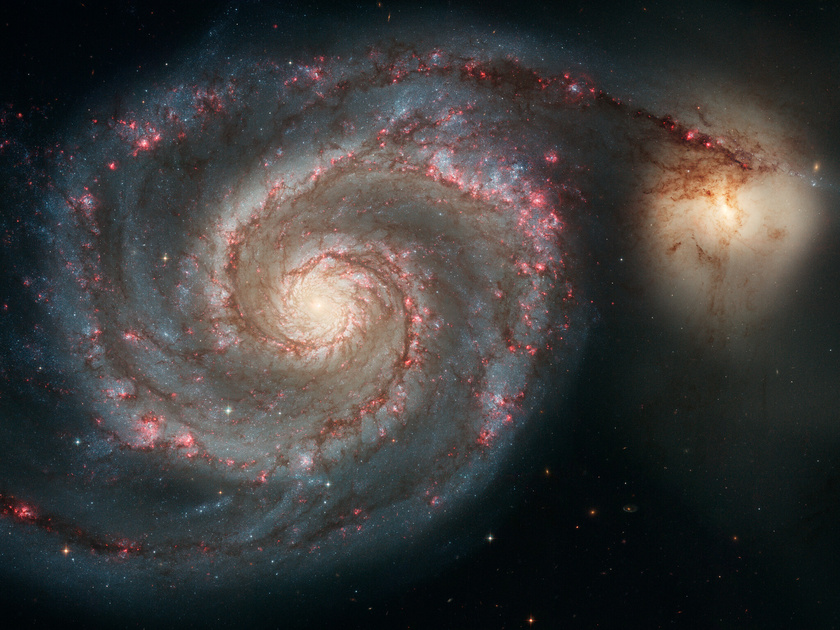
The Whirlpool Galaxy (M51 / NGC 5194) is one of the most famous objects in the night sky and a landmark in the history of how we came to understand that the universe is full of galaxies far beyond our own.
What was known before 1773
By the early 18th century, telescopes had revealed a number of diffuse, cloud-like objects that did not behave like stars or planets. The Orion Nebula had been noted as early as 1610 (Peiresc) and better described by Huygens in 1656. These were simply called “nebulae” (from the Latin for mist or cloud).
Comet hunters were the people most likely to stumble across them. A fuzzy, non-moving patch could easily be mistaken for a new comet at first glance. Charles Messier, a French comet searcher, began cataloguing these fixed “nebulae and star clusters” specifically so that he and others would not waste time on them while hunting comets. His catalogue (published in stages, final version 1781) contained what we now know are a mixture of true gas nebulae, star clusters, and what would later be recognised as galaxies.
Philosophically, the idea that some of these objects might be distant “island universes” comparable to the Milky Way had already been floated. Immanuel Kant, in his 1755 Universal Natural History and Theory of the Heavens, suggested that the nebulae might be other Milky Ways seen from afar. Most astronomers, however, still treated them as local objects within or associated with our own system. There was no reliable way to measure their distances, and spectra and resolved stars were still decades away.
Messier’s discovery (13 October 1773)
On the night of 13 October 1773, while tracking a comet, Messier noticed a faint, fixed nebulous object in the constellation Canes Venatici (the Hunting Dogs), near the end of the handle of the Big Dipper. He recorded it as a “very faint nebula without any stars” that was difficult to see with an ordinary 3.5-foot telescope. It became entry 51 in his catalogue.
In 1781 his colleague Pierre Méchain noticed that the object was double—two bright centres separated by about 4½ arcminutes, with their nebulous “atmospheres” touching. Messier included this information. The companion is what we now call NGC 5195. Messier himself never resolved any spiral structure; his instruments simply were not powerful enough.
The first spiral: Lord Rosse, 1845
The decisive observational leap came with William Parsons, 3rd Earl of Rosse, and his enormous 72-inch (1.8 m) reflecting telescope at Birr Castle in Ireland—the “Leviathan of Parsonstown,” the largest telescope in the world for decades. In the spring of 1845 (probably April; the exact night is not perfectly documented), Rosse examined M51 and saw a clear pinwheel or spiral arrangement. It was the first object in which spiral structure was recognised.
Rosse’s careful drawings of the object (often called the “Question Mark” because of the shape of the arms plus the companion) are remarkably accurate when compared with modern photographs. He and others soon found more “spiral nebulae.” At the time these were widely interpreted as possible solar systems in the process of forming—clouds of gas collapsing into stars and planets—rather than as vast systems of stars themselves. The true nature remained open because distances were still unknown.
The Great Debate and the resolution
Through the later 19th and early 20th centuries the spiral nebulae became central to a larger controversy about the scale of the universe. Were they relatively nearby gas clouds or star systems inside (or on the edge of) the Milky Way, or were they independent galaxies millions of light-years away?
This reached a formal public airing in the 1920 Shapley–Curtis Debate (“The Scale of the Universe”). Harlow Shapley argued for a large Milky Way that essentially constituted the universe, with the spirals as local nebulous objects. Heber Curtis argued that they were separate “island universes.” Neither side had conclusive distance measurements at the time.
The breakthrough came in 1923–24 when Edwin Hubble, using the 100-inch Hooker telescope at Mount Wilson, identified Cepheid variable stars in the Andromeda “nebula” (M31). Because the period of a Cepheid reveals its true luminosity, Hubble could calculate a distance far greater than the accepted size of the Milky Way. Andromeda, and by extension the other spiral nebulae, had to be separate galaxies. The universe suddenly became vastly larger. (Hubble’s distance to Andromeda was later revised upward, but the qualitative conclusion was secure.)
Modern understanding of the Whirlpool
Today M51 is known to be a classic grand-design spiral galaxy (roughly SA(s)bc) interacting with its smaller companion NGC 5195. The pair lies in Canes Venatici at a distance of roughly 23–31 million light-years (recent Cepheid and supernova work favours values around 24–25 million light-years / ~7.5 Mpc). The main galaxy is about 75,000–80,000 light-years across—comparable in size to the Milky Way, though somewhat smaller.
The beautiful, well-defined spiral arms are not a permanent feature of an isolated galaxy; they are strongly shaped by the gravitational interaction with NGC 5195. Simulations and observations indicate the companion has passed through or near the disk of M51 at least once (and probably more than once) in the last 500–600 million years. These encounters compress gas, trigger bursts of star formation (visible as bright blue knots and pink H II regions along the arms), and help organise the spiral density waves. Radio and infrared observations clearly show that the two galaxies are physically connected by tidal bridges of gas and stars.
M51 also hosts a Seyfert 2 active galactic nucleus—a supermassive black hole that is accreting material and producing high-energy emission. It is one of the nearest and best-studied examples of a galaxy interaction, and it remains a favourite target for both amateur observers (visible in binoculars under dark skies; spiral structure suggested in larger telescopes) and professional instruments from Hubble to the James Webb Space Telescope.
In short: Messier found a faint smudge while comet-hunting; Rosse revealed it was a spiral; Hubble and later astronomers showed that spirals are galaxies in their own right; and modern multi-wavelength studies have revealed the dynamical dance with its companion that produces the iconic whirlpool appearance we see today.
=
October 13 is a busy day in the historical calendar, spanning Roman succession intrigue, medieval power plays, astronomical discovery, the birth of American institutions, and more. Here is a concise tour of the events you listed, with context.
AD 54: Claudius dies; Nero succeeds
Roman emperor Claudius died suddenly on 13 October 54 at age 63. Ancient sources (Tacitus, Suetonius, Cassius Dio) widely claim he was poisoned—most often blamed on his wife Agrippina the Younger, who favored her son Nero over Claudius’s own son Britannicus. A poisoned mushroom is the traditional detail. Nero (then 16–17) was proclaimed emperor the same day with the backing of the Praetorian Guard and Senate; he was guided early on by Agrippina, Seneca, and Burrus. The Julio-Claudian dynasty would end with Nero’s suicide in 68.
409: Vandals, Alans (and Suebi) enter Hispania
After crossing the frozen Rhine on the last day of 406 and devastating Gaul, a coalition of Vandals (Hasdingi and Silingi), Alans, and Suebi crossed the Pyrenees into Roman Hispania in late September or early October 409 (sources vary slightly on the exact day; Hydatius places it around then). They divided the peninsula among themselves, accelerating the collapse of Roman authority in the west. The Alans took Lusitania and Carthaginensis; later Visigothic campaigns under Wallia reduced them.
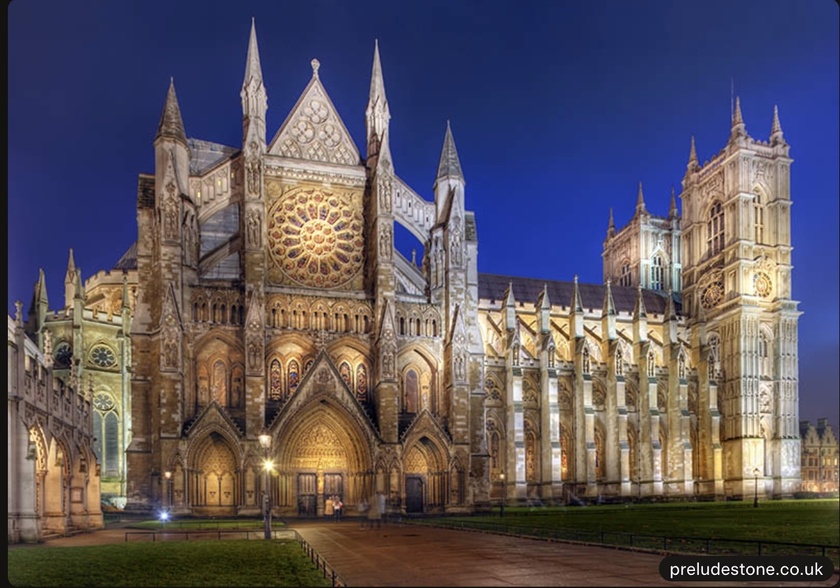
1269: Westminster Abbey consecrated
The present Gothic church of Westminster Abbey (Collegiate Church of St Peter) was consecrated on 13 October 1269 under Henry III. He had begun rebuilding Edward the Confessor’s Romanesque abbey in 1245 in the new French Gothic style, intending it as a royal coronation and burial church. That day the Confessor’s remains were translated to the new shrine. The nave was unfinished at Henry’s death; the older structure stood attached for decades. It remains a coronation site and burial place of monarchs.
1307: Arrest of the Knights Templar
On Friday, 13 October 1307, agents of King Philip IV of France simultaneously arrested hundreds of Knights Templar across the kingdom, including Grand Master Jacques de Molay. Philip, heavily in debt to the wealthy military order, used charges of heresy, blasphemy, and idolatry (extracted under torture). The move, coordinated with a compliant Pope Clement V, led to the order’s suppression in 1312. De Molay was later burned in 1314. The date is often linked (retrospectively) to Friday-the-13th superstition, though that association is modern.
1332: Brief reign of Rinchinbal Khan (Ningzong)
Rinchinbal (born 1326), a young son of Kusala (Emperor Mingzong), was installed as Khagan of the Mongols and Emperor Ningzong of the Yuan dynasty. Scholarly sources (including Wikipedia) date the enthronement to 23 October 1332; some popular “on this day” compilations list the 13th—likely a calendar-conversion or secondary-source discrepancy. He reigned only until his death on 14 December 1332 (roughly 53 days) at age six. Court politics then brought in his half-brother Toghon Temür. The empire was already fragmenting.
1582: The day that did not exist (Gregorian reform)
In Italy, Poland, Portugal, and Spain, 5–14 October 1582 simply did not occur. Pope Gregory XIII’s bull Inter gravissimas ordered the jump from Thursday 4 October to Friday 15 October to correct the Julian calendar’s drift relative to the equinoxes (critical for calculating Easter). Those ten days were omitted at once in the adopting territories. Protestant countries delayed for decades or centuries; Britain and its colonies switched in 1752.
1644: Battle of Fehmarn
A Swedish–Dutch fleet under Carl Gustaf Wrangel and Dutch commanders defeated a Danish fleet near the island of Fehmarn in the Baltic during the Torstenson War (part of the Thirty Years’ War). The Allies fielded roughly 37 ships; the Danes about 17. Denmark lost 10 ships captured, others wrecked or sunk, and about 1,000 prisoners (including senior officers); Admiral Pros Mund was killed. The victory strengthened Swedish naval dominance in the Baltic and helped force the Treaty of Brömsebro (1645).
1710: Fall of Port Royal (Acadia)
After a siege beginning around 5 October, the French capital of Acadia, Port Royal (present-day Annapolis Royal, Nova Scotia), surrendered to British forces under Francis Nicholson on 13 October 1710 during Queen Anne’s War. The British renamed it Annapolis Royal. This was a key step in the eventual British control of Nova Scotia (formalized later by the Treaty of Utrecht). Note: this is distinct from the Jamaican Port Royal destroyed by earthquake in 1692.
1773: Discovery of the Whirlpool Galaxy
French astronomer Charles Messier discovered the object later catalogued as M51 (the Whirlpool Galaxy) on 13 October 1773 while searching for comets. He described it as a faint nebula. In 1845 Lord Rosse first resolved its spiral structure with his large reflector—the first “spiral nebula” so identified. It is a classic interacting grand-design spiral in Canes Venatici, with companion NGC 5195.
1775: Birth of the Continental Navy
Meeting in Philadelphia, the Second Continental Congress ordered the fitting out of two armed vessels (with carriage guns and swivel guns, crews of 80) to intercept British supply ships. This 13 October resolution is regarded as the founding act of the Continental Navy, predecessor of the U.S. Navy. A Naval Committee soon followed, and the force grew rapidly as the Revolution progressed.
1792: White House cornerstone laid
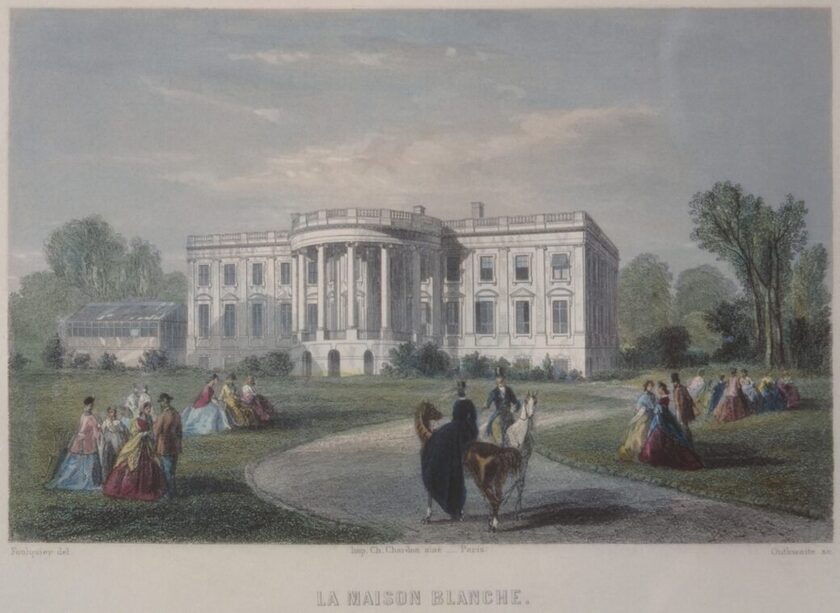
In the new federal capital of Washington, D.C., the cornerstone of the Executive Mansion (later the White House) was laid on 13 October 1792. Irish-born architect James Hoban designed the neoclassical building (influenced by Leinster House in Dublin); George Washington had selected the site. Construction used both free and enslaved labor. John Adams became the first president to occupy it in 1800. The name “White House” arose from the white-gray sandstone that contrasted with nearby red brick.
1793: First Battle of Wissembourg
In the War of the First Coalition, an Austro-Prussian force under Dagobert von Wurmser (with Hessian and émigré contingents) attacked the French Army of the Rhine under the inexperienced Jean Pascal Carlenc at the Lines of Wissembourg (Alsace). The Allies broke the French positions on 13 October; the French retreated in disorder toward Strasbourg, losing guns and prisoners. Carlenc was soon arrested and replaced by Jean-Charles Pichegru. A French counteroffensive later that winter (Second Battle of Wissembourg / Geisberg) reversed the gains.
These episodes illustrate recurring themes: contested successions and court intrigue (Claudius/Nero, Yuan child emperor), the sudden application of state power against wealthy or independent orders (Templars), calendar and institutional foundations (Gregorian reform, Continental Navy, White House), and the military and migratory pressures that reshaped late antiquity and early modern Europe. The Whirlpool discovery stands apart as a quiet scientific milestone that later helped redefine the scale of the universe.