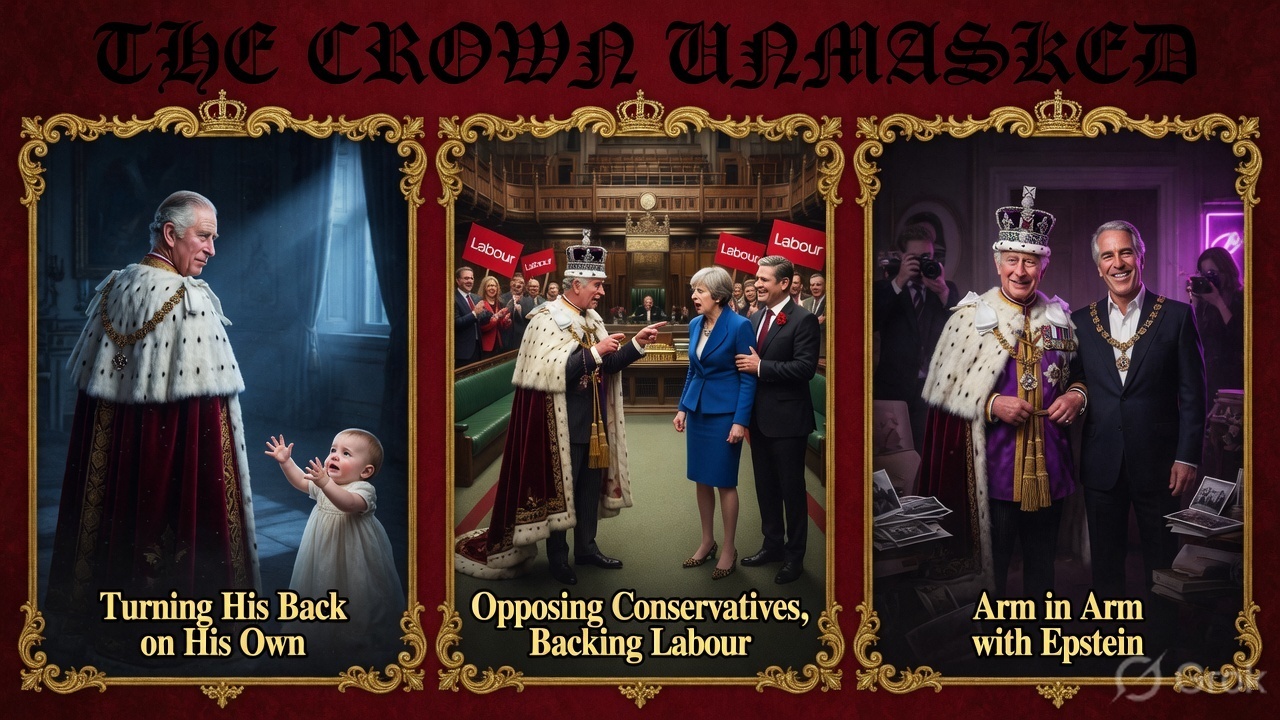
King Charles III sits on the throne of the United Kingdom. Yes, he is King of England in the shorthand most people still use. He is also King of Australia, Canada, New Zealand and a dozen other realms. The crown did not skip him. The constitution did not bend. Elizabeth II died; Charles succeeded. That is the fact of the matter.
But facts and fitness are not the same thing. Charles was a known quantity long before 2022. He arrived at the throne already carrying the baggage of decades of controversy, and those who hoped the crown would somehow ennoble him have been disappointed. The monarchy was supposed to be above politics. Charles never really was.
One of the most telling indictments is the so-called “black spider memos” — the private letters the then-Prince of Wales sent to government ministers. Handwritten in his distinctive scrawl, they lobbied Tony Blair’s administration on everything from badger culling and organic farming to military helicopters and alternative medicine. The memos were released only after a ten-year legal battle. What they revealed was not the harmless interest of a concerned citizen. They showed a man wielding the immense, unelected weight of his position to press his personal views on elected officials. Private citizens may write to their MP; that is democracy. A Prince (and now a King) doing the same in secret is something else. Influence that cannot bear sunlight is influence that should not be exercised. Charles understood the difference. He simply chose to ignore it.
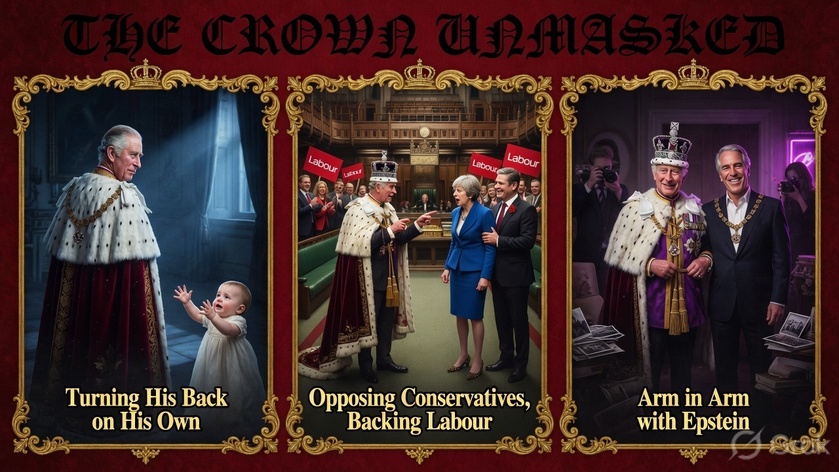
Now add the Epstein affair and Charles’s ruthless handling of his own brother. Prince Andrew — stripped of titles, evicted from Royal Lodge, and in 2026 arrested on suspicion of misconduct in public office for allegedly sharing confidential information with Jeffrey Epstein while serving as trade envoy — was sacrificed on the altar of royal damage control. Charles acted with uncharacteristic speed and force: titles gone, patronages stripped, security funding withdrawn, and public statements of “profound concern” while throwing full support behind police inquiries. It was decisive, clinical, and necessary to protect the institution.
Yet the question must be asked: why such ferocious distancing? Andrew’s entanglement with Epstein was deep and public — flights on the Lolita Express, stays at the properties, the disastrous BBC interview, the out-of-court settlement with Virginia Giuffre. But Andrew’s role as trade envoy placed him in diplomatic and intelligence-adjacent circles where Epstein, with his web of powerful handlers and blackmail potential, was known to operate. If Epstein’s operation was designed to compromise influential figures through “diplomacy and black ops” as some accounts suggest, Andrew may have been the perfect mark — a titled but politically naïve royal whose indiscretions could be weaponised.
Charles, by contrast, has faced no equivalent accusations of sexual misconduct. Yet he has been named in newly released Epstein files, with emails from the financier himself claiming Charles was instrumental in pushing Andrew out of his trade envoy role. Biographers have alleged the King’s involvement in the Giuffre settlement and a broader cover-up to shield the monarchy. The speed and totality with which Charles cut his brother loose raises an uncomfortable possibility: was the King himself compromised enough by Epstein’s circle to know that association with Andrew had become toxic — not just for Andrew, but for him? Did he act so forcefully to cauterise a wound that might otherwise spread? The optics are damning. A monarch who preaches duty and integrity appears instead to be engaged in the coldest of family executions to save his own reputation and the crown’s. If Charles was clean, why the panic? If he wasn’t, the hypocrisy is staggering.
Character matters in a constitutional monarch. Charles’s record here is no better. His marriage to Diana, Princess of Wales, collapsed in full public view. He admitted adultery. The “Camillagate” tapes, the bitterness, the betrayal — all of it played out while the world watched. Diana became a global icon of wronged womanhood; Charles the aloof, self-pitying prince who had never grown up. He has spent years trying to rehabilitate his image, but the wound to the monarchy’s dignity has never fully healed.
Then there is the persistent allegation — never acknowledged, never disproved in any public forum — that Charles has an unacknowledged family in Australia. Simon Charles Dorante-Day, a Queensland man, has spent years claiming he is the secret son of Charles and Camilla, conceived in the mid-1960s and adopted out. He has taken his claims to court, demanded DNA testing, and spoken publicly about threats and mockery he says followed his pursuit of the truth. The Palace maintains its customary silence. Whether the story is true or fantasy is almost beside the point. What matters is the impression it leaves: a man who preaches duty and tradition while allegedly failing the most basic duty of all — acknowledging his own flesh and blood. Character is revealed in private as much as in public. On this front, Charles fails the test.
And what of the future? Some quietly ask whether Prince William has already been corrupted by the same system. The heir has so far avoided the worst of his father’s public missteps, but the whispers grow: the Duchy of Cornwall’s finances, the careful management of image, the quiet accumulation of influence. The monarchy has a way of bending even the most promising figures to its ancient rituals and self-preservation. Whether William will prove any different remains to be seen. The institution itself may be the problem.
Could we have had Queen Anne instead? Princess Anne, the King’s sister, is widely admired for her no-nonsense work ethic and straight talk. She sits far down the line of succession — currently around 18th or 19th — because British law still carries the imprint of male-preference rules for those born before 2013. Bypassing Charles, William and the rest of the line for Anne would require an act of Parliament, the consent of every Commonwealth realm, and a national conversation Britain has shown no appetite for. The question is therefore rhetorical. It reveals the deeper frustration many feel: the monarchy is not a meritocracy. It is birthright, for better or worse.
Charles was never going to be a transformative King. He was always going to be the caretaker of a fragile institution he helped weaken. His private lobbying, his public scandals, his personal failings — and now the Epstein shadow and the surgical removal of his own brother — all of it was known. Britain chose to look away. Now the bill has come due. The monarchy’s survival depends not on popularity polls or carefully staged walkabouts, but on public confidence that the person wearing the crown is worthy of it. On the evidence, Charles III never was. The question for Britain is whether it still believes the institution is worth the cost.