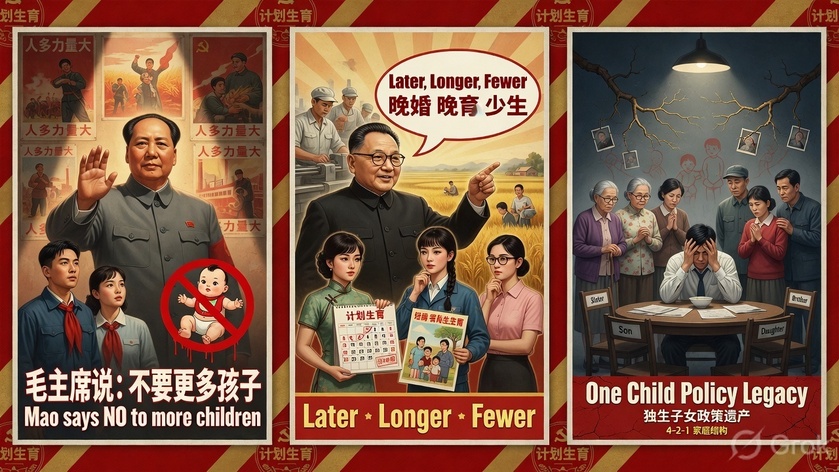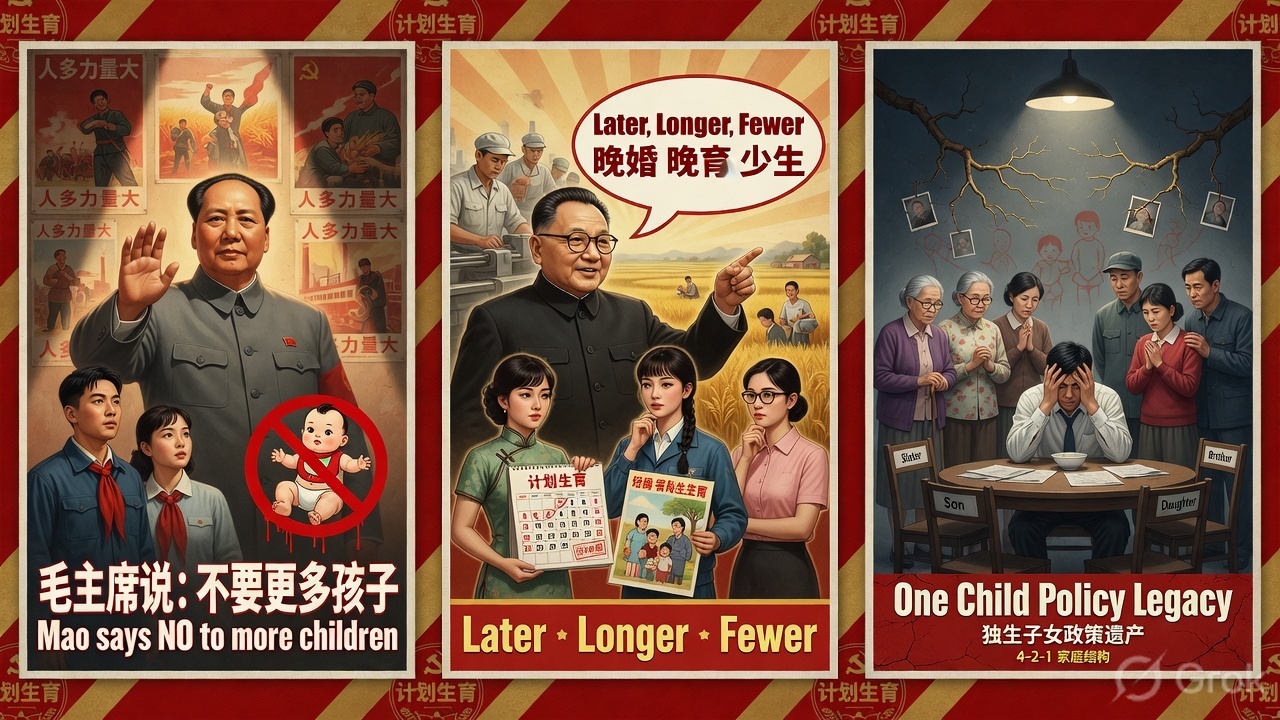
For 36 years, from 1979 to 2015, China's Communist Party wielded the one-child policy like a blunt instrument of social engineering. It was sold as a necessary sacrifice for modernization—curb the population, fuel the economy, secure the future. In human terms, it was a catastrophe. Families were shattered, millions of lives erased before birth, and an entire generation of "only children" grew up as the sole bearers of their family lines. The policy didn't just limit births; it snapped branches off the human tree, leaving entire lineages vulnerable to extinction with a single tragedy.
Contrast this with India's approach to population stabilization. India launched family planning in 1952 as one of the world's first national programs in a developing nation, emphasizing voluntary access to contraception, education, and maternal health. It had a dark coercive chapter during the 1975–1977 Emergency, when mass sterilizations targeted the poor and sparked political backlash. Yet India never imposed a national one-child mandate. Its National Population Policy of 2000 stressed informed choice, rights-based services, and integration with broader development. Fertility fell from over 6 births per woman in the 1950s to around replacement level (2.1 or below) today through persuasion, not force—proving that demographic transition can occur without authoritarian brutality. China's policy, by contrast, treated citizens as data points in a central plan, with quotas enforced by local officials whose careers depended on compliance.
The human cost in China was staggering. Enforcement went far beyond fines or lost benefits. Millions of women endured forced abortions—often in the third trimester—and compulsory sterilizations. Homes were demolished, wages docked, and relatives detained as leverage. One 2012 case in Shaanxi saw a seven-months-pregnant woman dragged to a clinic for a 40,000-yuan fine she couldn't pay. Between 1980 and 2014, an estimated 324 million women received intrauterine devices and 107 million underwent tubal ligations, many under duress. The policy didn't just control numbers; it invaded the most intimate sphere of life, traumatizing generations of women and scarring the national psyche.
The "broken branches" metaphor captures the policy's cruelest legacy. Under the one-child rule, most urban families—and many rural ones—had a single heir. No siblings. No cousins in the next generation. If that child died, the family tree ended. The 2008 Sichuan earthquake laid this bare. An 8.0-magnitude quake killed nearly 90,000 people, including an estimated 10,000 schoolchildren crushed in shoddily built classrooms that collapsed while their parents worked. Because these were overwhelmingly only children, entire families were left childless and heirless overnight. Parents who had complied with the policy for decades watched their sole legacy vanish in rubble. The government made a rare exception, allowing bereaved couples to try for another child—but no policy could restore what was lost: the emotional devastation, the extinguished futures, the snapped family lines. These weren't abstract statistics. Each lost student represented a grandmother without grandchildren, a lineage without continuity.
Patriarchal son preference compounded the horror. Ultrasound technology enabled widespread sex-selective abortions. China's sex ratio at birth skewed to 117 boys per 100 girls (far above the natural 105:100), creating tens of millions of "missing women"—estimates run as high as 30 million or more from abortions, infanticide, and neglect. The result: a generation of surplus men, millions of reluctant bachelors, and social strains from bride shortages, trafficking, and loneliness. Girls who survived often became "little emperors'" counterparts in overprotected only-child households, but the demographic wound cut deepest for women overall.
Even when the policy relaxed—two children in 2016, three in 2021—compliance had become cultural habit. Fertility didn't rebound. By 2025, China's total fertility rate hovered near 1.0, with births plunging to a record-low 7.92 million and the population shrinking for the fourth straight year to about 1.4 billion. The very mechanisms of enforcement—propaganda, monitoring, economic pressure—had normalized tiny families. Urbanization, soaring child-rearing costs, women's education, and shifting values did the rest. China now faces the inverse problem it feared: a shrinking workforce, a ballooning elderly population (the "4-2-1" structure of one child supporting two parents and four grandparents), and a demographic dividend turned deficit.
In military terms, the policy's timing was a strategic own-goal. The one-child era coincided with China's economic boom, producing a bulge of young men in their prime fighting age during the 2000s and 2010s. That was the window for belligerence—when manpower was abundant and the People's Liberation Army could draw from a vast pool. Instead, Beijing bided its time with gray-zone tactics and economic leverage. Now, as the population ages and shrinks, the recruit pool is drying up. Fighting-age males (15–49) are projected to decline sharply in the coming decades. An older society diverts resources to pensions and healthcare, crowding out military spending. The PLA already struggles with quality over quantity; technology and alliances (with Russia or Iran) can mitigate but not reverse the trend. Each passing year makes China demographically weaker, its strategic window closing. The policy that was meant to strengthen the nation for global competition has left it racing against its own obsolescence.
China's one-child experiment stands as a warning against hubris in population control. It prevented some births, yes—but at the price of broken families, gendercide, and a future of decline. India chose a harder, slower, more humane path and emerged with a more balanced demographic trajectory. The lesson is clear: Governments cannot command the future by controlling the cradle. They can only distort it, leaving scars that outlast any five-year plan. The branches China broke will not regrow easily. The human cost echoes in empty schoolyards, aging villages, and a superpower confronting its self-inflicted frailty.