Editorial: Creation on a timetable — what the telescopes actually falsified
The Big Bang was never a photograph of a beginning. It was a model of a hot, dense early state that expanded. Telescopes have not found a wall at the end of that expansion. They have found something more unsettling for anyone who likes tidy creation stories: a sky that keeps going, and a first few hundred million years that assembled stars far faster than the textbooks allowed.
That is the observation. The rest is what we do with it.
There is no physical edge to the universe in the way a sphere or a box has a boundary. In every direction the large-scale sky looks the same. On present evidence the whole thing is either infinite or so large that our observable patch is a scrap. What telescopes reach is only the boundary of the observable universe: the farthest light that has had time to arrive since the hot beginning, about 13.8 billion years ago. Space kept stretching while that light travelled, so the present distance to that horizon is about 46.5 billion light-years — a sphere roughly 93 billion light-years across.
Two complementary “edges” matter.
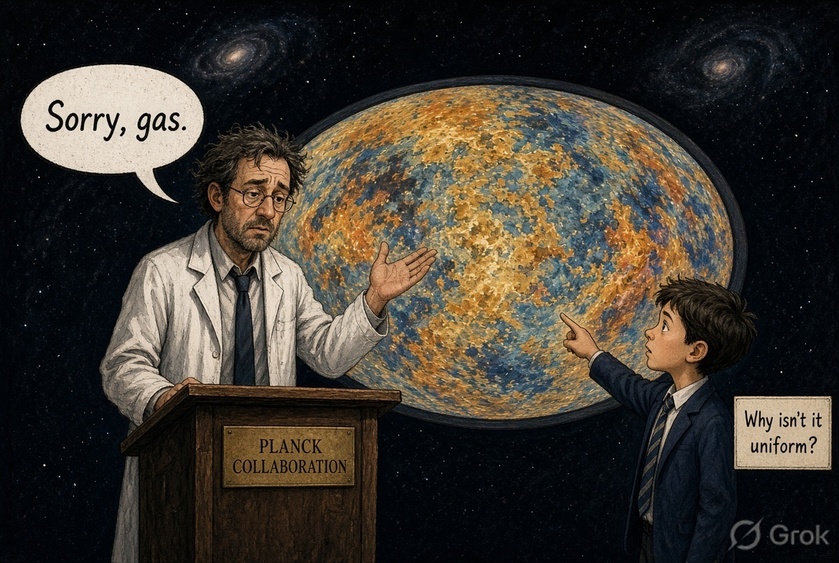
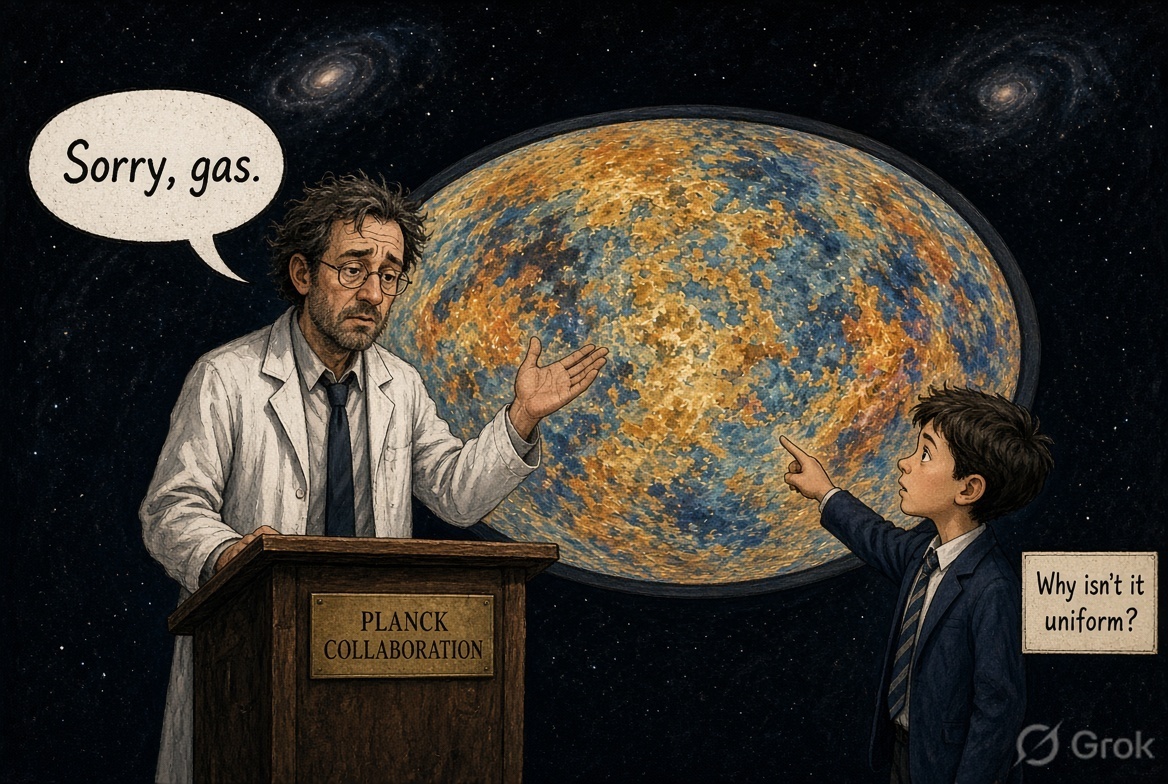
The first is the cosmic microwave background: the last-scattering surface from about 380,000 years after the hot beginning. Before that, the universe was an opaque plasma. When it cooled enough for electrons and protons to form neutral hydrogen, light streamed free. That light is what we measure now as a 2.725-kelvin blackbody filling the sky. Planck, and before it WMAP, mapped its ripples — about one part in 100,000. Those ripples are the seeds of every galaxy and cluster. Later experiments (ACT, SPT) have sharpened the map. They have not shown a preferred direction, a wrap-around pattern, or a cutoff that would close the universe on scales we can see.
The CMB is not the glow of later stars. It is leftover heat from when the universe itself was still a furnace. It “differs” from place to place only by those tiny fluctuations, plus later wrinkles from gravity and foregrounds. It was once about 3,000 kelvin. Expansion stretched the wavelengths and cooled it. That is why a radio telescope sees a cold fog, not a fire.

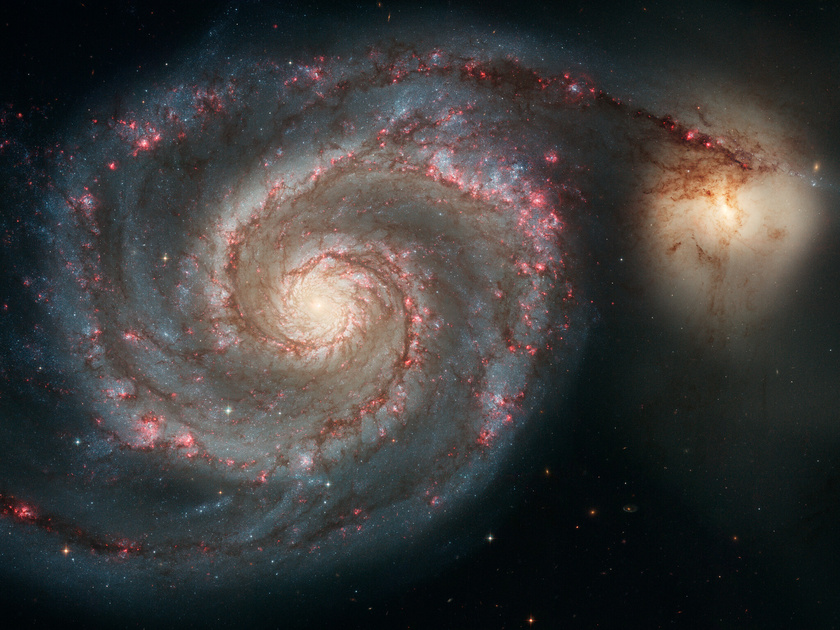
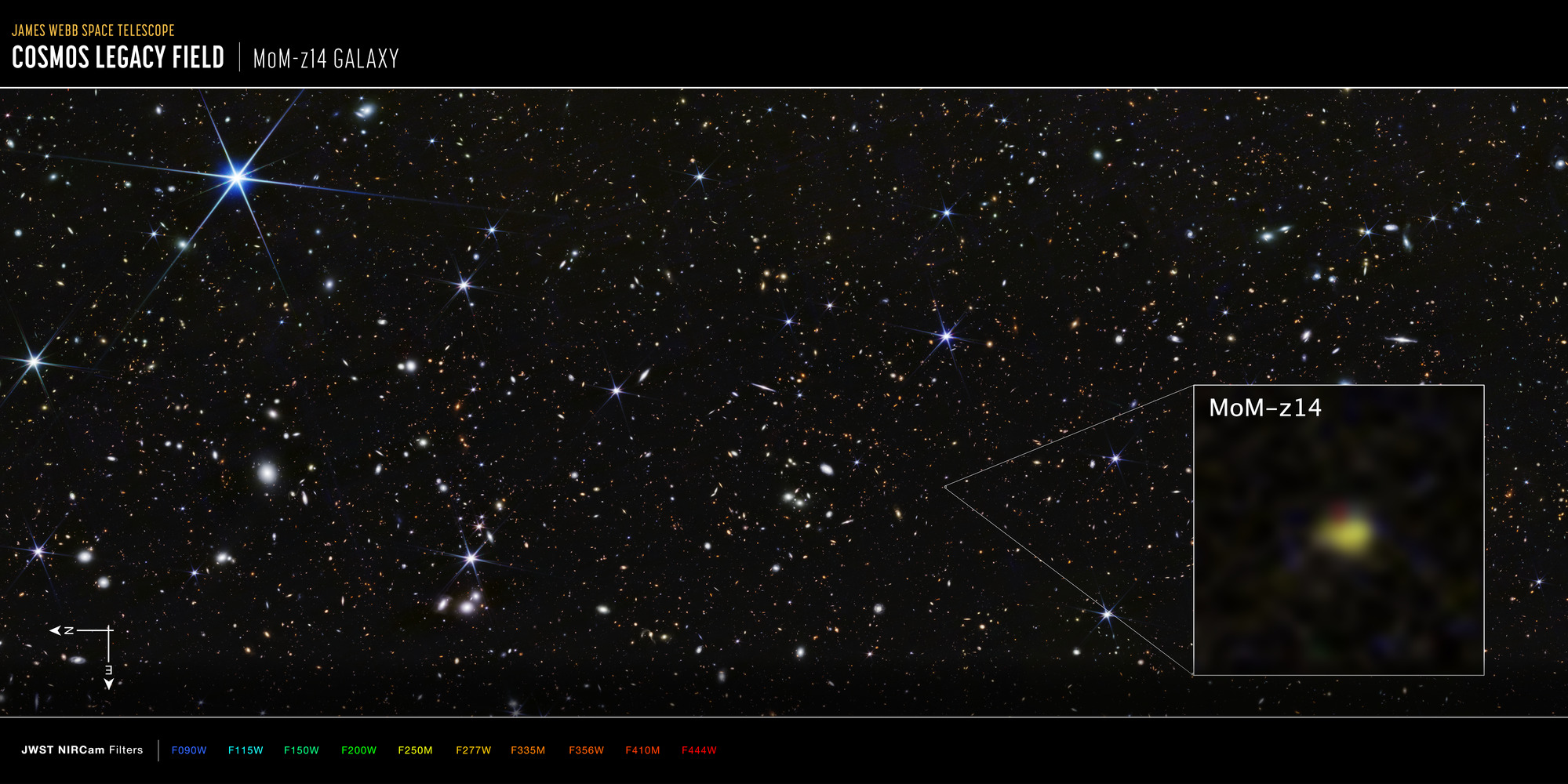
The second edge is galaxies. Infrared telescopes, above all the James Webb Space Telescope since 2022, now catch starlight from when the universe was only 280 to 400 million years old. The spectroscopically confirmed record holder is MoM-z14, redshift 14.44: light that left 280 million years after the hot beginning. JADES-GS-z14-0 sat just behind it. Hubble’s GN-z11, once the prize, is no longer even close to the frontier.
Those early galaxies are the shock. They are bright, compact, already chemically seasoned, and far more numerous than pre-Webb models predicted — on some surveys, of order a hundred times more at z > 10. Some already leak Lyman-alpha, which means they had begun punching holes in the fog of neutral hydrogen earlier than expected. “Little red dots,” early bars, and mature-looking clusters arrive sooner than the old assembly line allowed.
That is what observation falsified: not that there was a hot, dense, expanding early universe, but the timetable we had written for how quickly the first cities of stars could form. Expansion, the CMB spectrum, the abundances of light elements, and the growth of structure still hang together. Galaxy-formation recipes — how efficiently gas turns into stars, how massive those first stars were, how fast black holes grew, how dust behaves — are what broke. Theorists now have too many patches, which is another way of saying the old certainty is gone.
The diabolical reversal
Suppose expansion stopped. Suppose space compressed. Distant galaxies would not pop back into view like actors from the wings. Light still has a speed. Only regions that could send a signal in time would reappear, and they would first blueshift, not politely resume their old places. The CMB would heat. The sky would not be a rerun; it would be a crush.
Present data do not favour that ending. Expansion is still accelerating. DESI’s great galaxy map has produced a hint that dark energy may weaken with time, stronger when combined with supernovae and the CMB, weaker in some later slices of the same survey. A hint is not a recollapse. Weakening dark energy can still leave the universe accelerating for a very long time. A Big Crunch would require the dark component to change character far beyond what has been measured. Extrapolating a disputed wiggle across a trillion years is not observation. It is a story.
Why early light looks the way it does
It is not that “light used to be less bright” because the background was brighter. The CMB energy density was higher in the past — it scales steeply with redshift — but that is a uniform bath. Individual galaxies look faint mainly because they are distant and because expansion stretches photons and dims surface brightness. Webb’s surprise runs the other way: those first systems are too bright for the old models, not too dim. If anything, the early sky was a harsher floodlight of star formation than we budgeted for.
Heat death is not vanishing
Does expansion make matter “virtually extinct”? Inside a galaxy, gravity has already won. Stars will burn out. Black holes will evaporate on timescales that make geology look impatient. If protons decay, even atoms eventually go. That is a long fade, not a vanishing act caused by empty space opening between us and Andromeda. Isolated groups recede beyond an event horizon in an accelerating cosmos. Bound systems remain. “Extinct” is a word for the far future of radiation and dust, not for matter packing its bags next century.
Matter, antimatter, and a handed universe
A universe of enormous energy can make particle–antiparticle pairs. That is not by itself a Big Bang. Equal amounts annihilate back to light. We live in a world with leftover matter. The measured CP violation in the Standard Model is too small to explain that leftover. The weak force is left-handed: it treats left- and right-chiral particles differently. That chirality is real. It is not proof that “the universe is right-handed” and therefore antimatter was sentenced to extinction. Baryogenesis remains an unsolved ledger. Inflation, if it happened, can turn vacuum energy into a hot particle bath at reheating. That is a mechanism, not a completed biography of creation.
What remains
We do not know whether the whole universe is infinite. We do not know what dark energy is. We do not know how the first stars converted gas so fast, or how the first heavy black holes got so fat so soon. We do not know why there is something rather than an equal ruin of matter and antimatter.
We do know this. No telescope has photographed a rim. No repeating pattern has shown a small cosmos wrapping around on itself. The cosmic web, mapped now back to when the universe was about a billion years old, looks like a younger version of the same filament-and-void architecture we see nearby. Beyond the particle horizon the rest is inaccessible. Inflation, if it is right, says that rest is vast — quite possibly endless.
So the honest sentence is narrower than a headline and sharper than a sermon. The hot beginning has not been cancelled. The creation schedule we printed for galaxies has been. The universe is still growing. It may have no edge at all. What we thought we knew about how quickly light and dust could organise themselves in the first few hundred million years has been overturned by looking.
That is not the end of theory. It is the return of the only discipline that ever deserved the name: observation first, and the model made to bow.