VoiceDDB
Politics • Culture • News
'Deep state' continues playing games in opposition to Trump.
Those games have serious consequences for those doing their job under Trump administration.
September 20, 2026
post photo preview

'Deep state' continues playing games in opposition to Trump.

Those games have serious consequences for those doing their job under Trump administration.

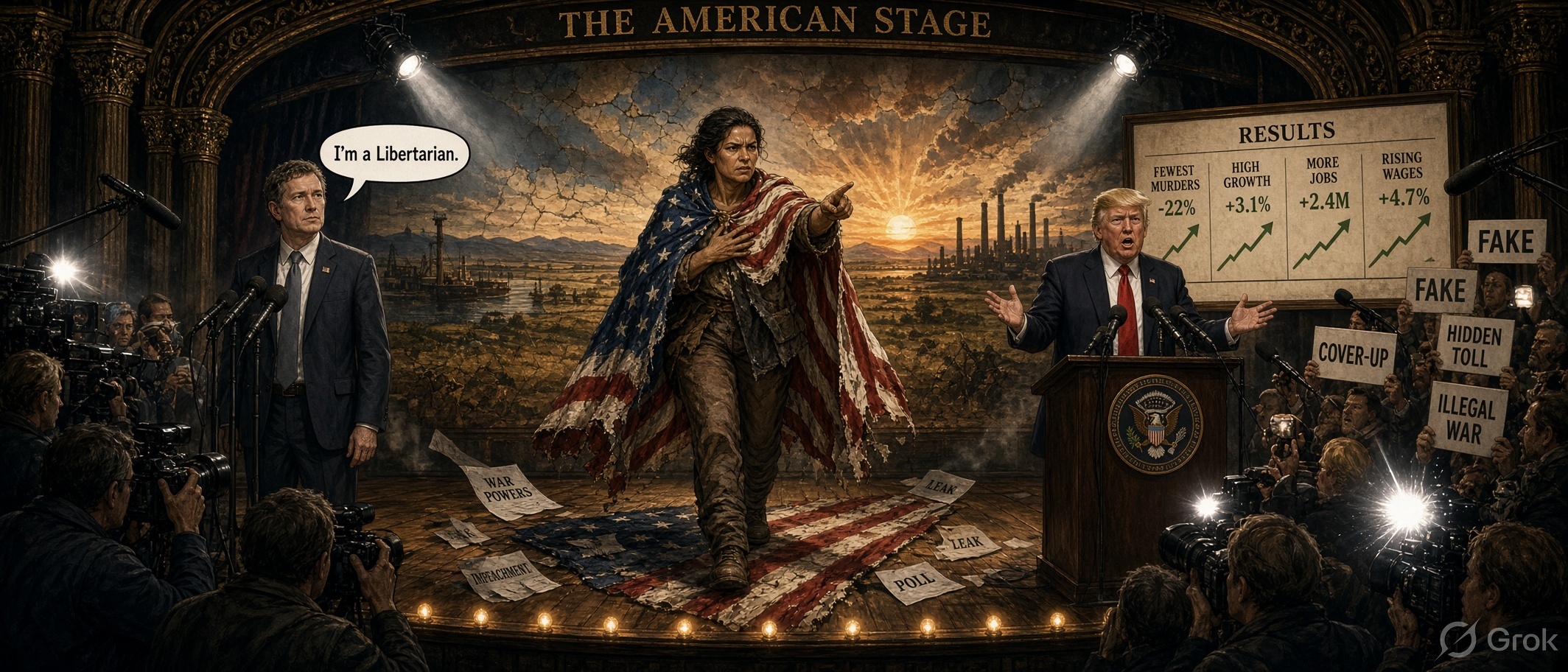
Has Massie’s dart landed? Not in the only place that counts. Hegseth is still Secretary of War. The House did not impeach him. Speaker Mike Johnson cancelled Thursday and sent the chamber home until after the midterms, which is how a privileged resolution dies without anyone having to put their name on the knife. Johnson called it a stunt. Massie called it the “Hegseth holiday.” Both descriptions can be true at once.

The dart still drew blood. That is the point of these games.

Massie is not a deep-state apparatchik. He is a lame-duck libertarian who already lost his primary to a Trump-backed challenger Hegseth campaigned for. He has spent a career voting no on wars, surveillance, and spending. He aimed at Hegseth rather than Trump because Hegseth is the man executing the orders and ignoring the War Powers clock. That is a constitutional argument, and it is also a political weapon fired by a man with nothing left to lose inside the party. The effect is the same either way: force Republicans onto the record against a wartime secretary weeks before an election, or force leadership to look as if it is hiding. Leadership hid. That is not victory for Massie. It is not clean for the administration either.

The serious consequence is not the 34-page resolution. It is the climate around the people doing the job. A secretary running a seven-month campaign against Iran, a maritime campaign against drug boats, and the seizure of Nicolás Maduro is now spending part of every week answering process attacks, leak stories, and impeachment theatre. Officers and civilians under him learn the lesson fast: anonymous sourcing is safer than loyalty, and the press will treat a casualty-accounting dispute as proof of a cover-up. That is how institutions punish an administration they did not choose, without ever winning a vote.

Look at the Washington Post piece that dropped three days after Massie spoke. The headline machinery said more U.S. troops have died “amid” the Iran war than the Pentagon has disclosed. The body of the story is thinner. Official public count: 18. Anonymous officials: at least 22, maybe 23. Then the caveat the headline does not want: not all of the extra deaths were tied directly to combat in Iran. Some were personnel in the Middle East while the war was on. Hegseth called the story a lie. The paper called it accountability. Readers were invited to hear “they’re hiding bodies in Iran.” What they were given was framing plus unnamed insiders. That is not the same thing as a suppressed battlefield toll. It is the same method used for years against this president and almost never against the last one when the last one’s wars, withdrawals, and body counts were the story.

None of that requires pretending civilian death is imaginary. A school in Minab was hit early. Children died. A preliminary U.S. assessment said America was likely responsible and did not intend the school. Drug-boat strikes have killed people the administration calls traffickers and Massie calls victims of extrajudicial force. Wars kill people who were not the target. The relevant comparison is intent and method. Trump’s Iran and Venezuela campaigns have been notable for constraint by the standards of American expeditionary history: no occupation army, no nation-building brief, no invitation to linger for twenty years. That is not sainthood. It is not the reckless bloodlust the coverage implies either.

Massie wrapped four different fights into one instrument: War Powers on Iran, civilian-harm law, Kelly’s speech, Maduro, and Yemen. Some of that is a real argument about Article I. Some of it is an attempt to criminalize policy. Kelly reminding troops they may refuse unlawful orders is not sedition. Hegseth treating a sitting senator as if he were still on the Navy’s punishment roster was a political error even if the legal theory was clever. Mixing those counts with the war itself is how an impeachment document becomes a press package.

So: did the dart land?

It did not remove Hegseth. It did not stop the war. It did not command a Republican majority. It did force the Speaker to choose between a midterm roll call and a recess, and Johnson chose the recess. It did feed a week of copy in which “impeachment” and “hidden deaths” travelled farther than the caveats. It did tell every official still working the problem that the opposition’s preferred battlefield is process, leaks, and moral vocabulary, not a declaration of war they will not vote and not an alternative strategy they will not own.

That is the game. It has always been the game against this administration. The people under Trump pay for it in time, morale, and the permanent suggestion that doing the job is itself the scandal. Massie threw the dart at Hegseth so it would stick in Trump. It stuck in the news cycle. It did not stick in the statute book. When the House comes back in November, Johnson says the resolution will be tabled. Believe him. Then watch the next leak. That is where the next dart is already being cut.

community logo
Join the VoiceDDB Community
To read more articles like this, sign up and join my community today
0
What else you may like…
Videos
Posts
Articles
00:01:07
November 27, 2022
Jingle Bell Rock

Jingle bell, jingle bell, jingle bell rock
Jingle bells swing and jingle bells ring
Snowin' and blowin' up bushels of fun
Now the jingle hop has begun

Jingle bell, jingle bell, jingle bell rock
Jingle bells chime in jingle bell time
Dancin' and prancin' in Jingle Bell Square
In the frosty air

What a bright time, it's the right time
To rock the night away
Jingle bell time is a swell time
To go glidin' in a one-horse sleigh

Giddy-up jingle horse, pick up your feet
Jingle around the clock
Mix and a-mingle in the jinglin' feet
That's the jingle bell rock

Jingle bell, jingle bell, jingle bell rock
Jingle bell chime in jingle bell time
Dancin' and prancin' in Jingle Bell Square
In the frosty air

What a bright time, it's the right time
To rock the night away
Jingle bell time is a swell time
To go glidin' in a one-horse sleigh

Giddy-up jingle horse, pick up your feet
Jingle around the clock
Mix and a-mingle in the jinglin' feet
That's the jingle bell
That's the jingle...

00:02:04
September 01, 2021
Intro to Locals for the Conservative Voice

David Daniel Ball calls himself the Conservative Voice.

I'm a teacher with three decades experience teaching math to high school kids.I also work with first graders and kids in between first grade and high school. I know the legends of why Hypatia's dad is remembered through his contribution to Math theory. And I know the legend of why followers of Godel had thought he had disproved God's existence.

I'm not a preacher, but I am a Christian who has written over 28 books all of which include some reference to my faith. Twelve blog books on world history and current affairs, detailing world events , births and marriages on each day of the year, organised by month. Twelve books on the background to and history of Bible Quotes. One Bible quote per day for a year. An intro to a science fiction series I'm planning, post apocalyptic cyber punk. An autobiography with short story collections.

I'm known in Australia for my failure as a whistleblower over the negligence death of a school boy. ...

00:01:50
September 04, 2026
Should violent criminals be made fat? Grok says 'no'

No. Transferring gut bacteria from an obese person into a violent criminal is not a reliable, ethical, or effective way to make them “fat, sedentary, and less of a physical threat.”

The science does not deliver the outcome you want

Mouse studies in germ-free animals showed that microbiota from obese donors can increase energy harvest and adiposity compared with lean-donor microbiota. That is the origin of the idea. Human evidence is far weaker.

Randomized trials of fecal microbiota transplant (FMT) from lean donors into people with obesity have generally failed to produce meaningful, sustained weight loss. Microbiome composition can change; body weight and metabolic markers often do not, or the effects are small and inconsistent. Diet and the existing gut environment usually dominate. A 2025 Nature paper found diet outperformed microbial transplant for microbiome recovery. Human guts are already colonized, not sterile like lab mice, so engraftment is variable and effects unpredictable.

It is not a ...

post photo preview
August 28, 2026
Pfizer struggles to answer

Some in Australia are brilliant. Malcolm Roberts Investigates Pfizer over Covid vaccine.

Holiday break is over back to work tonight

Tonight I'll start double posting until I've caught up.

post photo preview
Edmund Burke, Prophet?
November 1st

Edmund Burke, Prophet? 

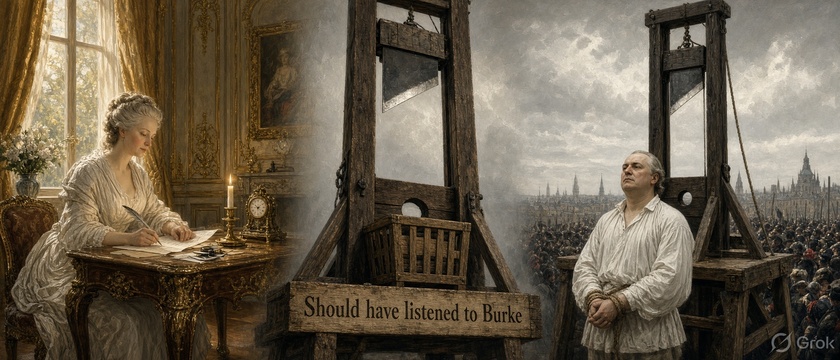
Edmund Burke’s Reflections on the Revolution in France (published 1 November 1790) is a long political pamphlet written as a letter to a young French acquaintance, Charles-Jean-François Depont. It became one of the foundational texts of modern conservatism.

Edmund Burke (1729–1797)

Burke was an Anglo-Irish Whig statesman, orator, and writer. Born in Dublin, he studied at Trinity College and later became a Member of Parliament. Earlier in his career he was widely seen as a reformer and liberal: he supported the American colonists’ grievances (and eventual independence), criticised royal overreach, and led the long impeachment of Warren Hastings for abuses in British India. He also defended Catholic rights in Ireland and argued for gradual, prudent reform of existing institutions rather than abstract schemes of change.

His stance on the French Revolution surprised many former allies. He initially watched events with interest but quickly grew alarmed by the scale and style of the upheaval.

Before 1790: Context and Triggers

The French Revolution began in 1789 with the calling of the Estates-General, the fall of the Bastille, and the Declaration of the Rights of Man. In Britain many Whigs and radicals welcomed it as a natural continuation of the Glorious Revolution of 1688 (which had replaced James II with William and Mary and limited monarchical power).

A key trigger for Burke was a sermon by the radical Dissenting minister Richard Price delivered on 4 November 1789 to the Revolution Society in London. Price celebrated the French events and argued that the principles of 1688 gave the people the right to choose, dismiss, and remake their government. The Society also sent a congratulatory address to the French National Assembly.

Burke was further prompted by letters from Depont seeking his opinion. He had already grown critical of what he saw as the destruction of established institutions, the confiscation of Church and aristocratic property, and the elevation of abstract “rights of man” over inherited liberties and practical experience. In Parliament in early 1790 he publicly broke with colleagues such as Charles James Fox over the Revolution.

The Reflections Itself

Published on 1 November 1790, the work sold rapidly (thousands of copies in the first weeks). Burke argued that:

  • Society is a partnership across generations (“the living, the dead, and those yet to be born”).
  • Rights and institutions are not pure abstract constructions to be redesigned from scratch by reason; they are an inheritance refined by time, custom, and prudence.
  • The French were recklessly destroying proven institutions (monarchy, Church, nobility, law) in the name of theory, which would produce chaos rather than liberty.
  • He offered a famous, sympathetic portrait of Marie Antoinette and the courtly world being swept away, and he predicted that the Revolution would end in violence, confiscation, and ultimately military dictatorship or tyranny.

At the time of writing, France was still formally a constitutional monarchy; Louis XVI and Marie Antoinette were under pressure but had not yet been executed (that came in 1793). Burke’s warnings about the direction of events later struck many as prophetic once the Terror arrived.

Significant Figures Around the Debate

  • Richard Price – The Dissenter whose 1789 sermon and the Revolution Society’s actions directly provoked Burke.
  • Thomas Paine – Radical author and former acquaintance of Burke. His Rights of Man (Part 1, 1791; Part 2, 1792) was the most famous and widely read reply, defending natural rights, the French Revolution, and democratic principles. It sold far more copies than Burke’s work.
  • Mary Wollstonecraft – Published the first major response, A Vindication of the Rights of Men (late 1790), attacking Burke’s defence of aristocracy, tradition, and hereditary privilege. She later expanded related arguments in A Vindication of the Rights of Woman (1792).
  • Charles James Fox – Leading Whig and Burke’s long-time ally, who enthusiastically supported the French Revolution; their public split marked a major fracture in the Whig party.
  • Other respondents included William Godwin and various radical writers associated with publishers such as Joseph Johnson.

The exchange launched a major pamphlet war in Britain in the early 1790s.

After 1790

Burke’s position isolated him within much of the Whig opposition. He continued to warn against the Revolution and urged war against revolutionary France. Events in France (the execution of the king and queen, the Reign of Terror under the Committee of Public Safety, the rise of Napoleon) led many to view his earlier predictions as vindicated. Reflections became a classic of conservative political thought, emphasising prescription, tradition, the dangers of abstract ideology, and the value of gradual reform over revolutionary rupture. Its influence has continued through later conservative and classical-liberal thinkers who stress the limits of pure reason in politics and the importance of inherited institutions.

In short, the book marked both a personal turning point for Burke and a lasting intellectual divide between those who saw the Revolution as the triumph of reason and rights and those who saw it as a reckless destruction of the social and political fabric that sustained liberty.

= November 1st

These are events clustered around October 31 (often All Saints’ Eve or closely associated with November 1 / All Saints’ Day) across different centuries. Many lists group them under October 31 even when precise dates fall on November 1 or nearby; I’ve noted the more accurate dating where sources clarify it.

Late Antiquity & Early Medieval

  • 365 – Alemanni cross the Rhine / invade Gaul: In 365 the Alemanni (a Germanic confederation) raided across the Rhine into Roman Gaul after tensions with the new emperor Valentinian I. He moved toward Paris in October 365 to oversee the defense of the Gallic cities; Roman generals later inflicted defeats on the raiders (notably in 366). This was part of ongoing pressure on the Rhine frontier in the later 4th century.
  • 996 – Otto III’s deed mentioning Ostarrîchi: On 1 November 996 (Kalends of November) at Bruchsal, Emperor Otto III issued a grant of land (around Neuhofen an der Ybbs in what is now Lower Austria) to Gottschalk, Bishop of Freising. The document is the earliest known written use of the name “Ostarrîchi” (Old High German for “eastern realm”), the linguistic ancestor of “Österreich” / Austria. It is preserved in the Bavarian Main State Archives.

High & Late Middle Ages

  • 1141 – Matilda’s “Lady of the English” period ends: During the Anarchy, Empress Matilda (daughter of Henry I) was recognized as “Lady of the English” after Stephen of Blois was captured at the Battle of Lincoln (February 1141). Her support eroded due to her style of rule and other factors; Stephen was effectively restored later in 1141 after a prisoner exchange involving her half-brother Robert of Gloucester. The civil war continued until the 1150s.
  • 1179 – Philip II crowned: Philip II (later “Augustus”) was crowned and anointed co-king with his ailing father Louis VII at Reims on 1 November 1179 (All Saints’ Day). He assumed effective power soon afterward and became sole king on Louis VII’s death in 1180. He was one of the strongest Capetian monarchs, expanding the royal domain significantly.
  • 1214 – Sinope surrenders to the Seljuqs: The port of Sinope (on the Black Sea, then held by the Empire of Trebizond) surrendered to the Sultanate of Rum under Kaykaus I on 1 November 1214 after the Trapezuntine emperor Alexios I was captured. This gave the Seljuqs a major Black Sea outlet.
  • 1348 – Attack on Jews in Murviedro (Sagunto): During the Black Death era and amid political strife in the Crown of Aragon, the anti-royalist Union of Valencia attacked the Jewish community of Murviedro on the pretext that they were royal serfs (and thus “royalist”). This was one of several violent episodes against Jews in the region that year.

Early Modern

  • 1503 – Pope Julius II elected: Cardinal Giuliano della Rovere was elected Pope Julius II on 1 November 1503 in a very short conclave (which began on 31 October). The energetic “warrior pope” later commissioned Michelangelo’s Sistine ceiling and began the rebuilding of St. Peter’s.
  • 1512 – Sistine Chapel ceiling first exhibited: Michelangelo’s ceiling frescoes (commissioned by Julius II) were revealed on 31 October 1512 (All Hallows’ Eve), with a formal public / liturgical unveiling the next day (All Saints). The work includes the famous Creation of Adam and other Genesis scenes plus prophets and sibyls.
  • 1520 – Strait of Magellan entered: Magellan’s expedition entered the strait (which he named for All Saints) on or around 1 November 1520 after reaching the Cape of the Virgins on 21 October. It provided the first known European navigation of a passage between the Atlantic and Pacific south of mainland South America; the remaining ships exited into the Pacific on 28 November.
  • 1555 – France Antarctique colony: French Huguenots under Nicolas Durand de Villegaignon established a short-lived colony (France Antarctique) in what is now Rio de Janeiro, Brazil. It lasted only a few years before Portuguese forces eliminated it.
  • 1570 – All Saints’ Flood: A catastrophic North Sea storm surge struck the Dutch and neighboring coasts on 1–2 November 1570. It broke many dikes, inundated large areas, destroyed villages (including the origin of the “Drowned Land of Saeftinghe”), and is estimated to have killed roughly 20,000 people or more—one of the worst pre-modern floods in the region.

17th Century

  • 1604 – Othello first performed: The earliest recorded performance of Shakespeare’s Othello (“The Moor of Venice”) was at Whitehall Palace on 1 November 1604 (Hallowmas / All Saints) by the King’s Men for James I.
  • 1611 – The Tempest first performed: Shakespeare’s The Tempest was likewise first recorded at Whitehall Palace on 1 November 1611.
  • 1612 – Polish troops expelled from Moscow’s Kitay-gorod: During the Time of Troubles, Russian forces under Prince Dmitry Pozharsky (with others) drove Polish-Lithuanian troops from the Kitay-gorod commercial quarter of Moscow on 22 October Old Style (corresponding to early November New Style). This was a key step toward the end of the occupation and the rise of the Romanov dynasty.
  • 1683 – New York colony divided into 12 counties: The British Crown colony of New York was subdivided into twelve counties (including the five that make up present-day New York City plus others on Long Island and upstate).
  • 1688 – William of Orange sails for England: William III of Orange set out from Hellevoetsluis on a second attempt (after an earlier one was turned back by weather) to invade England and claim the throne from James II in the Glorious Revolution. He landed successfully and James fled.

18th Century

  • 1755 – Lisbon earthquake: On the morning of 1 November 1755 (All Saints’ Day), a major earthquake (estimated ~8.5–9 Mw, epicenter in the Atlantic off Portugal) devastated Lisbon. Many people were in churches; subsequent fires and a tsunami killed tens of thousands (estimates for Lisbon alone often range 30,000–60,000+). It had major philosophical and scientific impact in Enlightenment Europe.
  • 1765 – Stamp Act: The British Parliament enacted the Stamp Act on the American colonies (to help fund military costs after the Seven Years’ War). It required stamped paper for many printed materials and legal documents and helped spark colonial resistance that led toward the American Revolution.
  • 1790 – Burke’s Reflections on the Revolution in France: Edmund Burke published this influential critique of the French Revolution. He argued it would lead to chaos and tyranny rather than stable reform and defended traditional institutions, influencing conservative thought for generations.

These moments range from frontier defense and the first documentary mention of “Austria,” through royal coronations, papal elections, artistic unveilings, geographic discovery, natural disasters, Shakespearean premieres, and political turning points. Many cluster around the liturgical calendar of All Saints / All Souls, which is why they appear together in October 31 compilations.

Read full Article
October 29, 2026
post photo preview
Halloween
The night you can be your authentic self

Halloween The night you can be your authentic self

Halloween (All Hallows’ Eve) is a hybrid festival whose modern form combines ancient Celtic seasonal rites, medieval Christian observances of the dead, British and Irish folk customs, and 19th–20th-century American commercialization. It is now celebrated, in varying degrees of intensity and meaning, in dozens of countries.

Ancient and Early Origins

The deepest roots lie in Samhain (pronounced roughly “sow-in” or “sah-win”), a Gaelic festival marking the end of the harvest and the beginning of winter (the “dark half” of the year). It was observed among the Celts of Ireland, Scotland, and parts of Britain and northern France, typically from sunset on 31 October to sunset on 1 November. The boundary between the world of the living and the Otherworld was believed to thin, allowing spirits, fairies (the Aos Sí), and the dead to cross over. Practices included communal bonfires (to cleanse and protect), divination, feasting, and possibly disguises to avoid recognition by supernatural beings. Archaeological evidence, such as Neolithic tombs aligned with the sun around these dates, suggests the season had ritual importance long before written records.

When the Romans occupied Celtic lands, they contributed their own festivals: Feralia (honoring the dead in late February, later linked more loosely) and elements associated with Pomona, the goddess of fruit and orchards. These blended with local customs rather than replacing them.

Christianization

In the early medieval period, the Christian Church overlaid its own calendar on existing seasonal observances. All Saints’ Day (All Hallows) was established or formalized on 1 November—Pope Gregory III (731–741) dedicated a chapel in St. Peter’s to all saints on that date, and Pope Gregory IV extended the feast more widely in the 830s. All Souls’ Day (2 November), focused on praying for the departed, was later added. The night before All Saints’ became All Hallows’ Eve (later shortened to Halloween). Over centuries, Samhain customs, Christian vigils, and local folklore fused. By the later Middle Ages, practices such as souling (the poor going door-to-door offering prayers for the dead in exchange for soul cakes) and guising/mumming (disguised performers receiving food or money) were established in parts of Britain and Ireland. These are the clearest medieval precursors to trick-or-treating.

Historians debate the strength of direct continuity from pre-Christian Samhain to modern Halloween. 19th-century folklorists sometimes overstated a seamless pagan survival, and some contemporary scholars emphasize that the Christian feasts, medieval customs, and later American developments shaped the holiday at least as much as ancient Celtic rites. The date and association with the dead, however, clearly reflect the layering of traditions.

Migration and Americanization

Irish and Scottish immigrants carried guising, carved vegetable lanterns, fortune-telling games, and other customs to North America in the 18th and especially 19th centuries (accelerated by the Great Famine). In the New World, turnips and other root vegetables used for lanterns were replaced by the more abundant and easier-to-carve pumpkin. The jack-o’-lantern tradition draws on Irish folklore about “Stingy Jack” (a figure doomed to wander with a hollowed turnip lantern) and older associations with will-o’-the-wisps, adapted to American conditions.

In the late 19th and early 20th centuries, Halloween became more organized and child-focused in the United States and Canada. Community parties, pranks, and later organized trick-or-treating (popularized mid-20th century, partly as a safer alternative to mischief) grew. By the post-World War II era, mass-produced costumes, candy, and commercial decorations turned it into a major consumer holiday. Today it is one of the largest seasonal retail events in North America after Christmas.

Global Variations and Related Traditions

Halloween has spread worldwide through media, migration, and commerce, but it coexists with (and is often distinct from) older local observances of the dead:

  • Ireland and Scotland: Still the cultural heartland. Bonfires, traditional foods (such as barmbrack, a fruit bread with hidden tokens for fortune-telling), guising, and large public festivals (e.g., Derry’s Banks of the Foyle Halloween Carnival) continue alongside modern trick-or-treating. Scotland retains turnip (“neep”) lanterns in some places.
  • Mexico and much of Latin America: Día de los Muertos (1–2 November) is a distinct, vibrant tradition blending Indigenous (including Aztec) practices with Catholic All Saints’ and All Souls’ Days. Families build ofrendas (altars) with marigolds, photos, favorite foods, and candles; they visit cemeteries and treat death as a continuation of family connection rather than something primarily frightening. It is not “Mexican Halloween,” though commercial Halloween elements appear in cities. UNESCO has recognized the Mexican observance as intangible cultural heritage.
  • East Asia: Japan adopted Halloween relatively recently as a commercial costume and party phenomenon (promotional parades from the 1980s, Tokyo Disneyland events from 1997). It has become famous for elaborate adult cosplay and large street gatherings (especially Shibuya), which authorities have tried to manage due to crowds and disorder. Japan already has Obon, a summer festival for ancestral spirits. In China and Chinese communities, the Hungry Ghost Festival (Zhongyuan/Yulan, 15th day of the 7th lunar month, usually August–September) involves offerings, burning paper money, and caution during “Ghost Month”; it is a serious ritual of filial piety and appeasing wandering spirits, not a playful costume holiday, though the comparison is sometimes made.
  • Philippines: Undas (1–2 November) centers on families gathering at cemeteries; Halloween elements exist alongside it.
  • Europe more broadly: All Saints’ and All Souls’ remain religious observances in many Catholic countries (cemetery visits, flowers, masses). Secular Halloween parties and retail have grown in Western and Northern Europe. Poland has older Slavic customs layered with All Souls’.
  • Australia: Irish and Scottish immigrants brought customs in the 19th century (documented balls and gatherings from at least 1858 in places like Castlemaine, Victoria, often organized by Caledonian societies). It remained relatively low-key for a long time and grew more visibly in the late 20th century through American media influence (films, television). It is now widely observed in cities with parties, costumes, and some trick-or-treating, though it is not a traditional public holiday and intensity varies by community.

Other related or parallel festivals include Haiti’s Fèt Gede (Vodou ancestral observance), various European bonfire and saint-day customs, and seasonal “thin veil” observances in multiple cultures.

Modern Character

Today Halloween is predominantly secular and commercial in much of the English-speaking world and increasingly elsewhere, emphasizing costumes, candy, parties, horror media, and decoration. Religious communities (especially some Protestant groups) sometimes object to it on theological grounds, while others treat it as harmless fun or adapt it. Neo-pagan and Celtic Reconstructionist groups have revived Samhain observances that emphasize the seasonal and ancestral aspects more than the modern party version.

In short, Halloween is less a pure survival of one ancient rite than a long process of cultural layering, migration, and reinvention. Its core associations—the changing of the seasons, the presence of the dead, and the use of light, disguise, and offering—echo across many societies, even when the specific forms differ.

= October 31st

These events all occurred on October 31. Here’s a summary of each:

475 – Romulus Augustulus proclaimed Western Roman Emperor

Orestes, a Roman general (magister militum), overthrew the Western emperor Julius Nepos (who fled to Dalmatia) and installed his young son Romulus as emperor on 31 October 475. Romulus (born c. 460–465) was a minor—likely around 10–15 years old—and served as a figurehead while his father held real power. He was never recognized by the Eastern emperor Zeno. His brief reign (about 10 months) ended on 4 September 476 when the Germanic general Odoacer defeated and killed Orestes, then deposed Romulus. Odoacer spared the boy due to his youth, pensioned him, and sent him to live in Campania. With no successor proclaimed in the West, Romulus is conventionally regarded as the last Western Roman emperor; his deposition is often taken as the end of the Western Roman Empire as a political entity. His name invited mockery (Romulus + Augustus → “Augustulus,” or “little Augustus”).

683 – The Kaaba burns during the Siege of Mecca

During the Second Fitna (the second major Muslim civil war), the Umayyad caliph Yazid I sent an army under Husayn ibn Numayr to suppress the rebellion of ʿAbd Allāh ibn al-Zubayr, who controlled Mecca. After Medina fell, the Umayyads besieged Mecca starting in late September. On 31 October (3 Rabiʾ I 64 AH), the Kaaba—the cube-shaped structure at the center of the Masjid al-Haram, Islam’s holiest site—caught fire and was severely damaged. Its wooden structure and coverings burned; the Black Stone was shattered. Contemporary accounts differ on the cause: some attribute it to Umayyad catapult fire or projectiles, while others (including more reliable early sources) say a torch carried by one of Ibn al-Zubayr’s own supporters was blown onto the building by the wind. The siege ended after news of Yazid’s death reached the army in November; Ibn al-Zubayr later rebuilt the Kaaba.

802 – Empress Irene deposed; Nikephoros I takes the Byzantine throne

Irene of Athens had ruled as regent for her son Constantine VI and then as sole emperor (the first woman to do so in Byzantine history) from 797 after she had Constantine blinded and deposed. On the night of 31 October 802, a group of high officials—including the finance minister (logothete of the genikon) Nikephoros, the domestic of the Schools Niketas, and others—seized power. They confined Irene, processed to the Great Church to crown Nikephoros, and exiled her to Lesbos (she died there in August 803). The coup was driven in part by opposition to her proposed marriage alliance with Charlemagne (recently crowned emperor in the West in 800) and by dissatisfaction with her rule. Nikephoros I reigned until he was killed fighting the Bulgars in 811.

1517 – Martin Luther and the Ninety-five Theses

According to long-standing tradition, on 31 October 1517 the Augustinian friar and theology professor Martin Luther posted his Ninety-five Theses (a Latin disputation against the sale of indulgences) on the door of the Castle Church (Schlosskirche / All Saints’ Church) in Wittenberg. The theses challenged the idea that indulgences could remit the temporal penalty of sin and criticized the practices of indulgence preachers such as Johann Tetzel. Luther also sent copies to Archbishop Albrecht of Mainz and others around the same date. The episode is commemorated by many Protestants as Reformation Day and is traditionally treated as the start of the Protestant Reformation, though modern historians note that the precise details of any public “nailing” rest on later accounts (notably Melanchthon’s) rather than contemporary eyewitness testimony, and that the theses circulated primarily through print and correspondence. Their content, rather than the exact manner of posting, drove the subsequent theological and political crisis.

1587 – Leiden University Library opens

Leiden University had been founded in 1575 during the Dutch Revolt. Its library was formally established and became operational on 31 October 1587 in a vaulted room of the Academy Building (a former Catholic church) on the Rapenburg. Early holdings included the eight-volume Polyglot Bible (Biblia Regia) donated by William of Orange in 1575, books from the bequest of theologian Johannes Holmannus, and manuscripts purchased from the Greek professor Bonaventura Vulcanius. Janus Dousa had been appointed the first librarian a couple of years earlier. The library later moved (1595) and remains one of the oldest and most important university libraries in the Netherlands.

1614 – First performance of Ben Jonson’s Bartholomew Fair

Ben Jonson’s comedy Bartholomew Fair received its premiere on 31 October 1614 at the Hope Theatre on London’s Bankside, performed by the Lady Elizabeth’s Men. The play’s own Induction explicitly dates and locates the opening performance. The next day (1 November) the same company repeated it at court in Whitehall before King James I. The play is a sprawling, satirical depiction of the annual Bartholomew Fair in Smithfield, with a large cast of London types, sharp social observation, and a famous puppet-show scene. It was not published in Jonson’s lifetime but appeared in the 1631 folio of his works.

These October 31 dates span the end of the Western Roman Empire, an early Islamic civil war, a Byzantine palace coup, the symbolic start of the Reformation, the founding of a major scholarly library, and a notable Jacobean theatrical premiere.

Read full Article
October 29, 2026
post photo preview
The Party, 1501 Rome.
October 30th

The Party, 1501 Rome. 

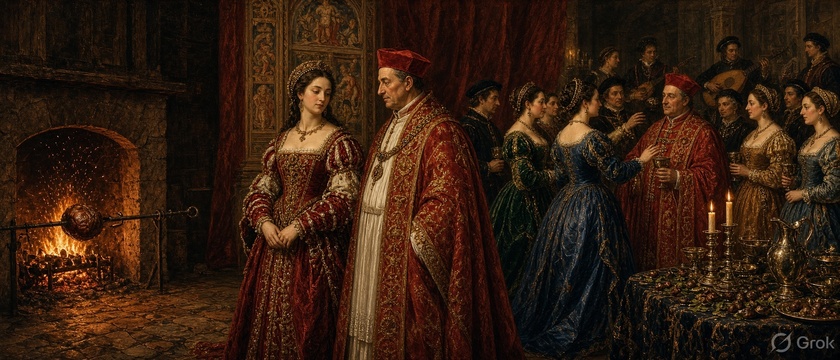
The Banquet (or Ballet) of Chestnuts was a notorious supper and entertainment purportedly held in the Apostolic Palace (Vatican) in Rome on the evening of 30/31 October 1501 (All Saints’ Eve), hosted by Cesare Borgia. The primary and most detailed source is the Liber Notarum (also called the Diarium), the official diary of Johann Burchard, the papal master of ceremonies.

Significant Figures

  • Cesare Borgia (c. 1475–1507): Son of Pope Alexander VI. A former cardinal who renounced the purple to become a condottiere and Duke of Valentinois. He was the host and central organizer.
  • Pope Alexander VI (Rodrigo Borgia, 1431–1503): The Spanish-born pope (elected 1492). According to Burchard, he was present and observed the proceedings. He is historically noted for nepotism, multiple illegitimate children, and a reputation for worldliness.
  • Lucrezia Borgia (1480–1519): Daughter of Alexander VI and sister of Cesare. Burchard places her among the spectators. She was a political pawn in dynastic marriages; at this time she was between marriages and later became Duchess of Ferrara.
  • Johann (Johannes) Burchard (c. 1450–1506): Alsatian-born priest, Protonotary Apostolic, and long-serving Master of Ceremonies under several popes. His diary is a key primary source for the Roman court under Alexander VI. He was not especially friendly to the Borgias.

Background

Alexander VI’s papacy (1492–1503) was marked by intense political maneuvering, the elevation of family members, and a court culture that blended Renaissance humanism, luxury, and clerical worldliness. Rome had a large and visible community of courtesans (high-status sex workers who also functioned as entertainers and conversationalists). Cesare, ambitious and military-minded, frequently hosted gatherings in his apartments. The date—All Saints’ Eve—adds a note of liturgical contrast that later writers emphasized.

Burchard’s account states that Cesare arranged a supper in his chambers for about fifty “honest prostitutes” (meretrices honestae), also called courtesans. After the meal they danced with servants and guests, first clothed and then naked. Candelabra with burning candles were placed on the floor; chestnuts were scattered among them. The naked women crawled on hands and knees between the lights to collect the nuts while the Pope, Cesare, and Lucrezia looked on. Prizes (silken tunics, shoes, barrets, and other items) were then offered to the men who “performed the act” most frequently with the women.

Result and Historicity

There was no formal political or institutional “result.” The episode’s lasting impact has been cultural and reputational: it became a cornerstone of the Borgia “black legend,” amplified in later Protestant and anti-papal writing and in modern popular culture (novels, films, and the TV series The Borgias).

Contemporary and modern assessments treat the full account with caution:

  • Two independent contemporary sources confirm that a social gathering involving courtesans occurred around that date, but they give far fewer and milder details. A Florentine envoy (Francesco Pepi) reported dancing and late revelry; a letter associated with Silvio Savelli notes courtesans dining at the palace and offering “a most shocking sight” without mentioning the chestnut ritual or open sexual contest.
  • Critics (including the Vatican researcher Peter de Roo) have argued that the most extreme elements may be a later interpolation, an exaggeration by a hostile diarist, or a conflation of milder events. Some note that the surviving original manuscript of Burchard does not cover 1501, so the passage depends on early copies. Others observe that inviting courtesans to lively private gatherings was not unknown in Renaissance Rome.
  • Defenders point out that Burchard is generally a sober, factual recorder of court protocol, that the passage appears in the oldest copies, and that Alexander VI’s known lifestyle (multiple children, open favoritism) makes a licentious evening plausible. Giles Milton and others have argued the account is consistent with the diary’s overall character.

In short, a banquet with courtesans and dancing in Cesare’s apartments on or about 31 October 1501 is reasonably supported; the precise chestnut-crawling spectacle, the open sexual competition, and the active spectatorship of Alexander VI and Lucrezia rest almost entirely on Burchard’s single diary entry and remain debated. The story has endured far more for its vividness and its fit with the broader Borgia reputation than for unanimous scholarly acceptance of every detail.

= October 30th 

October 30 is the shared date for these events (with minor variations in some records for the exact day of the Stettin negotiations or the Guangzhou raid, which Chinese sources place in late September/the ninth lunar month of 758).

Here is a concise overview of each:

  • 637 – Surrender of Antioch: After the Battle of the Iron Bridge (fought near the Orontes River, with heavy Byzantine losses), the Rashidun army under commanders including Khalid ibn al-Walid and Abu Ubaidah ibn al-Jarrah besieged Antioch. The city, a major Byzantine center in Syria, surrendered on 30 October. Terms typically allowed safe passage for troops or payment of the jizya. This effectively completed Muslim control over most of Roman Syria.
  • 758 – Sack of Guangzhou: During the Tang dynasty (amid the An Lushan Rebellion), Arab and Persian forces (described in Chinese annals as Dashi and Bosi troops or raiders) attacked the major port of Guangzhou (Canton). They looted and burned warehouses and parts of the city; the local governor Wei Lijian fled. Motives are debated—possibly related to trade grievances, mistreatment of foreign merchants, or military opportunism—but it disrupted the city’s role as a Silk Road maritime hub for a period.
  • 1137 – Battle of Rignano: Fought on 30 October near Rignano Garganico in southern Italy during the Norman conquest. Rebel Normans under Ranulf of Alife (recently made Duke of Apulia by Emperor Lothair II and Pope Innocent II, with some German troops) defeated the forces of King Roger II of Sicily (and his son Roger III). Sergius VII of Naples was killed. It was a significant setback for Roger II’s efforts to consolidate control in southern Italy.
  • 1270 – End of the Eighth Crusade / Siege of Tunis: King Louis IX of France had died of illness (likely dysentery) in August during the siege. His brother Charles I of Sicily (Anjou) negotiated an agreement with the Hafsid sultan of Tunis on or around 30 October. The Crusaders gained trade privileges and protections for clergy but no major territorial gains or conversion; the campaign largely collapsed due to disease. Edward of England’s forces arrived shortly afterward for what became the Ninth Crusade.
  • 1340 – Battle of Río Salado (or Tarifa): On 30 October, allied Castilian and Portuguese forces under Alfonso XI of Castile and Afonso IV of Portugal decisively defeated a large Marinid (Moroccan) and Granadan army under Abu al-Hasan and Yusuf I near the Salado River. This halted a major North African invasion of Iberia and was a key late-stage victory in the Reconquista.
  • 1485 – Coronation of Henry VII: Henry Tudor (who had defeated Richard III at Bosworth on 22 August) was crowned King of England at Westminster Abbey on 30 October, founding the Tudor dynasty. The timing helped secure his position before Parliament sat.
  • 1501 – Ballet (or Banquet) of Chestnuts: According to the diary of papal master of ceremonies Johann Burchard, Cesare Borgia hosted a notorious banquet in the Papal Palace on 30/31 October. About fifty courtesans/prostitutes entertained guests (including, by the account, the Pope and Lucrezia Borgia); after dinner they allegedly danced naked while picking up chestnuts from the floor amid candelabra, with sexual prizes offered. Contemporary and modern sources debate the account’s full accuracy or possible later embellishment.
  • 1657 – Battle of Ocho Rios (Las Chorreras): During the Anglo-Spanish War, Spanish forces under former governor Cristóbal Arnaldo Isasi (with reinforcements from Cuba) landed near Ocho Rios, Jamaica, hoping to retake the island seized by the English in 1655. English forces under acting governor Edward D’Oyley defeated them in a short engagement; Isasi fled to the hills while others were captured. This helped secure English control of Jamaica.
  • 1806 – Capitulation of Stettin: In the aftermath of Napoleon’s victories at Jena-Auerstedt, Prussian Lt. Gen. Friedrich von Romberg (with ~5,300 men and many guns) surrendered the fortress of Stettin (Szczecin) on the night of 29–30 October to a much smaller French force (~500–800 light cavalry under Gen. Antoine Lasalle). Romberg was bluffed into believing he faced a far larger army. The garrison was captured with minimal French losses.
  • 1817 – Venezuelan independence efforts under Bolívar: After securing Angostura (Ciudad Bolívar) and dealing with internal challenges (including the execution of rival Manuel Piar earlier in October), Simón Bolívar was consolidating the independent government of the Third Republic of Venezuela in the Orinoco region. Records note administrative and military steps around late October (including a Council of State), marking progress in the independence wars against Spanish rule.
  • 1831 – Capture of Nat Turner: After leading the deadliest U.S. slave rebellion (August 1831 in Southampton County, Virginia, which killed ~55–60 whites), Nat Turner hid for weeks. He was captured on 30 October by Benjamin Phipps near the rebellion’s starting area. He was tried, hanged on 11 November, and his dictated Confessions were published soon after. The revolt led to harsher slave codes across the South.

These events span Muslim expansions, medieval European wars, the Reconquista, Tudor England, Renaissance papal scandals, colonial Caribbean conflict, Napoleonic campaigns, Latin American independence, and U.S. antebellum slavery. Dates for some (especially the 758 Guangzhou raid and precise Stettin timing) can vary slightly by source or calendar.

Read full Article
See More
Available on mobile and TV devices
google store google store app store app store
google store google store app tv store app tv store amazon store amazon store roku store roku store
Powered by Locals