When actors fight with writers
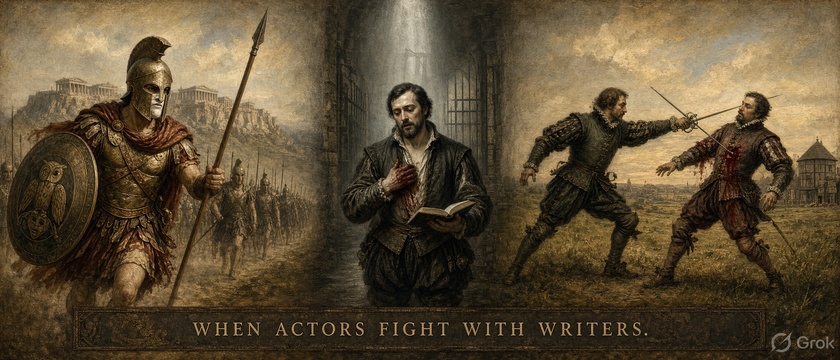
In ancient Greece and Rome, the theatre could be brutal, but it had not yet gone as far as Elizabethan London. Playwrights might serve, actors might brawl, and festivals could explode. What they rarely did was meet in a field with rapiers and leave one man dead of a six-inch wound.
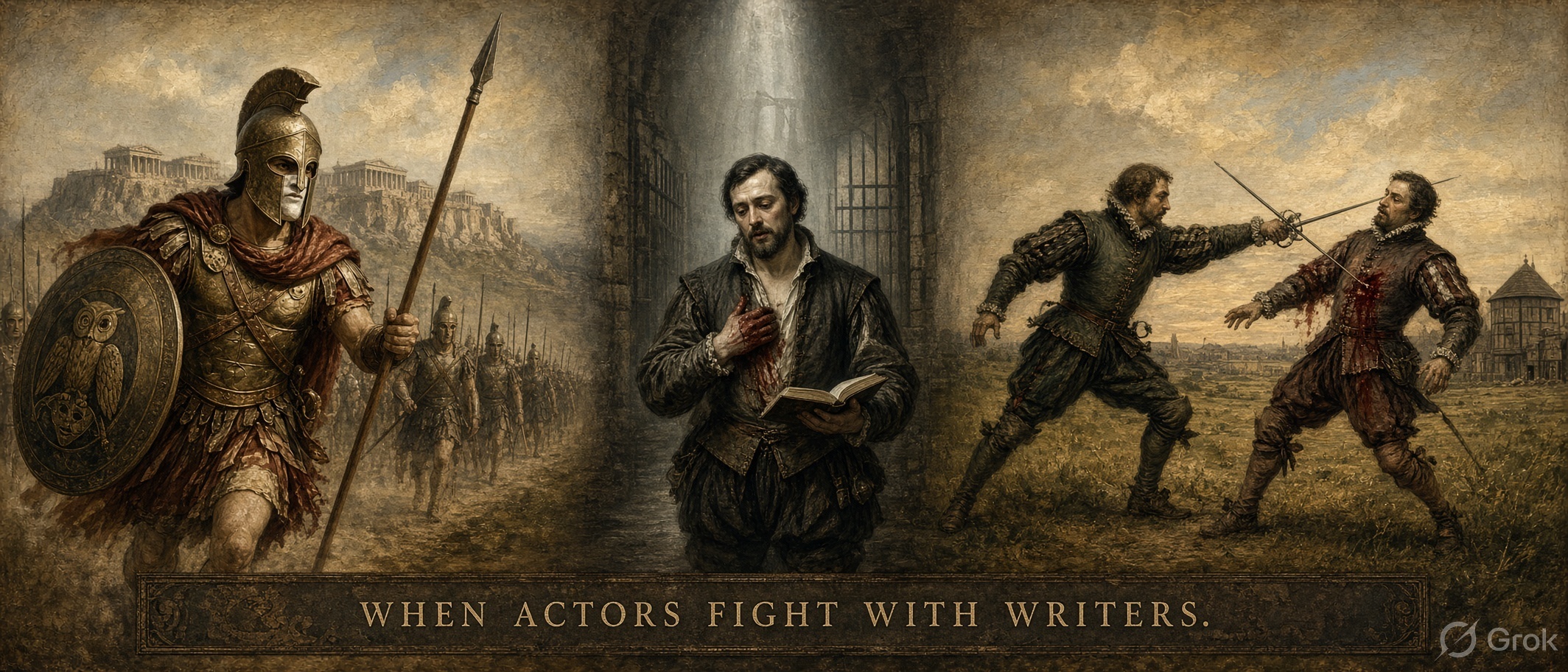
The clearest military example is Aeschylus. He fought at Marathon in 490 BC; his brother Cynaegirus died there. Tradition also links him with Salamis and Plataea. He acted in his own plays. The epitaph he is said to have composed for himself mentions Marathon and says nothing about his tragedies. Sophocles held the civic-military office of strategos. That is command, not arena fighting.
Rome usually kept the professions apart. Livy records that professional actors—histriones—were not enrolled in the legions, and that a citizen who took up acting was struck from his tribe. Players of Atellan farce were an exception, because that form stayed closer to amateur performance. Actors and gladiators both carried infamia: legal disgrace. They could not hold certain offices; their testimony and marriage rights were restricted. They were adjacent low-status spectacle trades, not the same job.
Violence still gathered around the theatre. Competition was fierce. Alcibiades punched a rival chorus-producer—and, in some accounts, a chorus boy—in the Theatre of Dionysus during the Great Dionysia. Decades later Meidias punched Demosthenes in the same theatre. Those were political-religious festival assaults, not stage fights. In Rome, actor cliques and their partisans could riot. Livy and later writers describe faction feeling that ran to bloodshed, in the same register as the circus crowds. Audiences pelted performers.
Elizabethan London closed the gap. On 22 September 1598, in the fields at Hoxton—then Hogsden or Hoggesdon Fields, in Shoreditch—the twenty-six-year-old playwright Ben Jonson killed the actor Gabriel Spencer in a duel. Spencer died on the spot from a rapier thrust six inches deep and an inch wide into his right side. Jonson was indicted for manslaughter, pleaded guilty, and escaped the gallows only by claiming benefit of clergy.
Spencer was a rising player with the Admiral’s Men under Philip Henslowe. He already had a violent reputation. In December 1596, in a Shoreditch barber’s house, he drove a still-sheathed rapier into the eye of James Feake, a goldsmith’s son, after Feake threatened him with a candlestick. Feake died three days later. There is no record that Spencer was punished.
The two men had also been locked up together the year before. In 1597 Jonson co-wrote the lost satirical play The Isle of Dogs with Thomas Nashe. The Privy Council judged it seditious, closed the London theatres, and imprisoned Jonson, Spencer, and another actor, Robert Shaa, in the Marshalsea. Nashe fled. The company broke up and Spencer had to find new work. No one recorded why they later fought. Later guesses include leftover anger over that scandal, or Spencer calling Jonson a bricklayer—the trade Jonson had been trained in and disliked.
Years afterwards Jonson told William Drummond that Spencer had challenged him, arrived with a sword ten inches longer than Jonson’s, and wounded him in the arm first. The indictment is colder: Benjamin Johnson, “yeoman,” “feloniously and wilfully” assaulted Spencer in the fields with a rapier worth three shillings and gave him the mortal wound. Spencer “died instantly.”
Henslowe wrote to Edward Alleyn four days later: “I have lost one of my company, which hurteth me greatly, that is Gabriel, for he is slain in Hogsden Fields by the hands of Benjamin Jonson, bricklayer.”
Jonson was held in Newgate. At the Old Bailey he confessed to manslaughter. The penalty was hanging. He then claimed benefit of clergy: a medieval privilege that, by Elizabeth’s reign, any literate man could use once. He read Psalm 51—the “neck verse”: “Have mercy upon me, O God…” The court recorded that he “read like a clerk,” branded him on the thumb with the letter T, the Tyburn T, and confiscated his goods. He could not use the plea again.
While in prison he converted to Roman Catholicism, possibly under the influence of the Jesuit Thomas Wright, who worked among prisoners. He later returned to the Church of England. The same year his first major success, Every Man in His Humour, was on the stage. Enemies do not seem to have used Spencer’s death against him much afterwards. Some contemporaries thought Spencer had it coming.
Jonson had already, by his own later account, killed a man in single combat while serving in the Low Countries. The 1598 duel is the one that left a mark on his thumb and nearly ended the career that produced Volpone, The Alchemist, and Bartholomew Fair.
Aeschylus could fight Persians and still be buried as a soldier. Sophocles could hold a generalship and still be Sophocles. Rome kept actors off the roll of honour. London put the writer and the player in the same marsh and the same field, with steel in their hands.
Today it tends to be certain drugs that spark the violence. That is not limited to actors.