United We Stand. Divided We Fall.
First guns at sea and a massacre of prisoners; a broken truce that made Drake and Hawkins lifelong enemies of Spain; a treasure still on the bottom; a dying ship that won anyway; and a pass in a boot that saved a fortress and hanged a major. Late September, four centuries of the same themes — cargo, convoy, honour, and who keeps faith once the shooting starts.
Benedict Arnold was a traitor who tried to give West Point to the British. He had intended the death of many. With Major John André, charged with carrying the plans, he achieved one. They met on the night of 21 September 1780. Arnold, commanding the Hudson fortress, had been selling it for £20,000. André came upriver in HMS Vulture, took the maps and the notes on how the defences had been weakened, and took a pass in the name “John Anderson.” American guns drove the Vulture downriver. André had to go overland in civilian clothes with the papers in his stocking. On the morning of the 23rd, three New York militiamen — John Paulding, David Williams and Isaac Van Wart — stopped him near Tarrytown. He first took them for Loyalists, then offered watch and money. They searched him, found the papers, and sent him in. Arnold got word in time and fled to the British. André, taken in disguise with the documents, was tried as a spy, not a prisoner of war, and hanged at Tappan on 2 October. Washington kept West Point. Arnold’s name became the American word for treason. André, young and composed on the scaffold, drew reluctant respect even from some of his captors. Division did its work: one man sold the line; another paid for the meeting.
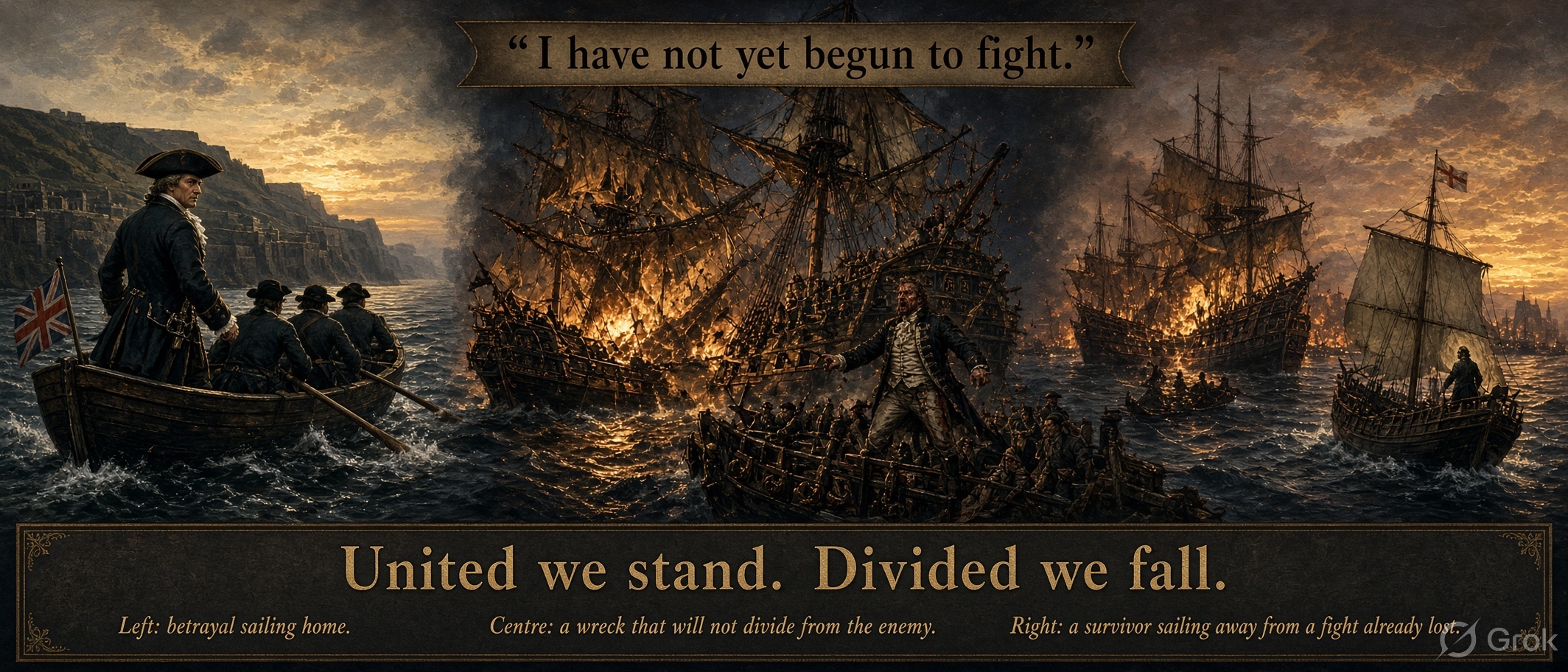
A year earlier, almost to the day, John Paul Jones said, “I have not yet begun to fight.” Stirring words — and he was already in the middle of a pitched battle. On 23 September 1779, off Flamborough Head, Jones in the converted East Indiaman Bonhomme Richard — named for Franklin’s Poor Richard — met a Baltic convoy with Alliance, Pallas and Vengeance. The escorts were the new 44-gun Serapis under Captain Richard Pearson and Countess of Scarborough. After a ruse with British colours, both sides fired almost together. Two of Jones’s old 18-pounders burst. Outgunned and leaking, he lashed his ship to Serapis so Pearson could not use better sailing and a heavier broadside. The fight ran into the night. When asked if he struck, he gave the line. A grenade down a hatch set off cartridges on Serapis. Pearson struck. Pallas took Countess of Scarborough. Bonhomme Richard was so smashed she sank two days later. Jones shifted his flag to the prize. The convoy escaped, but the Royal Navy had lost two warships in home waters to a rebel squadron. Unity here was oak, lashings and refusal to separate. A dying ship won because its captain would not let the enemy fight at the range that favoured him.
One hundred and thirty-eight years earlier, same stretch of late September, Merchant Royal sank with Spanish gold now valued in the high hundreds of millions, often put over a billion pounds. It was not a battle, except against weather, a leak and broken pumps. On 23 September 1641, off Land’s End, the English merchantman went down. She had spent two years in the West Indies, put into Cádiz leaking, then taken on a Spanish payroll for Flanders — gold, Mexican silver bars, pieces of eight, jewels — on top of her own cargo. Captain John Limbrey and some forty men were taken off by the sister ship Dover Merchant. Eighteen drowned. The wreck was never found. An anchor lifted by a Cornish trawler in 2019 is sometimes claimed as hers; it has not been proved. She is still called the El Dorado of the seas. The gold was too heavy to salvage. Division again, of a blunter kind: hull from pumps, ship from sister, treasure from the men who lived.
Seventy-three years before that, near Veracruz, English ships — branded pirates and slavers by Madrid — fought a losing fight against about thirteen Spanish vessels. Drake escaped. On 23–24 September 1568, John Hawkins’s third slaving and trading voyage into Spain’s American monopoly ended in the harbour of San Juan de Ulúa. Six ships: flagship Jesus of Lübeck, leased from Elizabeth I; Minion; Drake’s little Judith; three smaller craft. They had been selling enslaved Africans and goods along the Spanish Main, often by force, in defiance of the Treaty of Tordesillas. Storm damage sent them in to repair. A Spanish fleet arrived with the new viceroy, Martín Enríquez de Almanza. A truce was agreed so both sides could use the anchorage. The Spanish broke it: boarding parties, shore batteries, a hulk as a platform. Four English ships were sunk or taken. Only Minion and Judith got out. English losses ran to hundreds of men and almost the whole profit of the voyage. Hawkins and Drake called it treachery. Madrid called it the suppression of smugglers. The hatred it planted helped set the tone of later English privateering against Spain. A truce is a form of unity. Break it, and you breed a longer war.
Two hundred and thirty years earlier still, in 1338, the first naval battle of the Hundred Years’ War proved gunpowder useful, but not everything. Off Arnemuiden, usually dated 23 September, five English cogs under John Kingston were carrying wool to Antwerp so Edward III could pay his allies. A French galley fleet under Hugues Quiéret and Nicolas Béhuchet caught them — outnumbered about ten to one, some English still ashore. The flagship Christopher mounted three primitive cannons and one hand-gun: first recorded European use of artillery at sea. Stone and metal at range instead of only arrows, ramming and boarding. It was not enough. After a day’s fighting Kingston surrendered. The French took the ships and the wool, then massacred the prisoners. Chronicles dwell on the handsome Christophe, built at great cost to the English king, and on the crew put to death. The tactical lesson ran against the technological one. Artillery had arrived at sea. Numbers and boarding still decided the day. A small squadron, divided from the shore and from any supporting fleet, died with its new guns.
United we stand. Divided we fall. The proverb is older than any of these fights, and it is not a hymn to sameness. It is a warning about the moment when a line, a hull, a truce or a pass is split from the men who have to hold it. Arnold divided the cause and ran. Jones refused to divide his wreck from Pearson’s stronger ship and took her. Merchant Royal divided from her pumps and her sister and took the gold with her. Hawkins trusted a harbour truce and lost a fleet. Kingston’s five cogs, cut off and outnumbered, learned that the first cannons at sea do not cancel isolation. Late September keeps teaching the same lesson: cargo and convoy matter; honour matters more; and the side that keeps faith after the first shot is the side that still has a fortress, a prize, or a name worth keeping.