JFK tried
These two events both occurred on (or were dated to) 6 November in successive years.
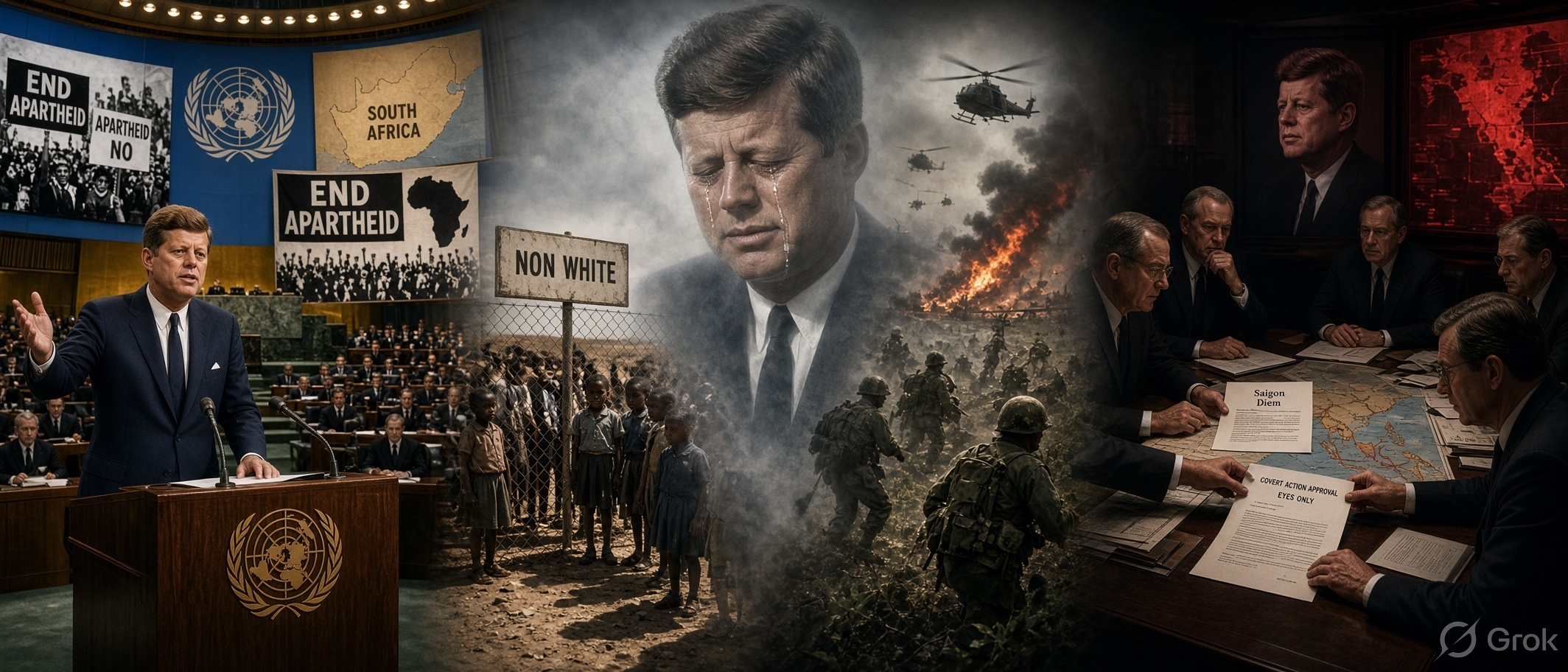
1962 – UN General Assembly Resolution 1761 condemning apartheid
On 6 November 1962 the UN General Assembly adopted Resolution 1761 (XVII), “The policies of apartheid of the Government of the Republic of South Africa.”
The resolution:
- Deplored South Africa’s refusal to abandon its racial policies and its disregard of the UN Charter.
- Declared that the continuance of apartheid seriously endangered international peace and security.
- Called on member states, separately or collectively, to take measures including breaking diplomatic relations (or not establishing them), closing ports to vessels flying the South African flag, prohibiting their own ships from entering South African ports, boycotting South African goods, and suspending landing rights for South African aircraft.
- Established a Special Committee on the Policies of Apartheid to keep the situation under review.
It passed by 67 votes to 16, with 23 abstentions. South Africa itself, along with several Western states (including the United Kingdom, the United States, Australia, Belgium, Canada, and Portugal), voted against or abstained. The resolution was non-binding.
Context and significance. Apartheid had been formalised after the 1948 election victory of the National Party. International condemnation intensified after the 1960 Sharpeville massacre, in which police killed 69 unarmed Black protesters. Resolution 1761 was one of the strongest early UN calls for diplomatic, economic, and military isolation. Western powers and South Africa’s main trading partners largely resisted full sanctions at the time, but the resolution marked a clear shift toward treating apartheid as an international issue. Later UN measures, including an arms embargo and the eventual designation of apartheid as a crime against humanity, built on this foundation. South Africa was suspended from the General Assembly in 1974; apartheid formally ended in the early 1990s.
1963 – General Dương Văn Minh assumes leadership of South Vietnam
On 1–2 November 1963 a group of South Vietnamese generals staged a coup against President Ngô Đình Diệm. Diệm and his influential brother Ngô Đình Nhu were captured and killed (officially reported as suicide, but widely understood to have been executed). In the following days the coup leaders consolidated power; by 6 November, General Dương Văn Minh (“Big Minh”) was recognised as the head of the new Military Revolutionary Committee and effectively the leader of South Vietnam.
Key figures.
- Dương Văn Minh (1916–2001): Senior army officer, popular with many officers and the Americans. He chaired the Military Revolutionary Committee. Real power rested with the military junta rather than any civilian figurehead.
- Ngô Đình Diệm: President since 1955; increasingly authoritarian, especially in the suppression of Buddhist protests in 1963. His removal had the tacit awareness (and, according to some accounts, encouragement) of the U.S. Embassy under Ambassador Henry Cabot Lodge.
- Other junta members included Generals Trần Văn Đôn and Tôn Thất Đính. A civilian, Nguyễn Ngọc Thơ, was named premier, but the military committee held ultimate authority. The constitution was suspended, the National Assembly dissolved, and martial law declared.
Aftermath. Minh’s government was short-lived and ineffective. He was ousted in a bloodless coup led by General Nguyễn Khánh on 30 January 1964. South Vietnam then entered a period of rapid political instability with successive coups and juntas. Minh later served briefly as the last president of South Vietnam in April 1975 and oversaw the formal surrender to North Vietnamese forces.
The 1963 coup is widely regarded as a turning point: it removed a leader the United States had supported for years, deepened U.S. involvement, and contributed to the political chaos that characterised South Vietnam until its collapse in 1975. President Kennedy was reportedly shocked by the assassinations of Diệm and Nhu.
Both events reflected the intensifying Cold War and decolonisation pressures of the early 1960s—one through multilateral diplomatic condemnation of racial policies, the other through a U.S.-influenced military takeover that accelerated the Vietnam War.
= 6th November
These events all took place on 6 November in their respective years. Here is a concise overview of each:
355 – Elevation of Julian to Caesar
Roman Emperor Constantius II promoted his cousin Julian (later known as Julian the Apostate) to the rank of Caesar at Mediolanum (modern Milan). Julian, then about 23–24 and a scholarly, inexperienced figure who had spent much of his life under supervision studying Greek philosophy and Neoplatonism, was given responsibility for the Prefecture of the Gauls (the Western provinces).
The appointment came after Constantius had executed Julian’s half-brother Gallus and faced ongoing Germanic threats and a recent revolt in Gaul. Julian was married to Constantius’s sister Helena and sent west with limited forces and oversight. He proved unexpectedly successful as a military and administrative leader, defeating Alemanni and Franks and restoring order. In 360 his troops proclaimed him Augustus; after Constantius’s death in 361, Julian became sole emperor (361–363).
963 – Synod of Rome and deposition of Pope John XII
Emperor Otto I convened a synod in St. Peter’s Basilica in Rome beginning on 6 November. Pope John XII (who had crowned Otto emperor in 962) faced charges including simony, perjury, murder, adultery, incest, and breaking his oath of loyalty by plotting against Otto. John refused to appear, excommunicated the participants from afar, and fled. The synod deposed him (formally on 4 December) and elected the layman Leo (as Leo VIII) in his place.
This was a significant assertion of imperial authority over the papacy. After Otto left, John returned, overturned the acts, and the situation remained contested until later events.
1217 – Charter of the Forest
The Charter of the Forest was sealed at Old St Paul’s Cathedral in London by the young King Henry III (acting under the regency of William Marshal, 1st Earl of Pembroke). Issued as a companion to the reissued Magna Carta, it restored rights of access for free men to the royal forests that had been heavily restricted and expanded by William the Conqueror and his successors.
Key provisions limited the extent of royal forest, reduced harsh forest-law punishments, and allowed free men to use wood, pasture, and other resources on forest land under certain conditions. It remained influential for centuries (some elements lasted until the 20th century) and is regarded as an important early statement of common rights over land and resources.
1528 – Cabeza de Vaca reaches Texas
Shipwrecked Spanish conquistador Álvar Núñez Cabeza de Vaca (of the failed Narváez expedition) and surviving companions washed ashore on or near what is now Galveston Island (or a nearby Texas barrier island) on 6 November. This is widely regarded as the first known European landing in the area that became Texas.
The expedition had collapsed after landing in Florida; survivors built crude rafts and tried to reach Mexico. Storms separated them; only a handful eventually survived years of hardship, captivity, and travel among Indigenous peoples across the Gulf Coast and interior before reaching Spanish settlements in northern Mexico in 1536. Cabeza de Vaca’s later account is a major early source on the peoples and geography of the region.
1789 – Appointment of the first U.S. Catholic bishop
Pope Pius VI appointed Father John Carroll as the first Catholic bishop in the United States (Bishop of Baltimore, with jurisdiction over the entire country) on 6 November. Carroll, a Maryland Jesuit from a prominent family, had previously served as prefect apostolic and was recommended by the American clergy.
He was consecrated the following year (15 August 1790) in England. As the first American bishop he organised the Church in the new republic, founded institutions including Georgetown College (later University), and worked to establish a native clergy and seminaries while navigating relations with both Rome and the U.S. government.
1792 – Battle of Jemappes
In the French Revolutionary Wars (War of the First Coalition), French forces under General Charles-François Dumouriez defeated an Austrian army commanded by Duke Albert of Saxe-Teschen near Jemappes (in the Austrian Netherlands, modern Belgium) on 6 November. The French, with a large force of volunteers, outnumbered the Austrians and carried a prepared position on a ridge after hard fighting.
It was one of the first major offensive victories for the armies of the young French Republic. The French quickly overran the Austrian Netherlands (including Brussels), though they later lost the territory at the Battle of Neerwinden. The battle demonstrated the effectiveness of the new revolutionary armies against professional European forces.
These events span late antiquity, the medieval period, the Age of Exploration, the American founding era, and the French Revolution, illustrating a range of political, religious, legal, and military developments on the same calendar date.