“AREOPAGITICA” by John Milton
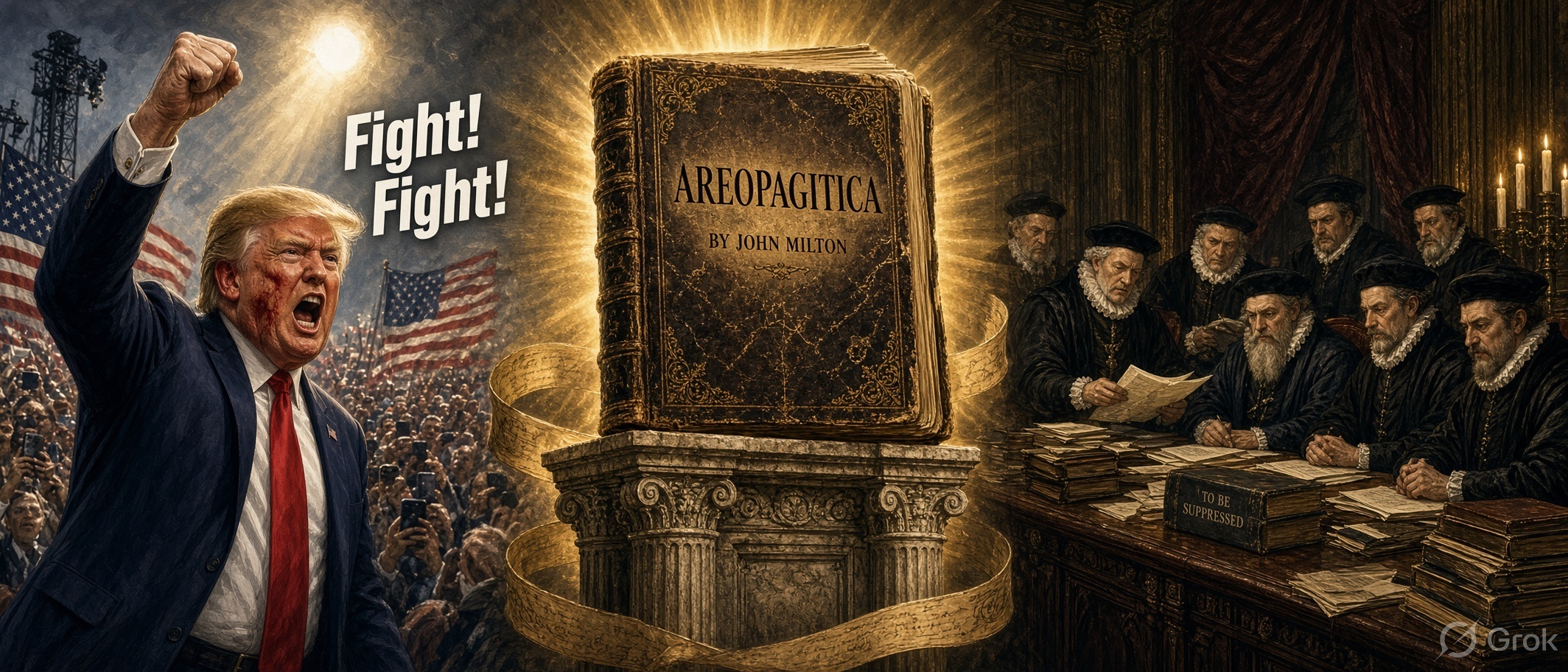
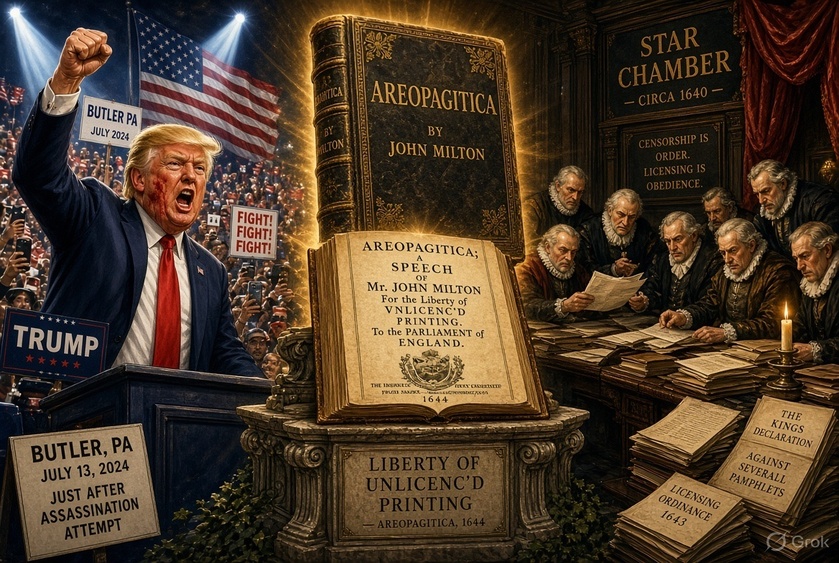
Areopagitica (full title: Areopagitica; A Speech of Mr. John Milton for the Liberty of Unlicenc’d Printing, to the Parlament of England) is one of the most important early modern arguments against pre-publication censorship. Published on 23 November 1644 as a pamphlet (itself unlicensed), it was addressed to the English Parliament during the First English Civil War. It did not immediately succeed, but it became a foundational text for later ideas about free speech and a free press.
Before: Context and the Licensing Order of 1643
Press control in England had a long history. Henry VIII introduced licensing of books; later monarchs and the Star Chamber (a royal prerogative court) enforced it. The system aimed to suppress heresy, sedition, and criticism of Church or Crown.
In 1641, during the lead-up to and early stages of the English Civil War (1642–1651), the Long Parliament abolished the Star Chamber. This removed the main instrument of pre-publication censorship and triggered an explosion of pamphlets, newsbooks, and political/religious tracts—from a few dozen per year to nearly 2,000 in 1642 alone. Parliament had earlier opposed royal censorship, but once in power it faced royalist propaganda, radical religious writing, and disorder in the book trade.
On 14 June 1643, Parliament issued the Ordinance for the Regulating of Printing (the Licensing Order of 1643). It required that no book, pamphlet, or paper be printed or sold unless first approved and licensed by persons appointed by Parliament, entered in the Stationers’ Company register, and (in most cases) bearing the author’s name. Unlicensed presses could be searched and seized; authors, printers, and sellers could be punished. The stated goals were to suppress “false, forged, scandalous, seditious, libellous, and unlicensed” works and to protect the Stationers’ Company’s commercial privileges.
Milton had personal reasons to object. In 1643–44 he published controversial tracts arguing for the right to divorce on grounds of incompatibility (after a short and troubled marriage to Mary Powell). These were censored or met with hostility; one clergyman reportedly said they deserved to be burnt. Milton had earlier supported the Parliamentary side and the attack on royal censorship, so the Order felt like a betrayal of the liberties he expected from the new regime. He also referenced the harsh treatment of figures such as John Lilburne (flogged and pilloried in 1638 for importing unlicensed books).
The title alludes to Isocrates’ Areopagiticus (4th century BC), a speech addressed to the Athenian Areopagus council. Milton, not a member of Parliament, wrote in the form of a speech to the “High Court of Parliament,” deliberately circulating it without a licence.
Significant Figures
- John Milton (1608–1674): The author—poet, scholar, and polemicist, deeply versed in classical, biblical, and contemporary learning. At this stage he was a supporter of Parliament (initially leaning Presbyterian) who later served the Commonwealth as Latin Secretary (Secretary for Foreign Tongues). He is best known today for the epic Paradise Lost (1667). Areopagitica is his finest prose work. Later, under the Commonwealth, he himself licensed material for the official newsbook Mercurius Politicus (edited by Marchamont Nedham) and other texts—an apparent practical contradiction of his earlier principles that scholars note when assessing the consistency of his free-speech stance.
- The Long Parliament: The body that issued the 1643 Order. Milton addresses it directly, praising its anti-royalist stance while criticising the new censorship.
- Stationers’ Company: The London guild of printers and booksellers that enforced licensing and held monopolies. The Order protected its commercial interests as well as political control.
- Later influencers and readers: John Locke (who helped argue against renewal of licensing in the 1690s), John Stuart Mill (On Liberty, 1859), and American figures such as Thomas Jefferson (who quoted or engaged with the ideas). The French revolutionary Mirabeau’s translation circulated in the late 1780s–early 1790s.
After: Immediate Failure and Longer-Term Legacy
Areopagitica did not persuade Parliament to repeal the licensing requirement. The Order remained in force through the Commonwealth period. After the Restoration of the monarchy (1660), tighter controls returned under the Licensing of the Press Act 1662 (and renewals). Pre-publication licensing finally ended in England in 1695 when Parliament allowed the Licensing Act to lapse (John Locke played a notable role in the opposition, citing both commercial monopolies and the principle that a man should be free to print what he is free to speak, and answerable afterward).
Milton’s pamphlet had little immediate political effect—partly because his radical views on divorce had already marked him as extreme to many Presbyterians. Its real influence came later. It helped shape Enlightenment and liberal arguments for free expression. Key elements that endured include:
- Opposition to prior restraint (pre-publication licensing) while accepting that authors could still be punished after publication for libel, sedition, or other offences.
- The idea that truth is strengthened by open contest with error (“Let her and Falsehood grapple; who ever knew Truth put to the worse, in a free and open encounter?”).
- The value of reading widely, including “bad” or erroneous books, for developing judgment and virtue (“I cannot praise a fugitive and cloistered virtue”).
- Books as living things that embody reason: “as good almost kill a man as kill a good book… who destroys a good book, kills reason itself.”
- The famous plea: “Give me the liberty to know, to utter, and to argue freely according to conscience, above all liberties.”
These ideas fed into the Anglo-American free-speech tradition. They influenced arguments against prior restraint in English and American law, the “marketplace of ideas” concept associated with Mill and later free-speech theory, and the intellectual climate that produced the U.S. First Amendment. Note, however, that Milton did not advocate absolute free speech. He explicitly excluded Roman Catholicism (“popery”) and certain “superstitious” or “evil” writings from protection, and he was prepared to support post-publication sanctions. Modern readers often highlight both the power of his arguments and these limitations.
Influence Today
Areopagitica remains a foundational text in the history of free expression. It is regularly cited in discussions of press freedom, prior restraint (e.g., in U.S. Supreme Court cases opposing government pre-approval of speech), academic freedom, and the dangers of state or institutional gatekeeping of ideas. The core claim—that open debate is more likely to advance truth than pre-emptive censorship, and that individuals need exposure to conflicting ideas to develop sound judgment—still underpins liberal free-speech principles.
In the digital age it is invoked in debates over content moderation, social-media platforms, “disinformation,” campus speech codes, and government attempts to regulate online expression. Critics note that Milton’s own exceptions and later role as a licenser show the perennial tension between free expression and the desire to suppress ideas one regards as dangerous. Supporters emphasize that the pamphlet’s lasting value lies in its insistence that the risks of free exchange are preferable to the risks of empowering censors.
In short: written in the heat of civil war against a Parliament that had just reimposed the censorship it once opposed, Areopagitica failed in its immediate goal but supplied enduring arguments that helped dismantle licensing systems and shaped the modern ideal of a free press. Its influence is visible wherever free societies still debate the proper limits of prior restraint and the value of open argument.
= November 23rd
These events are traditionally associated with 23 November in historical calendars (including Wikipedia’s “On this day” listings). Here is a concise overview of each:
534 BC – Thespis of Icaria becomes the first recorded actor
Thespis (from the deme of Icaria/Icarius near Athens) is credited by Aristotle and later tradition as the first person to step out of the chorus and portray an individual character on stage, rather than merely narrating or singing in the third person. He used masks (often of linen) to distinguish roles and is regarded as the inventor or pioneer of tragedy. In 534 BC, under the tyrant Peisistratus, formal tragic competitions began at the City Dionysia festival in Athens; Thespis is said to have won the first one. His name is the root of the word “thespian.” He is also associated with early theatrical touring, carrying props and costumes in a wagon.
1174 – Saladin enters Damascus
After the death of Nur al-Din in 1174, Saladin (Ṣalāḥ ad-Dīn Yūsuf ibn Ayyūb), already dominant in Egypt (where he had abolished the Fatimid caliphate in 1171 and restored Sunni rule under the Abbasids), moved on Damascus. He entered the city relatively peacefully and added it to his domains. This was a crucial step in uniting Egypt and Syria under Ayyubid rule, enabling the later campaigns that culminated in the Battle of Hattin (1187) and the recapture of Jerusalem from the Crusaders.
1248 – Conquest of Seville by Ferdinand III of Castile
Ferdinand III of Castile completed a roughly 16-month siege of Seville (one of the major remaining Muslim cities in al-Andalus). Castilian forces isolated the city by land and sea; Ramón de Bonifaz’s fleet broke the chain across the Guadalquivir that linked Seville to Triana. The city surrendered on 23 November 1248. Large numbers of Muslim inhabitants were allowed or compelled to leave; the great mosque was converted into a cathedral (later rebuilt as the Gothic Seville Cathedral, with the Giralda minaret surviving as the bell tower). This was a major milestone in the Reconquista.
1499 – Execution of Perkin Warbeck
Perkin Warbeck (born Pierrechon de Werbecque in Tournai, Flanders) was a pretender who claimed to be Richard of Shrewsbury, Duke of York—one of the Princes in the Tower, the younger son of Edward IV. He gained support from various European courts, invaded England in 1497 with Cornish rebels, and was captured. After a later escape attempt from the Tower of London (linked to a plot involving the Earl of Warwick), he was tried for treason and hanged at Tyburn on 23 November 1499, after reading a confession. His elimination, along with Warwick’s execution days later, helped secure the Tudor dynasty under Henry VII.
1510 – Ottoman campaign against Imereti
This was the first major Ottoman campaign against the Kingdom of Imereti in western Georgia. Ottoman forces sacked the capital Kutaisi and burned the Gelati Monastery (a major 12th-century cultural and religious centre founded by King David IV “the Builder,” later a UNESCO site). The campaign reflected growing Ottoman pressure on the Caucasus as the unified Kingdom of Georgia had fragmented. Georgian sources vary slightly on the exact year (1509–1512 range), but the sack of Kutaisi and damage to Gelati are consistently recorded.
1531 – Second War of Kappel
The Second War of Kappel (October–November 1531) was a conflict between the Catholic and Protestant cantons of the Old Swiss Confederacy during the Swiss Reformation. The five Catholic cantons attacked Zürich; at the Battle of Kappel on 11 October, the Protestant forces were defeated and the reformer Huldrych Zwingli (serving as a military chaplain) was killed. The Second Peace of Kappel (late November 1531) largely upheld Catholic positions in contested areas and limited further Protestant expansion within the Confederacy.
1644 – John Milton publishes Areopagitica
On 23 November 1644, during the English Civil War, John Milton published the pamphlet Areopagitica; A Speech of Mr. John Milton for the Liberty of Unlicenc’d Printing, to the Parlament of England. It argued against the Licensing Order of 1643, which reimposed pre-publication censorship. Milton defended the free exchange of ideas as essential to truth-seeking (“Give me the liberty to know, to utter, and to argue freely according to conscience, above all liberties”). It remains one of the foundational texts in the history of free speech and freedom of the press, influencing later Enlightenment and constitutional thinking, though it did not immediately end licensing in England.
1733 – Start of the slave insurrection on St. John
On 23 November 1733, approximately 150 enslaved Akwamu people (from the Gold Coast, modern Ghana) launched a revolt on the Danish island of St. Jan (Sankt Jan, now St. John in the U.S. Virgin Islands). They seized the fort at Coral Bay (using concealed cane knives during a wood delivery), killed most of the garrison, and took control of much of the island for months, aiming to eliminate European planters and resume production under their own authority. Leaders included figures such as Breffu. The uprising was suppressed by mid-1734 with the help of French troops from Martinique. It was one of the earliest and longest slave revolts in the Americas.
These events span ancient Greek drama, the Crusades and Reconquista, Tudor England, the Caucasus, the Swiss Reformation, early modern free speech debates, and Caribbean slave resistance. Let me know if you want more detail on any of them.