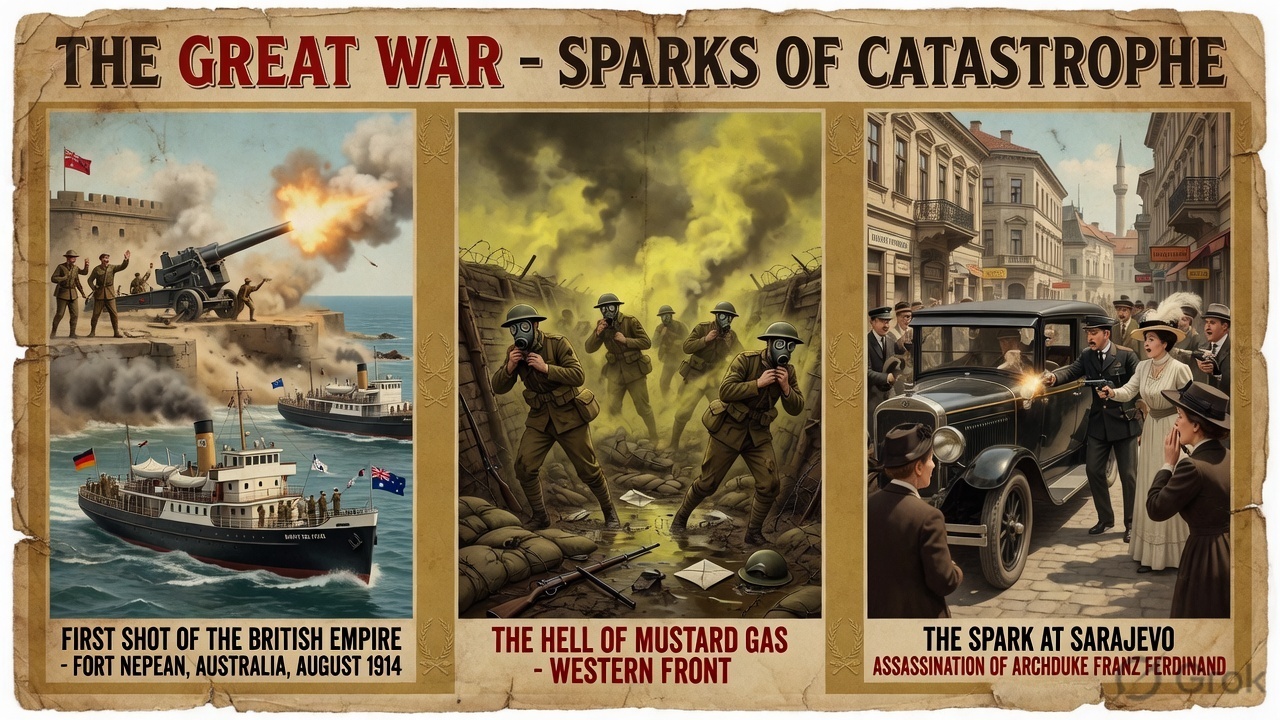
The Great War: A Tragedy Foretold, Poorly Managed
The conflict that erupted in 1914 was never truly the "First World War." That title belongs, more accurately, to the Seven Years' War a century and a half earlier, which sprawled across Europe, North America, India, the Caribbean, and the high seas. Nor was 1914-1918 a straightforward defensive crusade for Britain, as the Second World War would later be framed. Instead, the Great War was a collective European suicide pact with many fathers—nationalism, rigid alliances, imperial ambition, militarist culture, and sheer diplomatic incompetence. It deserved its original name, and the bitter joke that it was a "Family Feud" among blood-related monarchs.
The Spark and the Tinder
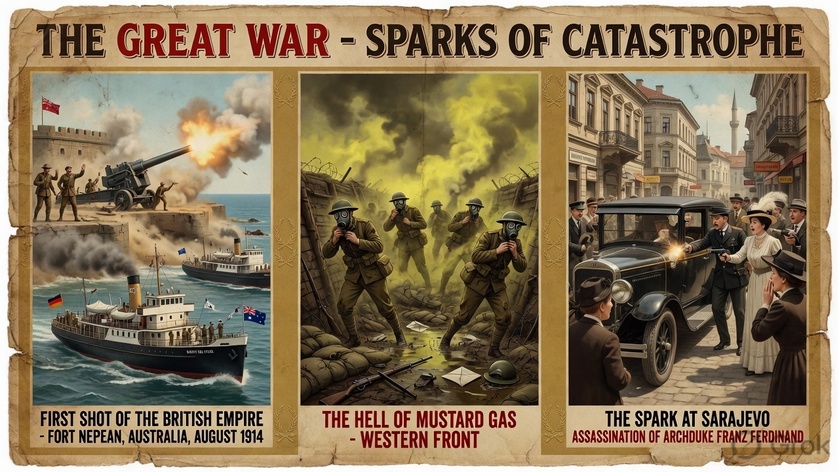
The immediate trigger was the assassination of Archduke Franz Ferdinand in Sarajevo. The idea that the Emperor Franz Joseph (or elements around him) somehow "sacrificed" his nephew remains a dark conspiracy theory rather than established fact, but it captures the cynicism many felt even at the time. Austria-Hungary's leadership did see the assassination as a convenient pretext. The Dual Monarchy had long chafed at Russian influence in the Balkans and Serbian nationalism. They wanted a limited war to crush Serbia and reassert dominance. What they got was the opposite.
What no one fully anticipated was how modern communications—telegraphs, railways, and a feverish press—would accelerate the doom spiral. Jingoistic outrage in Vienna met matching outrage in St. Petersburg, Berlin, Paris, and London. Old-fashioned balance-of-power politics, which had contained previous crises, now operated at electric speed with no off-switch. Mobilization timetables became destiny. Once the machines of war began turning, they were almost impossible to stop.
Strange Alliances and Rapid Escalation
The war scrambled old friendships quickly. Japan, bound by alliance to Britain, moved against German possessions in the Pacific and China with surprising speed. Italy, nominally allied with Germany and Austria-Hungary, ultimately betrayed them to join the Entente in 1915, chasing territorial promises. Australia, as part of the British Empire, was involved almost immediately—its navy helped hunt down German raiders in the Pacific within weeks of the outbreak.
These global dimensions were real, yet the war's heart remained European. What began as a Balkan crisis became a continental catastrophe because the great powers had locked themselves into inflexible alliance systems. Germany feared encirclement. Russia feared loss of prestige. France burned for revenge over Alsace-Lorraine. Britain feared German naval and industrial supremacy. Everyone expected a short, sharp war. Almost no one expected the slaughter that followed.
The Primacy of Defence
One of the clearest military realities of 1914-1918 was that technology had temporarily tilted the battlefield toward the defender. Machine guns, rapid-fire artillery, barbed wire, and trenches made frontal assaults suicidal. The generals understood this better than popular memory gives them credit for, but many were trapped by political pressure and institutional culture. No commander wanted to be the one who "lost" through inaction or allowed a breakthrough. The result was years of bloody, incremental attrition—Passchendaele, the Somme, Verdun—where the objective often seemed to be avoiding embarrassment more than achieving decisive victory.
Trench warfare was not mere stupidity. It was a rational, if horrific, response to the firepower of the age. The war only broke open again in 1918 with new tactics, tanks, aircraft, and American manpower.
A War of Many Fathers
Blame cannot be laid solely at the feet of any one nation or ruler. Germany bears heavy responsibility for the blank cheque given to Austria and for the Schlieffen Plan's violation of Belgian neutrality. Austria-Hungary was reckless. Russia was inflexible. France was revanchist. Britain might have done more to deter Germany earlier. But the deeper causes were structural: the decay of multi-ethnic empires, the rise of ethnic nationalism, an arms race fueled by industrial capacity, and a generation of leaders who had romanticized war without experiencing its modern form.
The Great War destroyed the old European order. It toppled emperors, bankrupted nations, radicalized populations, and sowed the seeds for something even worse twenty years later. The "war to end all wars" instead became the prologue to the bloodiest century in human history.
In the end, it was less a heroic clash of good and evil than a failure of imagination and statesmanship on a tragic scale. Europe walked into the abyss with eyes half-open, convinced that honor, alliances, and the next offensive would somehow make it right. They were wrong. Millions paid the price.