"God Is Love": A Profound Truth Too Easily Weaponized
The simple declaration “God is love” (1 John 4:8) ranks among the most beautiful and frequently quoted statements in the Bible. Yet its very simplicity can mislead. In context, the Apostle John was not offering a sentimental slogan but a profound theological claim rooted in the character of the Christian God—one who initiates relationship, shows mercy, and calls His people to reflect that same self-giving love. History, however, reveals how easily this truth can be twisted when human zeal, politics, and self-righteousness enter the picture.
Biblical Foundations: Old and New Testaments
In the Old Testament, God’s love is most often expressed as hesed—steadfast, covenantal loyalty. It is not abstract emotion but faithful action. God demonstrates this love by creating humanity in His image, rescuing the Israelites from Egyptian slavery in the Exodus, providing for them in the wilderness, and repeatedly forgiving their idolatry and rebellion. The prophet Hosea dramatically enacts this love by marrying an unfaithful wife, mirroring God’s persistent commitment to wayward Israel despite betrayal. Even in wisdom literature like Ecclesiastes, God appears as the generous Giver of life’s joys (food, work, relationships), while Song of Songs celebrates the goodness of marital love and physical delight as part of His created order. Love here includes both tenderness and holy discipline—God corrects those He cares for, as a father disciplines a son.
The New Testament intensifies and personalizes this revelation. “For God so loved the world that he gave his one and only Son, that whoever believes in him shall not perish but have eternal life” (John 3:16). The Apostle Paul puts it starkly: “God demonstrates his own love for us in this: While we were still sinners, Christ died for us” (Romans 5:8). Jesus embodies this love through compassion for the marginalized, forgiveness of enemies, and ultimate self-sacrifice on the cross. John’s statement “God is love” appears in a letter urging believers to love one another practically—sharing resources, laying down their lives if needed. Love is not tolerance of all behavior but redemptive action aimed at restoration and holiness.
Throughout Scripture, God’s love is never portrayed as mere niceness or approval of everything. It is holy, just, patient, and costly.
The Tragic Irony of Oliver Cromwell
Few historical episodes illustrate the perilous gap between professed belief and practice as starkly as Oliver Cromwell’s campaign in Ireland. A devout Puritan who helped depose and execute King Charles I during the English Civil Wars, Cromwell saw himself as an instrument of divine providence. In 1649, he led the New Model Army into Ireland to crush Royalist and Catholic resistance. At the Siege of Drogheda in September that year, his forces stormed the town after it refused to surrender. What followed was a massacre: roughly 3,500 people—mostly Royalist soldiers, but also armed civilians, prisoners, and Catholic priests—were put to the sword.
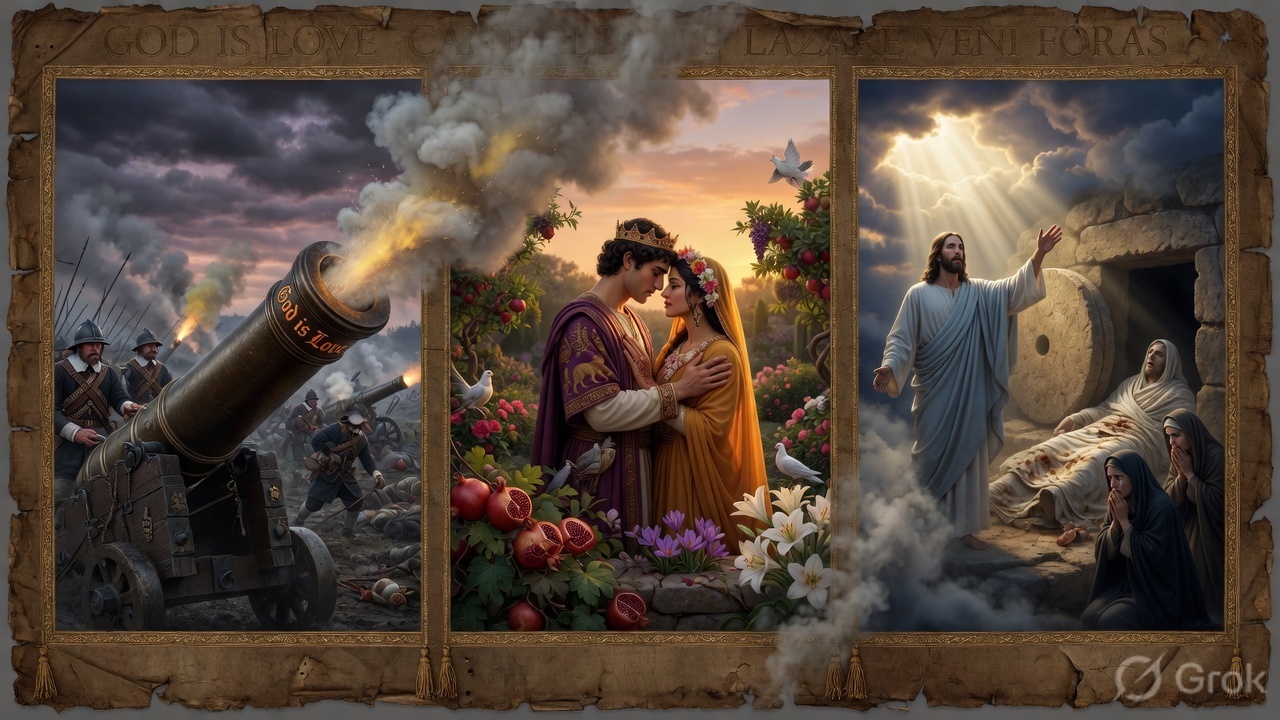
Cromwell justified the slaughter in religious terms, writing that it was “a righteous judgment of God upon these barbarous wretches.” The enduring image, immortalized in James Joyce’s Ulysses, is of Cromwell’s Ironsides firing cannons wrapped with the biblical text “God is love.” Whether the detail is strictly historical or symbolic, it captures a bitter irony that has lingered in Irish memory for centuries.
Oliver Cromwell was likely sincere in his Puritan faith. He believed he was fighting for a godly commonwealth against what he saw as idolatrous Catholicism and political tyranny, avenging earlier massacres of Protestants. Many Puritans viewed their military successes as signs of divine favor. Yet sincerity does not excuse the horror. The scale and nature of the violence at Drogheda (and later Wexford) — killing surrendered soldiers and non-combatants in the name of a loving God — seems profoundly off. It clashes violently with the biblical portrait of love that seeks redemption, shows mercy to the vulnerable, and restrains vengeance. Cromwell’s prosecution of the Irish campaign mixed genuine religious conviction with the brutal logic of total war, producing results that look more like tribal retribution than Christlike love.
Lessons for Today
This episode should humble us. “God is love” is not a blank check for our agendas, crusades, or justifications of violence. When invoked by the powerful, it has too often masked conquest, colonialism, or cultural supremacy. At the same time, reducing God’s love to harmless sentimentality ignores the biblical reality of judgment on evil and the call to costly obedience.
True love, as revealed in Scripture and supremely in Jesus, is neither weak nor cruel. It creates, redeems, forgives, and transforms. It confronts sin but offers grace to sinners. Cromwell may have believed he was advancing God’s kingdom; history suggests he confused divine love with his own political and religious certainty.
In an age still tempted by self-righteous zeal—whether religious, ideological, or nationalistic—we would do well to remember that claiming “God is love” while acting without mercy, justice, or humility renders the claim hollow. The challenge remains what it was for the early church: not merely to profess that God is love, but to know Him, and therefore to love as He has loved us.