VoiceDDB
Politics • Culture • News
Sumerian, Greek writing And Robert Graves
Archaeology lives
May 29, 2026
post photo preview

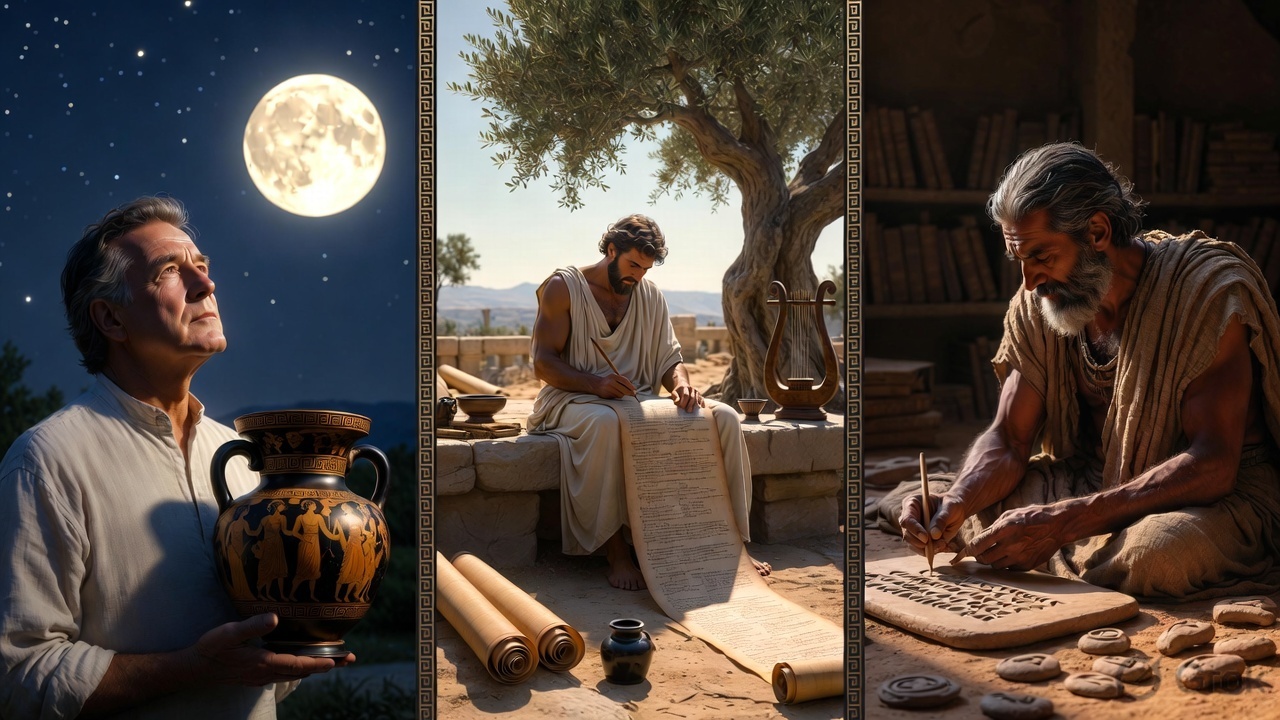
Archaeology has dramatically illuminated the deep, layered history of writing in both Sumerian and Greek civilizations, revealing systems far older and more complex than classical texts alone suggested. These discoveries underscore humanity’s drive to record, administer, and mythologize — often bridging practical bureaucracy with sacred narrative.

Sumerian Cuneiform: The Dawn of Writing

In Mesopotamia, archaeology unearthed the birth of true writing. Excavations at Uruk (and other sites) in the late 19th and 20th centuries revealed clay tablets from around 3500–3200 BCE, evolving from pictographic tokens and accounting marks into a sophisticated logo-syllabic cuneiform system. Thousands of tablets — from temple archives, palaces, and private contexts — document economic transactions, laws, literature (Epic of Gilgamesh), and myths. Recent decipherments continue to uncover unknown stories, such as new Sumerian myths about gods like Ishkur.

This system, initially for administration in growing city-states, endured for millennia and influenced neighboring cultures. It represents one of humanity’s greatest leaps: moving from memory and oral tradition to durable, shareable knowledge. The wedge-shaped impressions on clay (made with reeds) survived where other media perished, offering an astonishingly rich window into the world’s first urban civilizations.

Greek Writing: Layers of Innovation and Loss

Greek writing tells a story of interruption and rebirth. The earliest attested Greek script is Linear B, a syllabary adapted from Minoan Linear A around 1450 BCE (Mycenaean period). Deciphered in the 1950s by Michael Ventris and others, it revealed an early form of Greek used mainly for palace inventories and administration on Crete and the mainland.

The Mycenaean collapse (~1200 BCE) led to the Greek Dark Ages, with writing largely vanishing for centuries. Then, around the late 9th–8th century BCE, the Greek alphabet emerged — adapted from the Phoenician script, with the crucial Greek innovation of adding vowels. This made it far more phonetic and accessible, fueling the explosion of literature, philosophy, and democracy in the Archaic and Classical periods.

Archaeology (pottery sherds, inscriptions, tablets) traces this evolution: early alphabetic graffiti on vases, dedications, and trade goods show writing spreading rapidly beyond elites.

Robert Graves’ Perspective

Poet and mythographer Robert Graves offered a poetic, speculative lens on this timeline in The Greek Myths and The White Goddess. He placed the origins of Greek myth and culture in a pre-patriarchal, matriarchal Aegean world dominated by the Triple Goddess (aspects later split into Hera, Aphrodite, Athena, etc.). He argued that invading Indo-European (Achaean/Dorian) tribes overlaid patriarchal Olympian religion onto older goddess-centered rites.

Graves dated full alphabetic Greek writing to roughly the 8th century BCE (post-Dark Ages), aligning with mainstream archaeology. However, he emphasized what presaged it: rich traditions of pottery, seals, frescoes, and iconography from Minoan and Mycenaean times, which preserved ritual "pictorial shorthand" of the older religion. He interpreted these artifacts through iconotropy — the misreading or reinterpreting of sacred images by later patriarchal mythographers.

For Graves, pottery and visual arts were not mere decoration but encoded records of Triple Goddess worship, sacred kingship, seasonal rituals, and the dying-reviving god. These images — three female figures, lunar symbols, apples, axes — carried the "true" poetic myths before alphabetic writing standardized and patriarchalized them. He saw the alphabet’s arrival as part of a cultural shift: enabling prose, rational philosophy, and the final eclipse of the old poetic, goddess-linked oral/visual tradition.

Editorial Reflection

Archaeology humbles us by showing how much was lost and recovered. Sumerian tablets prove writing began as a tool of the state and temple — power consolidated through lists. Greek writing, interrupted then reinvented, became a vehicle for individual voice and democratic inquiry. Graves romanticizes the pre-alphabetic visual world as more alive with mythic resonance: pottery as a silent archive of the Goddess’s cycles, where a queen’s sacred marriage and the king’s sacrificial return to the soil (as fertilizer) ensured fertility.

His views blend scholarship with poetic intuition — insightful for understanding myth’s evolution, but often critiqued as overly speculative. Yet they remind us that writing doesn’t just record history; it reshapes it. Every cuneiform tablet or painted Greek sherd whispers of forgotten worldviews. In an age of digital ephemera, these durable artifacts challenge us to consider what we are preserving — and what deeper stories our own "pottery" (memes, data, images) might encode for future decipherers. The archaeologist’s spade and the mythographer’s insight together reveal writing not as neutral technology, but as a battleground of cultures, genders, and worldviews.

community logo
Join the VoiceDDB Community
To read more articles like this, sign up and join my community today
0
What else you may like…
Videos
Posts
Articles
00:01:07
November 27, 2022
Jingle Bell Rock

Jingle bell, jingle bell, jingle bell rock
Jingle bells swing and jingle bells ring
Snowin' and blowin' up bushels of fun
Now the jingle hop has begun

Jingle bell, jingle bell, jingle bell rock
Jingle bells chime in jingle bell time
Dancin' and prancin' in Jingle Bell Square
In the frosty air

What a bright time, it's the right time
To rock the night away
Jingle bell time is a swell time
To go glidin' in a one-horse sleigh

Giddy-up jingle horse, pick up your feet
Jingle around the clock
Mix and a-mingle in the jinglin' feet
That's the jingle bell rock

Jingle bell, jingle bell, jingle bell rock
Jingle bell chime in jingle bell time
Dancin' and prancin' in Jingle Bell Square
In the frosty air

What a bright time, it's the right time
To rock the night away
Jingle bell time is a swell time
To go glidin' in a one-horse sleigh

Giddy-up jingle horse, pick up your feet
Jingle around the clock
Mix and a-mingle in the jinglin' feet
That's the jingle bell
That's the jingle...

00:02:04
September 01, 2021
Intro to Locals for the Conservative Voice

David Daniel Ball calls himself the Conservative Voice.

I'm a teacher with three decades experience teaching math to high school kids.I also work with first graders and kids in between first grade and high school. I know the legends of why Hypatia's dad is remembered through his contribution to Math theory. And I know the legend of why followers of Godel had thought he had disproved God's existence.

I'm not a preacher, but I am a Christian who has written over 28 books all of which include some reference to my faith. Twelve blog books on world history and current affairs, detailing world events , births and marriages on each day of the year, organised by month. Twelve books on the background to and history of Bible Quotes. One Bible quote per day for a year. An intro to a science fiction series I'm planning, post apocalyptic cyber punk. An autobiography with short story collections.

I'm known in Australia for my failure as a whistleblower over the negligence death of a school boy. ...

00:01:50
Chinese Space Bio Labs

While Elon Musk is busy landing reusable rockets and building robot swarms on Earth, the CCP has gone full 'Musk but make it bioweapons': they're launching fleets of Starship-inspired rockets crewed by copycat Optimus robots, blasting 'Fau Chi' biolabs straight into Low Earth Orbit.

These gleaming orbital stations, proudly emblazoned with the Chinese characters 福奇 (Fú Qí — sounding suspiciously like 'Fau Chi'), are officially designated as The Science™ Research Facilities. Perfect for safe, ethical gain-of-function experiments on exciting new pathogens like TDS (Trump Derangement Syndrome), 'Last Millennia' nostalgia plagues, and the deadly 'We Are Living in 2026' variant.

The endgame? A billion trusting parents worldwide voluntarily neutering their own children on expert 'Fau Chi' advice from the heavens — because nothing says 'public health' like taking guidance from a floating Chinese biolab with reusable re-entry capabilities.

post photo preview
Editorial from 2018 for June 9th

Don't give up on hope. Western Civilisation is on the nose of universities in Australia. Sydney University collapsed in 1990, and her upper executive got replaced by ALP managerialists as Keating fought a culture war which the Liberal Party have not effectively engaged. Dame Kramer had been made Chancellor, but the Chancellor's position is not executive at Sydney University. Kramer fought effectively for Western Values, but the University, now, is as partisan left as the ABC is now. Kramer had been a powerful presence in charge of the ABC too. 

In 1990, Sydney University lost her Chancellor and Vice Chancellor. The Chancellor, Hermann David Black, died after a long illness. James Anthony Rowland, a former governor of NSW took the chancellor's position for a few years, before passing it to Kramer in 1991. She held on to 2001. From 1981 to 1990, John Manning Ward was the executive head of Sydney University as Vice Chancellor. He had been writing a trilogy on Australian conservative leaders ...

post photo preview
Sarah Palin wrote when Obama took office

We're in for a helluva' ride, America. Obama just named Susan Rice as his National Security Adviser and nominated Samantha Power to replace Rice as our U.N. ambassador. Samantha Power is married to Cass Sunstein, the very, very strange Obama pick for an early "czar" position who wowed us with his numerous bizarre claims including the wacko belief that animals should have the right to sue in court, that hunting should be banned as genocide, and that pet ownership is akin to “slavery.” But Mrs. Cass Sunstein’s character judgment in choosing her life partner is the least of America's worries. Information about Obama's new picks will be revealed in coming days. Pay attention to who they are; what they stand for; and what their records, associations, and statements reveal about them and their intentions. Especially consider Obama's chosen ones as evidence of his skewed thinking as he "fundamentally transforms" our great nation.

Here's just a taste, as summarized by The Daily Caller:

"In 2002, ...

post photo preview
Death by Policy
When Government Fails in the Execution of Duty

Death by Policy: When Government Fails in the Execution of Duty

Ronald Reagan once quipped that the nine most terrifying words in the English language are: “I’m from the government and I’m here to help.” What began as wry conservative wit has hardened, over decades, into a grim warning. When governments insert themselves into the minutiae of daily life — dictating how buildings are constructed, how fires should be fought, or how citizens should behave in a crisis — the results can be lethal. Nowhere is this clearer than in the avoidable tragedy of Grenfell Tower.

On June 14, 2017, a small kitchen fire in a fourth-floor flat of Grenfell Tower, a 24-storey public housing block in West London, ignited highly combustible aluminium composite cladding installed during a refurbishment. What should have been a containable incident became a towering inferno. Seventy-two people died. Many more were injured. The building’s “stay put” policy — a cornerstone of UK high-rise fire strategy — instructed residents to remain in their flats, trusting in fire-resistant compartmentation to protect them while firefighters tackled the blaze. Fire escapes existed and were functional, yet policy overrode instinct. Residents who followed official advice perished as smoke and flames raced up the exterior, rendering the “fireproof” assumption a deadly lie.

The policy was not born in malice but in bureaucratic hubris: the belief that regulators and planners could engineer perfect safety through rules, materials approvals, and centralized directives. Warnings about the cladding had been ignored. Cost-cutting and regulatory capture played their part. Even the terrorism risk — the fear that evacuations could expose people to secondary attacks — helped entrench the “stay put” doctrine in some contexts. When the assumptions collapsed, so did the lives entrusted to them.

This was not the first time locked-in policy killed the vulnerable. In 1911, the Triangle Shirtwaist Factory fire in New York claimed 146 lives, mostly young immigrant women. Factory owners had locked exit doors to prevent theft and unauthorized breaks. Workers burned or jumped to their deaths. The parallels to Grenfell are haunting: authorities and management, claiming to act in everyone’s interest, removed the most basic escape option — personal agency.

Contrast this with Australia. Similar combustible cladding fires have occurred here — notably the 2014 Lacrosse Apartments blaze in Melbourne, where flames raced up the facade. No one died. Prompt evacuation, effective firefighting, and the absence of a rigid “stay put” lockdown mindset allowed residents to escape. Australian authorities responded with audits, remediation programs like Project Remediate in NSW, and a more pragmatic focus on individual safety over blanket policy. The difference was not superior building stock alone, but a less dogmatic approach to resident behaviour in emergencies.

The same pattern of policy-induced helplessness repeated, writ large, during the COVID-19 crisis. Governments worldwide imposed lockdowns that confined people indoors, often in cramped conditions. Fresh air, sunshine, exercise, and natural vitamin D — long understood to support immune health — were sidelined in favour of masks, mandates, and isolation. The very measures meant to contain spread sometimes amplified vulnerability, particularly for the elderly and poor. Once again, the state’s promise of expert guidance trumped common sense and individual judgment. Reagan’s joke rang hollow as real harm accumulated.

These tragedies share a common thread: the substitution of government prescription for human responsibility. Central planners assume they can foresee every variable — fire spread, viral transmission, human panic. When reality deviates, the body count rises. The Grenfell Inquiry, like countless reviews before it, revealed systemic failures in regulation, procurement, and oversight. Yet the deeper failure is philosophical: the belief that more rules, more funding, and more bureaucracy equal better outcomes.

Governments have a legitimate duty to set basic safety standards, enforce building codes, and respond to genuine threats. They fail when they overreach, when they discourage personal initiative, or when they prioritize uniformity over adaptability. The cladding scandals in both the UK and Australia exposed regulatory capture and cost-cutting under the guise of “green” or modern building practices. Remediation efforts drag on, costing billions, while residents live in limbo.

True safety emerges not from edicts to “stay put” or “stay home,” but from resilient systems that empower people: functional escapes, transparent information, accountable builders, and a culture that trusts individuals to make life-saving decisions. Reagan understood the danger of unchecked government benevolence. Grenfell, Triangle, and the lockdowns remind us that when the state fails in execution of its limited duties — or exceeds them — the vulnerable pay with their lives.

It is past time to heed the joke as the warning it always was. Smaller, more competent government. Greater individual agency. And a healthy scepticism toward anyone who says, “I’m from the government and I’m here to help.” The alternative is more deaths by policy.

Read full Article
post photo preview
The Pilgrim Fathers
America’s True Founding Spirit

The Pilgrim Fathers: America’s True Founding Spirit

While Jamestown and the ill-fated Roanoke colony preceded them, it was the Puritan settlers—beginning with the Pilgrims at Plymouth—who provided the enduring moral, cultural, and institutional foundation for what became the United States. Roanoke simply vanished, leaving behind only cryptic clues and the haunting label “Lost Colony.” Jamestown, for all its ambitions—searching for a northwest passage, spreading Anglican Christianity, hunting gold, and establishing English claims—remained a precarious commercial venture plagued by starvation, disease, and conflict. Its legacy is real, but limited. The Puritan colonies, by contrast, endured and multiplied, shaping the Thirteen Colonies and the character of the young republic.

On November 11, 1620 (Old Style), the Mayflower’s passengers—Separatists who had fully broken from the Church of England—dropped anchor at Provincetown Harbor. By March 16, 1621, after a brutal winter that claimed nearly half their number, a lone Native American named Samoset strode boldly into the settlement. He famously asked for beer. The Pilgrims did not hand over their precious stores, but they offered him alcohol and a meal. That act of hospitality forged friendship. Through Samoset and later Squanto, peaceful relations with local tribes took root, enabling the colony’s survival and the first Thanksgiving. It was a small gesture with outsized consequences: pragmatic welcome grounded in faith.

The Puritan wave extended far beyond Plymouth. The broader Puritans who founded Massachusetts Bay, Connecticut, New Haven, and (through dissenters) Rhode Island carried a different but related vision: not total separation at first, but the reform and purification of the English church. They came primarily as families, not lone adventurers or soldiers. They prized education so that every believer could read the Bible. They established schools, colleges (Harvard in 1636), and town covenants that emphasized consent, moral order, and accountability. Within fifty years of Plymouth’s founding, England itself had endured civil war, Cromwell’s Puritan Commonwealth, and the Restoration of the monarchy. Puritanism faltered at home amid political excess, but it took deep root across the Atlantic.

These colonies differed profoundly from earlier efforts. They were built on covenant theology—the idea that communities, like individuals, stood in solemn agreement with God. This fostered habits of self-government, literacy, and industry that proved far more durable than gold-seeking or military outposts. Their success became a beacon. It inspired other dissenting groups, including Anabaptists whose stricter traditions later produced the Amish communities that still testify to plain living and separation from worldly excess.

Puritanism has taken an unfair beating in modern telling. The English Interregnum’s excesses and, especially, the Salem witch trials of 1692–93 are held up as proof of bigotry and hysteria. Yet the trials occurred amid genuine fear and strange afflictions. Young women exhibited fits, sensations of being pinched and bitten, and other torments. Even a test—giving a dog urine from one of the afflicted, which reportedly caused the animal to convulse, chew rocks, and ultimately be put down—suggested something real was at work. Historians have pointed to ergot poisoning from moldy rye as a possible physiological trigger, alongside social tensions, factionalism, and spectral evidence. The authorities were not cartoon “hanging judges” but sober men facing an outbreak they did not fully understand. In a society that believed in the reality of spiritual warfare, they acted on the evidence available to them. To dismiss it all as mere victim-blaming ignores the complexity and the era’s worldview.

After the Revolution, America’s religious landscape diversified rapidly. French and Spanish settlers brought their own muscular Catholic expressions to the South and West. The Quaker influence grew, producing leaders and a distinctive witness for peace. By the 20th century, a Catholic (John F. Kennedy) could win the presidency, and evangelical voices under leaders like George W. Bush became a potent political force. Waves of immigrants and awakenings added layers—Baptists, Methodists, Pentecostals, and more. Today, America is not defined by any single denomination. Yet her spiritual and cultural father remains the Pilgrim who welcomed a stranger with spirits and vittles, who endured unimaginable hardship for the sake of conscience, and who planted institutions ordered toward liberty under God.

The Puritan legacy is not perfection but persistence: a commitment to moral seriousness, education, ordered liberty, and the belief that a people can form a “city upon a hill.” In an age quick to condemn the past, we do well to remember that the same soil that produced Salem also produced the Mayflower Compact, town meetings, common schools, and a resilient work ethic that propelled the American experiment. The Pilgrim spirit—practical, hospitable, Bible-shaped—still whispers in our national character. We would do well to listen.

Read full Article
post photo preview
The Enduring Lament of "Waly Waly"
From Scottish Court Scandal to Timeless Ballad of Love and Faith

The Enduring Lament of "Waly Waly": From Scottish Court Scandal to Timeless Ballad of Love and Faith

In the rich tapestry of British folk music, few songs carry the layered weight of "Waly Waly" — better known today as "The Water Is Wide." A deceptively simple lament of love's fragility, it emerged from the turbulent politics and personal betrayals of 17th-century Scottish nobility, only to evolve through oral tradition, folk revival, and sacred adaptation into a universal meditation on impermanence. Its melody, haunting and adaptable, has bridged secular heartbreak and divine contemplation, finding poignant expression even in the final recordings of the gifted Eva Cassidy as illness claimed her voice.

The song's political origins are rooted in the unhappy marriage of James Douglas, 2nd Marquess of Douglas, to Lady Barbara Erskine in 1670. This union, forged amid the complex alliances of Restoration-era Scotland, unraveled amid accusations of adultery — allegations many historians attribute to court intrigue and a spurned suitor. Lady Barbara's subsequent separation and abandonment inspired ballads that captured her lament, blending personal sorrow with the era's aristocratic scandals. Verses echo the real "Jamie Douglas" (Child Ballad 204), where a high-born woman's renown gives way to forsaken isolation. "O Waly, Waly" (an old Scots exclamation of woe) first crystallized in collections like Allan Ramsay's Tea-Table Miscellany (1724–1727), drawing from earlier broadsides and floating verses that mixed political gossip, courtly despair, and folk commonplaces.

This was no mere domestic tragedy; it highlighted the precarious power dynamics of Scottish courts, where marriages sealed political pacts, reputations were weapons, and women of rank could be undone by rumor as readily as by royal decree. In an age of shifting loyalties post-Covenanters and amid the lead-up to Union with England, such ballads subtly critiqued the moral rot behind noble facades. The song's imagery — a wide, uncrossable water symbolizing insurmountable barriers, a once-sturdy oak bent and broken by betrayal — mirrored the fractured alliances and personal ruins of the time.

From these contentious beginnings, "Waly Waly" transitioned into new modes with remarkable fluidity, a hallmark of folk evolution. Collected and refined by Cecil Sharp in Folk Songs from Somerset (1906), it shed some of its rawer political edges to become the streamlined "The Water Is Wide," popularized in the American folk revival by Pete Seeger and others. Its melody proved endlessly versatile: Benjamin Britten arranged it for voice and piano, John Rutter incorporated it into orchestral works, and it crossed into pop, film soundtracks, and even fusions with other traditions. Floating verses allowed singers to adapt it to contemporary woes, transforming a Scottish court lament into a universal anthem of love's joys and inevitable fading "like morning dew."

One of its most profound transitions came in sacred music. The tune served as a vehicle for Isaac Watts' hymn "When I Survey the Wondrous Cross" (1707), one of the finest expressions of Christian contemplation on Christ's sacrifice. Here, the ballad's themes of transient earthly love were elevated to eternal spiritual reality: human affection's impermanence contrasts with divine constancy. What began as a lament for betrayed nobility became a vehicle for Protestant devotion, underscoring how folk melodies often carried theology across divides of class and creed.

No modern rendition captures the song's emotional depth quite like those of Eva Cassidy. Her crystalline voice brought aching vulnerability to "The Water Is Wide," emphasizing its quiet longing. Even more moving is her studio take on the variant "Waly Waly," recorded near the end of her life as cancer progressed. It was, by accounts from her collaborators, among the last things she could fully perform before illness silenced her. Stripped of artifice, her interpretation distills the song's essence: love's jewel when new, its cold fading, the desperate plea for a boat to cross impossible divides. In her frail yet transcendent delivery, the political origins and sacred adaptations recede, leaving raw humanity — a dying artist singing of mortality's waters with the grace of one who has surveyed her own cross.

Today, "Waly Waly" endures as a reminder that the personal is often political, that cultural artifacts mutate across contexts, and that simple melodies can carry profound truths. In an era of fleeting digital affections and renewed court-like intrigues in media and power, its wisdom resonates: love, like the song itself, persists not through permanence but through reinterpretation and honest lament. Whether as folk protest, hymn, or farewell, it invites us to row together while we can.

Read full Article
See More
Available on mobile and TV devices
google store google store app store app store
google store google store app tv store app tv store amazon store amazon store roku store roku store
Powered by Locals